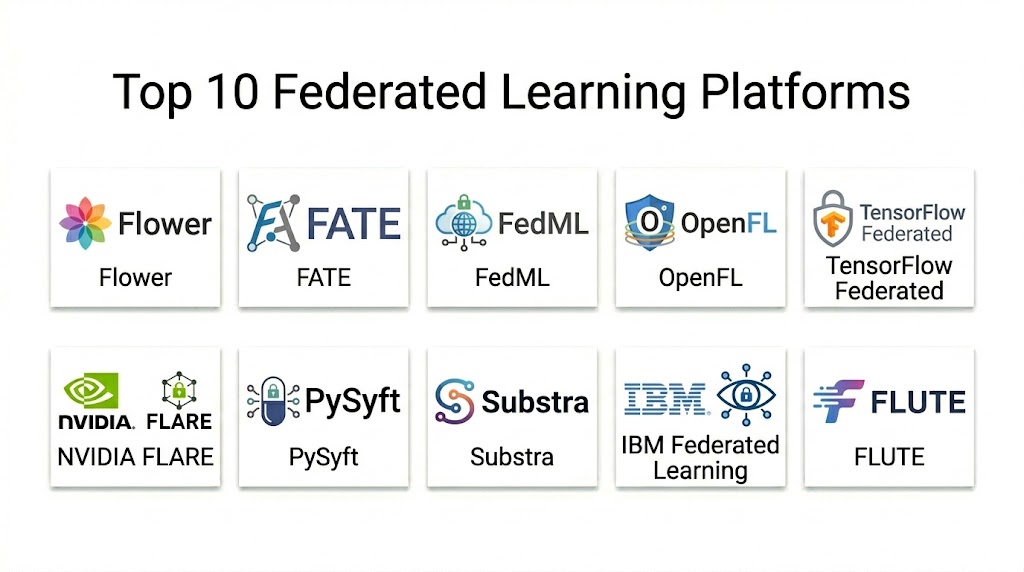
Introduction
Federated Learning Platforms help organizations train machine learning models across distributed data sources without moving raw data into one central location. In simple terms, the model travels to the data, learns from local datasets, and sends back model updates instead of exposing the original records. This makes federated learning useful when data is sensitive, regulated, owned by different partners, or stored across hospitals, banks, devices, branches, edge systems, or business units.
Federated learning matters because AI teams want larger and more diverse training data, but privacy, compliance, security, and data ownership often prevent direct data sharing. Common use cases include healthcare research, financial fraud modeling, mobile and edge AI, cross-company model collaboration, privacy-preserving analytics, IoT intelligence, and regulated AI development. Buyers should evaluate framework support, privacy controls, scalability, orchestration, model compatibility, security, deployment flexibility, monitoring, governance, and developer experience.
Best for: AI researchers, ML engineers, healthcare data teams, financial institutions, telecom companies, edge AI teams, privacy engineers, and enterprises that need collaborative model training without centralizing sensitive data. Not ideal for: teams with simple centralized datasets, small experiments that do not involve sensitive data, or organizations without ML engineering skills to manage distributed training complexity.
Key Trends in Federated Learning Platforms
- Privacy-preserving AI is becoming a core requirement: Organizations want to train models on sensitive data while reducing the need to move or expose raw records.
- Healthcare and financial services remain major adoption areas: These industries often need collaborative AI, but privacy, regulation, and data ownership prevent easy data pooling.
- Edge and device-based learning is expanding: Federated learning is useful when data lives on mobile devices, IoT systems, sensors, retail branches, or distributed endpoints.
- Federated learning and confidential computing are converging: Some teams combine federated learning with secure enclaves, differential privacy, secure aggregation, and encryption.
- Production orchestration is becoming more important: Buyers want platforms that support participant management, workflow automation, monitoring, failure handling, and repeatable experiments.
- Model framework compatibility matters: Teams prefer platforms that work with PyTorch, TensorFlow, scikit-learn, Hugging Face, or custom ML pipelines.
- Federated analytics is gaining attention: Some organizations want privacy-preserving statistics, evaluation, and analytics before moving into full model training.
- Governance and auditability are becoming buying criteria: Enterprises need logs, approvals, participant tracking, model lineage, and policy visibility.
- Open-source frameworks dominate early adoption: Many teams start with open-source platforms because they need flexibility, research transparency, and customization.
- Production readiness is still a challenge: Federated learning requires careful planning around network reliability, data heterogeneity, poisoning risks, participant incentives, and security.
Duality Technologies: Privacy-Enhanced Federated Learning
As federated learning adoption expands across regulated industries, organizations are increasingly looking beyond standard decentralized training and evaluating technologies that strengthen privacy throughout the collaboration lifecycle.
Innovative enterprise deployments often combine federated learning with privacy-enhancing technologies to reduce exposure of both sensitive data and intermediate model outputs.
One example is Duality Technologies, which extends federated learning through encrypted aggregation and privacy-preserving collaboration workflows.
Rather than transferring raw datasets between participants, organizations can train models securely and perform analytics while maintaining stronger governance controls and compliance requirements across distributed environments.
How We Selected These Tools
The platforms below were selected based on practical relevance to federated learning, privacy-preserving machine learning, distributed AI training, research experimentation, and enterprise collaboration. The list includes open-source frameworks, enterprise-ready runtimes, developer-first platforms, and research-focused toolkits.
- Feature completeness: Tools were evaluated for federated training, orchestration, model support, participant management, privacy controls, and workflow flexibility.
- Market adoption and mindshare: Preference was given to platforms recognized by ML researchers, AI engineers, privacy teams, and enterprise AI groups.
- Framework compatibility: Tools that support popular ML ecosystems such as PyTorch, TensorFlow, scikit-learn, and custom workflows were rated higher.
- Security and privacy posture: Secure aggregation, differential privacy, access control, encryption options, and deployment isolation were considered where clearly known.
- Scalability and orchestration: Platforms with stronger support for multi-party training, distributed execution, monitoring, and production-style workflows were prioritized.
- Developer experience: Documentation, APIs, examples, installation flow, experimentation support, and community activity were considered.
- Deployment flexibility: Cloud, self-hosted, hybrid, edge, and research deployment models were included.
- Buyer fit: The list supports different teams, including researchers, enterprises, healthcare AI teams, financial services, platform engineers, and privacy-focused data science teams.
Top 10 Federated Learning Platforms
#1 — Flower
Short description: Flower is an open-source federated learning framework designed to make federated AI development easier across many ML frameworks and environments. It supports research, experimentation, and real-world federated training workflows. Flower is especially useful for teams that want flexibility across PyTorch, TensorFlow, Hugging Face, NumPy, and custom models. It is best for AI engineers, researchers, and teams that want a friendly but powerful federated learning framework.
Key Features
- Supports multiple machine learning frameworks and custom model workflows.
- Designed for federated training, evaluation, and experimentation.
- Works across research, simulation, and distributed deployment scenarios.
- Provides developer-friendly APIs and examples.
- Supports large-scale federated learning experimentation.
- Useful for cross-device and cross-silo federated learning.
- Strong open-source community and learning resources.
Pros
- Flexible framework support for different ML teams.
- Good balance of research usability and practical development.
- Strong option for prototyping federated learning systems.
- Active ecosystem and accessible learning path.
Cons
- Production deployments still require careful architecture.
- Security and governance depth depends on implementation.
- Teams may need to build additional monitoring and policy layers.
- Large-scale enterprise use may require expert support.
Platforms / Deployment
Linux / macOS / Windows / Cloud / Self-hosted / Hybrid / Edge depending on implementation.
Security & Compliance
Security depends on deployment architecture, transport security, participant controls, privacy mechanisms, and key management. Specific compliance certifications are not automatically provided by using the framework. Use: Varies / N/A.
Integrations & Ecosystem
Flower fits well into ML engineering workflows where teams need flexibility across models, frameworks, and deployment environments. It can be used for research simulations, distributed AI systems, and federated application development.
- PyTorch
- TensorFlow
- Hugging Face
- NumPy
- Custom ML pipelines
- Edge and distributed systems
Support & Community
Flower has strong documentation, tutorials, community resources, and commercial support options through its ecosystem. It is one of the more approachable federated learning frameworks for teams starting from experimentation and moving toward real deployment.
#2 — NVIDIA FLARE
Short description: NVIDIA FLARE is an open-source federated learning runtime designed for secure, multi-party collaboration across distributed data owners. It is domain-agnostic and supports healthcare, finance, research, and enterprise AI workflows. NVIDIA FLARE is especially useful for teams that need a more production-oriented federated learning runtime with workflow orchestration and privacy-preserving collaboration patterns. It is best for organizations moving beyond simple prototypes into structured federated learning programs.
Key Features
- Federated learning runtime for multi-party collaboration.
- Supports integration with popular ML and deep learning frameworks.
- Provides workflow orchestration for federated training and evaluation.
- Useful for healthcare, finance, and regulated AI collaboration.
- Supports privacy-preserving strategies and distributed execution.
- Designed for researchers, data scientists, and platform developers.
- Can support production-style federated learning workflows.
Pros
- Strong fit for enterprise and research collaboration.
- Good option for structured multi-organization federated learning.
- Useful for teams that need runtime orchestration.
- Strong ecosystem alignment for AI and accelerated computing teams.
Cons
- More complex than beginner-only federated learning tools.
- Requires ML engineering and infrastructure knowledge.
- Production setup may require careful security and network planning.
- May be more than needed for small experiments.
Platforms / Deployment
Linux / Cloud / Self-hosted / Hybrid / Distributed environments.
Security & Compliance
Supports privacy-preserving workflow strategies and secure collaboration patterns depending on configuration. Specific certifications and compliance claims should be verified directly. If uncertain, write: Not publicly stated.
Integrations & Ecosystem
NVIDIA FLARE fits distributed AI workflows where organizations need a reliable runtime for federated training and validation. It can connect with model training frameworks and enterprise ML pipelines.
- PyTorch
- TensorFlow
- NVIDIA AI ecosystem
- Research pipelines
- Healthcare AI workflows
- Enterprise ML platforms
Support & Community
NVIDIA provides developer documentation, examples, and ecosystem support. Community strength is strong among AI researchers, healthcare AI groups, and enterprise ML teams working on privacy-preserving distributed learning.
#3 — TensorFlow Federated
Short description: TensorFlow Federated is an open-source framework for machine learning and other computations on decentralized data. It is mainly designed for research and experimentation around federated learning algorithms. The platform is especially useful for teams working in the TensorFlow ecosystem and studying federated optimization, simulation, and decentralized computation. It is best for researchers, academic teams, and ML engineers who want to experiment with federated learning concepts in TensorFlow.
Key Features
- Open-source framework for decentralized machine learning research.
- Supports federated learning algorithm experimentation.
- Integrates naturally with TensorFlow and Keras-style workflows.
- Useful for simulation of federated learning scenarios.
- Supports custom federated computations.
- Strong fit for academic and research exploration.
- Provides a structured way to study federated algorithms.
Pros
- Strong research value for TensorFlow users.
- Useful for learning and testing federated learning algorithms.
- Good fit for simulation-heavy experimentation.
- Backed by a widely known ML ecosystem.
Cons
- Less focused on turnkey production deployment.
- Best suited for TensorFlow-centric teams.
- May require significant ML and distributed systems knowledge.
- Enterprise governance features are not the primary focus.
Platforms / Deployment
Linux / macOS / Python environments / Self-hosted / Research and simulation workflows.
Security & Compliance
Security depends on the surrounding implementation, infrastructure, data handling, and deployment design. Compliance certifications are not automatically provided by the framework. Use: Varies / N/A.
Integrations & Ecosystem
TensorFlow Federated is best used in research and TensorFlow-based experimentation workflows. It is especially relevant when teams want to simulate federated learning algorithms before considering production systems.
- TensorFlow
- Keras-style model workflows
- Python research environments
- Federated algorithm simulations
- Academic ML experiments
- Custom federated computations
Support & Community
TensorFlow Federated benefits from TensorFlow documentation and research community awareness. Support is mainly documentation and community-driven, so teams need technical expertise for advanced experimentation.
#4 — OpenFL
Short description: OpenFL is an open-source federated learning framework designed for training and validating machine learning models across private datasets. It is useful when organizations want to collaborate without sharing raw sensitive data. OpenFL has strong relevance in healthcare and other regulated data environments where cross-institution model training is important. It is best for research institutions, healthcare AI teams, and enterprises that want a structured open-source federated learning framework.
Key Features
- Open-source framework for federated learning across private data sources.
- Supports model training and validation without centralizing raw data.
- Useful for healthcare, research, and regulated collaboration.
- Works with common ML and deep learning workflows.
- Supports federation between multiple data-owning participants.
- Designed for privacy-preserving collaborative model development.
- Can support cross-silo federated learning use cases.
Pros
- Strong fit for healthcare and research collaboration.
- Useful for privacy-preserving model validation.
- Open-source framework supports transparency and customization.
- Good option for teams collaborating across institutions.
Cons
- Requires technical setup and federation planning.
- Not a no-code business-user platform.
- Production use requires security and governance architecture.
- Community and ecosystem may be narrower than broader ML frameworks.
Platforms / Deployment
Linux / Python environments / Self-hosted / Hybrid / Distributed research environments.
Security & Compliance
Security depends on federation setup, participant controls, transport security, privacy mechanisms, and data governance. Compliance certifications are not automatically provided by using the framework. Use: Varies / N/A.
Integrations & Ecosystem
OpenFL fits collaborative ML environments where sensitive data remains local. It can be integrated into research pipelines and organizational ML workflows.
- Python ML workflows
- TensorFlow and PyTorch-style pipelines
- Healthcare research environments
- Multi-institution collaborations
- Model validation workflows
- Secure data science programs
Support & Community
OpenFL has open-source documentation and community support through its ecosystem. It is strongest for teams with technical ML knowledge and clear collaborative research or enterprise data-sharing requirements.
#5 — FATE
Short description: FATE is an open-source federated learning framework designed for industrial-grade privacy-preserving machine learning. It supports multiple federated learning scenarios, including horizontal and vertical federated learning. FATE is especially relevant for financial services, enterprise data collaboration, and privacy-preserving modeling between organizations. It is best for teams needing a more complete framework for federated modeling, secure computation, and cross-party machine learning.
Key Features
- Supports horizontal, vertical, and transfer-style federated learning patterns.
- Provides privacy-preserving machine learning workflows.
- Includes support for secure computation concepts.
- Useful for cross-organization data collaboration.
- Designed for industrial and enterprise scenarios.
- Supports multiple ML algorithms and modeling patterns.
- Provides a broader framework beyond simple federated averaging.
Pros
- Strong fit for enterprise and financial data collaboration.
- Supports multiple federated learning modes.
- Useful for privacy-preserving modeling across parties.
- More comprehensive than lightweight research-only frameworks.
Cons
- Can be complex to install, configure, and operate.
- Requires strong ML engineering and infrastructure skills.
- Documentation and usability may feel heavy for beginners.
- May be more than needed for simple research simulations.
Platforms / Deployment
Linux / Self-hosted / Cloud / Hybrid / Distributed enterprise environments.
Security & Compliance
Security depends on deployment, secure computation configuration, access controls, encryption, and governance design. Specific compliance certifications should be verified directly. If uncertain, write: Not publicly stated.
Integrations & Ecosystem
FATE fits enterprise federated learning workflows where multiple organizations or departments need privacy-preserving machine learning. It is often relevant for structured data and cross-party modeling.
- Enterprise ML workflows
- Structured data systems
- Financial modeling pipelines
- Secure computation workflows
- Cross-party collaboration environments
- Cloud or self-hosted infrastructure
Support & Community
FATE has open-source documentation and community resources. Enterprise adoption usually requires experienced ML, data engineering, and infrastructure teams.
#6 — FedML
Short description: FedML is a federated and distributed machine learning platform focused on research, development, deployment, and operation of collaborative AI systems. It supports federated learning across edge, cloud, and distributed environments. FedML is especially useful for teams working on edge intelligence, IoT, mobile AI, and multi-party ML workflows. It is best for developers and researchers who want a broader platform for federated learning and distributed AI experimentation.
Key Features
- Supports federated learning and distributed machine learning workflows.
- Useful for edge, IoT, mobile, and cloud collaboration scenarios.
- Provides tools for experimentation and deployment.
- Supports multiple model types and training patterns.
- Helps manage federated learning across distributed participants.
- Useful for research and applied AI development.
- Can support collaborative AI application workflows.
Pros
- Strong fit for edge AI and distributed ML teams.
- Useful for research-to-application experimentation.
- Broad federated and distributed learning scope.
- Good option for teams exploring real-world FL scenarios.
Cons
- Platform breadth may increase learning curve.
- Production reliability depends on architecture and operations.
- Requires ML engineering knowledge.
- Buyers should validate fit for specific enterprise governance needs.
Platforms / Deployment
Linux / Cloud / Edge / Self-hosted / Hybrid / Distributed environments.
Security & Compliance
Security depends on deployment model, participant management, access control, data handling, and privacy mechanisms. Specific certifications and compliance claims should be verified directly. If uncertain, write: Not publicly stated.
Integrations & Ecosystem
FedML fits AI workflows that span cloud, edge, and distributed devices. It is relevant when teams want to experiment with federated learning beyond classic data-center scenarios.
- Edge devices
- Cloud ML workflows
- Mobile AI systems
- IoT environments
- Research pipelines
- Distributed training systems
Support & Community
FedML provides documentation, examples, and community resources. Support quality depends on deployment type and whether the team uses open-source or commercial offerings.
#7 — Substra
Short description: Substra is an open-source federated learning platform designed for privacy-preserving, traceable, and collaborative machine learning. It is commonly associated with healthcare and regulated data collaboration use cases. Substra focuses on enabling multiple organizations to train and evaluate models without directly sharing sensitive datasets. It is best for consortium-based AI projects, healthcare research groups, and organizations that need governance and traceability around federated learning workflows.
Key Features
- Federated learning platform for collaborative ML projects.
- Designed for privacy-preserving training across organizations.
- Supports traceability and controlled workflow execution.
- Useful for healthcare and regulated AI collaboration.
- Helps coordinate data owners and model developers.
- Supports cross-silo federated learning scenarios.
- Provides structured collaboration around sensitive datasets.
Pros
- Strong fit for healthcare and consortium AI projects.
- Useful when governance and traceability matter.
- Supports collaboration without raw data movement.
- Practical for multi-organization research programs.
Cons
- May be more specialized than general-purpose FL frameworks.
- Requires coordination between participating organizations.
- Technical setup and governance design can be complex.
- Buyers should validate integration with existing ML workflows.
Platforms / Deployment
Cloud / Self-hosted / Hybrid / Distributed collaboration environments.
Security & Compliance
Security depends on deployment model, participant controls, data governance, and infrastructure configuration. Specific certifications and compliance claims should be verified directly. If uncertain, write: Not publicly stated.
Integrations & Ecosystem
Substra fits collaborative AI projects where multiple data owners need secure and traceable ML workflows. It is especially relevant for regulated research and healthcare-like environments.
- Healthcare research workflows
- Consortium AI projects
- Secure ML collaboration
- Model evaluation pipelines
- Distributed data environments
- Governance workflows
Support & Community
Substra has documentation and open-source community resources. Vendor or ecosystem support may vary, so buyers should evaluate onboarding, documentation, and implementation experience during a pilot.
#8 — PySyft
Short description: PySyft is an open-source privacy-preserving machine learning framework associated with secure and remote data science workflows. It is designed to help teams work with data that cannot be freely copied or centralized. PySyft is especially useful for privacy research, remote data access, and experiments involving secure collaboration. It is best for researchers and privacy-focused teams exploring federated learning, data governance, and privacy-preserving computation concepts.
Key Features
- Supports privacy-preserving machine learning concepts.
- Useful for remote data science and secure collaboration workflows.
- Helps teams experiment with federated learning and data access patterns.
- Open-source and research-friendly.
- Can support workflows where data remains controlled by owners.
- Relevant for privacy engineering and secure ML experimentation.
- Designed for advanced data collaboration use cases.
Pros
- Strong privacy-preserving ML research focus.
- Useful for learning and experimentation.
- Open-source model supports transparency.
- Good fit for privacy engineers and data science researchers.
Cons
- May require advanced technical knowledge.
- Production readiness depends on use case and architecture.
- Ecosystem direction should be validated before major adoption.
- Not ideal for teams needing a simple managed enterprise platform.
Platforms / Deployment
Python environments / Self-hosted / Research workflows / Distributed data environments.
Security & Compliance
Security depends on architecture, access control, deployment model, data governance, and privacy mechanisms. Compliance certifications are not automatically provided by the framework. Use: Varies / N/A.
Integrations & Ecosystem
PySyft fits privacy-preserving research and remote data science workflows. It is useful for teams exploring federated learning and secure collaboration concepts before building production systems.
- Python data science environments
- Privacy research workflows
- Secure collaboration experiments
- Remote data science systems
- Federated learning prototypes
- Governance-oriented data workflows
Support & Community
PySyft has open-source community visibility and documentation resources. Teams should evaluate current project maturity, maintenance, and fit before using it in production-grade projects.
#9 — FederatedScope
Short description: FederatedScope is an open-source federated learning platform designed for flexible experimentation across different federated learning scenarios. It is useful for researchers and developers who want to test algorithms, benchmarks, and system designs in a modular way. FederatedScope supports different data settings, models, and federated learning strategies. It is best for academic teams, AI researchers, and ML engineers focused on federated learning experimentation.
Key Features
- Flexible framework for federated learning research and experimentation.
- Supports multiple FL algorithms and settings.
- Useful for benchmarking and comparing federated strategies.
- Modular design for extending components.
- Supports different data and model scenarios.
- Helps researchers test algorithm behavior under varied conditions.
- Open-source and experimentation-friendly.
Pros
- Strong fit for research and benchmarking.
- Useful for testing many federated learning scenarios.
- Modular approach supports customization.
- Good option for algorithm-focused teams.
Cons
- Less focused on enterprise production operations.
- Requires ML research and experimentation skills.
- May need additional security and governance layers.
- Not ideal for non-technical business teams.
Platforms / Deployment
Linux / Python environments / Self-hosted / Research and simulation workflows.
Security & Compliance
Security depends on implementation, infrastructure, access controls, and data handling practices. Compliance certifications are not automatically provided by the framework. Use: Varies / N/A.
Integrations & Ecosystem
FederatedScope fits research environments where teams need flexible FL experiments, benchmark comparisons, and algorithm development.
- Python ML workflows
- Research benchmarks
- Algorithm experimentation
- Distributed ML simulations
- Academic projects
- Custom FL pipelines
Support & Community
FederatedScope has open-source documentation and research community value. It is best suited for teams comfortable with experimentation and framework customization.
#10 — Fed-BioMed
Short description: Fed-BioMed is an open-source federated learning framework focused on healthcare and biomedical research. It helps researchers train machine learning models across distributed clinical or biomedical datasets without centralizing raw patient-level data. Fed-BioMed is especially relevant for medical AI, hospital collaboration, and privacy-sensitive research. It is best for healthcare researchers, biomedical AI teams, and clinical data science groups working on federated learning.
Key Features
- Federated learning framework for biomedical and healthcare research.
- Supports distributed training across data-owning organizations.
- Helps reduce the need to centralize sensitive patient data.
- Useful for medical AI and research collaboration.
- Supports researcher-oriented workflows.
- Designed for privacy-sensitive clinical data environments.
- Open-source and specialized for healthcare use cases.
Pros
- Strong fit for biomedical and clinical research.
- Useful for healthcare data collaboration.
- Reduces raw patient data movement.
- Supports privacy-aware medical AI development.
Cons
- More specialized than general-purpose FL platforms.
- May not fit non-healthcare use cases as naturally.
- Requires coordination across clinical or research sites.
- Production deployment requires governance and security planning.
Platforms / Deployment
Linux / Python environments / Self-hosted / Distributed healthcare research environments.
Security & Compliance
Security depends on deployment architecture, healthcare data governance, access control, privacy mechanisms, and institutional policies. Compliance certifications are not automatically provided by using the framework. Use: Varies / N/A.
Integrations & Ecosystem
Fed-BioMed fits healthcare and biomedical research environments where sensitive datasets remain local and collaborative training is required.
- Biomedical research workflows
- Hospital data environments
- Medical AI pipelines
- Python ML workflows
- Multi-site research projects
- Privacy-preserving clinical studies
Support & Community
Fed-BioMed has documentation and open-source community resources focused on healthcare and research users. Teams should evaluate technical maturity, data governance requirements, and institutional support before deployment.
Comparison Table
| Tool Name | Best For | Platform Supported | Deployment | Standout Feature | Public Rating |
|---|---|---|---|---|---|
| Flower | Flexible federated AI development | Linux / macOS / Windows / Python | Cloud / Self-hosted / Hybrid / Edge | Broad framework support and developer-friendly FL | N/A |
| NVIDIA FLARE | Enterprise and research FL runtime | Linux / Distributed ML environments | Self-hosted / Hybrid / Cloud | Production-oriented federated learning runtime | N/A |
| TensorFlow Federated | TensorFlow-based FL research | Python / TensorFlow environments | Self-hosted / Research workflows | Federated computation and simulation for TensorFlow | N/A |
| OpenFL | Healthcare and cross-silo FL | Python / ML environments | Self-hosted / Hybrid | Collaborative training and validation across private datasets | N/A |
| FATE | Enterprise privacy-preserving ML | Linux / Enterprise environments | Self-hosted / Hybrid / Cloud | Horizontal and vertical federated learning support | N/A |
| FedML | Edge and distributed AI | Linux / Cloud / Edge environments | Cloud / Self-hosted / Hybrid / Edge | Federated and distributed learning across cloud and edge | N/A |
| Substra | Traceable collaborative ML | Cloud / Distributed collaboration environments | Cloud / Self-hosted / Hybrid | Governed federated learning for regulated collaboration | N/A |
| PySyft | Privacy-preserving ML research | Python environments | Self-hosted / Research workflows | Remote data science and privacy-focused ML experimentation | N/A |
| FederatedScope | FL algorithm research | Python / Research environments | Self-hosted / Simulation workflows | Modular FL experimentation and benchmarking | N/A |
| Fed-BioMed | Biomedical federated learning | Python / Healthcare research environments | Self-hosted / Distributed research | Healthcare-focused federated learning framework | N/A |
Evaluation & Scoring of Federated Learning Platforms
| Tool Name | Core 25% | Ease 15% | Integrations 15% | Security 10% | Performance 10% | Support 10% | Value 15% | Weighted Total |
|---|---|---|---|---|---|---|---|---|
| Flower | 9 | 8 | 9 | 7 | 8 | 8 | 9 | 8.35 |
| NVIDIA FLARE | 9 | 7 | 9 | 8 | 8 | 8 | 8 | 8.20 |
| TensorFlow Federated | 8 | 7 | 8 | 7 | 7 | 7 | 8 | 7.55 |
| OpenFL | 8 | 7 | 8 | 8 | 8 | 7 | 8 | 7.85 |
| FATE | 9 | 6 | 8 | 8 | 8 | 7 | 8 | 7.85 |
| FedML | 8 | 7 | 8 | 7 | 8 | 7 | 8 | 7.65 |
| Substra | 8 | 7 | 7 | 8 | 7 | 7 | 7 | 7.45 |
| PySyft | 7 | 6 | 7 | 8 | 7 | 7 | 8 | 7.10 |
| FederatedScope | 8 | 7 | 7 | 7 | 7 | 7 | 8 | 7.45 |
| Fed-BioMed | 8 | 7 | 7 | 8 | 7 | 7 | 8 | 7.55 |
These scores are comparative and based on category fit, not absolute product quality. A higher score means the platform aligns strongly with federated learning needs such as orchestration, framework compatibility, privacy support, scalability, and developer experience. Research-focused platforms may score higher for experimentation but lower for production operations. Enterprise teams should adjust the weighting if governance, auditability, regulated deployment, or cross-organization collaboration is more important than experimentation speed.
Which Federated Learning Platform Is Right for You?
Solo / Freelancer
Solo developers and freelancers should start with platforms that are easy to learn and support simple experiments. Flower is a strong starting point because it is flexible, approachable, and works with popular ML frameworks. TensorFlow Federated is useful if you are already working inside the TensorFlow ecosystem. FederatedScope can help if your focus is algorithm research and benchmarking. For solo users, the goal should be learning federated concepts before attempting complex production deployments.
SMB
SMBs should choose platforms based on technical skill and business need. If the team wants to prototype privacy-preserving ML, Flower or FedML can be practical options. If the business is healthcare-focused, Fed-BioMed or OpenFL may be more relevant. If the use case involves structured collaboration with partners, Substra may be worth evaluating. SMBs should avoid overly complex federated learning programs unless there is a clear privacy, compliance, or data-access requirement.
Mid-Market
Mid-market organizations often need a balance of experimentation and operational structure. NVIDIA FLARE is a strong option when the team needs a more structured runtime for multi-party federated learning. FATE can be useful for cross-party enterprise modeling, especially with structured data. Flower remains valuable for flexible development across frameworks. Mid-market teams should invest early in governance, participant onboarding, monitoring, and security design.
Enterprise
Enterprises usually need production orchestration, security, compliance alignment, and cross-team coordination. NVIDIA FLARE, FATE, OpenFL, and Substra are strong candidates depending on the industry and collaboration model. Flower can be useful for prototyping and flexible model development, while FedML can support edge and distributed AI scenarios. Enterprises should evaluate identity controls, audit logs, secure aggregation, participant governance, network architecture, and model monitoring before scaling.
Budget vs Premium
Many federated learning platforms are open-source, but implementation is not free. Teams must account for engineering time, infrastructure, security review, participant coordination, and long-term maintenance. Flower, TensorFlow Federated, OpenFL, FATE, and FedML can provide strong open-source value. Premium or vendor-supported options may be better when organizations need faster onboarding, production support, compliance alignment, and enterprise reliability. Budget planning should include both platform cost and operational effort.
Feature Depth vs Ease of Use
For ease of use and broad framework support, Flower is one of the strongest options. For production-style runtime and enterprise collaboration, NVIDIA FLARE is a strong fit. For TensorFlow research, TensorFlow Federated is more natural. For enterprise privacy-preserving modeling, FATE offers deeper feature coverage but may be more complex. For healthcare-focused work, OpenFL and Fed-BioMed provide more domain-relevant workflows.
Integrations & Scalability
Integration needs vary by use case. PyTorch and TensorFlow teams may prefer Flower or NVIDIA FLARE. TensorFlow-only research teams may prefer TensorFlow Federated. Edge and IoT teams should evaluate FedML. Healthcare teams should review OpenFL, Substra, and Fed-BioMed. Scalability should be tested with realistic participant counts, network conditions, model size, data imbalance, and failure scenarios.
Security & Compliance Needs
For sensitive and regulated data, prioritize secure aggregation, transport security, access control, auditability, participant governance, model update validation, and privacy mechanisms such as differential privacy where appropriate. NVIDIA FLARE, FATE, OpenFL, and Substra are strong candidates for structured collaboration. Healthcare teams should consider Fed-BioMed and OpenFL. No platform automatically guarantees compliance, so legal, privacy, security, and ML teams should validate the full workflow.
Frequently Asked Questions
1. What is a federated learning platform?
A federated learning platform helps train machine learning models across distributed datasets without moving raw data into a central location. Each participant trains locally and sends model updates or learned parameters back to an aggregator. This allows organizations to collaborate while keeping sensitive data closer to its source. It is commonly used in healthcare, finance, edge AI, and privacy-sensitive machine learning.
2. How is federated learning different from traditional machine learning?
Traditional machine learning usually centralizes training data in one environment before model training. Federated learning keeps data distributed and trains models across participating sites, devices, or organizations. This reduces the need to move raw data but introduces new challenges around coordination, security, data imbalance, and network reliability. It is most useful when data cannot be easily shared or centralized.
3. What are common use cases for federated learning?
Common use cases include healthcare model training across hospitals, fraud detection across financial institutions, edge AI on devices, telecom network optimization, industrial IoT intelligence, privacy-preserving analytics, and collaborative research. Federated learning is also useful when organizations want to improve models using broader data without exposing raw records. The strongest use cases involve sensitive data, distributed ownership, or regulatory constraints.
4. Are federated learning platforms secure?
Federated learning can reduce raw data sharing, but it is not automatically secure by default. Model updates can still leak information if protections are weak, and malicious participants may submit harmful updates. Security depends on transport encryption, secure aggregation, participant authentication, access controls, audit logs, privacy mechanisms, and model update validation. Teams should design a full security architecture around the platform.
5. What is the difference between cross-device and cross-silo federated learning?
Cross-device federated learning usually involves many devices such as phones, sensors, or edge systems. Cross-silo federated learning usually involves fewer but more stable participants such as hospitals, banks, research institutions, or business units. Cross-device systems need strong scalability and unreliable client handling. Cross-silo systems usually need governance, contracts, auditability, and institutional coordination.
6. How are federated learning platforms priced?
Many federated learning frameworks are open-source, so the direct software cost may be low. However, real costs include infrastructure, engineering time, security review, participant onboarding, monitoring, governance, and maintenance. Vendor-supported platforms may include subscriptions, enterprise support, managed services, or consulting. Buyers should estimate total cost based on deployment complexity, not only license price.
7. What are common implementation mistakes?
A common mistake is assuming federated learning removes all privacy risk. Another mistake is starting with too many participants before testing with a small federation. Teams may also ignore data quality differences, network failures, model poisoning risks, and governance requirements. Successful projects define the threat model, choose a realistic use case, run pilots, monitor model updates, and validate privacy controls.
8. Can federated learning be used for AI models and deep learning?
Yes, federated learning can be used for deep learning, traditional ML, and some AI model workflows. Many platforms support PyTorch, TensorFlow, or custom model pipelines. However, large models can create challenges around communication cost, compute requirements, convergence, and participant heterogeneity. Teams should benchmark with realistic data, model size, and network conditions before production deployment.
9. What integrations should buyers look for?
Important integrations include ML frameworks, cloud platforms, identity systems, data governance tools, monitoring systems, experiment tracking tools, secure communication layers, and model registries. Healthcare teams may also need integration with research environments and clinical data workflows. Edge teams should look for device orchestration and lightweight client support. Enterprises should prioritize auditability and operational monitoring.
10. What is the best federated learning platform overall?
There is no single best platform for every organization. Flower is strong for flexible development and prototyping, NVIDIA FLARE is strong for structured federated learning runtimes, TensorFlow Federated is useful for TensorFlow research, FATE is strong for enterprise privacy-preserving modeling, and OpenFL is valuable for healthcare and cross-silo collaboration. The best choice depends on your ML framework, use case, privacy needs, deployment model, and team expertise.
Conclusion
Federated Learning Platforms are powerful tools for organizations that need to train AI and machine learning models across distributed data without centralizing sensitive information. The right platform depends on your use case: Flower is flexible and developer-friendly, NVIDIA FLARE is strong for structured multi-party workflows, TensorFlow Federated is useful for research, OpenFL and Fed-BioMed fit healthcare collaboration, and FATE supports enterprise privacy-preserving modeling. FedML is useful for edge and distributed AI, while Substra, PySyft, and FederatedScope serve specialized collaboration, privacy, and research needs. Buyers should avoid choosing based only on popularity and instead test model compatibility, participant setup, security controls, monitoring, scalability, and governance requirements. Start with a narrow pilot, validate training quality and privacy assumptions, involve security and compliance teams early, then scale the federation only after proving operational reliability.

Informative comparison highlighting how federated learning platforms enable collaborative AI model training while keeping data private and decentralized.
A key consideration is how well the platform supports governance, monitoring, and trust management across distributed participants.
Federated learning platforms are often evaluated for their privacy-preserving capabilities, but one of the biggest production challenges is handling data heterogeneity across participating organizations. Differences in data quality, feature distributions, and local training environments can significantly affect model performance even when privacy is maintained. Expanding the discussion around non-IID data handling, participant quality assessment, and continuous model validation across distributed environments would provide readers with a more practical perspective on deploying federated learning successfully at enterprise scale.