Introduction
Service discovery tools help applications automatically locate and communicate with each other in dynamic, distributed environments. Instead of relying on hardcoded IP addresses or manual configuration, these tools maintain a real-time registry of services and their endpoints, enabling seamless communication across microservices architectures.
In modern cloud-native systems, where services scale up and down frequently, service discovery is essential for maintaining reliability, availability, and performance. It plays a critical role in Kubernetes environments, service meshes, and distributed applications by ensuring that services can dynamically find and connect to each other without manual intervention.
Real-world use cases:
- Enabling communication between microservices
- Managing dynamic infrastructure in Kubernetes
- Supporting load balancing and failover
- Simplifying deployment in distributed systems
What buyers should evaluate:
- Service registration and discovery capabilities
- Integration with orchestration platforms
- Scalability and performance
- Fault tolerance and reliability
- Ease of setup and configuration
- Support for DNS and API-based discovery
- Security and access control features
- Observability and monitoring
Best for: DevOps teams, cloud architects, and organizations running microservices or distributed systems.
Not ideal for: Monolithic applications or static environments with minimal service scaling.
Key Trends in Service Discovery Tools
- Kubernetes-native discovery: Integration with container orchestration platforms
- Service mesh adoption: Tools like Istio and Linkerd combining discovery with traffic management
- Dynamic scaling support: Automatic updates of service endpoints
- DNS-based discovery: Simplified service resolution
- Security integration: Identity-based service communication
- Cloud-managed services: Reduced operational overhead
- Multi-cloud support: Cross-platform service discovery
- Observability enhancements: Improved monitoring and tracing
- Automation and self-healing: Automatic failover and recovery
How We Selected These Tools (Methodology)
- Evaluated market adoption and ecosystem popularity
- Compared service discovery mechanisms and features
- Assessed integration with cloud-native platforms
- Reviewed scalability and performance
- Analyzed ease of deployment and management
- Considered security and reliability features
- Evaluated community and enterprise support
- Balanced open-source and managed solutions
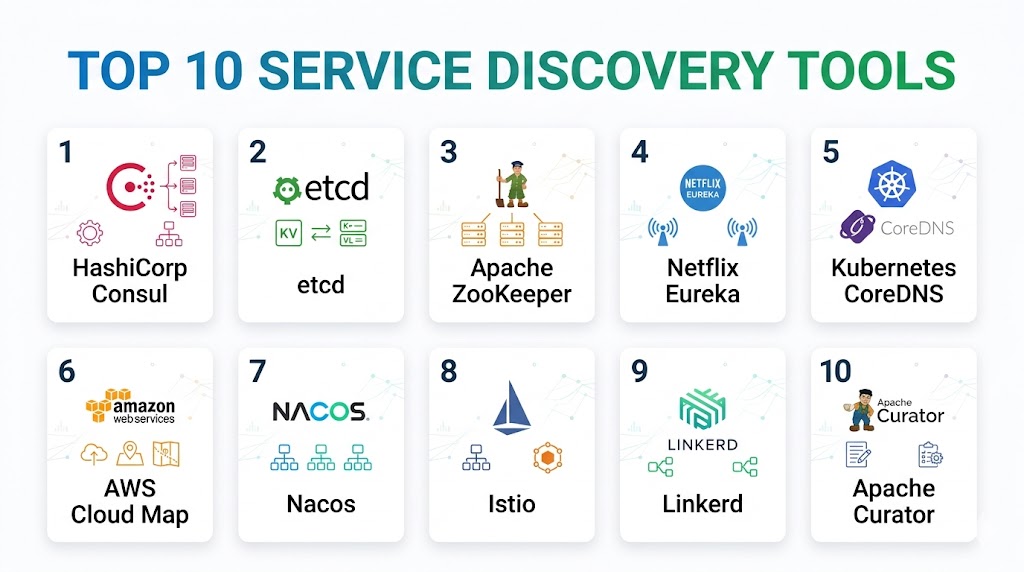
Top 10 Service Discovery Tools
#1 — HashiCorp Consul
Short description: Consul is a powerful service discovery and configuration tool that enables dynamic service registration and secure communication.
Key Features
- Service registry
- Health checks
- DNS and HTTP APIs
- Service mesh integration
- Multi-datacenter support
Pros
- Highly scalable
- Flexible
- Strong ecosystem
Cons
- Complex setup
- Requires management
- Learning curve
Platforms / Deployment
Linux / Windows
Cloud / Self-hosted
Security & Compliance
TLS, ACLs
Not publicly stated
Integrations & Ecosystem
Works across cloud and infrastructure environments.
- Kubernetes
- Cloud platforms
Support & Community
Strong community and enterprise support.
#2 — etcd
Short description: etcd is a distributed key-value store used for configuration and service discovery in Kubernetes.
Key Features
- Distributed storage
- Strong consistency
- High availability
- Watch functionality
- API-based access
Pros
- Reliable
- Core Kubernetes component
- High performance
Cons
- Limited UI
- Requires expertise
- Not a full-featured tool
Platforms / Deployment
Linux
Security & Compliance
TLS encryption
Not publicly stated
Integrations & Ecosystem
Deep integration with Kubernetes.
- Kubernetes
- Cloud platforms
Support & Community
Strong open-source community.
#3 — Apache ZooKeeper
Short description: ZooKeeper is a centralized service for maintaining configuration and coordination in distributed systems.
Key Features
- Distributed coordination
- Service registry
- Leader election
- Configuration management
- High availability
Pros
- Mature
- Reliable
- Widely used
Cons
- Complex setup
- Performance limitations
- Outdated architecture
Platforms / Deployment
Linux
Security & Compliance
Not publicly stated
Integrations & Ecosystem
Works with distributed systems and frameworks.
- Hadoop ecosystem
- Distributed apps
Support & Community
Strong community.
#4 — Netflix Eureka
Short description: Eureka is a service registry designed for cloud-native applications, widely used in microservices architectures.
Key Features
- Service registration
- Client-side discovery
- Health monitoring
- Load balancing support
- REST APIs
Pros
- Simple setup
- Microservices-friendly
- Flexible
Cons
- Limited enterprise features
- Less active development
- Requires configuration
Platforms / Deployment
Java environments
Security & Compliance
Not publicly stated
Integrations & Ecosystem
Works with microservices frameworks.
- Spring Cloud
Support & Community
Moderate community support.
#5 — Kubernetes CoreDNS
Short description: CoreDNS is the default DNS-based service discovery tool in Kubernetes environments.
Key Features
- DNS-based discovery
- Kubernetes integration
- Plugin architecture
- High performance
- Scalable
Pros
- Native Kubernetes support
- Easy to use
- Highly scalable
Cons
- Kubernetes-only
- Limited advanced features
- Requires cluster setup
Platforms / Deployment
Linux / Cloud
Security & Compliance
Not publicly stated
Integrations & Ecosystem
Works within Kubernetes ecosystems.
- Kubernetes
Support & Community
Strong community.
#6 — AWS Cloud Map
Short description: AWS Cloud Map provides service discovery for cloud applications, enabling dynamic resource registration.
Key Features
- Service registry
- DNS-based discovery
- Health checks
- Integration with AWS services
- Managed service
Pros
- Fully managed
- Easy to use
- Scalable
Cons
- AWS dependency
- Limited customization
- Pricing considerations
Platforms / Deployment
Cloud
Security & Compliance
AWS security features
Not publicly stated
Integrations & Ecosystem
Deep integration with AWS ecosystem.
- AWS services
Support & Community
Strong support.
#7 — Nacos
Short description: Nacos is a dynamic service discovery and configuration platform designed for cloud-native applications.
Key Features
- Service registry
- Configuration management
- Dynamic DNS
- Health checks
- Scalability
Pros
- Easy to use
- Flexible
- Lightweight
Cons
- Smaller ecosystem
- Limited enterprise adoption
- Documentation gaps
Platforms / Deployment
Linux
Security & Compliance
Not publicly stated
Integrations & Ecosystem
Works with cloud-native applications.
- Microservices
Support & Community
Growing community.
#8 — Istio
Short description: Istio is a service mesh platform that includes service discovery along with traffic management and security features.
Key Features
- Service mesh
- Traffic routing
- Security policies
- Observability
- Load balancing
Pros
- Feature-rich
- Strong security
- Scalable
Cons
- Complex setup
- Resource-heavy
- Requires expertise
Platforms / Deployment
Cloud / Kubernetes
Security & Compliance
mTLS, policies
Not publicly stated
Integrations & Ecosystem
Works within service mesh environments.
- Kubernetes
Support & Community
Strong community.
#9 — Linkerd
Short description: Linkerd is a lightweight service mesh with built-in service discovery and observability features.
Key Features
- Service mesh
- Automatic discovery
- Observability
- Security features
- Lightweight design
Pros
- Easy to deploy
- Lightweight
- Good performance
Cons
- Limited advanced features
- Smaller ecosystem
- Kubernetes-focused
Platforms / Deployment
Cloud / Kubernetes
Security & Compliance
mTLS
Not publicly stated
Integrations & Ecosystem
Works with Kubernetes ecosystems.
- Kubernetes
Support & Community
Active community.
#10 — Apache Curator
Short description: Curator simplifies interactions with ZooKeeper, providing higher-level abstractions for service discovery.
Key Features
- ZooKeeper integration
- Service registry
- Simplified APIs
- Reliability features
- Coordination tools
Pros
- Simplifies ZooKeeper
- Reliable
- Flexible
Cons
- Dependent on ZooKeeper
- Limited standalone use
- Smaller ecosystem
Platforms / Deployment
Linux
Security & Compliance
Not publicly stated
Integrations & Ecosystem
Works with ZooKeeper environments.
- Distributed systems
Support & Community
Moderate community.
Comparison Table (Top 10)
| Tool Name | Best For | Platform(s) Supported | Deployment | Standout Feature | Public Rating |
|---|---|---|---|---|---|
| Consul | Enterprise discovery | Cross-platform | Hybrid | Multi-datacenter | N/A |
| etcd | Kubernetes backend | Linux | Self-hosted | Strong consistency | N/A |
| ZooKeeper | Distributed systems | Linux | Self-hosted | Coordination | N/A |
| Eureka | Microservices | Java | Self-hosted | Client-side discovery | N/A |
| CoreDNS | Kubernetes | Linux/Cloud | Cloud | DNS discovery | N/A |
| AWS Cloud Map | Cloud apps | Cloud | Cloud | Managed service | N/A |
| Nacos | Cloud-native apps | Linux | Self-hosted | Config + discovery | N/A |
| Istio | Service mesh | Cloud/K8s | Cloud | Traffic management | N/A |
| Linkerd | Lightweight mesh | Cloud/K8s | Cloud | Simplicity | N/A |
| Curator | ZooKeeper tools | Linux | Self-hosted | API abstraction | N/A |
Evaluation & Scoring of Service Discovery Tools
| Tool Name | Core | Ease | Integrations | Security | Performance | Support | Value | Weighted Total |
|---|---|---|---|---|---|---|---|---|
| Consul | 9 | 7 | 9 | 9 | 9 | 9 | 8 | 8.7 |
| etcd | 9 | 7 | 9 | 9 | 9 | 9 | 8 | 8.7 |
| ZooKeeper | 8 | 6 | 8 | 8 | 8 | 8 | 8 | 8.0 |
| Eureka | 8 | 8 | 8 | 7 | 8 | 7 | 8 | 7.9 |
| CoreDNS | 9 | 9 | 8 | 8 | 9 | 9 | 9 | 8.9 |
| AWS Cloud Map | 8 | 9 | 9 | 8 | 8 | 9 | 8 | 8.4 |
| Nacos | 8 | 8 | 7 | 7 | 8 | 7 | 8 | 7.8 |
| Istio | 9 | 6 | 9 | 9 | 9 | 8 | 7 | 8.4 |
| Linkerd | 8 | 9 | 8 | 8 | 9 | 8 | 8 | 8.4 |
| Curator | 7 | 7 | 7 | 7 | 7 | 7 | 8 | 7.2 |
How to interpret the scores:
These scores provide a comparative overview of each tool’s capabilities across critical factors like scalability, integrations, and security. Higher scores indicate stronger overall performance, but the best choice depends on your environment. For example, CoreDNS excels in Kubernetes-native environments, while Consul offers enterprise-grade flexibility. Use these scores as guidance and align them with your architecture and operational needs.
Which Service Discovery Tool Is Right for You?
Solo / Freelancer
Choose CoreDNS or Nacos for simple setups and lightweight deployments.
SMB
Consul or AWS Cloud Map provide scalable and easy-to-manage solutions.
Mid-Market
etcd or Linkerd offer strong performance and flexibility.
Enterprise
Consul, Istio, or etcd are ideal for large-scale distributed systems.
Budget vs Premium
Open-source tools reduce costs, while managed services offer convenience.
Feature Depth vs Ease of Use
CoreDNS is simple, while Istio offers advanced features.
Integrations & Scalability
Kubernetes-native tools provide better integration.
Security & Compliance Needs
Service mesh tools provide stronger security features.
Frequently Asked Questions (FAQs)
1. What is service discovery?
Service discovery allows applications to find each other dynamically in distributed systems. It eliminates the need for hardcoded IP addresses. It improves scalability and reliability.
2. Why is service discovery important?
It enables dynamic scaling and communication between services. It reduces manual configuration. It is essential for microservices.
3. How does service discovery work?
Services register themselves with a registry. Other services query this registry to find endpoints. This ensures real-time updates.
4. What is DNS-based discovery?
DNS-based discovery uses domain names to locate services. It simplifies service communication. It is widely used in Kubernetes.
5. What is a service mesh?
A service mesh manages communication between microservices. It includes service discovery, security, and observability. Tools like Istio provide this functionality.
6. Are these tools cloud-native?
Many tools are designed for cloud-native environments. They integrate with Kubernetes and cloud platforms. This supports modern architectures.
7. Can service discovery improve performance?
Yes, it enables load balancing and efficient routing. This improves system performance. It reduces latency.
8. Are these tools secure?
Security depends on configuration and tool capabilities. Many tools offer encryption and access control. Service meshes provide advanced security.
9. What are the challenges of service discovery?
Challenges include complexity and scalability. Proper configuration is required. Monitoring is also important.
10. How do I choose the right tool?
Evaluate your architecture and requirements. Consider scalability, integrations, and ease of use. Test tools before deployment.
Conclusion
Service discovery tools are essential for managing communication in modern distributed and microservices-based architectures, enabling applications to dynamically locate and connect with each other without manual configuration. Tools like HashiCorp Consul and etcd provide robust and scalable service registries for enterprise environments, while Kubernetes CoreDNS simplifies service discovery within containerized ecosystems. Service mesh platforms like Istio and Linkerd extend discovery capabilities with advanced traffic management and security features. Managed solutions such as AWS Cloud Map reduce operational overhead and integrate seamlessly with cloud environments. Each tool offers unique advantages depending on your infrastructure, scalability needs, and operational complexity. The best approach is to identify your architecture requirements, shortlist a few tools, and test them in real-world scenarios to ensure they meet your performance, integration, and reliability expectations.

Really helpful article. The comparison is well structured and provides a clear understanding of how different service discovery tools work, making it easier to choose the right solution for modern infrastructure environments.