Introduction
Pharmacovigilance software tools are specialized platforms used in the life sciences industry to detect, assess, monitor, and prevent adverse effects of pharmaceutical products. These systems play a critical role in ensuring drug safety throughout clinical trials and post-market surveillance by managing safety case data, regulatory reporting, and signal detection workflows.
In today’s healthcare ecosystem, regulatory authorities demand faster reporting, real-time safety monitoring, and strong compliance with global standards such as ICH guidelines and FDA requirements. Manual pharmacovigilance processes are no longer sufficient due to the increasing volume of safety data from clinical trials, hospitals, and real-world evidence sources.
Modern pharmacovigilance systems help organizations:
- Capture and process adverse event reports efficiently
- Automate Individual Case Safety Report ICSR workflows
- Perform signal detection and risk analysis
- Ensure global regulatory compliance
- Improve drug safety decision-making
Common use cases include:
- Adverse event reporting and management
- Drug safety case processing
- Signal detection and analysis
- Regulatory submission and compliance
- Post-market surveillance
Key evaluation criteria:
- Case processing automation
- Regulatory compliance support
- Signal detection capabilities
- Integration with clinical systems
- Data security and audit trails
- Scalability for global safety databases
- Ease of use for safety teams
- Reporting and analytics features
Best for: Pharmaceutical companies, biotech firms, CROs, and regulatory agencies.
Not ideal for: Small organizations without regulatory or drug safety obligations.
Key Trends in Pharmacovigilance Software Tools
- AI-driven signal detection and safety analytics
- Automation of adverse event case processing
- Real-time pharmacovigilance monitoring systems
- Integration with EHR and clinical trial platforms
- Cloud-based pharmacovigilance ecosystems
- Increased regulatory automation for global submissions
- Use of NLP for case intake and medical coding
- Social media and real-world data monitoring
- Strong focus on compliance and audit readiness
- End-to-end safety lifecycle management platforms
How We Selected These Tools Methodology
- Evaluated global adoption in pharma and biotech industries
- Assessed adverse event processing capabilities
- Reviewed regulatory compliance coverage
- Considered integration with clinical and safety systems
- Analyzed signal detection and analytics features
- Included enterprise and mid-market solutions
- Focused on automation and AI readiness
- Balanced usability and scalability across teams
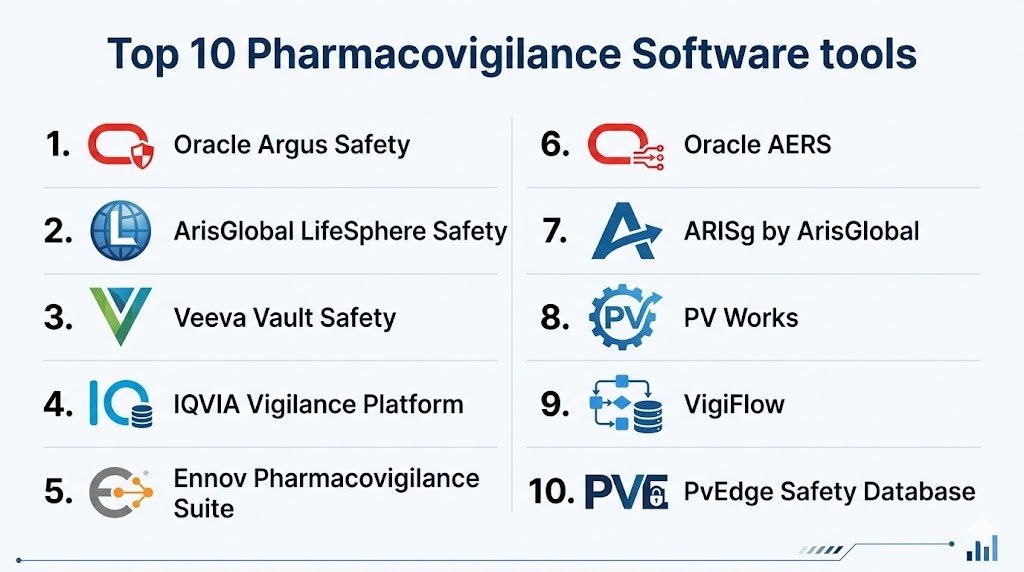
Top 10 Pharmacovigilance Software Tools
#1 — Oracle Argus Safety
Short description:
Oracle Argus Safety is one of the most widely used pharmacovigilance systems globally. It provides end-to-end drug safety case management and regulatory reporting. The platform supports global compliance and advanced safety workflows. It is ideal for large pharmaceutical companies.
Key Features
- Adverse event case management
- ICSR processing automation
- Regulatory reporting tools
- Global compliance support
- Signal detection capabilities
- Safety database management
Pros
- Industry standard platform
- Highly scalable
- Strong regulatory support
Cons
- Expensive
- Complex setup
- Requires training
Platforms / Deployment
Cloud / On-premise
Security & Compliance
Audit trails, role-based access, global regulatory compliance
Integrations & Ecosystem
Integrates with clinical and safety systems
- EDC systems
- CTMS platforms
- APIs
Support & Community
Enterprise-level global support
#2 — ArisGlobal LifeSphere MultiVigilance
Short description:
ArisGlobal LifeSphere is a cloud-native pharmacovigilance platform designed for end-to-end safety management. It automates case processing, reporting, and signal detection. The platform is widely used in global pharma organizations.
Key Features
- Automated case processing
- Signal detection
- Regulatory reporting
- Safety analytics
- Workflow automation
- Cloud-based architecture
Pros
- Modern cloud platform
- High automation
- Strong compliance support
Cons
- High cost
- Complex implementation
- Training required
Platforms / Deployment
Cloud
Security & Compliance
Regulatory compliance, audit logging
Integrations & Ecosystem
Integrates with enterprise safety systems
- Clinical systems
- APIs
Support & Community
Enterprise support
#3 — Veeva Vault Safety
Short description:
Veeva Vault Safety is a cloud-based pharmacovigilance system that unifies safety case processing and regulatory reporting. It is widely adopted in life sciences organizations. It ensures strong compliance and data consistency.
Key Features
- Safety case management
- ICSR processing
- Regulatory reporting
- Workflow automation
- Signal management
- Safety analytics
Pros
- Unified cloud platform
- Strong compliance
- Easy integration within Veeva ecosystem
Cons
- Expensive
- Limited customization
- Enterprise focus
Platforms / Deployment
Cloud
Security & Compliance
Audit trails and regulatory compliance support
Integrations & Ecosystem
Integrates with Veeva ecosystem
- Clinical systems
- Regulatory tools
Support & Community
Enterprise support
#4 — IQVIA Vigilance Platform
Short description:
IQVIA Vigilance is an end-to-end pharmacovigilance platform designed to manage the entire drug safety lifecycle. It includes case intake, processing, analytics, and signal detection. It is suitable for global safety operations.
Key Features
- Case intake and processing
- Signal detection
- Safety analytics
- Regulatory reporting
- Workflow automation
- Integrated safety modules
Pros
- End-to-end platform
- Strong analytics
- Scalable
Cons
- Complex setup
- Expensive
- Requires training
Platforms / Deployment
Cloud
Security & Compliance
Regulatory-grade compliance and audit trails
Integrations & Ecosystem
Integrates with clinical and safety systems
- APIs
- EHR systems
Support & Community
Enterprise support
#5 — Ennov Pharmacovigilance Suite
Short description:
Ennov PV Suite is an AI-powered pharmacovigilance platform that integrates case management, signal detection, and regulatory reporting. It is designed for pharma and biotech companies.
Key Features
- Case intake and management
- Signal detection
- Regulatory reporting
- Safety analytics
- AI automation
- Workflow tools
Pros
- AI-enabled
- Unified system
- Strong compliance
Cons
- Pricing varies
- Complex setup
- Smaller ecosystem
Platforms / Deployment
Cloud
Security & Compliance
Audit trails and compliance controls
Integrations & Ecosystem
Integrates with safety and clinical systems
- APIs
- Data platforms
Support & Community
Enterprise support
#6 — Oracle AERS / Oracle Safety Systems
Short description:
Oracle AERS is a traditional pharmacovigilance system used for adverse event reporting and safety case management. It is widely used in legacy safety environments. It provides strong regulatory reporting capabilities.
Key Features
- Adverse event reporting
- Case management
- Regulatory submissions
- Safety database
- Workflow management
- Compliance tracking
Pros
- Reliable legacy system
- Strong reporting
- Widely adopted
Cons
- Outdated interface
- Complex setup
- Limited modern features
Platforms / Deployment
On-premise / Cloud
Security & Compliance
Regulatory compliance support
Integrations & Ecosystem
Integrates with Oracle systems
- Clinical platforms
- ERP systems
Support & Community
Enterprise support
#7 — PV Works
Short description:
PV Works is a pharmacovigilance workflow system designed to manage safety cases and adverse event reporting. It provides automation and regulatory support. It is suitable for mid-sized pharma organizations.
Key Features
- Case management
- Workflow automation
- Safety reporting
- Regulatory compliance
- Data tracking
- Risk management
Pros
- Workflow focused
- Efficient
- Cost-effective
Cons
- Limited scalability
- Smaller ecosystem
- Basic analytics
Platforms / Deployment
Cloud
Security & Compliance
Audit trails and compliance support
Integrations & Ecosystem
Supports basic integrations
- APIs
- Safety systems
Support & Community
Standard support
#8 — ArisGlobal ArisG
Short description:
ArisG is a traditional pharmacovigilance database system used for safety case processing and regulatory reporting. It is widely adopted in global pharma companies. It provides strong compliance features.
Key Features
- Case processing
- Regulatory reporting
- Safety database
- Workflow management
- Signal detection
- Compliance tools
Pros
- Established platform
- Reliable
- Strong compliance
Cons
- Complex UI
- High cost
- Legacy system
Platforms / Deployment
On-premise / Cloud
Security & Compliance
Regulatory compliance support
Integrations & Ecosystem
Integrates with enterprise systems
- APIs
- Clinical tools
Support & Community
Enterprise support
#9 — VigiFlow
Short description:
VigiFlow is a web-based pharmacovigilance system used by national regulatory authorities and health organizations. It supports adverse event reporting and safety monitoring.
Key Features
- Adverse event reporting
- Safety monitoring
- Case tracking
- Regulatory submissions
- Data analysis
- Workflow tools
Pros
- Simple interface
- Government adoption
- Reliable
Cons
- Limited enterprise features
- Basic analytics
- Not highly customizable
Platforms / Deployment
Cloud
Security & Compliance
Public health compliance standards
Integrations & Ecosystem
Supports basic integration
- National reporting systems
Support & Community
Institutional support
#10 — PvEdge Safety Database
Short description:
PvEdge is a pharmacovigilance safety database designed to manage adverse event reporting and drug safety workflows. It supports compliance and case processing for pharma companies.
Key Features
- Safety case management
- Adverse event tracking
- Regulatory reporting
- Workflow automation
- Risk management
- Data analytics
Pros
- Efficient workflow engine
- Cost-effective
- Reliable
Cons
- Limited global adoption
- Smaller ecosystem
- Basic UI
Platforms / Deployment
Cloud
Security & Compliance
Audit logging and compliance features
Integrations & Ecosystem
Integrates with safety systems
- APIs
- Clinical tools
Support & Community
Standard support
Comparison Table
| Tool Name | Best For | Platform Supported | Deployment | Standout Feature | Public Rating |
|---|---|---|---|---|---|
| Oracle Argus | Global pharma | Web | Hybrid | Industry standard | N/A |
| ArisGlobal | Enterprise safety | Web | Cloud | Automation | N/A |
| Veeva Vault | Life sciences | Web | Cloud | Unified suite | N/A |
| IQVIA Vigilance | Global trials | Web | Cloud | End-to-end PV | N/A |
| Ennov PV Suite | Modern pharma | Web | Cloud | AI automation | N/A |
| Oracle AERS | Legacy users | Web | On-premise | Regulatory reporting | N/A |
| PV Works | Mid pharma | Web | Cloud | Workflow engine | N/A |
| ArisG | Pharma legacy | Web | Hybrid | Case processing | N/A |
| VigiFlow | Regulators | Web | Cloud | National reporting | N/A |
| PvEdge | Small pharma | Web | Cloud | Safety database | N/A |
Evaluation & Scoring
| Tool Name | Core | Ease | Integrations | Security | Performance | Support | Value | Weighted Total |
|---|---|---|---|---|---|---|---|---|
| Oracle Argus | 10 | 7 | 9 | 10 | 10 | 9 | 6 | 8.8 |
| ArisGlobal | 10 | 7 | 9 | 10 | 9 | 9 | 6 | 8.7 |
| Veeva Vault | 10 | 7 | 9 | 10 | 9 | 9 | 6 | 8.7 |
| IQVIA Vigilance | 9 | 7 | 9 | 9 | 9 | 9 | 7 | 8.4 |
| Ennov PV | 9 | 8 | 8 | 9 | 8 | 8 | 7 | 8.3 |
| Oracle AERS | 8 | 6 | 8 | 9 | 8 | 8 | 7 | 7.8 |
| PV Works | 7 | 8 | 7 | 8 | 7 | 7 | 8 | 7.6 |
| ArisG | 9 | 6 | 8 | 9 | 9 | 9 | 6 | 8.2 |
| VigiFlow | 7 | 9 | 7 | 8 | 7 | 8 | 8 | 7.7 |
| PvEdge | 7 | 8 | 7 | 8 | 7 | 7 | 8 | 7.6 |
Which Pharmacovigilance Software Is Right for You
Solo / Small Pharma
PvEdge or VigiFlow for simplicity and affordability.
SMB Pharma Companies
PV Works or Ennov PV Suite for balanced automation.
Mid Market Organizations
IQVIA Vigilance or ArisGlobal for scalability.
Enterprise Pharma
Oracle Argus, Veeva Vault, and ArisG for global compliance.
Budget vs Premium
Legacy systems are cheaper but less flexible, while enterprise tools offer full automation.
Feature Depth vs Ease of Use
Advanced systems offer full safety lifecycle control, simpler tools focus on usability.
Integrations & Scalability
API-driven systems scale best for global safety operations.
Security & Compliance Needs
Regulated industries require audit-ready enterprise platforms.
Frequently Asked Questions
1 What is pharmacovigilance software
It is software used to monitor and manage drug safety data and adverse events. It ensures regulatory compliance. It supports case reporting. It improves patient safety.
2 Why is it important
It helps detect drug safety issues early. It ensures compliance with regulations. It reduces risk. It improves decision-making.
3 Who uses it
Pharmaceutical companies, biotech firms, CROs, and regulatory agencies use it. It is essential for drug safety monitoring. Adoption is global. It supports healthcare systems.
4 What is ICSR in pharmacovigilance
ICSR stands for Individual Case Safety Report. It documents adverse drug events. It is required for regulatory reporting. It is a core PV function.
5 Is pharmacovigilance software cloud-based
Most modern systems are cloud-based. Some legacy systems are on-premise. Cloud improves scalability. Deployment varies.
6 Is it secure
Yes, it includes encryption and audit logs. Security is critical for compliance. Enterprise tools offer strong protection. Standards vary.
7 How expensive is it
Pricing varies from mid-range to enterprise-level costs. Enterprise tools are expensive. Smaller tools are more affordable. Cost depends on features.
8 What features are most important
Case management, signal detection, and regulatory reporting are key features. Automation is increasingly important. Integration is critical. Compliance is essential.
9 Can it integrate with other systems
Yes, it integrates with CTMS, EDC, and LIMS systems. This improves workflows. It ensures data consistency. Integration varies by tool.
10 How do I choose the right tool
Evaluate compliance, scalability, integrations, and automation. Consider organization size. Test multiple tools. Choose based on long-term needs.
Conclusion
Pharmacovigilance software tools are essential for ensuring drug safety by enabling structured adverse event reporting, real-time monitoring, and regulatory compliance across global healthcare systems. These platforms help pharmaceutical companies and regulatory bodies detect risks early, streamline case processing, and maintain strict compliance with international safety standards. While enterprise-grade systems like Oracle Argus, Veeva Vault, and ArisGlobal offer advanced automation, scalability, and global regulatory coverage, lightweight and specialized tools provide cost-effective solutions for smaller organizations. The best choice depends on organizational size, regulatory requirements, and operational complexity. A practical approach is to shortlist key platforms, evaluate them in real-world workflows, and select the system that best aligns with long-term pharmacovigilance and drug safety objectives.

This article provides a clear and practical comparison of pharmacovigilance software tools, helping readers quickly understand their key features and choose the most suitable solution.