Introduction
Change Data Capture tools enable organizations to track, capture, and replicate changes made to data in real time. Instead of repeatedly copying entire datasets, CDC tools identify incremental changes such as inserts, updates, and deletes, making data pipelines more efficient and scalable.
In modern data architectures, especially with real-time analytics and streaming systems, CDC plays a critical role in ensuring that downstream systems stay synchronized without excessive load. These tools are widely used in data warehousing, microservices architectures, event-driven systems, and cloud migrations.
Real-world use cases:
- Real-time data replication between databases
- Synchronizing operational systems with data warehouses
- Powering streaming analytics pipelines
- Supporting microservices with event-driven data flows
- Enabling near real-time dashboards and reporting
What buyers should evaluate:
- Supported data sources and targets
- Real-time vs batch capabilities
- Log-based vs trigger-based CDC
- Performance and latency
- Scalability and throughput
- Ease of setup and maintenance
- Integration with streaming platforms
- Security and compliance features
- Monitoring and error handling
Best for: Data engineers, analytics teams, and organizations building real-time data pipelines or modern data platforms.
Not ideal for: Small projects with static data or systems that do not require real-time synchronization.
Key Trends in Change Data Capture (CDC) Tools
- Shift toward log-based CDC for better performance and reliability
- Integration with streaming platforms like event pipelines
- Cloud-native CDC services gaining popularity
- Real-time analytics demand increasing adoption
- Automation and low-code CDC pipelines improving usability
- Hybrid and multi-cloud data synchronization
- Improved monitoring and observability tools
- Focus on data consistency and reliability
- Scalable architectures for high-throughput workloads
- Integration with modern data stacks and warehouses
How We Selected These Tools (Methodology)
- Evaluated industry adoption and credibility
- Assessed real-time data capture capabilities
- Reviewed performance and scalability features
- Analyzed integration with data platforms and streaming tools
- Considered ease of deployment and management
- Evaluated security and compliance features
- Reviewed monitoring and automation capabilities
- Compared overall value and flexibility
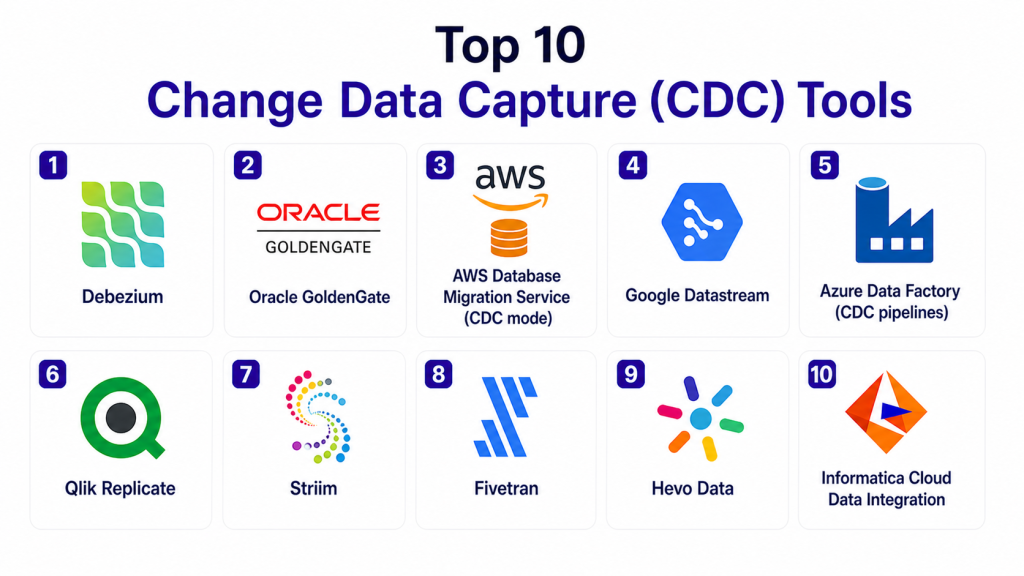
Top 10 Change Data Capture (CDC) Tools
#1 — Debezium
Short description:
Debezium is an open-source CDC platform that captures database changes and streams them to event systems, making it ideal for real-time data pipelines.
Key Features
- Log-based CDC
- Integration with Kafka
- Real-time streaming
- Open-source
- Supports multiple databases
Pros
- Highly scalable
- Strong community support
- Flexible integration
Cons
- Requires setup and expertise
- No native UI
- Depends on Kafka ecosystem
Platforms / Deployment
Linux / Cloud / Self-hosted
Security & Compliance
Encryption, authentication
Integrations & Ecosystem
Works with modern data stacks.
- Kafka
- Databases
Support & Community
Large open-source community.
#2 — Oracle GoldenGate
Short description:
Oracle GoldenGate is an enterprise-grade CDC tool that provides real-time data replication across heterogeneous environments.
Key Features
- Real-time data replication
- Log-based CDC
- Multi-platform support
- High availability
- Data transformation
Pros
- Enterprise-grade
- Reliable
- Supports complex environments
Cons
- Expensive
- Complex setup
- Requires expertise
Platforms / Deployment
Cloud / Hybrid
Security & Compliance
Encryption, audit logs
Integrations & Ecosystem
Works across enterprise systems.
- Databases
- Cloud platforms
Support & Community
Strong enterprise support.
#3 — AWS Database Migration Service (CDC)
Short description:
AWS DMS supports CDC for continuous data replication, enabling real-time data migration and synchronization within AWS.
Key Features
- Continuous replication
- Minimal downtime
- Multiple database support
- Integration with AWS services
- Monitoring tools
Pros
- Scalable
- Flexible
- Cloud-native
Cons
- AWS dependency
- Configuration complexity
- Cost management
Platforms / Deployment
Cloud
Security & Compliance
Encryption, access control
Integrations & Ecosystem
Works within AWS ecosystem.
- AWS databases
- Cloud services
Support & Community
Strong support and documentation.
#4 — Google Datastream
Short description:
Google Datastream is a serverless CDC and replication service for real-time data streaming into Google Cloud.
Key Features
- Serverless CDC
- Real-time streaming
- Managed service
- Integration with BigQuery
- Low latency
Pros
- Easy to use
- No infrastructure management
- Scalable
Cons
- Google Cloud dependency
- Limited customization
- Pricing considerations
Platforms / Deployment
Cloud
Security & Compliance
Encryption
Integrations & Ecosystem
Works within Google ecosystem.
- BigQuery
- Cloud services
Support & Community
Strong cloud support.
#5 — Azure Data Factory (CDC Pipelines)
Short description:
Azure Data Factory supports CDC through pipelines, enabling data movement and transformation in real time.
Key Features
- Data pipelines
- CDC support
- ETL/ELT integration
- Visual interface
- Scheduling
Pros
- Easy to use
- Strong integration
- Scalable
Cons
- Azure dependency
- Limited advanced CDC features
- Learning curve
Platforms / Deployment
Cloud
Security & Compliance
Encryption
Integrations & Ecosystem
Works within Azure ecosystem.
- Data warehouses
- Cloud services
Support & Community
Strong enterprise support.
#6 — Qlik Replicate
Short description:
Qlik Replicate provides real-time data replication and CDC capabilities with a focus on simplicity and performance.
Key Features
- Real-time replication
- Log-based CDC
- Data transformation
- Broad database support
- Automation
Pros
- Easy to use
- High performance
- Reliable
Cons
- Licensing cost
- Limited customization
- Learning curve
Platforms / Deployment
Cloud / Hybrid
Security & Compliance
Encryption
Integrations & Ecosystem
Supports enterprise systems.
- Databases
- Data platforms
Support & Community
Strong enterprise support.
#7 — Striim
Short description:
Striim is a real-time data streaming platform that includes CDC capabilities for analytics and integration.
Key Features
- Real-time streaming
- CDC integration
- Data pipelines
- Analytics support
- Monitoring
Pros
- Real-time capabilities
- Flexible
- Strong analytics integration
Cons
- Complex setup
- Cost considerations
- Requires expertise
Platforms / Deployment
Cloud / Hybrid
Security & Compliance
Encryption
Integrations & Ecosystem
Works with data ecosystems.
- Streaming platforms
- Databases
Support & Community
Enterprise support available.
#8 — Fivetran
Short description:
Fivetran supports CDC-based data pipelines for syncing data into analytics platforms.
Key Features
- Automated pipelines
- Real-time sync
- Schema management
- Cloud-native
- Monitoring
Pros
- Easy to use
- Reliable
- Fully managed
Cons
- Costly at scale
- Limited customization
- Connector dependency
Platforms / Deployment
Cloud
Security & Compliance
Encryption
Integrations & Ecosystem
Supports modern data stacks.
- Data warehouses
- SaaS apps
Support & Community
Strong support.
#9 — Hevo Data
Short description:
Hevo Data is a no-code platform that supports real-time data replication using CDC techniques.
Key Features
- No-code pipelines
- Real-time replication
- Data transformation
- Monitoring
- Automation
Pros
- User-friendly
- Fast setup
- Real-time
Cons
- Limited customization
- Pricing tiers
- Dependency on connectors
Platforms / Deployment
Cloud
Security & Compliance
Encryption
Integrations & Ecosystem
Works with modern data platforms.
- SaaS apps
- Data warehouses
Support & Community
Strong onboarding support.
#10 — Informatica Cloud Data Integration
Short description:
Informatica offers enterprise-grade CDC capabilities with strong data governance and integration features.
Key Features
- CDC pipelines
- Data integration
- Governance tools
- Automation
- Hybrid support
Pros
- Enterprise-ready
- Comprehensive features
- Strong governance
Cons
- Complex setup
- High cost
- Learning curve
Platforms / Deployment
Cloud / Hybrid
Security & Compliance
Encryption, compliance
Integrations & Ecosystem
Supports enterprise environments.
- Databases
- Cloud platforms
Support & Community
Strong enterprise support.
Comparison Table
| Tool Name | Best For | Platform(s) Supported | Deployment | Standout Feature | Public Rating |
|---|---|---|---|---|---|
| Debezium | Open-source CDC | Multi-platform | Self-hosted | Kafka integration | N/A |
| GoldenGate | Enterprise replication | Multi-platform | Hybrid | High reliability | N/A |
| AWS DMS | Cloud migration | Multi-platform | Cloud | Continuous replication | N/A |
| Datastream | Serverless CDC | Cloud | Cloud | Managed streaming | N/A |
| Azure DF | Pipelines | Cloud | Cloud | Visual workflows | N/A |
| Qlik | Easy replication | Multi-platform | Hybrid | Performance | N/A |
| Striim | Streaming | Multi-platform | Hybrid | Real-time analytics | N/A |
| Fivetran | Managed pipelines | Cloud | Cloud | Automation | N/A |
| Hevo | No-code CDC | Cloud | Cloud | Ease of use | N/A |
| Informatica | Enterprise data | Multi-platform | Hybrid | Governance | N/A |
Evaluation & Scoring
| Tool Name | Core | Ease | Integrations | Security | Performance | Support | Value | Weighted Total |
|---|---|---|---|---|---|---|---|---|
| Debezium | 9 | 6 | 9 | 8 | 9 | 8 | 9 | 8.5 |
| GoldenGate | 9 | 6 | 9 | 9 | 9 | 9 | 7 | 8.6 |
| AWS DMS | 8 | 7 | 9 | 8 | 9 | 8 | 8 | 8.3 |
| Datastream | 8 | 8 | 8 | 8 | 8 | 8 | 8 | 8.1 |
| Azure DF | 8 | 8 | 9 | 8 | 8 | 8 | 8 | 8.2 |
| Qlik | 8 | 8 | 8 | 8 | 9 | 8 | 7 | 8.1 |
| Striim | 8 | 7 | 8 | 8 | 9 | 8 | 7 | 8.0 |
| Fivetran | 8 | 9 | 8 | 8 | 8 | 8 | 7 | 8.1 |
| Hevo | 8 | 9 | 8 | 8 | 8 | 8 | 8 | 8.2 |
| Informatica | 9 | 6 | 9 | 9 | 8 | 9 | 7 | 8.4 |
How to interpret scores:
These scores reflect how each CDC tool performs across key dimensions such as functionality, usability, integrations, and performance. A higher score indicates a more balanced and capable solution, but it does not necessarily mean it is the best choice for every scenario. Some tools are optimized for enterprise-scale deployments, while others prioritize ease of use or real-time streaming capabilities. Use these scores as a comparative guide and align them with your specific data architecture, performance requirements, and team expertise.
Which Change Data Capture Tool Is Right for You?
Solo / Freelancer
Debezium or Hevo Data are good for lightweight and flexible setups.
SMB
Fivetran and Azure Data Factory provide ease of use and scalability.
Mid-Market
Qlik Replicate and Striim offer strong performance and real-time capabilities.
Enterprise
Oracle GoldenGate and Informatica are best for large-scale, mission-critical systems.
Budget vs Premium
Open-source tools like Debezium are cost-effective, while enterprise tools offer advanced features.
Feature Depth vs Ease of Use
No-code tools are easier, while enterprise platforms provide deeper control.
Integrations & Scalability
Choose tools aligned with your data ecosystem and cloud provider.
Security & Compliance Needs
Prioritize encryption, monitoring, and governance features.
Frequently Asked Questions (FAQs)
1. What is Change Data Capture?
CDC is a method of tracking changes in databases and replicating them in real time.
2. Why is CDC important?
It reduces load and enables real-time data synchronization.
3. What types of CDC exist?
Log-based, trigger-based, and query-based CDC.
4. Is CDC real-time?
Most modern tools support near real-time data capture.
5. Can CDC be automated?
Yes, most tools automate change tracking and replication.
6. What databases are supported?
Most tools support popular relational and NoSQL databases.
7. Is CDC secure?
Yes, with encryption and access controls.
8. What are common challenges?
Latency, schema changes, and complexity.
9. Do CDC tools support cloud?
Yes, most are cloud-native or hybrid.
10. How do I choose a tool?
Evaluate based on scale, performance, and integrations.
Conclusion
Change Data Capture tools are a foundational component of modern data architectures, enabling real-time data synchronization, streaming analytics, and efficient data integration across systems. As organizations continue to move toward cloud-native and event-driven environments, the ability to capture and process data changes instantly becomes a critical advantage. The tools covered in this guide offer a wide range of capabilities, from open-source flexibility to enterprise-grade reliability and governance. Choosing the right CDC tool depends on your data volume, infrastructure, and business requirements. Instead of selecting a tool based solely on popularity, it is more effective to align your choice with your specific use cases, performance needs, and integration requirements. The best next step is to test a few tools in your environment, validate their scalability and reliability, and then adopt the one that best supports your long-term data strategy.

Really informative article. The comparison makes it easy to understand the differences between CDC tools and provides valuable insights for selecting the right solution for data integration and real-time synchronization needs.