Introduction
Electronic Lab Notebook ELN tools are digital platforms designed to replace traditional paper lab notebooks by enabling researchers to record experiments, manage protocols, store scientific data, and collaborate in real time. These systems provide a structured and secure way to document research workflows, ensuring accuracy, traceability, and compliance across scientific and industrial laboratories.
In modern research environments, data integrity and reproducibility are critical. Paper notebooks often lead to issues like data loss, lack of version control, and limited collaboration. ELN platforms solve these challenges by centralizing experiment records, enabling searchable documentation, and integrating with laboratory instruments and data systems.
Common use cases include:
- Recording laboratory experiments and results
- Managing research protocols and workflows
- Tracking sample and inventory data
- Ensuring regulatory compliance and audit readiness
- Enabling collaboration between research teams
Key evaluation criteria:
- Experiment documentation and organization
- Collaboration and sharing features
- Data security and compliance support
- Integration with lab instruments and systems
- Search and version control capabilities
- Ease of use for researchers
- Scalability for enterprise labs
- Workflow automation capabilities
Best for: Research laboratories, biotech companies, pharmaceutical firms, universities, and R&D teams.
Not ideal for: Non-scientific workflows or teams without structured research processes.
Key Trends in Electronic Lab Notebook ELN Tools
- Cloud-first ELN platforms replacing on-premise notebooks
- Integration with laboratory information management systems
- AI-assisted experiment documentation and tagging
- Increased focus on regulatory compliance such as GLP and FDA standards
- Real-time collaboration across global research teams
- Mobile access for capturing lab data on the go
- Stronger data security and encryption standards
- Automation of workflows and experiment templates
- Integration with analytical instruments and IoT lab devices
- Expansion into biotech and pharmaceutical enterprise ecosystems
How We Selected These Tools Methodology
- Evaluated adoption across academic and enterprise research labs
- Assessed experiment documentation and workflow capabilities
- Reviewed compliance readiness for regulated industries
- Considered integration with lab instruments and systems
- Analyzed usability for scientists and researchers
- Included both enterprise and open-source solutions
- Focused on collaboration and data integrity features
- Balanced cost-effective and advanced platforms
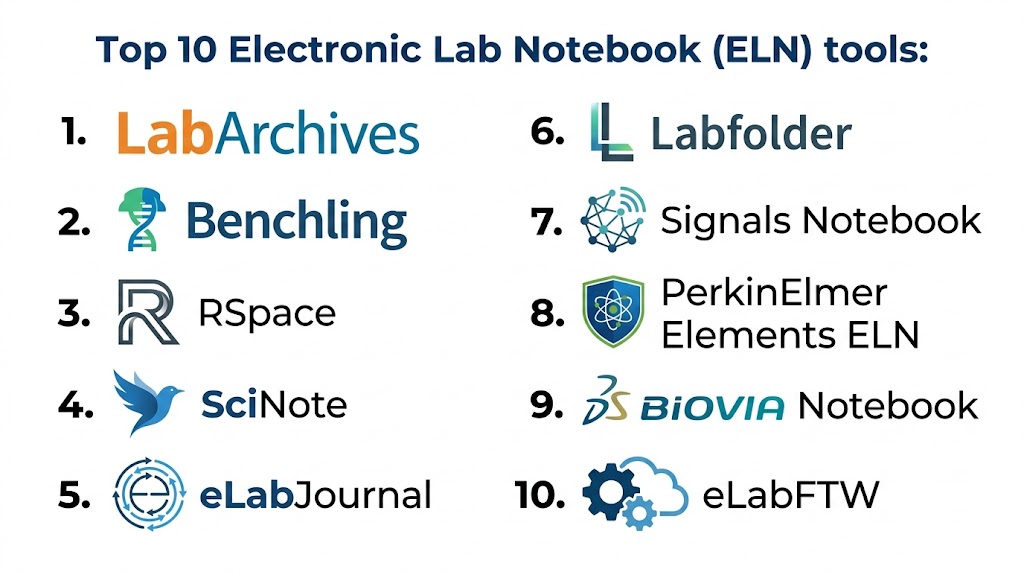
Top 10 Electronic Lab Notebook ELN Tools
#1 — LabArchives
Short description:
LabArchives is a widely used cloud-based ELN platform designed for academic and research laboratories. It enables secure experiment documentation, data storage, and collaboration. The platform supports compliance and audit readiness. It is suitable for universities and research institutions.
Key Features
- Experiment documentation
- Cloud-based storage
- Collaboration tools
- Data version control
- Compliance support
- Integration with lab tools
Pros
- Easy to use
- Strong academic adoption
- Secure cloud platform
Cons
- Limited offline features
- Pricing varies
- Basic customization
Platforms / Deployment
Cloud / Web / Mobile
Security & Compliance
Audit trails, access control, encryption
Integrations & Ecosystem
Integrates with lab systems and research tools.
- APIs
- LIMS integrations
Support & Community
Strong academic support
#2 — Benchling
Short description:
Benchling is a modern cloud-based platform widely used in biotech and life sciences research. It combines ELN functionality with data management and collaboration tools. The platform is highly scalable. It is ideal for enterprise R&D teams.
Key Features
- Molecular biology tools
- Experiment tracking
- Collaboration workspace
- Data management
- Workflow automation
- Integration APIs
Pros
- Highly scalable
- Modern interface
- Strong biotech focus
Cons
- Expensive
- Complex setup
- Requires training
Platforms / Deployment
Cloud
Security & Compliance
SOC type controls and audit logs
Integrations & Ecosystem
Integrates with biotech and lab systems.
- APIs
- Scientific tools
Support & Community
Enterprise support
#3 — RSpace
Short description:
RSpace is an ELN designed for research institutions and laboratories. It supports structured experiment documentation and data sharing. The platform focuses on reproducibility and collaboration. It is suitable for academic and enterprise labs.
Key Features
- Experiment documentation
- Data linking
- Collaboration tools
- Protocol management
- File organization
- Compliance tracking
Pros
- Strong collaboration
- Easy organization
- Reproducibility focus
Cons
- Limited advanced analytics
- Pricing varies
- UI simplicity
Platforms / Deployment
Cloud / On-premise
Security & Compliance
Access control, audit logs
Integrations & Ecosystem
Integrates with research systems.
- APIs
- LIMS integration
Support & Community
Good institutional support
#4 — SciNote
Short description:
SciNote is an ELN platform designed for life sciences and laboratory research. It helps manage experiments, tasks, and workflows in a structured way. The platform is user-friendly and scalable. It is suitable for regulated research environments.
Key Features
- Experiment tracking
- Task management
- Protocol storage
- Collaboration tools
- Compliance support
- Reporting features
Pros
- Easy to use
- Good workflow management
- Compliance-ready
Cons
- Limited customization
- Smaller ecosystem
- Advanced features require upgrade
Platforms / Deployment
Cloud
Security & Compliance
Audit trails and secure storage
Integrations & Ecosystem
Supports lab and research integrations.
- APIs
- LIMS systems
Support & Community
Good support
#5 — eLabJournal
Short description:
eLabJournal is a professional ELN system designed for laboratories and research organizations. It offers structured documentation and data management features. The platform supports compliance and collaboration. It is suitable for industrial and academic labs.
Key Features
- Experiment documentation
- Data management
- Inventory tracking
- Collaboration tools
- Reporting dashboards
- Compliance features
Pros
- Strong structure
- Reliable
- Good compliance support
Cons
- Pricing varies
- Requires setup
- Limited UI flexibility
Platforms / Deployment
Cloud / Hybrid
Security & Compliance
Audit trails, role-based access
Integrations & Ecosystem
Integrates with lab systems.
- APIs
- LIMS integration
Support & Community
Enterprise support
#6 — Labfolder
Short description:
Labfolder is a cloud-based ELN designed for collaborative research. It allows researchers to document experiments and share data securely. The platform is intuitive and flexible. It is suitable for academic and biotech labs.
Key Features
- Experiment logging
- Collaboration tools
- Data storage
- Protocol management
- Search functionality
- Version control
Pros
- User-friendly
- Strong collaboration
- Flexible structure
Cons
- Limited advanced analytics
- Pricing required
- Smaller ecosystem
Platforms / Deployment
Cloud
Security & Compliance
Encryption and access control
Integrations & Ecosystem
Supports research integrations.
- APIs
- Lab systems
Support & Community
Good support
#7 — Signals Notebook
Short description:
Signals Notebook is an enterprise-grade ELN platform designed for scientific research and development. It provides structured experiment documentation and workflow automation. The platform is widely used in pharmaceutical research. It is suitable for large organizations.
Key Features
- Experiment tracking
- Workflow automation
- Collaboration tools
- Data management
- Compliance support
- Integration capabilities
Pros
- Enterprise-ready
- Highly scalable
- Strong compliance
Cons
- Expensive
- Complex setup
- Requires training
Platforms / Deployment
Cloud
Security & Compliance
Regulatory compliance and audit logs
Integrations & Ecosystem
Integrates with enterprise lab systems.
- APIs
- Scientific tools
Support & Community
Enterprise support
#8 — PerkinElmer Elements ELN
Short description:
PerkinElmer Elements ELN is a laboratory documentation platform designed for regulated environments. It supports experiment tracking and data management. The platform is suitable for industrial and research labs. It ensures compliance and traceability.
Key Features
- Experiment documentation
- Data tracking
- Workflow management
- Compliance tools
- Reporting features
- Integration support
Pros
- Reliable
- Strong compliance
- Industrial-grade
Cons
- Expensive
- Complex interface
- Requires setup
Platforms / Deployment
Cloud / On-premise
Security & Compliance
Regulatory compliance support
Integrations & Ecosystem
Integrates with lab instruments and systems.
- APIs
- LIMS integration
Support & Community
Enterprise support
#9 — BIOVIA Notebook
Short description:
BIOVIA Notebook is an ELN solution designed for scientific research and enterprise R&D. It provides tools for experiment documentation and data management. The platform supports collaboration and compliance. It is suitable for pharmaceutical research.
Key Features
- Experiment tracking
- Data management
- Collaboration tools
- Compliance support
- Workflow automation
- Integration APIs
Pros
- Strong enterprise features
- Scalable
- Reliable
Cons
- Expensive
- Complex setup
- Requires training
Platforms / Deployment
Cloud
Security & Compliance
Audit trails and compliance controls
Integrations & Ecosystem
Integrates with enterprise scientific systems.
- APIs
- Lab systems
Support & Community
Enterprise support
#10 — eLabFTW
Short description:
eLabFTW is an open-source electronic lab notebook designed for researchers and laboratories. It offers experiment documentation and collaboration features. The platform is flexible and cost-effective. It is suitable for technical teams and institutions.
Key Features
- Experiment logging
- Protocol management
- Collaboration tools
- Inventory tracking
- Open-source customization
- Data export
Pros
- Free and open-source
- Flexible
- Lightweight
Cons
- Requires technical setup
- Limited enterprise features
- Smaller ecosystem
Platforms / Deployment
Web / Self-hosted
Security & Compliance
Basic access control
Integrations & Ecosystem
Supports API-based integrations.
- APIs
- Custom workflows
Support & Community
Community-driven support
Comparison Table
| Tool Name | Best For | Platform Supported | Deployment | Standout Feature | Public Rating |
|---|---|---|---|---|---|
| LabArchives | Academia | Web | Cloud | Collaboration | N/A |
| Benchling | Biotech | Web | Cloud | Molecular tools | N/A |
| RSpace | Research labs | Web | Hybrid | Reproducibility | N/A |
| SciNote | Life sciences | Web | Cloud | Workflow management | N/A |
| eLabJournal | Industrial labs | Web | Cloud | Compliance | N/A |
| Labfolder | Academic labs | Web | Cloud | Collaboration | N/A |
| Signals Notebook | Enterprise R&D | Web | Cloud | Automation | N/A |
| Elements ELN | Industrial research | Web | Hybrid | Regulatory compliance | N/A |
| BIOVIA Notebook | Pharma R&D | Web | Cloud | Enterprise workflows | N/A |
| eLabFTW | Open-source users | Web | Self-hosted | Free customization | N/A |
Evaluation & Scoring
| Tool Name | Core | Ease | Integrations | Security | Performance | Support | Value | Weighted Total |
|---|---|---|---|---|---|---|---|---|
| LabArchives | 9 | 8 | 8 | 8 | 8 | 8 | 9 | 8.3 |
| Benchling | 10 | 7 | 9 | 9 | 9 | 9 | 6 | 8.6 |
| RSpace | 8 | 8 | 8 | 8 | 8 | 8 | 8 | 8.0 |
| SciNote | 8 | 9 | 8 | 8 | 8 | 8 | 8 | 8.1 |
| eLabJournal | 9 | 8 | 8 | 9 | 9 | 8 | 7 | 8.3 |
| Labfolder | 8 | 9 | 7 | 8 | 8 | 8 | 8 | 8.0 |
| Signals Notebook | 9 | 7 | 9 | 9 | 9 | 9 | 6 | 8.5 |
| Elements ELN | 9 | 7 | 9 | 9 | 9 | 9 | 6 | 8.5 |
| BIOVIA Notebook | 9 | 7 | 9 | 9 | 9 | 9 | 6 | 8.5 |
| eLabFTW | 7 | 8 | 7 | 7 | 7 | 7 | 9 | 7.6 |
Which ELN Tool Is Right for You
Solo Researcher
Use eLabFTW or Labfolder for simple and flexible documentation.
SMB Labs
SciNote or LabArchives provide balanced usability and features.
Mid Market Organizations
RSpace or eLabJournal offer scalable workflows and compliance support.
Enterprise R&D
Benchling, Signals Notebook, and BIOVIA Notebook provide advanced capabilities.
Budget vs Premium
Open-source tools reduce cost, while enterprise tools offer advanced compliance.
Feature Depth vs Ease of Use
Advanced platforms offer deep functionality, while simple tools improve usability.
Integrations & Scalability
API-driven ELNs scale better across research environments.
Security & Compliance Needs
Regulated industries require tools with strong audit and compliance features.
Frequently Asked Questions
1 What is an Electronic Lab Notebook ELN
An ELN is a digital tool used to record, manage, and store laboratory experiments and research data. It replaces paper notebooks. It improves organization and collaboration. It ensures data integrity.
2 Why are ELN tools important
They improve reproducibility and reduce data loss. They help manage research workflows efficiently. They support compliance. They enhance collaboration.
3 Can ELNs replace paper notebooks completely
Yes, most modern labs use ELNs instead of paper notebooks. They offer better tracking and searchability. They improve data security. Adoption is increasing globally.
4 Are ELN tools secure
Yes, most ELNs include encryption and access control features. Enterprise tools offer advanced compliance support. Security depends on configuration. Institutions should choose carefully.
5 Can ELNs integrate with lab instruments
Yes, many ELNs integrate with laboratory systems and instruments. This improves data accuracy. It automates workflows. Integration varies by tool.
6 Are ELN tools expensive
Costs vary depending on features and scale. Open-source options are free. Enterprise tools are more expensive. Pricing depends on requirements.
7 Who uses ELN tools
Researchers, scientists, biotech companies, and academic institutions use ELNs. They are widely used in life sciences. Adoption is growing in R&D sectors. They support structured research.
8 Do ELNs support collaboration
Yes, most ELNs support multi-user collaboration. Teams can share experiments and data. It improves productivity. It enables remote research.
9 What features should I look for
Look for experiment tracking, compliance support, integrations, and collaboration tools. Ease of use is also important. Scalability matters for large labs. Security is essential.
10 How do I choose the right ELN
Evaluate based on workflow needs, compliance requirements, and integrations. Test multiple tools. Consider team size. Choose based on long-term research needs.
Conclusion
Electronic Lab Notebook ELN tools have become essential in modern research environments by replacing traditional paper-based documentation with structured, secure, and collaborative digital systems that improve accuracy, reproducibility, and compliance across scientific workflows. These platforms enable researchers to efficiently document experiments, manage data, and collaborate in real time while integrating seamlessly with laboratory instruments and enterprise systems. While enterprise-grade ELNs offer advanced automation, regulatory compliance, and scalability for large organizations, lightweight and open-source solutions provide flexibility and affordability for smaller labs and academic researchers. The best choice depends on research complexity, compliance needs, and integration requirements. A practical approach is to evaluate a few platforms through real-world lab scenarios before selecting the one that best supports long-term research productivity and data integrity.

This article provides a useful comparison of electronic lab notebook tools, making it easy to understand their features and choose the right platform for research documentation and collaboration.