Introduction
Patient portal platforms help healthcare organizations give patients secure digital access to their health information, appointments, messages, bills, prescriptions, test results, and care instructions. These platforms act as a bridge between patients and providers, making it easier for people to manage their healthcare without calling the clinic for every update or request.
Patient portals matter because healthcare is becoming more digital, more patient-centered, and more connected. Patients now expect online access to medical records, appointment scheduling, prescription refill requests, lab results, secure messaging, telehealth links, and payment options. For providers, a good portal can reduce phone calls, improve communication, support better follow-up, and make administrative workflows more efficient.
Common use cases include:
- Viewing lab results and visit summaries
- Appointment scheduling and reminders
- Secure patient-provider messaging
- Prescription refill requests
- Online bill payment
- Digital intake and forms
- Telehealth visit access
- Care plan and discharge instruction sharing
- Health record access
- Patient engagement and communication
Buyers should evaluate:
- Ease of patient use
- EHR and EMR integration
- Secure messaging capabilities
- Appointment and scheduling support
- Lab result and document access
- Online payment features
- Mobile experience
- Accessibility and language support
- Security and authentication
- Implementation and patient adoption support
Best for: hospitals, clinics, health systems, specialty practices, ambulatory care groups, community health centers, medical groups, and providers that want to improve digital patient engagement and reduce administrative workload.
Not ideal for: organizations that do not manage patient health information, very small non-clinical wellness businesses, or providers that only need basic appointment reminders. In those cases, simple scheduling, SMS reminder, or payment tools may be enough.
Key Trends in Patient Portal Platforms
- Mobile-first patient access is becoming essential, because patients increasingly expect healthcare tools to work smoothly on smartphones.
- Secure messaging is now a core feature, helping patients ask questions, request follow-ups, and communicate without unnecessary phone calls.
- Digital intake and forms are becoming more important, reducing front-desk workload and improving appointment preparation.
- Online bill payment is now expected, especially for practices that want to improve collections and make patient financial communication easier.
- Telehealth integration is becoming standard, allowing patients to access virtual visits directly from the portal or connected app.
- EHR-connected portals are preferred, because patients need accurate records, lab results, prescriptions, and visit summaries from the source system.
- Patient self-service is expanding, including appointment booking, refill requests, document uploads, and care plan access.
- Accessibility and language support are becoming stronger buying factors, especially for hospitals and community healthcare providers.
- Security expectations are increasing, because patient portals expose sensitive medical and billing information online.
- Patient adoption support matters more than features alone, because a portal only delivers value when patients actually use it.
How We Selected These Tools
- We selected patient portal platforms that are widely recognized in healthcare, EHR, EMR, ambulatory care, and patient engagement workflows.
- We included a balanced mix of hospital-focused portals, ambulatory patient portals, and practice-focused engagement platforms.
- We considered patient access to records, lab results, appointments, secure messaging, forms, payments, and telehealth workflows.
- We evaluated fit for different healthcare organizations, including hospitals, clinics, specialty practices, independent providers, and health systems.
- We considered usability for patients, providers, front-office staff, billing teams, and administrators.
- We reviewed ecosystem strength, especially integration with EHR, EMR, scheduling, billing, telehealth, and communication systems.
- We considered implementation support, documentation, training, patient adoption resources, and long-term support quality.
- We avoided guessing public ratings, certifications, or compliance claims where details are not clearly stated.
- We considered scalability, mobile experience, security posture, and workflow flexibility.
- We selected tools that are practical for real patient engagement workflows rather than simple communication tools only.
Top 10 Patient Portal Platforms Tools
#1 — Epic MyChart
Short description: Epic MyChart is a widely recognized patient portal platform used by hospitals, health systems, academic medical centers, and large provider networks. It gives patients access to test results, appointments, messages, medications, visit summaries, billing details, and care information. MyChart is especially valuable for organizations already using Epic because it connects deeply with clinical and administrative workflows. It is best suited for large healthcare organizations that want a mature patient engagement experience.
Key Features
- Patient access to medical records and visit summaries
- Lab result and test result viewing
- Secure messaging with care teams
- Appointment scheduling and management
- Prescription refill request support
- Online billing and payment workflows
- Mobile app and patient engagement tools
Pros
- Strong fit for Epic-based hospitals and health systems
- Mature patient-facing experience
- Deep integration with clinical records and care workflows
- Useful for large-scale patient engagement programs
Cons
- Best suited for organizations already using Epic
- Implementation and configuration require planning
- May be too enterprise-focused for small practices
- Patient adoption still requires outreach and training
Platforms / Deployment
Web / iOS / Android
Cloud / Self-hosted / Hybrid / Varies
Security & Compliance
Epic MyChart is designed for healthcare environments and supports secure patient access to health information. Specific authentication options, encryption details, audit capabilities, access controls, and compliance documentation should be confirmed directly during procurement and implementation.
Integrations & Ecosystem
Epic MyChart is strongly connected to the Epic ecosystem and supports patient engagement across clinical, billing, scheduling, and communication workflows.
- Epic EHR integration
- Appointment and scheduling workflows
- Lab result and document access
- Billing and payment workflows
- Medication and refill workflows
- Telehealth and care communication support
Support & Community
Epic provides structured implementation resources, documentation, training, and support through its vendor-led programs. MyChart also benefits from broad patient familiarity in many health systems, but successful adoption requires provider communication and patient onboarding.
#2 — Oracle Health Patient Portal
Short description: Oracle Health Patient Portal supports digital patient engagement for organizations using Oracle Health clinical and healthcare platforms. It helps patients access health records, appointments, communication tools, and care-related information. The portal is useful for hospitals and provider networks that need patient access connected with enterprise healthcare workflows. It is best suited for organizations that already use Oracle Health or want a portal aligned with broader healthcare data systems.
Key Features
- Patient access to health information
- Appointment and care communication workflows
- Secure messaging capabilities
- Integration with Oracle Health systems
- Patient document and result access
- Support for digital engagement workflows
- Useful for enterprise healthcare environments
Pros
- Strong fit for Oracle Health customers
- Supports connected patient access workflows
- Useful for hospitals and larger provider networks
- Can align with broader enterprise healthcare data strategies
Cons
- Best value depends on Oracle Health ecosystem alignment
- Implementation may require configuration and integration work
- Smaller practices may need simpler portal tools
- Exact feature depth should be validated during evaluation
Platforms / Deployment
Web / Mobile access varies
Cloud / Self-hosted / Hybrid / Varies
Security & Compliance
Security and compliance capabilities depend on deployment model, configuration, and organization requirements. Buyers should confirm authentication, encryption, access controls, audit logs, data handling, and healthcare privacy support directly with the vendor.
Integrations & Ecosystem
Oracle Health Patient Portal is designed to work within the Oracle Health ecosystem and broader healthcare IT environments.
- Oracle Health clinical system integration
- Patient record access workflows
- Appointment and communication support
- Billing and administrative connections
- Healthcare data and analytics ecosystem alignment
- Interoperability and exchange workflows
Support & Community
Support is vendor-led through Oracle Health implementation services, documentation, training, and customer support channels. Healthcare organizations should plan patient rollout, staff training, and workflow governance before launch.
#3 — MEDITECH Expanse Patient Connect
Short description: MEDITECH Expanse Patient Connect is a patient engagement and portal solution connected with the MEDITECH Expanse ecosystem. It helps patients view health information, manage appointments, communicate with care teams, and access digital healthcare services. The platform is especially useful for community hospitals and health systems using MEDITECH. It is best suited for organizations that need a portal connected with hospital and ambulatory workflows.
Key Features
- Patient access to health records
- Appointment and care communication features
- Secure patient-provider messaging
- Integration with MEDITECH Expanse
- Digital engagement and self-service workflows
- Access to results and visit information
- Support for hospital and ambulatory care settings
Pros
- Strong fit for MEDITECH Expanse customers
- Useful for community hospitals and regional health systems
- Supports connected hospital and outpatient workflows
- Helps improve patient access and communication
Cons
- Best suited for organizations using MEDITECH
- Feature scope may vary by configuration
- Patient adoption requires training and communication
- Smaller practices may prefer simpler standalone portals
Platforms / Deployment
Web / Mobile access varies
Cloud / Self-hosted / Hybrid / Varies
Security & Compliance
Security and compliance details depend on deployment, configuration, and customer environment. Healthcare organizations should confirm authentication, encryption, access controls, auditability, and privacy requirements directly with the vendor.
Integrations & Ecosystem
MEDITECH Expanse Patient Connect fits into MEDITECH’s broader hospital and ambulatory ecosystem.
- MEDITECH Expanse integration
- Patient record and result access
- Appointment management workflows
- Care team communication tools
- Billing and administrative workflow connections
- Hospital and outpatient care coordination support
Support & Community
MEDITECH provides vendor-led support, documentation, training, and implementation resources. Organizations should plan staff education, patient communication, and phased portal adoption to improve usage.
#4 — athenaPatient
Short description: athenaPatient is a patient portal and engagement tool connected with athenahealth’s cloud-based healthcare ecosystem. It helps patients view health information, manage appointments, communicate with providers, and access practice-related services. athenaPatient is especially useful for ambulatory practices and medical groups using athenaOne. It is best suited for clinics and provider groups that want cloud-based patient engagement connected with practice operations.
Key Features
- Patient access to health information
- Appointment management and reminders
- Secure messaging with providers
- Connection with athenahealth workflows
- Mobile patient experience
- Billing and payment support options
- Useful for ambulatory care engagement
Pros
- Strong fit for athenahealth customers
- Cloud-based and patient-friendly experience
- Useful for ambulatory practices and medical groups
- Connects patient communication with practice workflows
Cons
- Best value depends on athenahealth ecosystem alignment
- Feature depth may vary by practice setup
- Large hospital workflows may need broader enterprise tools
- Patient adoption still requires practice promotion
Platforms / Deployment
Web / iOS / Android
Cloud
Security & Compliance
athenaPatient is designed for healthcare environments and patient data access. Specific authentication, encryption, audit logging, access control, and compliance details should be confirmed directly with the vendor.
Integrations & Ecosystem
athenaPatient connects with athenahealth’s clinical, practice management, billing, and patient communication workflows.
- athenahealth ecosystem integration
- Appointment and scheduling workflows
- Patient messaging and communication
- Billing and payment workflows
- Patient record and visit information access
- Mobile engagement support
Support & Community
athenahealth provides vendor support, onboarding resources, documentation, and training. Practices should plan patient communication campaigns and staff workflows to increase portal adoption.
#5 — eClinicalWorks Patient Portal
Short description: eClinicalWorks Patient Portal helps practices and patients connect through secure messaging, appointment tools, health record access, online forms, and digital communication. It is commonly used by ambulatory practices, specialty clinics, and medical groups using eClinicalWorks. The platform supports patient engagement across clinical, administrative, and communication workflows. It is best suited for outpatient care groups that want a portal connected with their EHR and practice management tools.
Key Features
- Patient health record access
- Secure messaging with providers
- Appointment request and management workflows
- Digital forms and intake support
- Lab result and document access
- Patient communication tools
- Connection with eClinicalWorks workflows
Pros
- Strong fit for eClinicalWorks customers
- Useful for ambulatory and specialty practices
- Supports patient self-service and communication
- Helps reduce front-office communication burden
Cons
- Best value depends on eClinicalWorks setup
- User experience may vary by configuration
- Patient adoption requires staff promotion
- Large enterprise hospital needs may require broader portals
Platforms / Deployment
Web / Mobile access varies
Cloud / Self-hosted / Hybrid / Varies
Security & Compliance
eClinicalWorks Patient Portal is used in healthcare environments and supports secure patient access workflows. Specific details for authentication, encryption, access controls, audit logs, and compliance should be validated directly with the vendor.
Integrations & Ecosystem
eClinicalWorks Patient Portal connects with eClinicalWorks clinical and practice operations.
- EHR and patient record integration
- Scheduling and appointment workflows
- Patient messaging and communication
- Lab result and document access
- Digital intake and forms
- Billing and practice workflow connections
Support & Community
eClinicalWorks provides documentation, support, onboarding, and training resources. Practices should align staff workflows, patient communication, and portal settings before launch.
#6 — NextGen Patient Portal
Short description: NextGen Patient Portal supports patient engagement for practices and healthcare organizations using NextGen Healthcare systems. It helps patients access health records, communicate with providers, request appointments, and manage parts of their care online. The portal is especially useful for specialty and ambulatory practices that rely on NextGen clinical workflows. It is best suited for provider groups that need connected patient access and communication.
Key Features
- Patient health record access
- Secure messaging and communication
- Appointment request workflows
- Patient forms and self-service features
- Integration with NextGen Healthcare systems
- Billing and administrative workflow support
- Useful for ambulatory and specialty care
Pros
- Strong fit for NextGen Healthcare customers
- Supports patient communication and self-service
- Useful for specialty and ambulatory practices
- Can improve front-office workflow efficiency
Cons
- Best value depends on NextGen ecosystem alignment
- Configuration affects user experience
- Patient adoption requires active communication
- May not fit organizations outside the NextGen environment
Platforms / Deployment
Web / Mobile access varies
Cloud / Self-hosted / Hybrid / Varies
Security & Compliance
Security and compliance details should be confirmed directly with the vendor. Buyers should validate authentication, encryption, role-based access, audit logging, data handling, and privacy requirements.
Integrations & Ecosystem
NextGen Patient Portal connects with NextGen clinical, administrative, and patient engagement workflows.
- NextGen EHR integration
- Scheduling and appointment workflows
- Secure patient communication
- Patient forms and document access
- Billing workflow connections
- Reporting and administrative support
Support & Community
NextGen Healthcare provides vendor-led support, documentation, onboarding, and training. Organizations should validate implementation support and patient rollout resources before adoption.
#7 — FollowMyHealth
Short description: FollowMyHealth is a patient engagement and personal health record platform used by healthcare organizations to give patients access to records, appointments, communication, and care information. It is designed to help patients manage health data from connected providers and interact with care teams digitally. FollowMyHealth is useful for organizations that want a patient-facing platform with broader health record access and engagement capabilities. It is best suited for providers seeking a portal with patient-centered record access.
Key Features
- Patient access to health records
- Secure messaging and provider communication
- Appointment and care management tools
- Personal health record capabilities
- Support for multi-provider health information access
- Mobile patient engagement features
- Useful for patient-centered digital care
Pros
- Strong patient engagement orientation
- Useful for personal health record access
- Helps patients manage information across care touchpoints
- Supports communication and self-service workflows
Cons
- Integration depth may vary by provider system
- Best experience depends on connected healthcare organizations
- Implementation requires workflow planning
- Feature availability may vary by setup
Platforms / Deployment
Web / iOS / Android
Cloud / Varies
Security & Compliance
FollowMyHealth is designed for patient health information access. Specific authentication, encryption, access controls, audit capabilities, and compliance details should be confirmed directly with the vendor or platform provider.
Integrations & Ecosystem
FollowMyHealth supports patient engagement and health record access across connected healthcare environments.
- EHR and provider system connections
- Patient record access workflows
- Secure communication tools
- Appointment and care management support
- Personal health record capabilities
- Mobile engagement workflows
Support & Community
Support availability may vary by provider organization and implementation model. Healthcare organizations should confirm onboarding, patient support resources, technical assistance, and integration support before launch.
#8 — Healow
Short description: Healow is a patient engagement platform connected with eClinicalWorks and designed to help patients access care, records, appointments, telehealth, reminders, and communication tools. It provides mobile-friendly patient access and supports digital engagement for clinics and care groups. Healow is especially useful for practices using eClinicalWorks that want a stronger patient-facing experience. It is best suited for ambulatory care teams focused on mobile patient engagement.
Key Features
- Mobile patient engagement tools
- Appointment access and reminders
- Health record and result access
- Secure patient-provider communication
- Telehealth and digital care support
- Connection with eClinicalWorks workflows
- Patient self-service capabilities
Pros
- Strong mobile patient experience
- Useful for eClinicalWorks-connected practices
- Supports appointments, messaging, and telehealth
- Helps improve patient access and convenience
Cons
- Best value depends on eClinicalWorks ecosystem alignment
- Feature availability may vary by practice setup
- Patient adoption still requires promotion
- Large hospitals may need broader enterprise patient portals
Platforms / Deployment
Web / iOS / Android
Cloud / Varies
Security & Compliance
Healow is used for healthcare communication and patient information access. Specific security details such as authentication, encryption, data handling, auditability, and compliance should be validated directly with the vendor.
Integrations & Ecosystem
Healow fits strongly with eClinicalWorks and patient-facing digital care workflows.
- eClinicalWorks integration
- Appointment and reminder workflows
- Patient messaging and communication
- Telehealth access
- Health record and result access
- Mobile engagement tools
Support & Community
Support is typically vendor-led and connected with the practice’s eClinicalWorks setup. Practices should ensure staff understand how to promote the app, manage messages, and support patient questions.
#9 — MyHealthRecord
Short description: MyHealthRecord is a patient portal platform name used in healthcare environments to provide patients with access to medical records, results, appointments, and care communication. It is designed to support digital patient access and self-service workflows. The exact product experience can vary depending on provider, vendor, and implementation. It is best suited for healthcare organizations that need a patient record access portal connected with their clinical systems.
Key Features
- Patient health record access
- Lab result and document viewing
- Secure communication features
- Appointment-related workflows
- Patient self-service support
- Digital forms or information access may vary
- Integration with provider systems may vary
Pros
- Useful for patient access to health records
- Can support self-service and communication
- Helps reduce routine administrative calls
- Practical for healthcare organizations needing digital access
Cons
- Feature depth can vary by implementation
- Vendor and system context should be validated
- Integration quality depends on provider setup
- Buyers should confirm exact capabilities before selection
Platforms / Deployment
Web / Mobile access varies
Cloud / Self-hosted / Hybrid / Varies
Security & Compliance
Security and compliance details vary by implementation and vendor environment. Buyers should confirm authentication, encryption, audit logs, access controls, data sharing, and privacy requirements directly before adoption.
Integrations & Ecosystem
MyHealthRecord-style portals are usually designed to connect patient-facing access with clinical systems and healthcare workflows.
- Patient record access workflows
- Lab and result viewing
- Appointment and communication support
- Clinical system integration may vary
- Billing or payment support may vary
- Document and form workflows may vary
Support & Community
Support depends on the specific vendor, provider organization, and implementation model. Healthcare organizations should validate onboarding, technical support, patient assistance, and workflow documentation before rollout.
#10 — Tebra Patient Portal
Short description: Tebra Patient Portal supports patient engagement for independent practices and small healthcare organizations using Tebra’s practice platform. It helps patients interact with the practice, manage appointments, complete forms, communicate, and access selected information. Tebra is especially useful for independent practices that want patient engagement connected with scheduling, billing, and practice growth workflows. It is best suited for small to mid-sized practices that need a practical patient-facing platform.
Key Features
- Patient communication and engagement workflows
- Appointment and scheduling support
- Digital intake and form capabilities
- Patient billing and payment support
- Connection with Tebra practice workflows
- Practice growth and patient experience tools
- Useful for independent practice operations
Pros
- Strong fit for independent practices
- Combines patient engagement with practice operations
- Useful for digital intake and communication
- Cloud-based model supports easier access
Cons
- May not fit large hospital environments
- Clinical portal depth should be validated
- Feature availability may depend on selected modules
- Best suited for smaller practice workflows
Platforms / Deployment
Web / Mobile access varies
Cloud
Security & Compliance
Tebra Patient Portal supports healthcare practice workflows involving patient information. Specific details for authentication, encryption, role-based access, audit logs, data handling, and compliance documentation should be confirmed directly with the vendor.
Integrations & Ecosystem
Tebra Patient Portal connects patient engagement with independent practice operations and administrative workflows.
- Tebra practice platform integration
- Scheduling and intake workflows
- Patient communication tools
- Billing and payment workflows
- Practice growth and reputation features
- Reporting and operational support
Support & Community
Tebra provides vendor-led support, onboarding, documentation, and customer resources. Practices should validate patient rollout support, staff training, portal configuration, and billing or intake workflow setup before adoption.
Comparison Table
| Tool Name | Best For | Platforms Supported | Deployment | Standout Feature | Public Rating |
|---|---|---|---|---|---|
| Epic MyChart | Large hospitals and health systems | Web / iOS / Android | Cloud / Self-hosted / Hybrid / Varies | Deep Epic-connected patient engagement | N/A |
| Oracle Health Patient Portal | Oracle Health provider networks | Web / Mobile access varies | Cloud / Self-hosted / Hybrid / Varies | Enterprise patient access connected to Oracle Health | N/A |
| MEDITECH Expanse Patient Connect | Community hospitals and health systems | Web / Mobile access varies | Cloud / Self-hosted / Hybrid / Varies | MEDITECH-connected hospital patient engagement | N/A |
| athenaPatient | Ambulatory practices using athenahealth | Web / iOS / Android | Cloud | Cloud patient portal for practice workflows | N/A |
| eClinicalWorks Patient Portal | Outpatient practices and clinics | Web / Mobile access varies | Cloud / Self-hosted / Hybrid / Varies | Patient portal connected with eClinicalWorks | N/A |
| NextGen Patient Portal | Specialty and ambulatory practices | Web / Mobile access varies | Cloud / Self-hosted / Hybrid / Varies | NextGen-connected patient self-service | N/A |
| FollowMyHealth | Patient-centered health record access | Web / iOS / Android | Cloud / Varies | Personal health record and engagement tools | N/A |
| Healow | Mobile patient engagement | Web / iOS / Android | Cloud / Varies | Mobile-first portal experience | N/A |
| MyHealthRecord | Patient record access workflows | Web / Mobile access varies | Cloud / Self-hosted / Hybrid / Varies | Patient access to records and results | N/A |
| Tebra Patient Portal | Independent practices | Web / Mobile access varies | Cloud | Patient engagement for small practices | N/A |
Evaluation & Scoring of Patient Portal Platforms
| Tool Name | Core 25% | Ease 15% | Integrations 15% | Security 10% | Performance 10% | Support 10% | Value 15% | Weighted Total |
|---|---|---|---|---|---|---|---|---|
| Epic MyChart | 10 | 8 | 10 | 9 | 9 | 9 | 7 | 8.95 |
| Oracle Health Patient Portal | 8 | 7 | 9 | 8 | 8 | 8 | 6 | 7.70 |
| MEDITECH Expanse Patient Connect | 8 | 7 | 8 | 8 | 8 | 8 | 7 | 7.65 |
| athenaPatient | 8 | 8 | 8 | 8 | 8 | 8 | 8 | 8.00 |
| eClinicalWorks Patient Portal | 8 | 7 | 8 | 8 | 7 | 7 | 8 | 7.60 |
| NextGen Patient Portal | 7 | 7 | 8 | 8 | 7 | 7 | 7 | 7.25 |
| FollowMyHealth | 8 | 8 | 7 | 8 | 8 | 7 | 7 | 7.60 |
| Healow | 8 | 8 | 8 | 8 | 8 | 7 | 8 | 7.90 |
| MyHealthRecord | 6 | 7 | 6 | 7 | 7 | 6 | 7 | 6.55 |
| Tebra Patient Portal | 7 | 8 | 7 | 7 | 7 | 7 | 8 | 7.30 |
These scores are comparative and should be used as a shortlist guide, not a final purchasing decision. Epic MyChart scores highest for large health systems because of its deep integration and mature patient experience. athenaPatient, Healow, eClinicalWorks Patient Portal, NextGen Patient Portal, and Tebra Patient Portal are strong options for ambulatory and practice-focused environments. Oracle Health Patient Portal and MEDITECH Expanse Patient Connect are better suited for organizations already using those healthcare ecosystems. Security scores are conservative because buyers should validate authentication, encryption, audit logs, access controls, and compliance documentation directly before rollout.
Which Patient Portal Platform Is Right for You?
Solo / Freelancer
Solo providers and very small practices usually need a simple patient portal that supports appointment access, basic messaging, forms, reminders, and payments. Tebra Patient Portal, Healow, athenaPatient, and similar practice-focused portals may be practical choices depending on the provider’s EHR or practice platform.
Solo providers should avoid overly complex enterprise portals unless they are part of a larger healthcare network. The priority should be ease of use, fast setup, mobile access, and reduced front-office workload.
SMB
Small and mid-sized clinics need portals that connect with scheduling, patient records, billing, intake forms, and secure messaging. athenaPatient, eClinicalWorks Patient Portal, Healow, NextGen Patient Portal, Tebra Patient Portal, and FollowMyHealth can all be relevant depending on the existing clinical system.
SMBs should focus on patient adoption, staff workflow, appointment management, payment collection, and portal usability. A portal that patients do not use will not reduce calls or improve engagement.
Mid-Market
Mid-market healthcare groups and specialty networks usually need stronger portal integration across multiple providers, locations, billing workflows, and patient communication channels. Epic MyChart, athenaPatient, eClinicalWorks Patient Portal, NextGen Patient Portal, FollowMyHealth, and Healow may be strong options depending on the EHR ecosystem.
These organizations should evaluate message routing, provider inbox workload, patient identity matching, multi-location scheduling, payment workflows, and reporting on portal usage.
Enterprise
Large hospitals, health systems, academic medical centers, and integrated delivery networks need portals that can support complex clinical workflows, large patient populations, interoperability, billing, telehealth, and enterprise security. Epic MyChart, Oracle Health Patient Portal, MEDITECH Expanse Patient Connect, and FollowMyHealth are strong candidates depending on existing enterprise systems.
Enterprise buyers should focus on scalability, patient identity, role-based access, auditability, interoperability, accessibility, multi-language support, mobile experience, and change management.
Budget vs Premium
Budget-focused practices should use a portal that is already included or easily connected with their existing EHR or practice management system. Tebra Patient Portal, Healow, athenaPatient, eClinicalWorks Patient Portal, and NextGen Patient Portal may be practical depending on current software.
Premium buyers with large networks and complex workflows should evaluate Epic MyChart, Oracle Health Patient Portal, MEDITECH Expanse Patient Connect, and FollowMyHealth. The cost should be judged against patient adoption, call reduction, online payments, operational efficiency, and care coordination improvement.
Feature Depth vs Ease of Use
For feature depth, Epic MyChart, Oracle Health Patient Portal, MEDITECH Expanse Patient Connect, and FollowMyHealth are strong options for larger healthcare organizations. They can support broader record access, communication, billing, and enterprise care workflows.
For ease of use, athenaPatient, Healow, Tebra Patient Portal, and eClinicalWorks Patient Portal may be more approachable for ambulatory practices. Buyers should test the patient journey, not just the administrator dashboard.
Integrations & Scalability
Patient portals should integrate with EHR, EMR, scheduling, billing, lab results, telehealth, secure messaging, patient forms, and payment systems. Epic MyChart is strongest for Epic organizations, while athenaPatient, Healow, eClinicalWorks Patient Portal, and NextGen Patient Portal work best within their respective ecosystems.
Scalability should be evaluated based on patient volume, provider count, locations, languages, appointment types, payment workflows, and communication volume.
Security & Compliance Needs
Patient portals expose sensitive health and billing information, so security must be reviewed carefully. Buyers should evaluate login security, identity verification, encryption, audit logs, patient consent workflows, message privacy, data retention, and access controls.
Healthcare organizations should also train staff on message handling, patient privacy, portal invitations, password reset workflows, and safe communication practices. Security is not only a vendor feature; it also depends on implementation and daily operations.
Frequently Asked Questions
1. What is a patient portal platform?
A patient portal platform is a secure digital system that lets patients access health information and communicate with healthcare providers. It may include lab results, visit summaries, appointments, bills, prescriptions, and messages. Patient portals help reduce phone calls and improve patient self-service. They are commonly connected to EHR, EMR, billing, and scheduling systems.
2. Why do healthcare providers need patient portals?
Healthcare providers need patient portals to improve communication, reduce administrative workload, and give patients easier access to care information. Portals help patients view results, request appointments, pay bills, and send messages securely. They also support digital intake and follow-up workflows. A good portal can improve both patient experience and staff efficiency.
3. Which patient portal is best for hospitals?
Large hospitals and health systems often need enterprise patient portals such as Epic MyChart, Oracle Health Patient Portal, MEDITECH Expanse Patient Connect, or FollowMyHealth. The best choice usually depends on the hospital’s existing EHR ecosystem. Enterprise portals should support high patient volume, security, accessibility, billing, and interoperability. A full workflow review is important before selection.
4. Which patient portal is best for small practices?
Small practices often benefit from portals connected to their existing practice management or EHR system. athenaPatient, Healow, Tebra Patient Portal, eClinicalWorks Patient Portal, and NextGen Patient Portal can be practical options depending on the current software environment. Small practices should prioritize ease of use, digital forms, messaging, payments, and appointment workflows. Patient adoption support is also important.
5. Can patient portals reduce phone calls?
Yes, patient portals can reduce phone calls by letting patients complete routine tasks online. Patients can request appointments, view results, send messages, pay bills, and access visit summaries without calling the office. However, call reduction depends on patient adoption and staff workflow design. Practices should actively promote the portal and teach patients how to use it.
6. Are patient portals secure?
Patient portals are designed to protect health information, but security depends on the vendor, configuration, and internal practices. Buyers should review authentication, encryption, audit logs, access controls, password policies, and privacy workflows. Staff training is also important because portal messages may contain sensitive information. Security should be reviewed before patient rollout.
7. Do patient portals integrate with EHR systems?
Yes, most patient portals are designed to connect with EHR or EMR systems. This integration allows patients to view records, test results, visit summaries, medications, and appointments. Portal integration quality depends on the vendor and configuration. Buyers should validate which data flows automatically and which workflows require manual steps.
8. What features should a patient portal include?
A strong patient portal should include health record access, secure messaging, appointment tools, lab result viewing, digital forms, prescription refill requests, billing, payments, and mobile access. Larger organizations may also need telehealth, multi-language support, proxy access, accessibility features, and analytics. The most important features depend on patient needs and provider workflows. Usability should be tested from the patient perspective.
9. What are common mistakes when choosing a patient portal?
A common mistake is focusing only on features and ignoring patient adoption. Another mistake is choosing a portal that does not integrate well with the existing EHR, billing, or scheduling system. Practices may also underestimate staff workflow changes, message routing, and patient support needs. A pilot with real patients and staff feedback can prevent poor adoption.
10. What are alternatives to patient portal platforms?
Alternatives include appointment reminder tools, SMS messaging platforms, payment portals, telehealth tools, or simple online forms. These tools may help with specific tasks but usually do not replace a full patient portal. A full portal is better when patients need health record access, secure messaging, results, appointments, and billing in one place. The right alternative depends on the organization’s digital care goals.
Conclusion
Patient portal platforms are essential for improving digital patient engagement, reducing routine administrative work, and giving patients easier access to their health information. The best platform depends on the provider’s existing EHR or EMR ecosystem, organization size, patient volume, security requirements, mobile needs, and workflow goals. Epic MyChart, Oracle Health Patient Portal, and MEDITECH Expanse Patient Connect are strong options for larger health systems, while athenaPatient, eClinicalWorks Patient Portal, NextGen Patient Portal, Healow, FollowMyHealth, MyHealthRecord, and Tebra Patient Portal can fit ambulatory and practice-focused environments. No single portal is best for every provider because patient expectations, staff workflows, billing processes, and integration needs vary widely. The smartest next step is to shortlist two or three portal options, test the patient experience, validate EHR and billing integrations, review security documentation, and plan a patient adoption strategy before rollout.

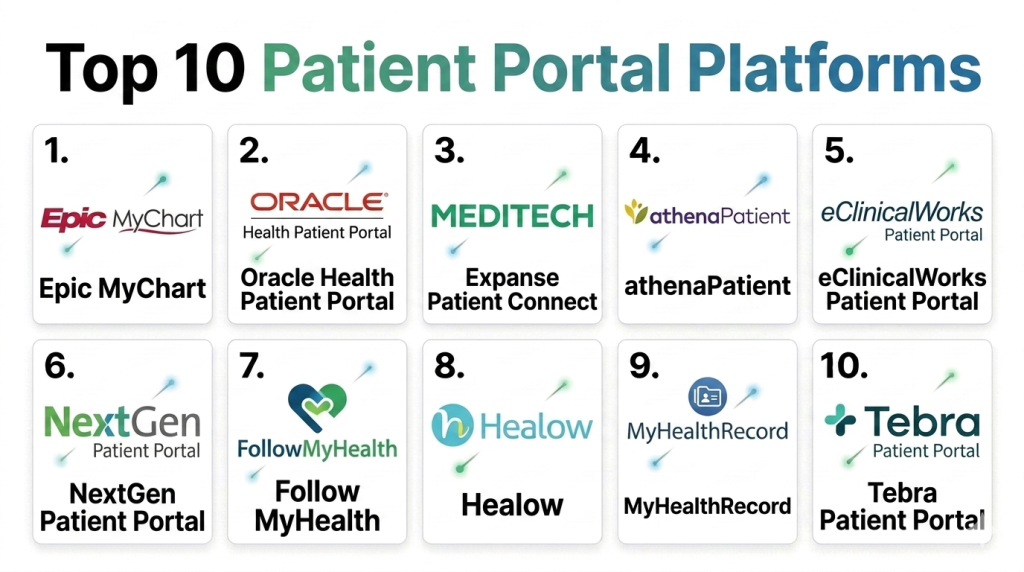
A well-structured comparison that highlights the strengths of different patient portal platforms and makes it easier to understand which solution best supports patient engagement and communication.