Introduction
Student Information Systems SIS are core platforms used by educational institutions to manage student data, academic records, admissions, attendance, grading, and administrative workflows. These systems act as the central source of truth for student lifecycle management, from enrollment to graduation, helping institutions operate efficiently and maintain accurate records.
As education becomes more digital and data-driven, SIS platforms have evolved into comprehensive solutions that integrate with learning systems, financial modules, and analytics tools. They help improve operational efficiency, enhance student experiences, and support compliance with regulatory and reporting requirements across institutions.
Common use cases include:
- Student enrollment and admissions management
- Attendance tracking and grading systems
- Academic record and transcript management
- Fee management and financial tracking
- Reporting and compliance management
Key evaluation criteria:
- Core student data management capabilities
- Integration with LMS and academic systems
- Automation of administrative workflows
- Reporting and analytics capabilities
- Scalability for institutions of different sizes
- User experience for staff and students
- Security and compliance features
- Cost and deployment flexibility
Best for: Schools, colleges, universities, and training institutions managing student data and academic operations at scale.
Not ideal for: Small organizations without structured academic programs or those needing only basic data tracking tools.
Key Trends in Student Information Systems SIS
- Cloud-based SIS platforms replacing legacy systems
- Integration with learning management and analytics tools
- AI-driven insights for student performance tracking
- Mobile-first access for students and staff
- Automation of admissions and administrative workflows
- Real-time reporting and dashboards
- Enhanced data security and privacy controls
- Integration with financial and HR systems
- Personalized student experience through analytics
- Growth of modular and flexible SIS architectures
How We Selected These Tools Methodology
- Evaluated global adoption across educational institutions
- Assessed feature depth for student lifecycle management
- Reviewed scalability and performance capabilities
- Considered integration with LMS and ERP systems
- Analyzed ease of use for administrators and students
- Included both enterprise and SMB-friendly platforms
- Focused on security and compliance readiness
- Balanced traditional and modern SIS solutions
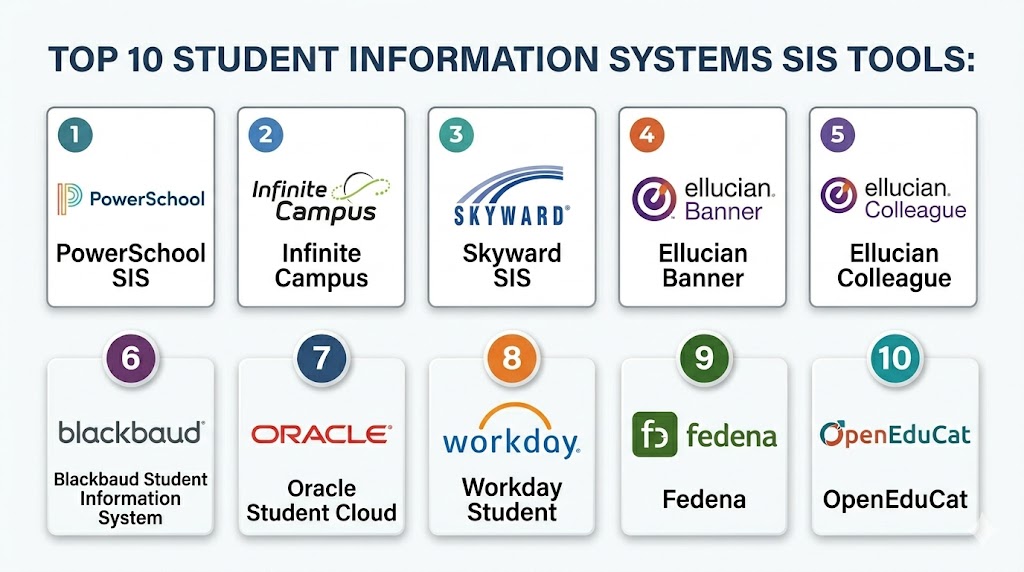
Top 10 Student Information Systems SIS Tools
#1 — PowerSchool SIS
Short description:
PowerSchool SIS is one of the most widely used student information systems for K-12 institutions. It offers comprehensive student data management, grading, attendance, and reporting capabilities. The platform is known for its scalability and strong ecosystem. It supports administrators, teachers, and students with integrated tools.
Key Features
- Student data management
- Attendance and grading
- Parent and student portals
- Reporting and analytics
- Scheduling tools
- Integration capabilities
Pros
- Widely adopted
- Feature-rich
- Strong ecosystem
Cons
- Complex setup
- Requires training
- Pricing varies
Platforms / Deployment
Cloud
Security & Compliance
Not publicly stated
Integrations & Ecosystem
Integrates with learning and education tools through APIs and connectors.
- APIs
- LMS integrations
- Education apps
Support & Community
Strong support and community
#2 — Infinite Campus
Short description:
Infinite Campus is a comprehensive SIS platform designed for K-12 schools and districts. It offers tools for student data management, attendance, and communication. The platform emphasizes usability and integration. It is widely used in education systems.
Key Features
- Student information management
- Attendance tracking
- Gradebook
- Communication tools
- Reporting dashboards
Pros
- User-friendly
- Comprehensive features
- Good reporting
Cons
- Limited customization
- Pricing varies
- Requires training
Platforms / Deployment
Cloud
Security & Compliance
Not publicly stated
Integrations & Ecosystem
Supports integration with education tools and systems.
- APIs
- LMS integrations
Support & Community
Good support
#3 — Skyward SIS
Short description:
Skyward SIS provides student management solutions for schools and districts. It focuses on administrative efficiency and communication. The platform supports attendance, grading, and financial management. It is suitable for K-12 institutions.
Key Features
- Student data management
- Attendance tracking
- Gradebook
- Financial management
- Communication tools
Pros
- Easy to use
- Reliable
- Good support
Cons
- Limited advanced analytics
- UI can feel outdated
- Customization limitations
Platforms / Deployment
Cloud
Security & Compliance
Not publicly stated
Integrations & Ecosystem
Integrates with school systems and applications.
- APIs
- Education integrations
Support & Community
Strong support
#4 — Ellucian Banner
Short description:
Ellucian Banner is a higher education SIS designed for universities and colleges. It offers comprehensive student lifecycle management and administrative tools. The platform is widely used globally. It supports complex academic workflows.
Key Features
- Student lifecycle management
- Academic records
- Financial management
- Reporting tools
- Integration capabilities
Pros
- Enterprise-grade
- Scalable
- Strong functionality
Cons
- Complex implementation
- Expensive
- Requires expertise
Platforms / Deployment
Cloud / Hybrid
Security & Compliance
Not publicly stated
Integrations & Ecosystem
Integrates with enterprise systems and academic platforms.
- APIs
- ERP integrations
Support & Community
Enterprise support
#5 — Ellucian Colleague
Short description:
Ellucian Colleague is another higher education SIS platform focused on student and administrative management. It provides tools for admissions, academics, and financial processes. The platform is suitable for mid-sized institutions. It supports flexible workflows.
Key Features
- Student information management
- Admissions and enrollment
- Financial tools
- Reporting capabilities
- Workflow automation
Pros
- Flexible
- Comprehensive features
- Reliable
Cons
- Complex setup
- Pricing varies
- Requires training
Platforms / Deployment
Cloud / Hybrid
Security & Compliance
Not publicly stated
Integrations & Ecosystem
Supports integration with enterprise systems.
- APIs
- ERP integrations
Support & Community
Enterprise support
#6 — Blackbaud Student Information System
Short description:
Blackbaud SIS is designed for private schools and institutions. It offers student data management, communication, and financial tools. The platform is known for its user-friendly interface. It supports school operations efficiently.
Key Features
- Student data management
- Communication tools
- Financial management
- Reporting
- Parent portals
Pros
- Easy to use
- Good interface
- Integrated tools
Cons
- Limited scalability
- Pricing varies
- Feature limitations
Platforms / Deployment
Cloud
Security & Compliance
Not publicly stated
Integrations & Ecosystem
Integrates with education and fundraising systems.
- APIs
- School integrations
Support & Community
Good support
#7 — Oracle Student Cloud
Short description:
Oracle Student Cloud is a modern SIS platform designed for higher education institutions. It offers cloud-based student lifecycle management and analytics. The platform integrates with Oracle ecosystem tools. It supports scalability and innovation.
Key Features
- Student lifecycle management
- Cloud architecture
- Analytics tools
- Integration capabilities
- Reporting dashboards
Pros
- Modern platform
- Scalable
- Strong analytics
Cons
- Expensive
- Complex setup
- Requires expertise
Platforms / Deployment
Cloud
Security & Compliance
Not publicly stated
Integrations & Ecosystem
Integrates with Oracle cloud and enterprise systems.
- APIs
- ERP integrations
Support & Community
Enterprise support
#8 — Workday Student
Short description:
Workday Student is a cloud-based SIS that combines student management with HR and financial systems. It provides real-time data and analytics. The platform is designed for modern institutions. It supports integrated workflows.
Key Features
- Student lifecycle management
- Real-time data
- Analytics and reporting
- Integration with HR and finance
- Cloud-based architecture
Pros
- Unified platform
- Real-time insights
- Scalable
Cons
- Expensive
- Complex implementation
- Requires training
Platforms / Deployment
Cloud
Security & Compliance
Not publicly stated
Integrations & Ecosystem
Integrates with Workday ecosystem and enterprise tools.
- APIs
- ERP integrations
Support & Community
Enterprise support
#9 — Fedena
Short description:
Fedena is an SIS platform designed for schools and educational institutions. It provides tools for managing student data, attendance, and communication. The platform is suitable for small and mid-sized institutions. It offers flexibility and ease of use.
Key Features
- Student management
- Attendance tracking
- Communication tools
- Reporting
- Customization
Pros
- Affordable
- Easy to use
- Flexible
Cons
- Limited enterprise features
- Smaller ecosystem
- Basic analytics
Platforms / Deployment
Cloud / Self-hosted
Security & Compliance
Not publicly stated
Integrations & Ecosystem
Supports integration with education systems.
- APIs
- LMS integrations
Support & Community
Good support
#10 — OpenEduCat
Short description:
OpenEduCat is an open-source SIS platform that provides tools for managing educational institutions. It supports student management, attendance, and academic processes. The platform is customizable. It is suitable for institutions needing flexibility.
Key Features
- Student information management
- Attendance tracking
- Academic management
- Reporting tools
- Customization
Pros
- Open-source flexibility
- Cost-effective
- Customizable
Cons
- Requires technical expertise
- Limited support
- Smaller community
Platforms / Deployment
Web / Self-hosted
Security & Compliance
Not publicly stated
Integrations & Ecosystem
Supports integration with open-source and education systems.
- APIs
- Custom integrations
Support & Community
Community-driven support
Comparison Table
| Tool Name | Best For | Platform Supported | Deployment | Standout Feature | Public Rating |
|---|---|---|---|---|---|
| PowerSchool | K-12 schools | Web | Cloud | Comprehensive features | N/A |
| Infinite Campus | School districts | Web | Cloud | User-friendly | N/A |
| Skyward | K-12 institutions | Web | Cloud | Reliable | N/A |
| Ellucian Banner | Universities | Web | Hybrid | Enterprise features | N/A |
| Ellucian Colleague | Colleges | Web | Hybrid | Flexible workflows | N/A |
| Blackbaud | Private schools | Web | Cloud | Ease of use | N/A |
| Oracle Student Cloud | Universities | Web | Cloud | Modern architecture | N/A |
| Workday Student | Large institutions | Web | Cloud | Unified platform | N/A |
| Fedena | SMB schools | Web | Cloud | Affordable | N/A |
| OpenEduCat | Custom setups | Web | Self-hosted | Open-source | N/A |
Evaluation and Scoring of Student Information Systems SIS
| Tool Name | Core | Ease | Integrations | Security | Performance | Support | Value | Weighted Total |
|---|---|---|---|---|---|---|---|---|
| PowerSchool | 9 | 7 | 8 | 8 | 9 | 8 | 7 | 8.3 |
| Infinite Campus | 8 | 8 | 7 | 8 | 8 | 7 | 7 | 7.8 |
| Skyward | 8 | 8 | 7 | 7 | 8 | 7 | 7 | 7.7 |
| Ellucian Banner | 9 | 6 | 9 | 9 | 9 | 8 | 6 | 8.3 |
| Ellucian Colleague | 8 | 6 | 8 | 8 | 8 | 7 | 6 | 7.7 |
| Blackbaud | 8 | 8 | 7 | 7 | 8 | 7 | 7 | 7.8 |
| Oracle Student | 9 | 6 | 9 | 9 | 9 | 8 | 6 | 8.3 |
| Workday Student | 9 | 6 | 9 | 9 | 9 | 8 | 6 | 8.3 |
| Fedena | 7 | 9 | 6 | 7 | 7 | 7 | 9 | 7.8 |
| OpenEduCat | 7 | 7 | 6 | 7 | 7 | 6 | 9 | 7.3 |
How to interpret these scores:
These scores provide a comparative overview of how each SIS platform performs across critical categories such as core functionality, ease of use, integrations, and value. Higher scores indicate stronger overall capabilities, but they should not be considered absolute rankings. Enterprise platforms typically score higher in features, integrations, and scalability, while smaller or open-source tools often excel in affordability and ease of use. The weighted scoring system balances all criteria to provide a realistic comparison. Institutions should prioritize the factors most relevant to their needs, such as scalability, cost, or integration capabilities, rather than relying solely on the total score. Testing shortlisted solutions in real-world scenarios is recommended before making a final decision.
Which Student Information System Is Right for You
Solo Freelancer
Not typically required unless managing structured academic programs.
SMB
Fedena or OpenEduCat are suitable for smaller institutions due to affordability and flexibility.
Mid Market
Infinite Campus or Blackbaud provide balanced features and usability.
Enterprise
PowerSchool, Workday, Oracle, and Ellucian platforms offer scalability and advanced capabilities.
Budget vs Premium
Budget tools focus on simplicity, while premium platforms offer advanced analytics and integrations.
Feature Depth vs Ease of Use
Advanced tools provide more control and features, while simpler tools prioritize usability.
Integrations and Scalability
API-first and cloud platforms are ideal for scaling operations.
Security and Compliance Needs
Institutions should prioritize platforms with strong security and compliance capabilities.
Frequently Asked Questions
1 What is a student information system
A student information system is a platform used to manage student data, academic records, and administrative processes. It acts as a central database for institutions. It helps streamline operations. It improves data accuracy and efficiency.
2 How does an SIS improve education management
An SIS automates administrative tasks such as enrollment, grading, and attendance tracking. It reduces manual errors. It improves efficiency and communication. It helps institutions manage data effectively.
3 Can SIS platforms integrate with LMS
Yes, most SIS platforms integrate with learning systems to provide seamless data flow. This improves coordination between teaching and administration. Integration is essential for modern institutions. API support enables flexibility.
4 Are SIS platforms secure
Most SIS platforms include security measures such as encryption and access controls. Security depends on the platform implementation. Institutions should choose trusted providers. Data protection is critical.
5 How much does an SIS cost
Costs vary based on features, institution size, and deployment model. Enterprise platforms are more expensive. Smaller tools are more affordable. Pricing should align with institutional needs.
6 Can SIS platforms handle large institutions
Yes, enterprise SIS platforms are designed for scalability and can handle large volumes of student data. They support complex workflows. Performance depends on infrastructure. Choosing the right platform is important.
7 What industries use SIS platforms
SIS platforms are primarily used in education, including schools, colleges, and universities. They are also used in training institutions. Any organization managing structured learning can benefit. Adoption is widespread.
8 What is cloud-based SIS
A cloud-based SIS is hosted online and accessed via the internet. It provides flexibility and scalability. It reduces infrastructure costs. It allows remote access.
9 Can SIS platforms be customized
Many SIS platforms offer customization options to meet institutional needs. Customization may require technical expertise. Some platforms offer low-code options. Flexibility varies by tool.
10 How do I choose the right SIS
Evaluate factors such as features, scalability, integrations, and cost. Consider your institution size and needs. Test different platforms before deciding. Choose one that aligns with your workflow.
Conclusion
Student Information Systems SIS platforms are essential for modern educational institutions, providing a centralized solution for managing student data, academic processes, and administrative workflows efficiently. These platforms help institutions improve operational efficiency, enhance student experiences, and ensure compliance with regulatory requirements while supporting digital transformation in education. Enterprise solutions offer scalability, advanced integrations, and analytics capabilities for large institutions, while smaller and open-source platforms provide flexibility and cost-effective options for growing organizations. The right SIS depends on factors such as institution size, budget, technical capabilities, and integration needs. Instead of choosing a single solution immediately, institutions should shortlist a few platforms, evaluate them through pilot implementations, and ensure they align with long-term goals. A structured selection approach will help maximize value and ensure a seamless academic management experience.
