Introduction
Medication Adherence Apps are specialized mobile health (mHealth) applications designed to solve the “silent epidemic” of non-adherence, where patients fail to take their prescribed medications correctly. These platforms go beyond simple alarm clocks; they serve as comprehensive digital health companions that track dosages, provide educational content, manage refill schedules, and alert caregivers to missed doses. By leveraging behavioral psychology and real-time data, these tools aim to improve clinical outcomes, reduce hospital readmissions, and lower the overall cost of healthcare delivery for chronic condition management.
In the current healthcare landscape, medication adherence is a critical metric for value-based care. As healthcare shifts toward remote monitoring and decentralized treatment models, these apps bridge the gap between the physician’s office and the patient’s home. Modern adherence tools are now integrating with wearable devices and “smart” pill bottles to provide a high-fidelity view of patient behavior, allowing for proactive interventions before a health crisis occurs. For healthcare providers and insurers, these apps are essential for managing large populations with chronic diseases like hypertension, diabetes, and heart disease.
Real-world use cases for these tools include:
- Sending automated alerts to family members or professional caregivers when a high-risk patient misses a critical dosage of life-saving medication.
- Identifying potential drug-to-drug interactions by scanning prescription bottles using computer vision and cross-referencing global databases.
- Gamifying the medication process for pediatric or elderly patients to increase daily engagement and routine consistency.
- Synchronizing pharmacy records to provide automatic notifications when a prescription is low and needs a refill authorization.
- Providing clinical-grade adherence reports that patients can share with their doctors during telehealth or in-person visits.
When evaluating these solutions, buyers should analyze several critical factors:
- User interface simplicity and accessibility for elderly users with limited technical dexterity.
- Depth of the medication database and the accuracy of pill identification features.
- Native synchronization with health ecosystems like Apple Health, Google Fit, and wearable devices.
- Robustness of the privacy and security framework, particularly regarding data encryption and HIPAA compliance.
- Availability of family or caregiver sharing features for collaborative health management.
- Integration capabilities with major pharmacy chains for automated refill tracking.
- Capability to document symptoms and side effects alongside medication logs.
- Reliability of notifications in offline environments or low-power modes.
- Incentive or gamification models to maintain long-term user engagement.
- The quality of data export formats for clinical review.
Mandatory paragraph
- Best for: Patients managing multiple chronic medications, family caregivers looking for remote oversight, and healthcare organizations aiming to improve population health metrics through digital therapeutics.
- Not ideal for: Acute care scenarios where medication is administered solely by professional staff in a hospital setting, or for users who do not have consistent access to a smartphone or mobile data.
Key Trends in Medication Adherence Apps for the Future
- Conversational AI Health Coaches: Apps are integrating advanced Large Language Models (LLMs) to provide personalized, conversational coaching that answers patient questions about side effects and dietary restrictions in real-time.
- Computer Vision Pill Identification: Using the smartphone camera, modern apps can identify individual pills by shape, color, and imprint, reducing the risk of a patient taking the wrong medication from a multi-drug pillbox.
- Behavioral Economics and Financial Incentives: Some platforms are incorporating “rewards-based” adherence, where patients earn points, discounts, or even direct financial incentives for maintaining a perfect adherence score.
- Digital Therapeutics (DTx) Integration: Adherence apps are evolving into full DTx platforms that offer clinical-grade treatments for conditions like insomnia or hypertension alongside medication tracking.
- Predictive Adherence Analytics: Using historical data, AI can now predict when a patient is likely to drop off their regimen (e.g., due to a change in routine or side effects) and trigger a preventive outreach from a clinical team.
- Social Determinants of Health (SDoH) Tracking: Future-ready apps are starting to track factors like transportation issues or financial stress that might lead to missed doses, allowing for more holistic patient support.
- Ambient Reminders via Smart Home Integration: Beyond phone alerts, apps are connecting with smart speakers and home automation systems to provide subtle ambient reminders via lighting or voice prompts.
- Decentralized Clinical Trial (DCT) Support: Adherence apps are becoming a primary tool for researchers to verify that trial participants are strictly following protocol in home settings.
How We Selected These Tools (Methodology)
The selection of the “Top 10” medication adherence apps was conducted using a multi-dimensional evaluation framework designed to identify the most effective digital health tools. The methodology focused on the following pillars:
- Clinical Validation and Research: We prioritized apps that have been used in peer-reviewed clinical studies or have partnerships with major health systems and research institutions.
- User Experience (UX) and Accessibility: Given the diverse age range of users, we evaluated the simplicity of the navigation and the clarity of the reminder systems.
- Feature Breadth: Selection was based on the ability of the tool to handle complex regimens, including varying dosages, PRN (as needed) meds, and multi-user tracking.
- Privacy and Security Standards: We reviewed the data handling practices, focusing on encryption levels and compliance with international healthcare privacy standards.
- Ecosystem Connectivity: Preference was given to apps that sync seamlessly with external health hardware, such as smart blood pressure cuffs and glucose monitors.
- Market Longevity and Reliability: We analyzed the app’s history of updates, uptime reliability, and the responsiveness of the development team to user feedback.
- Engagement and Retention Metrics: We looked for qualitative signals that indicate the app successfully keeps users engaged over months or years, rather than just days.
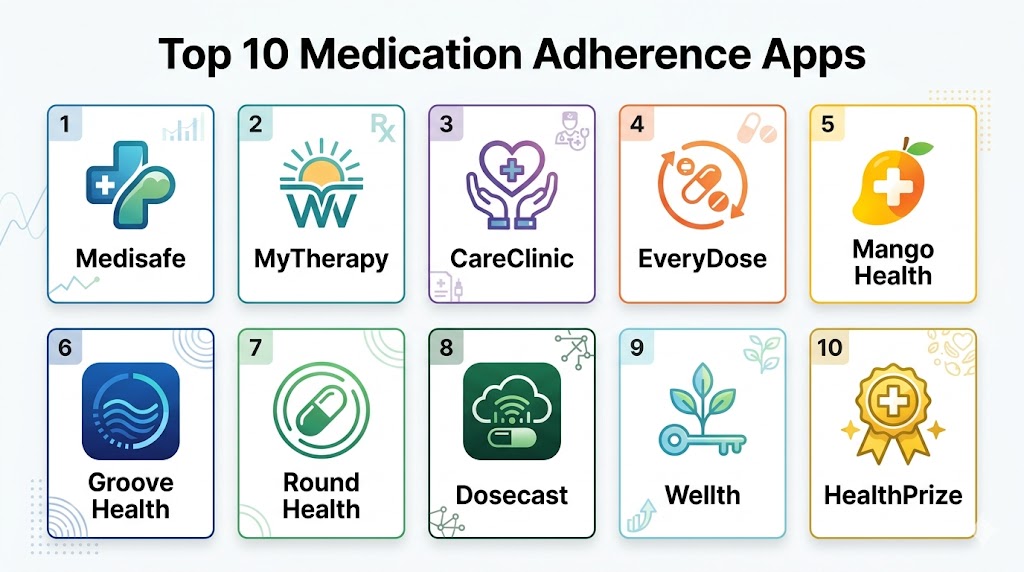
Top 10 Medication Adherence Apps Tools
#1 — Medisafe
Short description: Medisafe is arguably the most widely recognized medication management platform, serving as a comprehensive digital health companion. It is designed for both individual users and enterprise health partners, offering highly personalized reminders, drug interaction warnings, and caregiver notifications (Medfriends). The platform is used by millions to manage complex chronic conditions through data-driven insights.
Key Features
- Medfriend Caregiver Alerts: Notifies a designated contact if a user misses a critical dose, ensuring immediate support.
- Drug Interaction Checker: Automatically scans for potentially dangerous interactions between added medications.
- Pill Identification Gallery: Visual database to help users confirm they are taking the correct pill.
- Health Measurement Tracking: Logs vitals like blood pressure, glucose, and weight to see how medication impacts overall health.
- Refill Reminders: Notifies users when it is time to contact their pharmacy based on remaining dose counts.
Pros
- Extremely robust notification system that is difficult to ignore.
- Excellent data reporting that can be exported directly to a physician as a PDF.
- Strong focus on clinical partnerships, making it a trusted tool for health systems.
Cons
- The interface can feel slightly cluttered due to the high volume of features.
- The premium version is required for some advanced features like unlimited Medfriends.
- Frequent prompts for health surveys can be intrusive for some users.
Platforms / Deployment
- iOS / Android / Apple Watch / Android Wear
- Cloud
Security & Compliance
- AES 256-bit encryption, HIPAA compliant.
- SOC 2 Type II (Enterprise version).
Integrations & Ecosystem
Medisafe offers deep connectivity with health ecosystems to provide a holistic health view.
- Apple Health and Google Fit.
- Direct pharmacy links for some regional providers.
- Integration with various wearable devices.
Support & Community
Medisafe provides a comprehensive help center, email support, and an active community of users across social platforms for shared health journeys.
#2 — MyTherapy
Short description: MyTherapy is a privacy-focused medication reminder and health tracker developed in Europe. It combines a simple pill reminder with a symptom tracker and health journal, making it ideal for patients with chronic conditions like multiple sclerosis, psoriasis, or heart disease. The app is notably free of advertising and focuses on a clean, clinical user experience.
Key Features
- All-in-One Health Journal: Combines medication logs with weight, activity, and symptom tracking in a unified view.
- Team Feature: Allows family members or partners to monitor adherence and provide motivation.
- Printable Monthly Report: Generates a comprehensive health summary for doctor visits.
- Symptom and Well-being Tracking: Encourages users to note how they feel daily to identify patterns.
- Comprehensive Database: Includes a vast array of global medications for easy searching and adding.
Pros
- High commitment to data privacy; the app does not sell user data to third parties.
- completely free of advertisements, providing a calm user experience.
- The interface is minimalist and very easy to navigate for non-technical users.
Cons
- Does not have the advanced AI-driven coaching found in some newer competitors.
- Pharmacy integration is less developed compared to some US-centric apps.
- Notification customization is slightly more limited than in Medisafe.
Platforms / Deployment
- iOS / Android
- Cloud
Security & Compliance
- GDPR compliant (European standards), Encryption.
- HIPAA Compliant.
Integrations & Ecosystem
MyTherapy focuses on standard health data synchronization.
- Apple Health integration.
- Health kit connectivity for vitals tracking.
- Supports data export to standard formats.
Support & Community
MyTherapy offers direct email support and maintains a robust blog with educational content on various chronic diseases.
#3 — CareClinic
Short description: CareClinic is a powerful health management app that positions itself as a “Self-Care Platform.” It is designed for users who want to manage their entire health journey, including medications, habits, nutrition, and appointments. It is highly favored by patients managing complex comorbidities or mental health conditions that require strict routine management.
Key Features
- Built-in Symptom Tracker: Allows users to correlate medication doses with symptom relief or side effects.
- Care Team Collaboration: Provides a shared dashboard for doctors, nurses, and family members to view data.
- Customizable Reminders: Supports complex dosing schedules, including recurring cycles and tapering.
- Health Diary: A digital space to record notes on triggers, moods, and daily health observations.
- Pill Library: Searchable database with dosage instructions and medication information.
Pros
- One of the most comprehensive “whole health” apps on the market.
- Excellent for tracking how lifestyle factors (like sleep or diet) interact with medications.
- Highly customizable notification settings for almost any scenario.
Cons
- The breadth of features leads to a steeper learning curve than simpler apps.
- Some of the most useful features are locked behind a monthly subscription.
- May feel over-engineered for someone just looking for a simple pill alarm.
Platforms / Deployment
- Web / iOS / Android
- Cloud
Security & Compliance
- MFA, Encryption at rest.
- HIPAA Compliant.
Integrations & Ecosystem
CareClinic acts as a centralized data hub for all your health metrics.
- Apple Health / Google Fit.
- Wearable device sync.
- Exportable data for Electronic Health Records (EHR).
Support & Community
CareClinic provides a detailed knowledge base, video tutorials, and dedicated customer support for premium users.
#4 — EveryDose
Short description: EveryDose is an AI-powered medication management platform that targets both individual consumers and healthcare organizations. Its standout feature is “Maxwell,” an AI medication assistant that answers patient questions and provides reminders. It is designed to be a high-engagement tool that feels like a personal health coach rather than just an app.
Key Features
- Maxwell AI Assistant: A conversational interface that helps users add medications and answers questions.
- Proactive Adherence Notifications: Uses logic to determine the best time to remind users based on their habits.
- Caregiver Portal: A centralized view for clinical teams or family members to monitor adherence at scale.
- Progress Tracking: Provides simple, visual adherence scores to motivate patients.
- Medication Scanning: Users can take a photo of their prescription label to add the drug automatically.
Pros
- The AI interface makes adding complex medications significantly faster and more accurate.
- Clean, modern design that appeals to a younger demographic managing chronic issues.
- Excellent for clinics looking for a platform to manage their patient populations.
Cons
- The AI features require a consistent internet connection to function optimally.
- The app is newer to the market, so it has a smaller legacy user base than competitors.
- Some users may prefer a traditional menu system over a conversational AI interface.
Platforms / Deployment
- iOS / Android
- Cloud
Security & Compliance
- Encryption, Audit Logs.
- HIPAA Compliant.
Integrations & Ecosystem
EveryDose is built with clinical integration in mind to support health systems.
- Integration with health systems’ EHR platforms.
- Standard Apple/Google health connectivity.
- Pharmacy data feeds for automated med list updates.
Support & Community
EveryDose provides direct technical support and focuses on b2b support for its clinical partners.
#5 — Mango Health
Short description: Mango Health is a gamified medication adherence app that uses behavioral incentives to keep users on track. By rewarding users for taking their meds on time and logging their health habits, it turns mundane health management into an engaging daily routine. It is widely used by insurance companies to lower healthcare costs through better adherence.
Key Features
- Incentive Points: Users earn points for every dose taken on time, which can be redeemed for rewards.
- Curated Health Content: Provides educational articles tailored to the user’s specific health conditions.
- Drug Interaction Alerts: Notifies users of potential conflicts between their medications and supplements.
- Custom Reminders: Flexible alerts that can be scheduled for medications, supplements, and even healthy habits like drinking water.
- Refill Alerts: Keeps track of pill counts and reminds users when supply is running low.
Pros
- High retention rates due to the gamified and rewarding nature of the app.
- Simple, colorful interface that is less “clinical” and more inviting.
- Excellent for users who struggle with the motivation to maintain long-term regimens.
Cons
- The reward system may feel gimmicky to users looking for a purely medical tool.
- Not as deep in clinical symptom tracking as apps like CareClinic.
- Limited functionality in offline mode.
Platforms / Deployment
- iOS / Android
- Cloud
Security & Compliance
- Data Encryption, RBAC.
- HIPAA Compliant.
Integrations & Ecosystem
Mango Health focuses on basic health tracking and enterprise partnerships.
- Integration with health insurance portals for some users.
- Standard health kit connectivity.
- Community-level health challenges.
Support & Community
Mango Health offers a help center and email-based support for its user community.
#6 — Groove Health
Short description: Groove Health is a digital health platform that leverages AI to personalize the medication adherence experience. Like EveryDose, it features an AI assistant (Maxwell) but places a heavy emphasis on health literacy and education. It is particularly effective for patients newly diagnosed with a condition who need guidance through their new medication routine.
Key Features
- Maxwell the AI Coach: Provides 24/7 answers to medication questions and proactive adherence checks.
- Personalized Education: Delivers health information based on the specific medications the user is taking.
- Family Sharing: Allows for multiple profiles within one account to manage a household.
- Medication History: Keeps a detailed log of all past and present medications for easy reference.
- Smart Reminders: Adjusts reminder frequency and tone based on user responsiveness.
Pros
- High focus on educating the patient, which leads to better long-term adherence.
- The AI coach is excellent at simplifying complex medical jargon.
- Very intuitive onboarding process for new users.
Cons
- Some advanced features are more tailored toward enterprise partners than solo users.
- Requires a modern smartphone with sufficient processing power for the AI interface.
- Less emphasis on habit tracking (water, sleep) compared to CareClinic.
Platforms / Deployment
- iOS / Android
- Cloud
Security & Compliance
- End-to-end encryption.
- HIPAA Compliant.
Integrations & Ecosystem
Groove Health is designed to sit between the patient and their healthcare provider.
- EHR integration capabilities for clinics.
- Health app synchronization.
- Pharmacy benefit management (PBM) links.
Support & Community
Groove Health provides a dedicated support team and extensive educational resources for its partners.
#7 — Round Health
Short description: Round Health is a minimalist medication reminder app specifically designed for the iOS ecosystem. It focuses on “windows” of time for medication rather than rigid alarms, which more closely reflects how people live. It is a favorite for users who want a clean, aesthetic app that stays out of the way until it’s needed.
Key Features
- Reminder Windows: Allows users to set a period (e.g., between 8:00 AM and 10:00 AM) to take a dose.
- Apple Watch Focus: Features a highly optimized watch face for quick logging and notifications.
- Clean Visuals: Uses a simple “ring” interface to show daily progress.
- Complex Schedules: Handles varying doses and irregular schedules with ease.
- Refill Tracking: Simple pill count management and reminders.
Pros
- The “time window” approach reduces user stress and alarm fatigue.
- One of the best-designed apps for Apple Watch users.
- No-nonsense interface; no social features or complex journaling if not wanted.
Cons
- Lacks the clinical depth (symptom tracking, interaction checks) of larger apps.
- iOS-first development means the Android version often lags in features.
- Limited caregiver features compared to Medisafe’s “Medfriend” system.
Platforms / Deployment
- iOS / Apple Watch
- Cloud
Security & Compliance
- Standard iOS encryption, Privacy-first design.
- HIPAA Compliant.
Integrations & Ecosystem
Round Health is deeply integrated into the Apple health stack.
- Apple Health and HealthKit.
- iCloud synchronization across devices.
Support & Community
Round Health provides email support and a simple online FAQ for its users.
#8 — Dosecast
Short description: Dosecast is one of the oldest and most reliable medication management tools on the market. It is known for its extreme flexibility and its ability to function reliably across all devices. It is particularly popular among users who manage very complex regimens with different doses on different days of the week.
Key Features
- Flexible Scheduling: Supports daily, weekly, monthly, or “every X days/hours” schedules.
- Dose Proximity Alerts: Warns users if they are taking doses too close together.
- Sync Across Devices: Real-time synchronization between phones and tablets.
- Quantity Tracking: Automatically deducts from the pill count and alerts for refills.
- Multi-User Support: Allows one app to manage medications for multiple family members or pets.
Pros
- Rock-solid reliability; notifications rarely fail even in low-power modes.
- Excellent for managing pet medications alongside human meds.
- Supports very complex, non-standard dosing patterns.
Cons
- The user interface is functional but looks dated compared to modern apps.
- The free version is quite limited; most useful features require the “Pro” edition.
- No built-in drug interaction checker or AI assistant.
Platforms / Deployment
- iOS / Android / Amazon Kindle
- Cloud
Security & Compliance
- Encrypted data transmission.
- HIPAA Compliant.
Integrations & Ecosystem
Dosecast focuses on core data synchronization across the user’s own devices.
- Dropbox/iCloud for data backups.
- Standard health data exports.
Support & Community
Dosecast offers direct email support and a detailed manual for users managing complex setups.
#9 — Wellth
Short description: Wellth is an enterprise-level adherence platform that uses behavioral economics to drive patient behavior. It is primarily used by insurers and health systems to incentivize high-risk patients (e.g., those with heart failure or diabetes) to take their medications daily. Users take a “check-in” photo of their meds and receive financial rewards for consistency.
Key Features
- Photo-Based Check-in: Users verify adherence by taking a photo of their medication in their hand.
- Financial Incentives: Users earn actual money (often on a pre-paid card) for meeting adherence goals.
- Daily Health Surveys: Quick check-ins on symptoms and well-being.
- Clinical Dashboards: Provides health systems with a real-time view of their highest-risk patients.
- Peer Support: Connects users with “well-being” coaches to discuss barriers to adherence.
Pros
- Proven to significantly increase adherence in populations that have failed with other apps.
- Financial rewards are a powerful motivator for long-term behavior change.
- The photo-verification adds a layer of accountability that simple logging lacks.
Cons
- Typically only available through an employer or health insurance plan, not as a standalone consumer app.
- The photo-check-in process can be tedious for some users.
- Strictly focused on adherence; lacks broader lifestyle tracking.
Platforms / Deployment
- iOS / Android
- Cloud
Security & Compliance
- Enterprise-grade encryption, SOC 2.
- HIPAA Compliant.
Integrations & Ecosystem
Wellth is built to integrate with the financial and clinical systems of insurers.
- Integration with pre-paid card processors for rewards.
- EHR and population health platform connectivity.
Support & Community
Wellth provides dedicated coaching and high-touch support for participants in its sponsored programs.
#10 — HealthPrize
Short description: HealthPrize is a digital health platform that combines medication adherence with a loyalty and rewards program. It is often used as a “branded” experience for pharmaceutical companies to help patients stay on their specific therapy. It uses a mix of education, gamification, and incentives to drive better adherence.
Key Features
- Gamified Points System: Earn points for taking meds, refilling prescriptions, and completing health quizzes.
- Educational Modules: Delivers “snackable” health content related to the user’s condition.
- Sweepstakes and Competitions: Allows users to use points for entry into larger rewards.
- Verification of Refills: Connects with pharmacy data to verify that prescriptions are actually being picked up.
- Branded Experience: Often customized for specific high-cost medications.
Pros
- Strong focus on patient education alongside adherence.
- Excellent for pharmaceutical brands looking to support their patient base.
- The “quiz” model keeps users coming back even when they aren’t taking a dose.
Cons
- Focused more on branded therapies rather than being a “universal” pill tracker.
- The reward structure can be complex to understand.
- May feel less private due to the pharmaceutical branding.
Platforms / Deployment
- Web / iOS / Android
- Cloud
Security & Compliance
- High-level data encryption.
- HIPAA Compliant.
Integrations & Ecosystem
HealthPrize integrates with the pharmacy and pharmaceutical supply chain.
- Direct pharmacy data feeds.
- Payer and Pharma enterprise system links.
Support & Community
HealthPrize provides dedicated customer success teams for its corporate partners and comprehensive user help.
Comparison Table (Top 10)
| Tool Name | Best For | Platform(s) Supported | Deployment | Standout Feature | Public Rating |
|---|---|---|---|---|---|
| Medisafe | Universal / Families | iOS, Android, Wearables | Cloud | Medfriend Caregiver Alerts | N/A |
| MyTherapy | Privacy-Conscious Users | iOS, Android | Cloud | 100% Ad-Free Experience | N/A |
| CareClinic | Complex Multi-morbidity | Web, iOS, Android | Cloud | Integrated Habit & Mood Tracker | N/A |
| EveryDose | AI-First Users | iOS, Android | Cloud | Maxwell AI Health Coach | N/A |
| Mango Health | Gamification & Rewards | iOS, Android | Cloud | Incentive Points System | N/A |
| Groove Health | New Diagnoses / Education | iOS, Android | Cloud | Conversational Health Literacy | N/A |
| Round Health | Aesthetic / Minimalist | iOS, Apple Watch | Cloud | Reminder Windows (Flexibility) | N/A |
| Dosecast | Irregular Schedules / Pets | iOS, Android, Kindle | Cloud | Dose Proximity Warnings | N/A |
| Wellth | High-Risk Financial Incentives | iOS, Android | Cloud | Photo-Verification Rewards | N/A |
| HealthPrize | Pharma-Led Loyalty | Web, iOS, Android | Cloud | Sweepstakes & Health Quizzes | N/A |
Export to Sheets
Evaluation & Scoring of Medication Adherence Apps
The scoring below evaluates how well these apps perform across various dimensions, emphasizing their utility in clinical and daily life scenarios.
| Tool Name | Core (25%) | Ease (15%) | Integrations (15%) | Security (10%) | Performance (10%) | Support (10%) | Value (15%) | Weighted Total |
|---|---|---|---|---|---|---|---|---|
| Medisafe | 10 | 8 | 9 | 9 | 9 | 9 | 8 | 9.05 |
| MyTherapy | 8 | 9 | 8 | 10 | 9 | 8 | 10 | 8.85 |
| CareClinic | 10 | 6 | 9 | 9 | 8 | 8 | 7 | 8.35 |
| EveryDose | 9 | 8 | 8 | 9 | 9 | 8 | 9 | 8.65 |
| Mango Health | 7 | 9 | 7 | 8 | 9 | 8 | 9 | 7.95 |
| Groove Health | 8 | 8 | 8 | 9 | 9 | 8 | 8 | 8.20 |
| Round Health | 7 | 10 | 8 | 9 | 9 | 7 | 9 | 8.35 |
| Dosecast | 8 | 7 | 6 | 9 | 10 | 9 | 7 | 7.85 |
| Wellth | 9 | 7 | 9 | 10 | 9 | 10 | 8 | 8.80 |
| HealthPrize | 8 | 8 | 9 | 9 | 8 | 8 | 7 | 8.05 |
Export to Sheets
Interpreting the Scores
These scores are designed to help different personas find their ideal tool. A high “Core” score (Medisafe, CareClinic) indicates a deep clinical feature set. High “Ease” scores (Round Health, MyTherapy) signify apps that anyone can pick up and use instantly. “Value” is scored based on the balance of features vs. cost, with MyTherapy receiving a perfect score as a fully-featured free app. The “Weighted Total” highlights the overall strongest players, but specific needs (like financial rewards or pet support) should guide your final choice.
Which Medication Adherence App Is Right for You?
Solo / Independent Patient
If you are managing 1-3 simple medications and want an app that is quiet, private, and free, MyTherapy is the best choice. It provides a clean experience without the data-sharing or commercial noise often found in free apps.
SMB (Clinics & Small Practices)
Small clinics looking to provide a tool for their patients to improve outcomes should look toward EveryDose. Its AI assistant (Maxwell) can handle many basic patient questions, acting as a force multiplier for a busy clinical staff.
Mid-Market (Care Agencies)
For home care agencies or nursing services managing multiple clients, Medisafe is the standout. Its “Medfriend” system and robust data export features allow agencies to maintain high levels of oversight across their entire patient roster.
Enterprise (Insurers & Health Systems)
Large organizations looking to move the needle on population health through financial incentives should prioritize Wellth. Its photo-verification and reward-payout system are specifically engineered to drive behavior change in the most difficult-to-engage populations.
Budget vs Premium
MyTherapy and Round Health offer the best budget-friendly experiences. For users willing to pay for a “premium” experience, CareClinic offers an unmatched depth of tracking that justifies its monthly subscription fee for those managing complex health journeys.
Feature Depth vs Ease of Use
If you need to track every symptom, mood, and nutrient alongside your meds, CareClinic is the winner. If you just want a beautiful, simple ring that turns green when you take your pill, Round Health is the aesthetic choice.
Integrations & Scalability
For users deep in the Apple ecosystem, Round Health provides the tightest integration. For patients who need their data to sync across a wide variety of hardware (blood pressure cuffs, smart scales), Medisafe and Wellth offer the broadest compatibility.
Security & Compliance Needs
While all apps meet basic HIPAA standards, MyTherapy is particularly strong for those who value the rigid privacy protections of European GDPR standards. Enterprise users should look to Wellth for SOC 2-level security assurances.
Frequently Asked Questions (FAQs)
1. Are medication adherence apps safe and private?
Most top-tier adherence apps use bank-level encryption (AES 256-bit) and are HIPAA compliant. However, privacy policies vary; some apps may share anonymized data with researchers or pharmaceutical companies. Always check the privacy settings to see if you can opt-out of data sharing and ensure that the app does not store your social security or full financial details.
2. Do these apps work without an internet connection?
The core notification and logging features of most adherence apps work offline. However, cloud-syncing across devices, caregiver alerts, and AI-assistant features typically require an active internet connection. If you are in a remote area, ensure you log your doses; the app will sync with the server once you return to a data-rich environment.
3. Can I use these apps to manage medications for my parents or children?
Yes, apps like Medisafe and Dosecast have specific “Caregiver” or “Multi-user” modes. You can set up profiles for family members on your own phone or, better yet, have them install the app and link it to yours as a “Medfriend.” This allows you to receive a notification on your own device only if they miss their scheduled dose.
4. How accurate are the pill identification features?
Pill identification features are based on large visual databases and are generally very accurate for common medications. However, they should always be used as a secondary check. Factors like lighting and camera quality can affect identification. Never rely solely on an app to identify an unknown pill; always cross-reference with the physical prescription bottle or a pharmacist.
5. Will an adherence app drain my smartphone battery?
Most modern adherence apps are optimized for low battery consumption, using “push notifications” that don’t require the app to be constantly running in the foreground. However, apps with high-end graphics or continuous background syncing might have a slight impact. Users can usually mitigate this by adjusting the sync frequency in the app settings.
6. Can I sync these apps with my smart pill bottle or cap?
Several apps, such as Medisafe and Wellth, have partnerships or technical integrations with smart hardware vendors. These caps can automatically log a dose the moment the bottle is opened. If you have a specific smart cap, check the manufacturer’s website to see which adherence apps are officially supported for “native” syncing.
7. Do adherence apps integrate with my local pharmacy?
Integration levels vary. Some apps allow you to connect directly with major chains to pull in your medication list and track refills automatically. For smaller or independent pharmacies, you may need to enter the data manually, but the app will still help you track remaining pill counts and remind you when it’s time to call in a refill.
8. Is there a cost associated with these apps?
Many adherence apps use a “freemium” model. The basic reminder features are often free, while advanced features—like unlimited caregiver contacts, health journals, or ad-removal—require a monthly or yearly subscription. Some enterprise apps, like Wellth, are free to the patient because the cost is covered by their insurance provider.
9. Can I share my adherence data with my doctor?
Almost all professional-grade adherence apps allow you to export your logs as a PDF or CSV file. You can then email this report to your doctor or print it out for your next appointment. This data is incredibly valuable for physicians to see if a medication is actually working or if a “failed” treatment was simply due to inconsistent adherence.
10. How do I handle medications that are taken “as needed” (PRN)?
Apps like CareClinic and Dosecast have specific settings for “PRN” or “as needed” medications. Instead of a scheduled alarm, these meds sit in a separate list where you can log them manually the moment you take them. This ensures you still track the total daily dosage and can monitor patterns in how often you need that specific medication.
Conclusion
Medication Adherence Apps have evolved from simple digital alarms into sophisticated health ecosystems that empower patients and provide peace of mind to caregivers. Whether you choose the AI-driven guidance of EveryDose, the privacy-centric approach of MyTherapy, or the incentivized model of Wellth, these tools offer a measurable path toward better health outcomes. For patients managing chronic illnesses, the “best” app is the one that fits naturally into their daily routine and motivates them to stay consistent. We recommend starting with a shortlist of two apps, testing their notification reliability for a week, and ensuring the interface is comfortable before committing to a long-term regimen management plan.
