Introduction
Secure Software Supply Chain Attestation Tools help organizations verify the integrity, origin, and trustworthiness of software artifacts across the development lifecycle. In simple terms, these tools ensure that the code you build, ship, and deploy hasn’t been tampered with—and that every step is traceable and provable using standards like SLSA and provenance metadata.
This category has become critical as software supply chain attacks continue to rise, targeting CI/CD pipelines, dependencies, and build systems. With increasing regulatory pressure and enterprise security requirements, attestation tools are now a core component of DevSecOps strategies.
Real-world use cases:
- Verifying build provenance before deployment
- Ensuring trusted artifacts in CI/CD pipelines
- Compliance with SLSA and regulatory frameworks
- Securing open-source dependencies and packages
- Enforcing zero-trust software delivery pipelines
What buyers should evaluate:
- SLSA compliance levels supported
- Provenance generation and verification capabilities
- CI/CD integration depth
- Artifact signing and verification methods
- Policy enforcement and automation
- Scalability across environments
- Developer experience and ease of adoption
- Security and compliance posture
- Ecosystem integrations
Best for: DevOps teams, security engineers, platform engineers, and enterprises adopting zero-trust supply chains, especially in regulated industries like finance, healthcare, and SaaS.
Not ideal for: Small teams without CI/CD maturity, projects with minimal security requirements, or organizations not handling sensitive or distributed software delivery pipelines.
Key Trends in Secure Software Supply Chain Attestation Tools (SLSA/Provenance)
- Shift toward higher SLSA compliance levels as enterprises demand stronger guarantees
- AI-driven anomaly detection in build pipelines and artifact verification
- Deep integration with SBOM tools for end-to-end visibility
- Policy-as-code adoption for automated compliance enforcement
- Cloud-native attestation workflows becoming standard
- Growing adoption of Sigstore ecosystem for signing and verification
- Real-time verification in runtime environments
- Integration with Kubernetes and container security platforms
- Zero-trust software delivery becoming default architecture
- Vendor-neutral open standards gaining traction
How We Selected These Tools (Methodology)
- Evaluated market adoption and developer mindshare
- Assessed SLSA and provenance support capabilities
- Reviewed feature completeness and automation depth
- Considered security posture and trust frameworks
- Analyzed integration ecosystem and CI/CD compatibility
- Evaluated scalability and enterprise readiness
- Compared developer experience and usability
- Reviewed community and open-source adoption
- Considered flexibility across cloud and hybrid environments
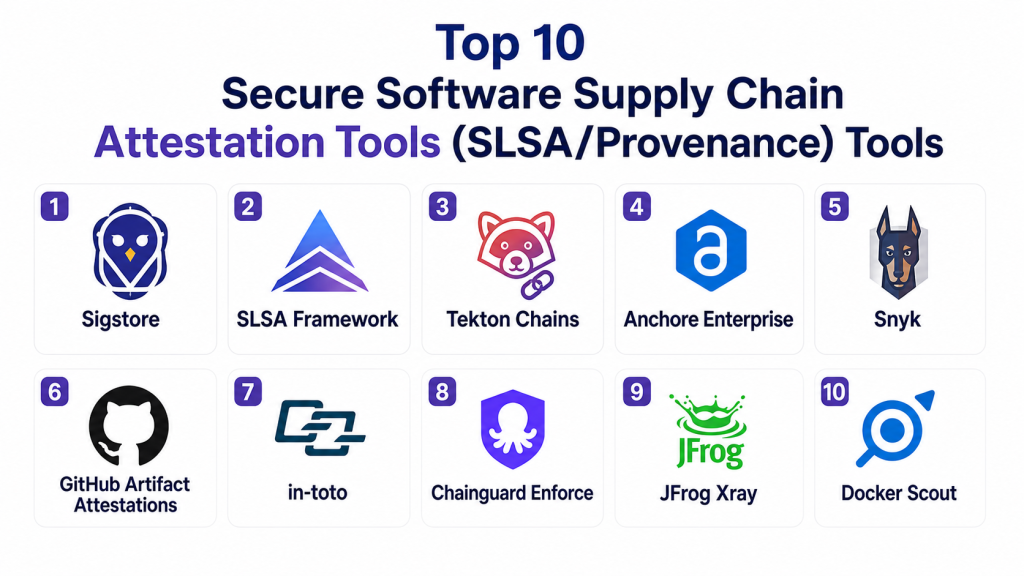
Top 10 Secure Software Supply Chain Attestation Tools (SLSA/Provenance) Tools
#1 — Sigstore (Cosign, Fulcio, Rekor)
Short description:
Sigstore is an open-source ecosystem designed to simplify software signing and verification. It enables developers to generate cryptographic signatures and provenance without complex key management. Widely adopted in cloud-native environments, it forms the backbone of modern supply chain security practices.
Key Features
- Keyless signing with identity-based verification
- Transparency log via Rekor
- Cosign for container signing
- Integration with CI/CD pipelines
- Open-source and community-driven
- Provenance generation support
- Kubernetes-native integrations
Pros
- Free and open-source
- Strong community and ecosystem
- Simplifies signing workflows
Cons
- Requires setup and understanding of components
- Limited enterprise support options
- Not a full platform
Platforms / Deployment
Cloud / Self-hosted
Security & Compliance
Encryption, audit logs, identity-based signing
Integrations & Ecosystem
Integrates deeply with cloud-native and DevOps tools.
- Kubernetes
- Docker
- GitHub Actions
- Tekton
Support & Community
Strong open-source community with active contributions.
#2 — Google SLSA Framework & Tooling
Short description:
SLSA is a widely adopted framework that provides structured levels for securing software builds. Its tooling helps organizations implement provenance generation and verification aligned with best practices.
Key Features
- Defined SLSA maturity levels
- Provenance metadata standards
- CI/CD integration support
- Policy enforcement capabilities
- Flexible adoption model
Pros
- Industry-recognized standard
- Strong documentation
- Scalable approach
Cons
- Not a standalone product
- Requires engineering effort
- No centralized UI
Platforms / Deployment
Varies / N/A
Security & Compliance
Not publicly stated
Integrations & Ecosystem
Compatible with modern CI/CD ecosystems.
- GitHub Actions
- Cloud build systems
- Tekton
Support & Community
Backed by a large community and ecosystem.
#3 — Tekton Chains
Short description:
Tekton Chains is a Kubernetes-native solution that automatically generates and signs supply chain metadata. It integrates tightly with pipeline workflows for secure software delivery.
Key Features
- Automated provenance generation
- Artifact signing
- Kubernetes-native design
- Integration with Sigstore
- Pipeline-level security
Pros
- Strong automation
- Native Kubernetes support
- Open-source flexibility
Cons
- Requires Kubernetes expertise
- Limited outside Tekton ecosystem
- Setup complexity
Platforms / Deployment
Cloud / Self-hosted
Security & Compliance
RBAC, audit logs
Integrations & Ecosystem
Focused on cloud-native ecosystems.
- Tekton Pipelines
- Kubernetes
- Sigstore
Support & Community
Growing community with active development.
#4 — Anchore Enterprise
Short description:
Anchore provides container security and supply chain validation through SBOM analysis and policy enforcement. It is widely used by enterprises managing containerized applications.
Key Features
- SBOM generation and analysis
- Policy enforcement
- Container scanning
- Supply chain validation
- CI/CD integrations
Pros
- Enterprise-ready
- Strong compliance features
- Flexible policies
Cons
- Advanced features require paid plans
- Container-focused
- Learning curve
Platforms / Deployment
Cloud / Self-hosted
Security & Compliance
RBAC, audit logs
Integrations & Ecosystem
Works with common DevOps tools.
- Jenkins
- GitHub
- Kubernetes
Support & Community
Commercial support available with active community.
#5 — Snyk Supply Chain Security
Short description:
Snyk offers developer-first security tools that include supply chain protection and dependency verification. It integrates easily into development workflows.
Key Features
- Dependency scanning
- Provenance insights
- CI/CD integration
- Developer-friendly interface
- Policy management
Pros
- Easy to use
- Strong integrations
- Developer-centric
Cons
- Limited deep attestation features
- Premium pricing
- Focus on vulnerabilities
Platforms / Deployment
Cloud
Security & Compliance
SSO, RBAC, audit logs
Integrations & Ecosystem
Broad DevOps integrations.
- GitHub
- GitLab
- Bitbucket
Support & Community
Strong documentation and enterprise support.
#6 — GitHub Artifact Attestations
Short description:
GitHub provides built-in artifact attestation capabilities within its CI/CD platform, making it easy to generate and verify provenance during builds.
Key Features
- Native CI/CD integration
- Provenance generation
- Identity-based verification
- Policy enforcement
- Secure workflows
Pros
- Easy adoption
- Seamless integration
- Developer-friendly
Cons
- Platform dependency
- Limited customization
- Feature constraints
Platforms / Deployment
Cloud
Security & Compliance
SSO, audit logs
Integrations & Ecosystem
Optimized for GitHub ecosystem.
- GitHub Actions
- Packages
- Developer tools
Support & Community
Strong platform support and documentation.
#7 — in-toto
Short description:
in-toto is an open-source framework that ensures integrity across every step of the software supply chain through cryptographic verification.
Key Features
- End-to-end verification
- Flexible workflow definitions
- Cryptographic signatures
- Open standard architecture
- Supply chain tracking
Pros
- Highly customizable
- Strong security model
- Open-source flexibility
Cons
- Complex implementation
- Requires expertise
- Limited UI
Platforms / Deployment
Self-hosted
Security & Compliance
Encryption, audit trails
Integrations & Ecosystem
Supports multiple DevOps workflows.
- Docker
- Kubernetes
- CI/CD systems
Support & Community
Active open-source community.
#8 — Chainguard Enforce
Short description:
Chainguard Enforce focuses on policy enforcement and secure software delivery using verified artifacts and minimal attack surface strategies.
Key Features
- Policy-as-code
- Verified images
- Continuous enforcement
- Supply chain protection
- Kubernetes integration
Pros
- Strong security model
- Modern architecture
- Automated enforcement
Cons
- Newer ecosystem
- Limited integrations
- Pricing not transparent
Platforms / Deployment
Cloud
Security & Compliance
Not publicly stated
Integrations & Ecosystem
Focused on modern cloud-native stacks.
- Kubernetes
- CI/CD pipelines
Support & Community
Commercial support with growing adoption.
#9 — JFrog Xray
Short description:
JFrog Xray enhances artifact management with deep scanning and policy enforcement, making it suitable for complex enterprise pipelines.
Key Features
- Artifact scanning
- Dependency tracking
- Policy enforcement
- CI/CD integration
- Compliance support
Pros
- Enterprise-grade
- Strong visibility
- Deep integrations
Cons
- Complex setup
- Higher cost
- Learning curve
Platforms / Deployment
Cloud / Self-hosted
Security & Compliance
RBAC, audit logs
Integrations & Ecosystem
Works across DevOps ecosystems.
- Jenkins
- Artifactory
- Kubernetes
Support & Community
Strong enterprise support.
#10 — Docker Scout
Short description:
Docker Scout provides insights into container images and supply chain security, helping teams analyze dependencies and improve software integrity.
Key Features
- Image analysis
- Dependency insights
- CI/CD integration
- Vulnerability detection
- Supply chain visibility
Pros
- Easy to use
- Fast insights
- Docker integration
Cons
- Limited attestation depth
- Docker-focused
- Not full SLSA solution
Platforms / Deployment
Cloud
Security & Compliance
Not publicly stated
Integrations & Ecosystem
Works within Docker ecosystem.
- Docker Hub
- CI/CD tools
Support & Community
Strong community and documentation.
Comparison Table (Top 10)
| Tool Name | Best For | Platform(s) Supported | Deployment | Standout Feature | Public Rating |
|---|---|---|---|---|---|
| Sigstore | Open-source signing | Multi-platform | Hybrid | Keyless signing | N/A |
| SLSA Framework | Standard adoption | Multi-platform | N/A | Security levels | N/A |
| Tekton Chains | Kubernetes pipelines | Linux | Self-hosted | Pipeline attestation | N/A |
| Anchore | Container security | Multi-platform | Hybrid | SBOM + policy | N/A |
| Snyk | Developer security | Multi-platform | Cloud | Dev-first UX | N/A |
| GitHub Attestations | GitHub users | Web | Cloud | Native integration | N/A |
| in-toto | Custom workflows | Multi-platform | Self-hosted | Flexible verification | N/A |
| Chainguard | Secure delivery | Multi-platform | Cloud | Policy enforcement | N/A |
| JFrog Xray | Enterprise pipelines | Multi-platform | Hybrid | Artifact scanning | N/A |
| Docker Scout | Container insights | Multi-platform | Cloud | Dependency analysis | N/A |
Evaluation & Scoring of Secure Software Supply Chain Attestation Tools (SLSA/Provenance)
| Tool Name | Core (25%) | Ease (15%) | Integrations (15%) | Security (10%) | Performance (10%) | Support (10%) | Value (15%) | Weighted Total |
|---|---|---|---|---|---|---|---|---|
| Sigstore | 9 | 7 | 8 | 9 | 8 | 7 | 9 | 8.4 |
| SLSA Framework | 8 | 6 | 7 | 9 | 8 | 7 | 8 | 7.8 |
| Tekton Chains | 8 | 6 | 8 | 8 | 8 | 7 | 8 | 7.7 |
| Anchore | 8 | 7 | 8 | 9 | 8 | 8 | 7 | 8.0 |
| Snyk | 7 | 9 | 9 | 8 | 8 | 9 | 7 | 8.2 |
| GitHub Attestations | 7 | 9 | 8 | 8 | 8 | 8 | 8 | 8.1 |
| in-toto | 9 | 5 | 7 | 9 | 8 | 7 | 8 | 7.8 |
| Chainguard | 8 | 8 | 7 | 9 | 8 | 7 | 7 | 8.0 |
| JFrog Xray | 9 | 7 | 9 | 9 | 9 | 8 | 7 | 8.5 |
| Docker Scout | 7 | 9 | 7 | 7 | 8 | 8 | 8 | 7.8 |
How to interpret scores:
These scores are comparative and reflect how each tool performs across critical dimensions like security, integrations, and usability. A higher score indicates a well-balanced tool across multiple criteria, but it does not automatically mean it is the best choice for every scenario. Some tools excel in specific areas such as open-source flexibility or enterprise scalability, which may matter more depending on your use case. Buyers should prioritize the criteria most relevant to their organization and validate results through real-world testing. Always treat these scores as directional guidance rather than absolute rankings.
Which Secure Software Supply Chain Attestation Tools (SLSA/Provenance) Tool Is Right for You?
Solo / Freelancer
For individuals or small projects, simplicity and ease of use matter most. Tools like Sigstore and Docker Scout offer lightweight adoption with minimal setup, making them ideal for quick integration without complex infrastructure requirements.
SMB
Small and medium businesses should focus on tools that balance usability with security. Snyk and GitHub Attestations are strong options due to their developer-friendly interfaces, automation capabilities, and seamless CI/CD integration.
Mid-Market
Mid-sized organizations typically require stronger policy enforcement and scalability. Anchore and Chainguard Enforce provide deeper control, better governance, and support for growing DevOps environments.
Enterprise
Large enterprises need comprehensive visibility, compliance support, and integration depth. JFrog Xray, Sigstore combined with in-toto, and SLSA-based implementations provide robust frameworks for managing complex and regulated software supply chains.
Budget vs Premium
Open-source tools like Sigstore and in-toto provide cost-effective solutions with flexibility. Premium platforms such as JFrog and Anchore offer advanced features, enterprise support, and easier management but come with higher costs.
Feature Depth vs Ease of Use
Developer-first tools like Snyk prioritize usability and quick onboarding, while frameworks like SLSA and in-toto offer deeper control and customization but require more expertise to implement effectively.
Integrations & Scalability
Organizations using GitHub workflows benefit from GitHub Attestations, while Kubernetes-heavy environments are better suited for Tekton Chains and Sigstore integrations. Choosing a tool aligned with your existing stack ensures smoother adoption.
Security & Compliance Needs
Highly regulated industries should prioritize tools that provide strong audit trails, policy enforcement, and provenance verification. Enterprise-grade tools and frameworks are better suited for these environments.
Frequently Asked Questions (FAQs)
1. What is SLSA in software supply chains?
SLSA is a framework that defines security levels for software builds and supply chains. It helps ensure that artifacts are created in a secure and verifiable manner. Organizations use it to prevent tampering and improve trust in their software delivery process.
2. What is software provenance?
Provenance refers to the origin and lifecycle history of a software artifact. It includes details about how the artifact was built, what tools were used, and who was involved. This information helps verify authenticity and detect tampering.
3. Are these tools necessary for all teams?
Not every team requires advanced attestation tools. However, organizations handling sensitive data or operating in regulated industries benefit greatly from implementing these solutions to improve security and compliance.
4. How difficult is implementation?
Implementation varies depending on the tool. Open-source frameworks may require engineering expertise, while SaaS platforms provide easier onboarding. Complexity also depends on the maturity of your CI/CD pipeline.
5. Can these tools integrate with existing CI/CD systems?
Yes, most attestation tools are designed to integrate directly into CI/CD pipelines. They automate the generation and verification of provenance during build and deployment processes.
6. Do these tools replace vulnerability scanners?
No, they complement vulnerability scanners. While scanners detect known security issues, attestation tools ensure the integrity and trustworthiness of the software supply chain.
7. What are common mistakes when adopting these tools?
Common mistakes include incomplete integration, lack of policy enforcement, and ignoring monitoring. Organizations should ensure full pipeline coverage and continuous validation for effective results.
8. Are open-source attestation tools reliable?
Many open-source tools are widely trusted and used in production environments. They often benefit from strong community support and transparency, making them a viable option for many organizations.
9. How do I choose the right tool?
Start by evaluating your team size, infrastructure, and security requirements. Consider ease of use, integration compatibility, and compliance needs before making a decision.
10. Can these tools scale with enterprise environments?
Yes, many tools in this category are designed to scale across large and complex environments. Enterprise-grade solutions offer advanced features for managing multiple pipelines, teams, and compliance requirements.
Conclusion
Secure software supply chain attestation is becoming a foundational requirement for modern software delivery. As threats continue to evolve, organizations must adopt tools and frameworks that ensure integrity, traceability, and trust across their pipelines. The tools covered in this guide offer a wide range of capabilities, from lightweight open-source solutions to enterprise-grade platforms with advanced policy enforcement. Choosing the right solution depends on your organization’s size, security maturity, and integration needs. Instead of searching for a single “best” tool, focus on aligning capabilities with your workflow and risk profile. The most effective approach is to shortlist a few tools, test them within your environment, and validate how well they support your security and operational goals before scaling adoption.
