Introduction
Digital Identity Wallets are secure applications that allow individuals and organizations to store, manage, and share digital credentials such as identity proofs, licenses, certificates, and verifiable credentials. These wallets are built on modern identity frameworks and often leverage decentralized identity models to give users control over their personal data.
As digital services expand and privacy regulations tighten, identity wallets are becoming a core component of secure authentication and trust ecosystems. They enable seamless identity verification without repeatedly sharing sensitive data, reducing fraud risks and improving user experience across industries.
Common use cases include:
- Secure login and authentication without passwords
- Storage of government-issued digital IDs
- Sharing verifiable credentials for onboarding
- Access control in enterprises and services
- Cross-border identity verification
Key evaluation criteria:
- Credential support and interoperability
- Security architecture and encryption
- User control and privacy features
- Integration with identity systems
- Standards support for verifiable credentials
- Ease of use and accessibility
- Scalability and ecosystem adoption
- Compliance with identity regulations
Best for: Governments, enterprises, fintech platforms, and users needing secure digital identity management and credential sharing.
Not ideal for: Simple authentication use cases where traditional login systems are sufficient without requiring advanced identity verification.
Key Trends in Digital Identity Wallets
- Adoption of decentralized identity frameworks for user control
- Integration with verifiable credential standards
- Increased use in government digital ID programs
- Biometric authentication for enhanced security
- Cross-platform identity interoperability
- Privacy-preserving data sharing models
- Expansion into financial and healthcare sectors
- Mobile-first identity solutions
- Integration with blockchain-based identity systems
- Growth of self-sovereign identity ecosystems
How We Selected These Tools Methodology
- Evaluated market adoption and ecosystem presence
- Assessed support for digital identity standards
- Reviewed security and privacy features
- Considered integration capabilities and interoperability
- Analyzed usability and accessibility
- Included both enterprise and consumer solutions
- Focused on scalability and real-world deployments
- Balanced centralized and decentralized approaches
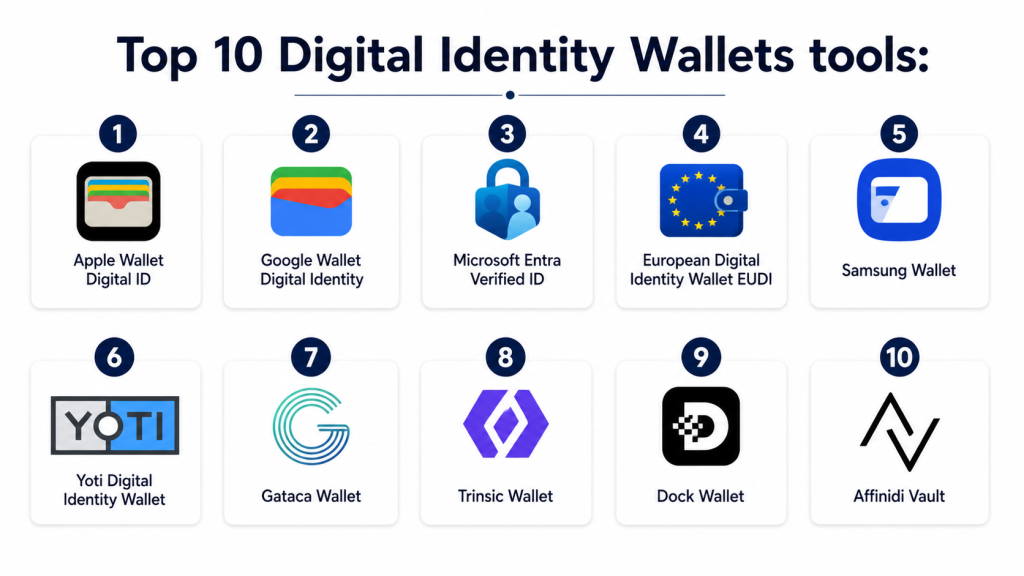
Top 10 Digital Identity Wallets Tools
#1 — Apple Wallet Digital ID
Short description:
Apple Wallet Digital ID enables users to store digital identity credentials securely on their devices. It integrates with mobile ecosystems and supports identity verification in supported regions. The solution focuses on privacy and user control. It is ideal for consumers within the Apple ecosystem.
Key Features
- Digital ID storage
- Secure device-based authentication
- Integration with mobile services
- Privacy-focused design
- Credential sharing support
Pros
- Easy to use
- Strong device security
- Seamless ecosystem integration
Cons
- Limited regional availability
- Platform restricted
- Dependent on device ecosystem
Platforms / Deployment
iOS
Security & Compliance
Device encryption, biometric authentication
Integrations & Ecosystem
Integrated with mobile apps and supported services within the Apple ecosystem.
- Mobile integrations
- App ecosystem
Support & Community
Strong user support through ecosystem
#2 — Google Wallet Digital Identity
Short description:
Google Wallet Digital Identity allows users to store and manage digital IDs securely. It supports identity verification and integrates with Android devices. The platform emphasizes accessibility and usability. It is suitable for Android users globally.
Key Features
- Digital ID storage
- Mobile authentication
- Secure credential sharing
- Integration with Android services
- Identity verification
Pros
- Wide device compatibility
- Easy to use
- Strong ecosystem
Cons
- Limited availability
- Privacy concerns for some users
- Dependent on Android
Platforms / Deployment
Android
Security & Compliance
Encryption and device security
Integrations & Ecosystem
Integrates with Android apps and services.
- Mobile APIs
- App integrations
Support & Community
Strong support through Google ecosystem
#3 — Microsoft Entra Verified ID
Short description:
Microsoft Entra Verified ID is an enterprise-grade identity wallet solution for managing verifiable credentials. It enables organizations to issue and verify digital identities securely. The platform integrates with enterprise systems. It is suitable for large organizations.
Key Features
- Verifiable credentials
- Identity issuance and verification
- Integration with enterprise systems
- Secure identity sharing
- Compliance support
Pros
- Enterprise-ready
- Strong integrations
- Scalable
Cons
- Complex setup
- Requires expertise
- Not consumer-focused
Platforms / Deployment
Cloud
Security & Compliance
Encryption, access controls
Integrations & Ecosystem
Integrates with enterprise identity systems and cloud services.
- APIs
- Identity integrations
Support & Community
Enterprise support
#4 — European Digital Identity Wallet EUDI
Short description:
EUDI Wallet is a government-led initiative for digital identity across regions. It enables secure identity storage and cross-border verification. The platform focuses on interoperability and compliance. It is designed for citizens and public services.
Key Features
- Government digital ID
- Cross-border identity verification
- Credential storage
- Privacy controls
- Compliance features
Pros
- Strong regulatory backing
- Interoperable
- High trust
Cons
- Limited availability
- Still evolving
- Region-specific
Platforms / Deployment
Mobile
Security & Compliance
Not publicly stated
Integrations & Ecosystem
Designed to integrate with public and private sector services.
- Government integrations
- Service APIs
Support & Community
Government-supported
#5 — Samsung Wallet
Short description:
Samsung Wallet provides digital identity storage and secure credential management. It integrates with Samsung devices and services. The platform offers convenience and security. It is suitable for Samsung users.
Key Features
- Digital ID storage
- Secure authentication
- Device integration
- Credential sharing
- Payment integration
Pros
- Easy to use
- Integrated with devices
- Secure
Cons
- Limited to Samsung ecosystem
- Regional restrictions
- Feature limitations
Platforms / Deployment
Android
Security & Compliance
Device security features
Integrations & Ecosystem
Integrated with Samsung apps and services.
- Mobile integrations
- Device ecosystem
Support & Community
Standard support
#6 — Yoti Digital Identity Wallet
Short description:
Yoti is a digital identity platform that enables users to store and share identity credentials securely. It is widely used for identity verification and age checks. The platform focuses on privacy and ease of use. It is suitable for consumers and businesses.
Key Features
- Digital ID storage
- Identity verification
- Age verification
- Secure sharing
- Privacy controls
Pros
- Easy to use
- Privacy-focused
- Trusted platform
Cons
- Limited enterprise features
- Regional adoption varies
- Feature limitations
Platforms / Deployment
Mobile
Security & Compliance
Encryption and privacy controls
Integrations & Ecosystem
Integrates with verification and onboarding systems.
- APIs
- Service integrations
Support & Community
Good support
#7 — Gataca Wallet
Short description:
Gataca Wallet is a decentralized identity wallet enabling secure credential management. It supports self-sovereign identity principles. The platform focuses on user control and privacy. It is suitable for digital identity ecosystems.
Key Features
- Decentralized identity
- Credential storage
- Secure sharing
- Privacy protection
- Interoperability
Pros
- Strong privacy focus
- Decentralized approach
- User control
Cons
- Limited adoption
- Requires understanding of identity concepts
- Smaller ecosystem
Platforms / Deployment
Mobile
Security & Compliance
Not publicly stated
Integrations & Ecosystem
Supports integration with decentralized identity systems.
- APIs
- Identity protocols
Support & Community
Growing community
#8 — Trinsic Wallet
Short description:
Trinsic Wallet is designed for managing verifiable credentials in decentralized identity systems. It enables secure storage and sharing of digital identities. The platform is developer-friendly. It is suitable for enterprises and developers.
Key Features
- Verifiable credentials
- Identity management
- Secure storage
- API support
- Interoperability
Pros
- Developer-friendly
- Flexible
- Scalable
Cons
- Requires technical knowledge
- Limited consumer features
- Smaller ecosystem
Platforms / Deployment
Cloud / Mobile
Security & Compliance
Not publicly stated
Integrations & Ecosystem
Integrates with identity platforms and developer tools.
- APIs
- SDKs
Support & Community
Developer-focused support
#9 — Dock Wallet
Short description:
Dock Wallet provides decentralized identity solutions for credential management. It supports verifiable credentials and blockchain-based identity. The platform is suitable for organizations building identity ecosystems. It focuses on security and interoperability.
Key Features
- Decentralized identity
- Credential management
- Blockchain integration
- Secure sharing
- Interoperability
Pros
- Strong security
- Flexible
- Open ecosystem
Cons
- Technical complexity
- Limited adoption
- Requires expertise
Platforms / Deployment
Mobile
Security & Compliance
Not publicly stated
Integrations & Ecosystem
Supports integration with decentralized identity frameworks.
- APIs
- Blockchain integrations
Support & Community
Growing ecosystem
#10 — Affinidi Vault
Short description:
Affinidi Vault is a digital identity wallet focused on data ownership and privacy. It allows users to store and control their personal data. The platform supports verifiable credentials. It is suitable for individuals and developers.
Key Features
- Personal data storage
- Verifiable credentials
- Privacy controls
- Secure sharing
- Identity management
Pros
- Strong privacy focus
- User control
- Flexible
Cons
- Limited adoption
- Requires awareness
- Smaller ecosystem
Platforms / Deployment
Cloud / Mobile
Security & Compliance
Not publicly stated
Integrations & Ecosystem
Integrates with identity and data platforms.
- APIs
- SDKs
Support & Community
Developer-focused support
Comparison Table
| Tool Name | Best For | Platform Supported | Deployment | Standout Feature | Public Rating |
|---|---|---|---|---|---|
| Apple Wallet | Consumers | iOS | Mobile | Device security | N/A |
| Google Wallet | Android users | Android | Mobile | Accessibility | N/A |
| Microsoft Entra | Enterprise | Web | Cloud | Verifiable credentials | N/A |
| EUDI Wallet | Government ID | Mobile | Public | Cross-border ID | N/A |
| Samsung Wallet | Device users | Android | Mobile | Integration | N/A |
| Yoti | Identity verification | Mobile | Cloud | Privacy focus | N/A |
| Gataca | Decentralized ID | Mobile | Cloud | User control | N/A |
| Trinsic | Developers | Web | Cloud | API-first | N/A |
| Dock Wallet | Blockchain ID | Mobile | Cloud | Decentralized identity | N/A |
| Affinidi Vault | Privacy | Mobile | Cloud | Data ownership | N/A |
Evaluation and Scoring of Digital Identity Wallets
| Tool Name | Core | Ease | Integrations | Security | Performance | Support | Value | Weighted Total |
|---|---|---|---|---|---|---|---|---|
| Apple Wallet | 8 | 9 | 7 | 9 | 9 | 8 | 8 | 8.5 |
| Google Wallet | 8 | 9 | 8 | 8 | 9 | 8 | 8 | 8.4 |
| Microsoft Entra | 9 | 6 | 9 | 9 | 8 | 8 | 7 | 8.2 |
| EUDI Wallet | 8 | 7 | 7 | 9 | 8 | 7 | 7 | 7.8 |
| Samsung Wallet | 7 | 9 | 7 | 8 | 8 | 7 | 8 | 7.9 |
| Yoti | 8 | 8 | 7 | 8 | 8 | 7 | 8 | 7.9 |
| Gataca | 7 | 7 | 8 | 8 | 7 | 6 | 7 | 7.4 |
| Trinsic | 8 | 7 | 9 | 8 | 8 | 7 | 7 | 7.9 |
| Dock | 7 | 6 | 8 | 8 | 7 | 6 | 7 | 7.3 |
| Affinidi | 8 | 7 | 8 | 8 | 7 | 6 | 8 | 7.7 |
How to interpret these scores:
These scores provide a comparative view across key criteria such as core features, usability, integrations, and security. Higher scores indicate stronger overall capability, but the best choice depends on your specific needs and ecosystem. Consumer-focused wallets tend to score higher in ease of use and accessibility, while enterprise solutions excel in integrations and compliance capabilities. The weighted total helps balance these factors, but organizations should prioritize criteria such as interoperability, privacy, and scalability based on their use case. Treat these scores as guidance and validate choices through testing and real-world evaluation.
Which Digital Identity Wallet Is Right for You
Solo Freelancer
Choose simple wallets like Apple Wallet or Google Wallet for basic identity storage and sharing.
SMB
Yoti or Affinidi Vault provide a balance of usability and privacy for small teams.
Mid Market
Trinsic or Gataca offer flexibility and integration capabilities for growing businesses.
Enterprise
Microsoft Entra Verified ID and EUDI Wallet provide scalability and compliance for large organizations.
Budget vs Premium
Consumer wallets are cost-effective, while enterprise solutions provide advanced features.
Feature Depth vs Ease of Use
Simple wallets focus on usability, while advanced platforms offer deeper identity capabilities.
Integrations and Scalability
API-first platforms are ideal for integrating with enterprise systems.
Security and Compliance Needs
Choose solutions with strong encryption and compliance support for regulated industries.
Frequently Asked Questions
1 What is a digital identity wallet
A digital identity wallet is an application that stores and manages identity credentials in a secure digital format. It allows users to share verified information without exposing unnecessary data. These wallets improve privacy and security in digital interactions. They are increasingly used for authentication and verification.
2 How do digital identity wallets work
They store credentials issued by trusted organizations and allow users to present them when needed. Verification happens through cryptographic validation. This ensures authenticity without sharing full data. It improves both security and user control.
3 Are digital identity wallets secure
Most wallets use encryption and secure storage methods to protect data. Many also include biometric authentication. Security depends on implementation and platform. Choosing trusted providers is important.
4 Can these wallets replace passwords
Yes, in many cases digital identity wallets can enable passwordless authentication. They use verified credentials instead of traditional login methods. This improves security and user experience. Adoption is growing across industries.
5 Are these wallets globally accepted
Adoption varies by region and regulatory environment. Some wallets are widely accepted, while others are limited to specific ecosystems. Governments are working on standardization. Global interoperability is improving.
6 Can businesses use digital identity wallets
Yes, businesses use them for employee access, customer onboarding, and verification processes. They help streamline identity workflows. Integration with existing systems is key. Enterprise solutions support these use cases.
7 What industries benefit the most
Financial services, healthcare, government, and e-commerce benefit significantly. Any sector requiring identity verification can use these tools. They improve security and compliance. Adoption is expanding rapidly.
8 What is decentralized identity
Decentralized identity allows users to control their own data without relying on a central authority. It uses secure technologies to verify identity. This improves privacy and reduces dependency on centralized systems. Many wallets support this model.
9 Can I use multiple wallets
Yes, users can maintain multiple wallets for different purposes. Some may be used for personal identity while others are for professional use. Managing multiple wallets requires organization. Interoperability helps simplify this.
10 How do I choose the right wallet
Consider factors like security, usability, compatibility, and ecosystem support. Evaluate whether the wallet meets your specific needs. Testing different options is helpful. Choose a solution that aligns with your use case.
Conclusion
Digital identity wallets are transforming how individuals and organizations manage identity in a digital-first world by enabling secure, privacy-focused, and user-controlled credential sharing. These solutions reduce reliance on traditional authentication methods and help streamline onboarding, access control, and compliance processes across industries. While consumer wallets offer simplicity and convenience, enterprise-grade platforms provide scalability, interoperability, and deeper integration capabilities. The right choice depends on your use case, whether it is personal identity management, business verification, or large-scale identity infrastructure. Organizations should evaluate solutions based on security, standards support, and integration readiness before making a decision. Shortlisting a few options and testing them in real-world scenarios ensures better alignment with operational needs and long-term success.

The article does a great job comparing digital identity wallets and explains the key features in a simple, easy-to-understand way.