Introduction
AI Content Authenticity & Provenance Tools help verify whether digital content such as images, videos, and text is real, AI-generated, or manipulated. These tools embed, track, and validate metadata, watermarks, and cryptographic signatures to ensure trust in digital media. As generative AI becomes more widespread, distinguishing authentic content from synthetic content is becoming a critical challenge for businesses, governments, and platforms.
The importance of these tools has grown due to rising concerns around misinformation, deepfakes, and intellectual property misuse. Organizations now require reliable systems to trace the origin of content and validate its integrity across workflows and platforms.
Real-world use cases:
- Verifying authenticity of news media and journalism content
- Detecting deepfakes in security and compliance workflows
- Protecting brand assets and intellectual property
- Ensuring transparency in AI-generated marketing content
What buyers should evaluate:
- Provenance tracking capabilities
- Watermarking and detection accuracy
- Compatibility with AI generation tools
- Integration with media workflows
- Scalability for enterprise use
- Regulatory and compliance alignment
- Ease of implementation
- Cross-platform support
Best for: Media organizations, enterprises, AI developers, cybersecurity teams, and compliance-focused industries that require content verification and trust mechanisms.
Not ideal for: Small teams with minimal content risk exposure or workflows that do not involve AI-generated or sensitive media content.
Key Trends in AI Content Authenticity & Provenance Tools
- Rise of AI watermarking: Invisible watermarking is becoming a standard for tracking generated content
- Regulatory pressure: Governments and platforms are enforcing content transparency requirements
- Deepfake detection advancements: Improved AI models for identifying manipulated media
- Standardization efforts: Industry-wide frameworks for provenance metadata are emerging
- Integration with creative tools: Native support in design and editing software
- Real-time verification: Instant authenticity checks during content upload
- Cross-platform metadata tracking: Ensuring provenance persists across platforms
- Enterprise adoption growth: Increasing demand in regulated industries
- AI model transparency: Linking outputs to source models and prompts
How We Selected These Tools (Methodology)
- Evaluated industry adoption and recognition
- Assessed accuracy of detection and watermarking capabilities
- Reviewed integration with AI and media platforms
- Considered security and trust frameworks
- Analyzed scalability and enterprise readiness
- Examined ease of implementation and usability
- Reviewed ecosystem partnerships and standards alignment
- Balanced innovative startups and established solutions
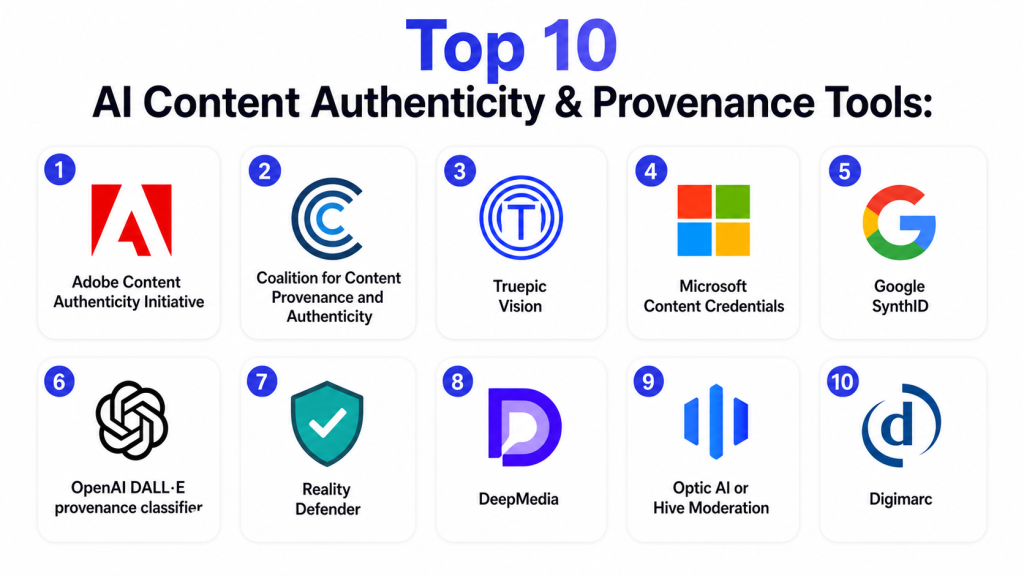
Top 10 AI Content Authenticity & Provenance Tools
#1 — Adobe Content Authenticity Initiative
Short description: A widely adopted framework focused on embedding provenance metadata into digital content. It enables creators and organizations to track content origin and edits across workflows.
Key Features
- Content credentials metadata
- Provenance tracking
- Integration with creative tools
- Open standard approach
- Digital signature support
Pros
- Strong industry backing
- Seamless integration with design tools
- Transparent metadata tracking
Cons
- Requires ecosystem adoption
- Limited standalone usage
- Dependence on compatible platforms
Platforms / Deployment
Web / Cloud
Security & Compliance
Metadata integrity, cryptographic signatures
Not publicly stated
Integrations & Ecosystem
Integrated into creative and publishing workflows with growing ecosystem adoption.
- Design software
- Media platforms
- Content workflows
Support & Community
Strong support through industry collaboration and documentation.
#2 — Coalition for Content Provenance and Authenticity
Short description: An industry standard initiative defining protocols for content authenticity and provenance tracking across platforms.
Key Features
- Open standard framework
- Metadata schema
- Cross-platform compatibility
- Industry collaboration
- Verification tools
Pros
- Widely supported standard
- Promotes interoperability
- Strong industry backing
Cons
- Not a standalone product
- Requires implementation
- Limited direct tooling
Platforms / Deployment
Varies / N/A
Security & Compliance
Standards-based security
Not publicly stated
Integrations & Ecosystem
Forms the foundation for many authenticity tools.
- Media platforms
- Content tools
- Verification systems
Support & Community
Backed by major industry players.
#3 — Truepic Vision
Short description: A verification platform that ensures images and videos are authentic and not manipulated, widely used in compliance and verification workflows.
Key Features
- Image verification
- Metadata validation
- Real-time capture verification
- Secure capture technology
- Fraud detection
Pros
- High verification accuracy
- Strong compliance use cases
- Trusted by enterprises
Cons
- Focused on images/video
- Limited creative integrations
- Pricing varies
Platforms / Deployment
Web / Mobile / Cloud
Security & Compliance
Encryption, audit logs
Not publicly stated
Integrations & Ecosystem
Works with enterprise verification systems and compliance workflows.
- API integrations
- Enterprise platforms
Support & Community
Enterprise-grade support.
#4 — Microsoft Content Credentials
Short description: A solution for embedding and verifying content authenticity metadata within digital media, integrated with broader Microsoft ecosystems.
Key Features
- Content provenance tracking
- Metadata embedding
- AI content labeling
- Integration with Microsoft tools
Pros
- Strong enterprise integration
- Scalable
- Trusted ecosystem
Cons
- Ecosystem dependency
- Limited standalone use
- Requires Microsoft stack
Platforms / Deployment
Cloud
Security & Compliance
Enterprise-grade security
Not publicly stated
Integrations & Ecosystem
Deep integration with enterprise tools and workflows.
- Microsoft ecosystem
- Cloud services
Support & Community
Strong enterprise support.
#5 — Google SynthID
Short description: A watermarking technology designed to embed invisible signals into AI-generated content for identification and traceability.
Key Features
- Invisible watermarking
- AI content detection
- Image and media support
- Robust signal embedding
Pros
- Highly scalable
- Advanced AI integration
- Invisible watermarking
Cons
- Limited public tooling
- Ecosystem dependent
- Not universally supported
Platforms / Deployment
Cloud
Security & Compliance
Watermarking security
Not publicly stated
Integrations & Ecosystem
Integrated with AI content generation pipelines.
- AI tools
- Cloud services
Support & Community
Supported within broader ecosystem.
#6 — OpenAI DALL·E Provenance Classifier
Short description: A detection system that identifies whether content was generated using specific AI models.
Key Features
- AI-generated content detection
- Model attribution
- Image analysis
- Classification engine
Pros
- Useful for detection workflows
- AI-specific focus
- Easy integration
Cons
- Limited scope
- Model-specific
- Not comprehensive
Platforms / Deployment
Cloud
Security & Compliance
Varies / N/A
Integrations & Ecosystem
Works with AI pipelines and detection systems.
- AI platforms
- Content moderation tools
Support & Community
Limited public details.
#7 — Reality Defender
Short description: A deepfake detection platform that identifies manipulated media across video, audio, and images.
Key Features
- Deepfake detection
- Multi-media analysis
- Real-time scanning
- API integration
Pros
- Strong detection accuracy
- Real-time capabilities
- Enterprise use cases
Cons
- Focus on detection only
- Limited provenance tracking
- Pricing varies
Platforms / Deployment
Cloud
Security & Compliance
Not publicly stated
Integrations & Ecosystem
Integrates with security and content moderation systems.
- APIs
- Enterprise platforms
Support & Community
Enterprise-focused support.
#8 — DeepMedia
Short description: A platform focused on detecting synthetic media and deepfakes across digital content channels.
Key Features
- Deepfake detection
- Audio and video analysis
- AI-based detection models
- Content monitoring
Pros
- Strong detection capabilities
- Multi-format support
- Scalable
Cons
- Limited provenance features
- Detection-focused
- Smaller ecosystem
Platforms / Deployment
Cloud
Security & Compliance
Not publicly stated
Integrations & Ecosystem
Works with media monitoring and security tools.
- APIs
- Monitoring systems
Support & Community
Moderate support availability.
#9 — Hive Moderation
Short description: A content moderation and detection platform that identifies AI-generated and unsafe content.
Key Features
- AI content detection
- Moderation tools
- API integration
- Multi-format support
Pros
- Easy integration
- Scalable
- Broad use cases
Cons
- Not focused solely on provenance
- Limited metadata tracking
- Detection accuracy varies
Platforms / Deployment
Cloud
Security & Compliance
Not publicly stated
Integrations & Ecosystem
Integrates with content platforms and moderation systems.
- APIs
- Content platforms
Support & Community
Strong developer support.
#10 — Digimarc
Short description: A digital watermarking platform used for tracking and verifying content authenticity across digital and physical media.
Key Features
- Digital watermarking
- Content tracking
- Metadata embedding
- Cross-media support
Pros
- Mature technology
- Strong tracking capabilities
- Enterprise-ready
Cons
- Implementation complexity
- Requires adoption
- Pricing varies
Platforms / Deployment
Cloud / Hybrid
Security & Compliance
Watermarking security
Not publicly stated
Integrations & Ecosystem
Works across media and enterprise systems.
- Media platforms
- Enterprise tools
Support & Community
Established enterprise support.
Comparison Table
| Tool Name | Best For | Platform(s) Supported | Deployment | Standout Feature | Public Rating |
|---|---|---|---|---|---|
| Adobe CAI | Content provenance | Web | Cloud | Content credentials | N/A |
| C2PA | Standards | Varies | N/A | Open standard | N/A |
| Truepic Vision | Media verification | Web/Mobile | Cloud | Secure capture | N/A |
| Microsoft Credentials | Enterprise | Cloud | Cloud | Metadata integration | N/A |
| Google SynthID | AI watermarking | Cloud | Cloud | Invisible watermark | N/A |
| OpenAI Classifier | AI detection | Cloud | Cloud | Model detection | N/A |
| Reality Defender | Deepfake detection | Cloud | Cloud | Real-time scanning | N/A |
| DeepMedia | Synthetic detection | Cloud | Cloud | Multi-media analysis | N/A |
| Hive Moderation | Content moderation | Cloud | Cloud | AI detection | N/A |
| Digimarc | Watermarking | Cloud/Hybrid | Hybrid | Content tracking | N/A |
Evaluation & Scoring of AI Content Authenticity & Provenance Tools
| Tool Name | Core | Ease | Integrations | Security | Performance | Support | Value | Weighted Total |
|---|---|---|---|---|---|---|---|---|
| Adobe CAI | 9 | 8 | 9 | 9 | 8 | 9 | 8 | 8.7 |
| C2PA | 8 | 6 | 9 | 9 | 8 | 8 | 7 | 8.0 |
| Truepic | 9 | 8 | 8 | 9 | 9 | 8 | 7 | 8.5 |
| Microsoft | 9 | 8 | 9 | 9 | 8 | 9 | 7 | 8.6 |
| SynthID | 8 | 7 | 8 | 9 | 9 | 8 | 7 | 8.2 |
| OpenAI | 7 | 8 | 7 | 7 | 8 | 7 | 8 | 7.6 |
| Reality Defender | 8 | 7 | 8 | 8 | 9 | 8 | 7 | 8.1 |
| DeepMedia | 8 | 7 | 7 | 8 | 8 | 7 | 7 | 7.7 |
| Hive | 8 | 9 | 9 | 7 | 8 | 8 | 9 | 8.3 |
| Digimarc | 9 | 7 | 8 | 9 | 8 | 8 | 7 | 8.3 |
How to interpret the scores:
These scores are relative comparisons across tools based on features, usability, ecosystem strength, and performance. Higher scores indicate stronger overall capabilities, but the best tool depends on your specific use case. For example, standards like C2PA score high in interoperability but may require additional tools, while platforms like Truepic and Reality Defender excel in detection accuracy. Use this table as a decision guide, not an absolute ranking.
Which AI Content Authenticity & Provenance Tool Is Right for You?
Solo / Freelancer
Use Hive Moderation or OpenAI detection tools for simple and quick verification workflows.
SMB
Choose Truepic Vision or Digimarc for balanced functionality and scalability.
Mid-Market
Consider Reality Defender or DeepMedia for strong detection capabilities.
Enterprise
Adopt Adobe CAI, Microsoft Content Credentials, or SynthID for full-scale provenance and compliance.
Budget vs Premium
Open frameworks are cost-effective, while enterprise solutions offer deeper integration.
Feature Depth vs Ease of Use
Simple tools provide ease, while full frameworks offer deeper provenance tracking.
Integrations & Scalability
Enterprise platforms provide better integration with large workflows.
Security & Compliance Needs
Prioritize tools with strong metadata tracking and verification.
Frequently Asked Questions (FAQs)
1. What are AI content authenticity tools?
These tools verify whether content is real or AI-generated. They use metadata, watermarking, and detection models to ensure trust. They are widely used in media, security, and compliance workflows.
2. Why is provenance important?
Provenance helps track the origin and history of content. It ensures transparency and trust. It is critical in combating misinformation and fraud.
3. How do watermarking tools work?
They embed invisible signals into content. These signals can later be detected to verify authenticity. They do not affect visual quality.
4. Can these tools detect deepfakes?
Yes, many tools specialize in detecting deepfake content. They analyze patterns and inconsistencies. Detection accuracy varies by tool.
5. Are these tools suitable for enterprises?
Yes, many tools are designed for enterprise use. They support scalability and compliance. They integrate with existing workflows.
6. Do these tools work across platforms?
Many tools support cross-platform use. However, compatibility depends on standards adoption. Integration is key.
7. Are they expensive?
Pricing varies widely. Some tools are free or open-source. Enterprise solutions may require significant investment.
8. Can they prevent misuse of AI?
They cannot fully prevent misuse but help detect and track it. They improve transparency and accountability.
9. How accurate are detection tools?
Accuracy depends on the model and dataset. No tool is perfect. Continuous updates improve performance.
10. How do I choose the right tool?
Evaluate your needs, scale, and workflow. Test tools before adoption. Focus on integration and reliability.
Conclusion
AI Content Authenticity & Provenance Tools are becoming essential for maintaining trust in digital ecosystems as AI-generated content continues to grow. Solutions like Adobe Content Authenticity Initiative and Microsoft Content Credentials lead in provenance tracking, while tools like Truepic Vision and Reality Defender focus on detection accuracy. Each tool serves a different purpose, from watermarking to deepfake detection, and the right choice depends on your use case, scale, and compliance needs. Organizations should focus on combining provenance tracking with detection capabilities for a comprehensive strategy. Start by identifying your risk areas, shortlist relevant tools, and run pilot implementations to validate performance, integration, and scalability before making a final decision.
