Introduction
Payment Orchestration Platforms are advanced software systems that sit between merchants and multiple payment service providers to manage, route, and optimize payment transactions intelligently. Instead of relying on a single gateway, these platforms allow businesses to connect multiple providers and dynamically choose the best route for each transaction.
In simple terms, payment orchestration platforms help businesses increase payment success rates, reduce costs, and improve customer experience by routing payments based on rules such as geography, card type, issuer behavior, or performance metrics.
As digital commerce expands globally, companies face challenges like payment failures, fraud risks, and complex integrations. Payment orchestration solves these problems by acting as a centralized control layer for all payment operations.
Common use cases include:
- Smart routing of transactions across multiple gateways
- Managing multiple payment providers from one platform
- Improving authorization rates and reducing failures
- Optimizing transaction costs and fees
- Managing global payments and compliance
Key evaluation criteria:
- Routing intelligence and automation
- Integration with multiple payment providers
- Analytics and reporting capabilities
- Scalability and performance
- Security and compliance features
- Ease of integration and API quality
- Multi-currency and global support
- Fraud detection and risk management
- Flexibility and customization
Best for: Large e-commerce companies, global SaaS platforms, marketplaces, fintech firms, and enterprises managing high-volume payments.
Not ideal for: Small businesses using a single payment gateway with low transaction complexity.
Key Trends in Payment Orchestration Platforms
- Smart routing using AI and real-time decisioning
- Multi-PSP integration for redundancy and optimization
- Payment retries and failover mechanisms
- Growth of subscription and recurring payment orchestration
- Embedded finance and payment infrastructure layers
- Real-time analytics and payment insights
- Global expansion with multi-currency support
- Fraud detection integrated into orchestration layers
- No-code and low-code orchestration tools
- Increased focus on payment performance optimization
How We Selected These Tools
- Strong adoption among enterprise and high-growth companies
- Ability to integrate with multiple payment providers
- Proven scalability and reliability
- Advanced routing and optimization capabilities
- Security and compliance readiness
- API and developer ecosystem strength
- Flexibility for global payment operations
- Vendor innovation and product roadmap
- Ease of implementation and usability
- Performance and analytics capabilities
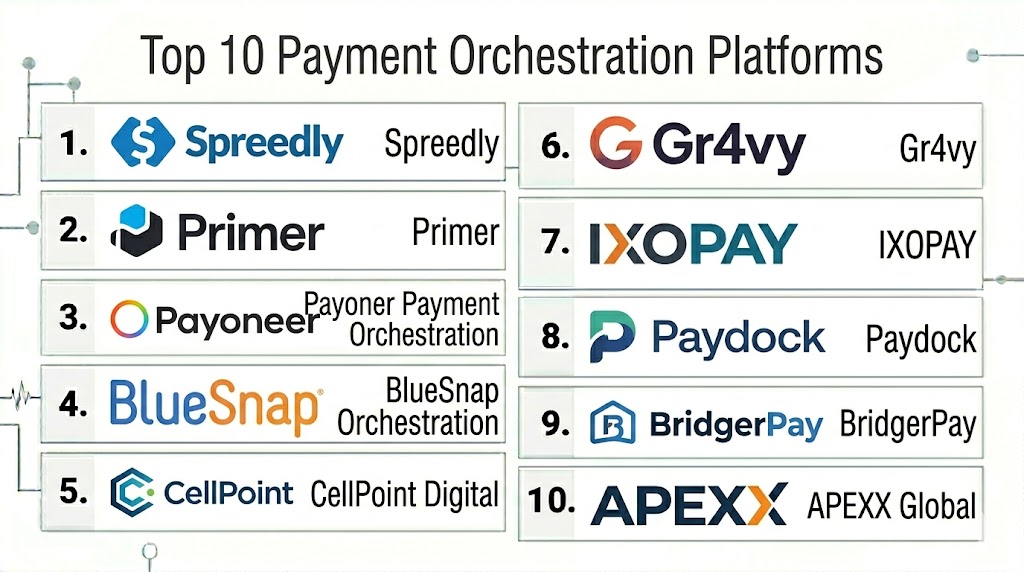
Top 10 Payment Orchestration Platforms Tools
#1 — Spreedly
Short description:
A leading payment orchestration platform that connects businesses to multiple payment gateways and services. It offers flexibility, security, and strong API capabilities.
Key Features
- Multi-gateway connectivity
- Tokenization and vaulting
- Payment routing
- Fraud prevention integrations
- Reporting tools
- API-first architecture
Pros
- Strong integration ecosystem
- Flexible routing capabilities
- High reliability
- Developer-friendly
Cons
- Requires technical setup
- Pricing not transparent
- Learning curve
- Limited UI for non-technical users
Platforms / Deployment
Cloud
Security & Compliance
PCI compliance, encryption, tokenization.
Integrations & Ecosystem
Supports extensive payment integrations.
- Payment gateways
- Fraud tools
- CRM systems
- APIs
Support & Community
Strong developer documentation and support.
#2 — Primer
Short description:
A modern no-code payment orchestration platform designed for businesses to manage and optimize payments easily.
Key Features
- No-code workflow builder
- Payment routing
- Analytics dashboards
- Integration management
- Automation tools
Pros
- Easy to use
- Fast implementation
- Strong analytics
- Flexible workflows
Cons
- Limited deep customization
- Pricing not transparent
- Scaling complexity
- Integration effort
Platforms / Deployment
Cloud
Security & Compliance
Encryption, RBAC. Compliance not publicly stated.
Integrations & Ecosystem
Supports multiple PSP integrations.
- Payment gateways
- Fraud tools
- APIs
- Data platforms
Support & Community
Modern support with strong onboarding.
#3 — BlueSnap Orchestration
Short description:
A payment platform offering orchestration capabilities along with payment processing, designed for global commerce.
Key Features
- Global payment processing
- Smart routing
- Fraud prevention
- Analytics tools
- Subscription billing
Pros
- Unified platform
- Global reach
- Good analytics
- Scalable
Cons
- Less flexibility than pure orchestration tools
- Pricing not transparent
- Integration complexity
- Limited customization
Platforms / Deployment
Cloud
Security & Compliance
PCI DSS compliant, encryption.
Integrations & Ecosystem
Supports integrations with commerce platforms.
- E-commerce systems
- Payment gateways
- CRM tools
- APIs
Support & Community
Vendor support available.
#4 — CellPoint Digital
Short description:
An orchestration platform focused on airlines, travel, and global enterprise payments with advanced routing capabilities.
Key Features
- Multi-PSP orchestration
- Payment routing
- Fraud management
- Analytics tools
- Global payment support
Pros
- Strong travel industry focus
- Advanced routing
- Scalable
- Reliable
Cons
- Niche focus
- Complex implementation
- Pricing not transparent
- Requires expertise
Platforms / Deployment
Cloud
Security & Compliance
Encryption, RBAC. Compliance not publicly stated.
Integrations & Ecosystem
Supports enterprise integrations.
- Payment gateways
- Airline systems
- APIs
- Financial tools
Support & Community
Enterprise support available.
#5 — Gr4vy
Short description:
A cloud-native orchestration platform designed for flexibility and data ownership, allowing merchants to control their payment infrastructure.
Key Features
- Payment orchestration
- Cloud deployment options
- Data control
- Routing logic
- API integrations
Pros
- Flexible deployment
- Strong API support
- Scalable
- Modern design
Cons
- Requires setup effort
- Learning curve
- Pricing not transparent
- Integration complexity
Platforms / Deployment
Cloud
Security & Compliance
Encryption, tokenization. Compliance not publicly stated.
Integrations & Ecosystem
Supports integrations with PSPs and services.
- Payment gateways
- Fraud tools
- APIs
- Data platforms
Support & Community
Growing ecosystem.
#6 — IXOPAY
Short description:
A payment orchestration platform that focuses on transaction routing, monitoring, and risk management.
Key Features
- Smart routing
- Payment monitoring
- Fraud prevention
- Analytics dashboards
- Integration capabilities
Pros
- Strong monitoring tools
- Scalable
- Reliable
- Good analytics
Cons
- Complex setup
- Pricing not transparent
- Integration effort
- Learning curve
Platforms / Deployment
Cloud
Security & Compliance
PCI compliance, encryption.
Integrations & Ecosystem
Supports integrations with payment providers.
- PSPs
- Fraud tools
- APIs
- Financial systems
Support & Community
Vendor support available.
#7 — Paydock
Short description:
A unified payments platform offering orchestration capabilities along with integration and transaction management.
Key Features
- Payment orchestration
- API integrations
- Payment routing
- Analytics
- Workflow automation
Pros
- Easy integration
- Flexible APIs
- Scalable
- Good for mid-market
Cons
- Limited enterprise features
- Pricing not transparent
- Customization limits
- Integration effort
Platforms / Deployment
Cloud
Security & Compliance
Encryption, RBAC. Compliance not publicly stated.
Integrations & Ecosystem
Supports multiple payment integrations.
- Payment gateways
- CRM tools
- APIs
- Data platforms
Support & Community
Good vendor support.
#8 — BridgerPay
Short description:
A payment operations platform with orchestration features, focusing on improving transaction success rates.
Key Features
- Payment routing
- Analytics tools
- Workflow automation
- Fraud prevention
- Integration support
Pros
- Easy to use
- Good analytics
- Scalable
- Strong routing
Cons
- Limited customization
- Pricing not transparent
- Integration effort
- Learning curve
Platforms / Deployment
Cloud
Security & Compliance
Encryption, RBAC. Compliance not publicly stated.
Integrations & Ecosystem
Supports PSP integrations.
- Payment gateways
- APIs
- Data tools
- CRM systems
Support & Community
Vendor support available.
#9 — APEXX Global
Short description:
An orchestration platform designed for enterprise payment optimization with strong global capabilities.
Key Features
- Multi-PSP routing
- Global payments
- Fraud tools
- Analytics dashboards
- Integration capabilities
Pros
- Strong global coverage
- Scalable
- Enterprise-ready
- Reliable
Cons
- Complex setup
- Pricing not transparent
- Learning curve
- Integration effort
Platforms / Deployment
Cloud
Security & Compliance
Encryption, RBAC. Compliance not publicly stated.
Integrations & Ecosystem
Supports enterprise integrations.
- Payment providers
- Financial systems
- APIs
- Data platforms
Support & Community
Enterprise-level support.
#10 — Payoneer Payment Orchestration
Short description:
A platform focused on global payment management and orchestration for cross-border businesses.
Key Features
- Cross-border payments
- Multi-PSP orchestration
- Analytics tools
- Workflow automation
- Integration support
Pros
- Strong global reach
- Reliable
- Scalable
- Good for marketplaces
Cons
- Limited customization
- Pricing not transparent
- Integration effort
- Feature limitations
Platforms / Deployment
Cloud
Security & Compliance
Encryption, RBAC. Compliance not publicly stated.
Integrations & Ecosystem
Supports integrations with global payment systems.
- PSPs
- Financial tools
- APIs
- Data platforms
Support & Community
Vendor support available.
Comparison Table
| Tool Name | Best For | Platforms | Deployment | Standout Feature | Public Rating |
|---|---|---|---|---|---|
| Spreedly | API orchestration | Web | Cloud | Tokenization | N/A |
| Primer | No-code orchestration | Web | Cloud | Workflow builder | N/A |
| BlueSnap | Unified payments | Web | Cloud | All-in-one platform | N/A |
| CellPoint | Travel industry | Web | Cloud | Industry focus | N/A |
| Gr4vy | Data control | Web | Cloud | Merchant-owned data | N/A |
| IXOPAY | Monitoring | Web | Cloud | Payment analytics | N/A |
| Paydock | Mid-market | Web | Cloud | Unified APIs | N/A |
| BridgerPay | Routing | Web | Cloud | Success optimization | N/A |
| APEXX | Enterprise | Web | Cloud | Global routing | N/A |
| Payoneer | Cross-border | Web | Cloud | Global payments | N/A |
Evaluation and Scoring
| Tool Name | Core | Ease | Integrations | Security | Performance | Support | Value | Weighted Total |
|---|---|---|---|---|---|---|---|---|
| Spreedly | 9 | 7 | 10 | 9 | 9 | 8 | 7 | 8.5 |
| Primer | 8 | 9 | 8 | 8 | 8 | 8 | 8 | 8.2 |
| BlueSnap | 8 | 8 | 8 | 8 | 8 | 8 | 7 | 7.9 |
| CellPoint | 9 | 6 | 9 | 9 | 9 | 9 | 6 | 8.3 |
| Gr4vy | 8 | 7 | 9 | 8 | 8 | 8 | 7 | 7.9 |
| IXOPAY | 8 | 7 | 8 | 8 | 8 | 8 | 7 | 7.8 |
| Paydock | 7 | 8 | 8 | 7 | 7 | 7 | 8 | 7.5 |
| BridgerPay | 7 | 8 | 7 | 7 | 7 | 7 | 8 | 7.4 |
| APEXX | 9 | 6 | 9 | 9 | 9 | 9 | 6 | 8.3 |
| Payoneer | 8 | 7 | 8 | 8 | 8 | 8 | 7 | 7.8 |
Which Payment Orchestration Platform Is Right for You
Solo / Freelancer
Not required. Single payment gateways are sufficient.
SMB
Primer and Paydock are easier to adopt and manage.
Mid-Market
Gr4vy, IXOPAY, and BridgerPay offer scalability and flexibility.
Enterprise
Spreedly, APEXX, and CellPoint are best for large-scale operations.
Budget vs Premium
Budget tools focus on ease of use, while premium platforms offer advanced routing and optimization.
Feature Depth vs Ease of Use
Enterprise tools provide deep routing capabilities, while SMB tools are simpler.
Integrations and Scalability
API-first platforms offer better scalability and integrations.
Security and Compliance Needs
Enterprise platforms provide stronger compliance and security frameworks.
Frequently Asked Questions
1. What is a payment orchestration platform
A payment orchestration platform manages multiple payment providers through a single system.
It routes transactions intelligently to improve success rates.
It acts as a control layer for payments.
2. Why use payment orchestration
It improves payment success rates and reduces costs.
It provides flexibility and redundancy.
It helps manage global payments efficiently.
3. How is it different from a payment gateway
A gateway processes payments, while orchestration manages multiple gateways.
Orchestration optimizes routing and performance.
It adds a strategic layer to payments.
4. Are these platforms secure
Yes, they use encryption, tokenization, and compliance frameworks.
Security depends on vendor implementation.
Enterprises should verify standards.
5. Do small businesses need orchestration
Most small businesses do not need it.
It is designed for high-volume operations.
Simple gateways are sufficient.
6. How long does implementation take
Implementation varies based on integrations.
It can take weeks to months.
Cloud platforms are faster.
7. Do these platforms support global payments
Yes, most support multi-currency and cross-border transactions.
They connect with multiple PSPs globally.
This improves coverage.
8. What are common mistakes
Using orchestration too early is common.
Ignoring integration complexity is another issue.
Proper planning is essential.
9. Can orchestration reduce costs
Yes, by routing payments to cheaper providers.
It also reduces failure-related losses.
It improves efficiency.
10. What are alternatives
Alternatives include single payment gateways.
However, they lack routing flexibility.
Orchestration offers more control.
Conclusion
Payment Orchestration Platforms are becoming essential for businesses operating at scale in global digital commerce. They provide a centralized layer to manage multiple payment providers, optimize transaction routing, and improve authorization rates. From API-first platforms like Spreedly to no-code solutions like Primer and enterprise systems like APEXX, organizations have a wide range of options based on their needs. The right platform depends on transaction volume, geographic reach, and integration complexity. Businesses should focus on flexibility, performance optimization, and long-term scalability when choosing a solution. A practical approach is to test routing strategies, evaluate success rates, and validate integrations before full deployment.
