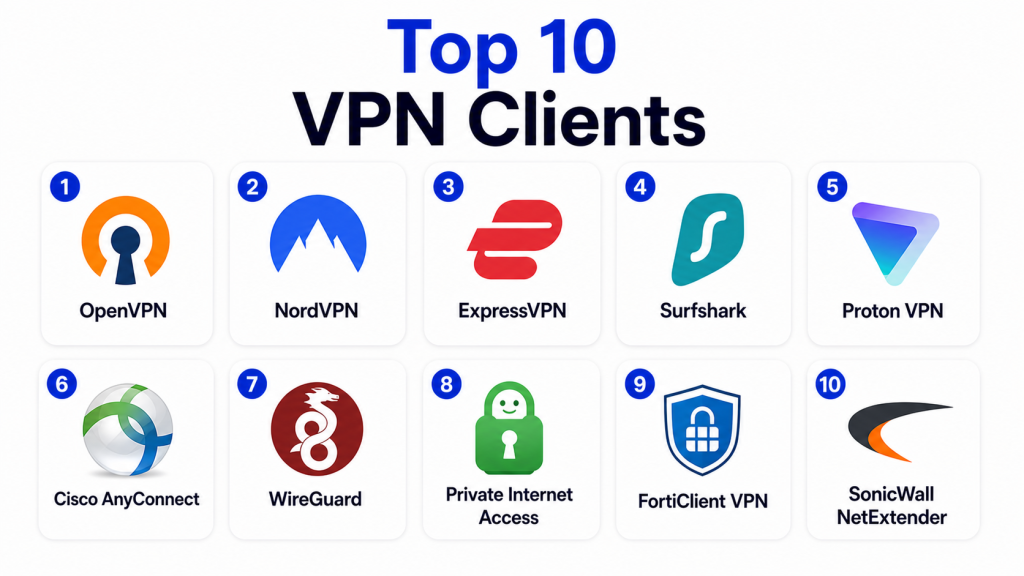
Introduction
VPN clients are applications that allow users to establish secure, encrypted connections between their device and a remote network. By routing internet traffic through encrypted tunnels, VPN clients protect sensitive data, maintain privacy, and enable secure access to internal systems from anywhere. They are widely used in both personal and enterprise environments for secure browsing, remote work, and compliance requirements.
With the rise of remote work, cloud adoption, and cybersecurity threats, VPN clients have become a critical component of modern IT infrastructure. Organizations rely on VPNs to safeguard data in transit, enforce access control, and ensure secure communication across distributed teams and systems.
Real-world use cases:
- Secure remote access to corporate networks
- Protecting sensitive data on public Wi-Fi
- Bypassing geo-restrictions for content access
- Enabling secure communication for distributed teams
What buyers should evaluate:
- Encryption standards and protocols
- Connection speed and reliability
- Ease of use and setup
- Cross-platform compatibility
- Server coverage and scalability
- Security features like kill switch and DNS protection
- Integration with enterprise systems
- Privacy policies and logging practices
Best for: Remote workers, enterprises, IT administrators, and individuals seeking secure and private internet access.
Not ideal for: Users who do not require encrypted connections or those operating entirely within secure, closed networks.
Key Trends in VPN Clients
- Zero Trust integration: VPNs are being integrated into broader Zero Trust architectures
- WireGuard adoption: Faster and more efficient VPN protocol gaining popularity
- Cloud-native VPNs: Designed for hybrid and multi-cloud environments
- Improved performance: Optimized routing and reduced latency
- Enhanced privacy features: No-log policies and advanced encryption
- Mobile-first design: Optimized apps for mobile devices
- Split tunneling: Better traffic management
- Enterprise security integration: Seamless connection with identity and access tools
- AI-based threat detection: Emerging trend in VPN security
How We Selected These Tools (Methodology)
- Evaluated market popularity and adoption
- Compared security protocols and encryption strength
- Assessed performance and connection reliability
- Reviewed ease of use and user experience
- Analyzed cross-platform support
- Considered enterprise and individual use cases
- Evaluated privacy practices and policies
- Balanced consumer and enterprise VPN solutions
Top 10 VPN Clients Tools
#1 — OpenVPN
Short description: OpenVPN is a widely used open-source VPN solution known for its flexibility and strong security features, suitable for both individuals and enterprises.
Key Features
- Open-source architecture
- Strong encryption
- Custom configuration
- Cross-platform support
- Secure tunneling
Pros
- Highly secure
- Flexible configuration
- Large community
Cons
- Complex setup
- Requires technical knowledge
- No built-in UI
Platforms / Deployment
Windows / macOS / Linux / iOS / Android
Cloud / Self-hosted
Security & Compliance
SSL/TLS encryption, strong authentication
Not publicly stated
Integrations & Ecosystem
Works across a wide range of enterprise and cloud environments.
- Network infrastructure
- Cloud platforms
Support & Community
Very strong open-source community.
#2 — NordVPN
Short description: NordVPN is a popular consumer VPN offering strong privacy features, fast speeds, and a large global server network.
Key Features
- No-log policy
- High-speed servers
- Double VPN
- Kill switch
- Global coverage
Pros
- Easy to use
- Strong privacy
- Fast performance
Cons
- Subscription cost
- Limited enterprise features
- Some advanced features hidden
Platforms / Deployment
Windows / macOS / Linux / iOS / Android
Cloud
Security & Compliance
Encryption, privacy features
Not publicly stated
Integrations & Ecosystem
Primarily designed for consumer use with limited integrations.
- Apps across devices
Support & Community
Strong customer support.
#3 — ExpressVPN
Short description: ExpressVPN is known for its speed, security, and ease of use, making it a top choice for both beginners and advanced users.
Key Features
- High-speed servers
- Strong encryption
- Easy-to-use apps
- Global server network
- Split tunneling
Pros
- Fast performance
- User-friendly
- Reliable
Cons
- Higher pricing
- Limited customization
- Subscription-based
Platforms / Deployment
Windows / macOS / Linux / iOS / Android
Cloud
Security & Compliance
Encryption, privacy features
Not publicly stated
Integrations & Ecosystem
Focused on user-friendly applications across devices.
- Device apps
Support & Community
Reliable customer support.
#4 — Surfshark
Short description: Surfshark is a cost-effective VPN offering unlimited device connections and strong privacy features.
Key Features
- Unlimited devices
- No-log policy
- Ad blocking
- Kill switch
- Multi-hop connections
Pros
- Affordable
- Feature-rich
- Easy to use
Cons
- Performance varies
- Smaller server network
- Limited enterprise use
Platforms / Deployment
Windows / macOS / Linux / iOS / Android
Cloud
Security & Compliance
Encryption, privacy tools
Not publicly stated
Integrations & Ecosystem
Designed for personal use across devices.
- Multi-device support
Support & Community
Good support availability.
#5 — Proton VPN
Short description: Proton VPN focuses on privacy and security, offering strong encryption and transparency features.
Key Features
- No-log policy
- Secure core servers
- Open-source apps
- Strong encryption
- Privacy focus
Pros
- High privacy standards
- Transparent
- Free tier available
Cons
- Slower free version
- Limited features in free plan
- Smaller network
Platforms / Deployment
Windows / macOS / Linux / iOS / Android
Cloud
Security & Compliance
Encryption, privacy-first design
Not publicly stated
Integrations & Ecosystem
Works with privacy-focused tools and services.
- Secure apps
Support & Community
Strong community and support.
#6 — Cisco AnyConnect
Short description: Cisco AnyConnect is an enterprise-grade VPN client designed for secure remote access and corporate environments.
Key Features
- Enterprise security
- Secure remote access
- Multi-factor authentication
- Policy enforcement
- Scalable deployment
Pros
- Enterprise-ready
- Highly secure
- Scalable
Cons
- Complex setup
- Expensive
- Requires Cisco infrastructure
Platforms / Deployment
Windows / macOS / Linux / iOS / Android
Cloud / Self-hosted
Security & Compliance
Enterprise-grade security
Not publicly stated
Integrations & Ecosystem
Deep integration with enterprise IT systems.
- Identity management
- Network infrastructure
Support & Community
Strong enterprise support.
#7 — WireGuard
Short description: WireGuard is a modern VPN protocol and client known for its simplicity, speed, and high performance.
Key Features
- Lightweight design
- High-speed connections
- Modern cryptography
- Easy configuration
- Open-source
Pros
- Very fast
- Simple design
- Efficient
Cons
- Limited features
- Requires setup
- Not full enterprise solution
Platforms / Deployment
Windows / macOS / Linux / iOS / Android
Self-hosted
Security & Compliance
Modern encryption
Not publicly stated
Integrations & Ecosystem
Works with modern networking environments.
- Network tools
Support & Community
Active open-source community.
#8 — Private Internet Access
Short description: A VPN service known for strong privacy features and customizable settings.
Key Features
- No-log policy
- Custom encryption settings
- Large server network
- Ad blocking
- Multi-device support
Pros
- Customizable
- Affordable
- Reliable
Cons
- Interface complexity
- Performance varies
- Limited enterprise features
Platforms / Deployment
Windows / macOS / Linux / iOS / Android
Cloud
Security & Compliance
Encryption
Not publicly stated
Integrations & Ecosystem
Designed for personal and small business use.
- Device apps
Support & Community
Good support availability.
#9 — FortiClient VPN
Short description: FortiClient VPN is part of Fortinet’s security ecosystem, offering secure remote access and endpoint protection.
Key Features
- Secure remote access
- Endpoint security
- Integration with Fortinet tools
- Policy enforcement
- Threat protection
Pros
- Enterprise-grade
- Integrated security
- Scalable
Cons
- Requires Fortinet ecosystem
- Complex setup
- Limited standalone use
Platforms / Deployment
Windows / macOS / Linux / iOS / Android
Cloud / Hybrid
Security & Compliance
Enterprise security
Not publicly stated
Integrations & Ecosystem
Works within Fortinet security stack.
- Network security tools
Support & Community
Strong enterprise support.
#10 — SonicWall NetExtender
Short description: SonicWall NetExtender is a VPN client designed for secure remote access within enterprise environments.
Key Features
- SSL VPN
- Secure remote access
- Lightweight client
- Easy deployment
- Enterprise integration
Pros
- Simple to use
- Secure
- Lightweight
Cons
- Limited features
- Requires SonicWall setup
- Not for personal use
Platforms / Deployment
Windows / Linux
Self-hosted
Security & Compliance
SSL encryption
Not publicly stated
Integrations & Ecosystem
Designed for enterprise network environments.
- SonicWall systems
Support & Community
Enterprise-focused support.
Comparison Table (Top 10)
| Tool Name | Best For | Platform(s) Supported | Deployment | Standout Feature | Public Rating |
|---|---|---|---|---|---|
| OpenVPN | Flexibility | Cross-platform | Hybrid | Open-source | N/A |
| NordVPN | Personal use | Cross-platform | Cloud | Privacy features | N/A |
| ExpressVPN | Speed | Cross-platform | Cloud | High performance | N/A |
| Surfshark | Budget users | Cross-platform | Cloud | Unlimited devices | N/A |
| Proton VPN | Privacy | Cross-platform | Cloud | Transparency | N/A |
| Cisco AnyConnect | Enterprise | Cross-platform | Hybrid | Secure access | N/A |
| WireGuard | Performance | Cross-platform | Self-hosted | Lightweight | N/A |
| PIA | Customization | Cross-platform | Cloud | Config options | N/A |
| FortiClient | Enterprise security | Cross-platform | Hybrid | Integration | N/A |
| SonicWall | Remote access | Windows/Linux | Self-hosted | SSL VPN | N/A |
Evaluation & Scoring of VPN Clients
| Tool Name | Core | Ease | Integrations | Security | Performance | Support | Value | Weighted Total |
|---|---|---|---|---|---|---|---|---|
| OpenVPN | 9 | 6 | 8 | 9 | 8 | 9 | 9 | 8.4 |
| NordVPN | 8 | 9 | 6 | 8 | 9 | 9 | 8 | 8.3 |
| ExpressVPN | 8 | 9 | 6 | 8 | 9 | 9 | 7 | 8.2 |
| Surfshark | 8 | 9 | 6 | 8 | 8 | 8 | 9 | 8.3 |
| Proton VPN | 8 | 8 | 6 | 9 | 8 | 8 | 8 | 8.1 |
| Cisco AnyConnect | 9 | 7 | 9 | 9 | 8 | 9 | 7 | 8.6 |
| WireGuard | 8 | 7 | 7 | 9 | 10 | 8 | 9 | 8.5 |
| PIA | 8 | 8 | 6 | 8 | 8 | 8 | 9 | 8.1 |
| FortiClient | 9 | 7 | 9 | 9 | 8 | 9 | 7 | 8.6 |
| SonicWall | 8 | 7 | 8 | 8 | 7 | 8 | 8 | 7.9 |
How to interpret the scores:
These scores provide a relative comparison based on security, performance, usability, and integrations. Higher scores indicate stronger overall capabilities, but the best tool depends on your use case. For example, WireGuard excels in performance, while Cisco AnyConnect is better suited for enterprise environments. Always align your choice with your requirements, budget, and infrastructure.
Which VPN Client Is Right for You?
Solo / Freelancer
Choose NordVPN, Surfshark, or Proton VPN for ease of use and privacy.
SMB
OpenVPN or WireGuard offer flexibility and cost efficiency.
Mid-Market
Private Internet Access or Proton VPN provide balanced features.
Enterprise
Cisco AnyConnect or FortiClient VPN are best for scalability and security.
Budget vs Premium
Consumer VPNs are affordable, while enterprise tools require higher investment.
Feature Depth vs Ease of Use
Consumer tools are easier, while enterprise tools offer deeper control.
Integrations & Scalability
Enterprise VPNs integrate better with IT infrastructure.
Security & Compliance Needs
Choose enterprise solutions for strict compliance requirements.
Frequently Asked Questions (FAQs)
1. What is a VPN client?
A VPN client is software that creates a secure, encrypted connection between your device and a remote server. It helps protect your data and privacy while using the internet. It is widely used for secure communication.
2. Are VPN clients safe?
Yes, VPN clients are designed to secure your internet traffic using encryption. However, safety depends on the provider and configuration. Always choose trusted tools.
3. Which VPN is best for privacy?
VPNs with strict no-log policies and strong encryption are best for privacy. Proton VPN and NordVPN are commonly used for this purpose. Always review privacy policies.
4. Can VPNs improve security?
Yes, VPNs protect data in transit and reduce exposure to cyber threats. They are especially useful on public networks. They add an extra layer of security.
5. Do VPNs slow down internet speed?
VPNs may reduce speed slightly due to encryption. However, modern VPNs optimize performance to minimize impact. Premium tools offer better speed.
6. What is WireGuard?
WireGuard is a modern VPN protocol known for its speed and simplicity. It uses advanced cryptography. It is becoming widely adopted.
7. Are VPNs legal?
VPNs are legal in most regions, but usage laws vary. Always check local regulations. Enterprises commonly use VPNs for security.
8. Can VPNs bypass restrictions?
Yes, VPNs can bypass geo-restrictions by routing traffic through different servers. However, this depends on the provider. Not all VPNs support this equally.
9. Do I need a VPN at home?
It depends on your security needs. VPNs can enhance privacy and protection. Many users use them for added security.
10. How do I choose a VPN client?
Evaluate security, performance, and usability. Consider your use case and budget. Test a few options before deciding.
Conclusion
VPN clients play a crucial role in securing modern digital communication by providing encrypted connections, protecting sensitive data, and enabling remote access across distributed environments. From consumer-friendly solutions like NordVPN and Surfshark to enterprise-grade tools like Cisco AnyConnect and FortiClient, each option serves different user needs based on scale, security requirements, and infrastructure complexity. While protocols like WireGuard are improving performance and efficiency, traditional solutions like OpenVPN continue to offer flexibility and reliability. The best VPN client depends on your specific use case, whether it is personal privacy, small business operations, or enterprise-level security. Start by identifying your requirements, shortlist a few tools, and test them to ensure they meet your performance, security, and integration needs before making a final decision.
