Introduction
Academic Credentialing Platforms are specialized systems used by educational institutions to issue, manage, verify, and share academic credentials such as diplomas, transcripts, certificates, and digital badges. These platforms replace traditional paper-based credentials with secure, verifiable digital formats that can be easily shared and validated by employers, institutions, and third parties.
As education becomes increasingly digital and global, credentialing platforms play a critical role in preventing fraud, improving credential transparency, and enabling seamless academic mobility. They support modern learning models such as micro-credentials, online certifications, and lifelong learning pathways while ensuring authenticity and compliance.
Common use cases include:
- Digital diploma and transcript issuance
- University credential verification
- Online course certification
- Academic credential sharing for job applications
- Skill-based credentialing and micro-certifications
Key evaluation criteria:
- Credential security and verification mechanisms
- Support for digital badges and transcripts
- Integration with LMS and student information systems
- Automation and bulk issuance
- Compliance with academic standards
- User experience for students and administrators
- Global recognition and interoperability
- Analytics and reporting
Best for: Universities, colleges, online education platforms, certification bodies, and academic institutions managing large-scale credential issuance.
Not ideal for: Organizations issuing only a few paper certificates or those without digital credential verification requirements.
Key Trends in Academic Credentialing Platforms
- Shift from paper credentials to secure digital formats
- Adoption of verifiable credentials and metadata-based validation
- Integration with LMS and student information systems
- Growth of micro-credentials and digital badges
- Blockchain-based credential verification to reduce fraud
- Mobile-first access to academic credentials
- Increased demand for global credential portability
- White-label branding for institutions
- Real-time credential issuance and tracking
- Stronger focus on interoperability standards
How We Selected These Tools Methodology
- Evaluated global adoption across universities and institutions
- Assessed credential issuance and verification capabilities
- Reviewed scalability and automation features
- Considered integration with LMS and SIS systems
- Analyzed ease of use for administrators and students
- Included both enterprise and flexible platforms
- Focused on security and fraud prevention capabilities
- Balanced traditional academic and modern credential systems
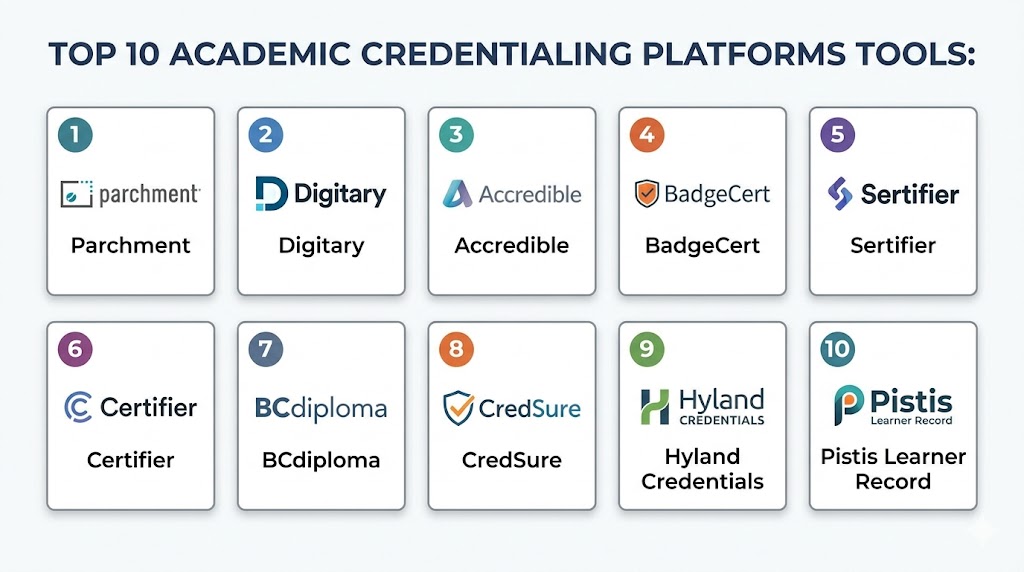
Top 10 Academic Credentialing Platforms Tools
#1 — Parchment
Short description:
Parchment is a widely used academic credential platform focused on digital transcripts and diploma delivery for educational institutions. It provides secure credential sharing and verification for employers and institutions. The platform supports large-scale academic networks. It is highly trusted in higher education systems.
Key Features
- Digital transcript and diploma delivery
- Secure credential verification
- Student-controlled sharing
- Integration with academic systems
- Long-term credential storage
- Global institution network
Pros
- Strong adoption in universities
- Trusted verification system
- Reliable infrastructure
Cons
- Limited customization
- Focused mainly on higher education
- Pricing varies
Platforms / Deployment
Cloud
Security & Compliance
Encryption, audit trails, compliance alignment
Integrations & Ecosystem
Integrates with student information systems and institutional platforms.
- APIs
- SIS integrations
- Academic systems
Support & Community
Enterprise support for institutions
#2 — Digitary
Short description:
Digitary provides digital credential solutions for universities and education providers. It focuses on secure credential access and sharing. The platform supports global academic mobility. It enables students to manage their credentials digitally.
Key Features
- Digital credential storage
- Secure access and sharing
- Academic record management
- Verification tools
- Global credential support
Pros
- Strong academic focus
- Secure sharing
- Global reach
Cons
- Limited customization
- Smaller ecosystem
- Pricing varies
Platforms / Deployment
Cloud
Security & Compliance
Not publicly stated
Integrations & Ecosystem
Integrates with education systems and credential networks.
- APIs
- Academic integrations
Support & Community
Institution-focused support
#3 — Accredible
Short description:
Accredible is a leading digital credential platform used by education providers to issue certificates and badges. It focuses on automation, branding, and learner engagement. The platform supports verifiable credentials. It is widely adopted in academic and training environments.
Key Features
- Digital certificate and badge issuance
- Credential verification
- Automation workflows
- Analytics and reporting
- Branding customization
- Credential transcripts
Pros
- Easy to use
- Strong automation
- High customization
Cons
- Pricing may be high
- Advanced setup required
- Limited free options
Platforms / Deployment
Cloud
Security & Compliance
Not publicly stated
Integrations & Ecosystem
Integrates with LMS and training systems for automated issuance.
- APIs
- LMS integrations
- CRM systems
Support & Community
Good documentation and support
#4 — BadgeCert
Short description:
BadgeCert is a digital credential platform designed for issuing and verifying academic credentials. It provides tools for managing digital certificates and badges. The platform emphasizes security and authenticity. It is suitable for institutions and enterprises.
Key Features
- Credential issuance
- Verification tools
- Secure sharing
- Analytics dashboard
- Branding options
Pros
- Strong verification features
- Easy sharing
- Secure
Cons
- Limited customization
- Smaller ecosystem
- UI limitations
Platforms / Deployment
Cloud
Security & Compliance
Not publicly stated
Integrations & Ecosystem
Supports integration with enterprise and education systems.
- APIs
- Integration tools
Support & Community
Standard support
#5 — Sertifier
Short description:
Sertifier is a credentialing platform designed for educational organizations to issue digital certificates and badges efficiently. It offers automation and customization features. The platform is suitable for academic institutions and training providers. It simplifies credential workflows.
Key Features
- Certificate issuance
- Automation tools
- Credential tracking
- Branding customization
- Analytics
Pros
- Easy to use
- Fast setup
- Affordable
Cons
- Limited enterprise features
- Smaller ecosystem
- Fewer integrations
Platforms / Deployment
Cloud
Security & Compliance
Not publicly stated
Integrations & Ecosystem
Supports integration with education platforms.
- APIs
- LMS integrations
Support & Community
Responsive support
#6 — Certifier
Short description:
Certifier is a modern credentialing platform designed for creating and managing digital academic certificates. It focuses on automation and ease of use. The platform is suitable for small and mid-sized institutions. It supports efficient credential distribution.
Key Features
- Certificate creation
- Automated issuance
- Credential tracking
- Analytics dashboard
- Branding options
Pros
- User-friendly
- Affordable
- Fast deployment
Cons
- Limited enterprise features
- Smaller ecosystem
- Basic integrations
Platforms / Deployment
Cloud
Security & Compliance
Not publicly stated
Integrations & Ecosystem
Supports integration with learning systems.
- APIs
- LMS integrations
Support & Community
Good support
#7 — BCdiploma
Short description:
BCdiploma is a blockchain-based academic credential platform designed for secure diploma issuance and verification. It focuses on fraud prevention and authenticity. The platform is suitable for institutions seeking advanced security. It supports decentralized credential systems.
Key Features
- Blockchain-based credentials
- Diploma issuance
- Verification tools
- Secure storage
- Fraud prevention
Pros
- High security
- Decentralized approach
- Strong verification
Cons
- Technical complexity
- Limited adoption
- Requires expertise
Platforms / Deployment
Cloud
Security & Compliance
Not publicly stated
Integrations & Ecosystem
Supports integration with blockchain systems and academic platforms.
- APIs
- Blockchain integrations
Support & Community
Growing ecosystem
#8 — CredSure
Short description:
CredSure is a blockchain-powered credential platform that enables secure issuance and verification of academic credentials. It focuses on authenticity and tamper-proof records. The platform is suitable for institutions adopting modern credential systems. It enhances trust in digital credentials.
Key Features
- Digital credential issuance
- Blockchain verification
- Secure storage
- Credential sharing
- Fraud prevention
Pros
- Tamper-proof credentials
- Strong security
- Modern approach
Cons
- Limited adoption
- Requires technical knowledge
- Smaller ecosystem
Platforms / Deployment
Cloud
Security & Compliance
Not publicly stated
Integrations & Ecosystem
Supports integration with academic and blockchain systems.
- APIs
- Developer tools
Support & Community
Growing support
#9 — Hyland Credentials
Short description:
Hyland Credentials provides solutions for managing academic records and credentialing processes. It focuses on document management and secure credential handling. The platform is suitable for institutions managing large volumes of records. It supports compliance and data management.
Key Features
- Credential management
- Document storage
- Secure sharing
- Workflow automation
- Reporting tools
Pros
- Strong document management
- Scalable
- Reliable
Cons
- Less focused on modern credentials
- Complex setup
- Pricing varies
Platforms / Deployment
Cloud / Hybrid
Security & Compliance
Not publicly stated
Integrations & Ecosystem
Integrates with enterprise and academic systems.
- APIs
- Data integrations
Support & Community
Enterprise support
#10 — Pistis Learner Record
Short description:
Pistis Learner Record is a platform focused on managing learner credentials and academic records. It supports digital credential storage and sharing. The platform is suitable for institutions and training providers. It enables secure and efficient record management.
Key Features
- Learner record management
- Credential storage
- Secure sharing
- Reporting tools
- Integration capabilities
Pros
- Simple interface
- Efficient record management
- Flexible
Cons
- Limited advanced features
- Smaller ecosystem
- Pricing varies
Platforms / Deployment
Cloud
Security & Compliance
Not publicly stated
Integrations & Ecosystem
Supports integration with learning and academic systems.
- APIs
- LMS integrations
Support & Community
Standard support
Comparison Table
| Tool Name | Best For | Platform Supported | Deployment | Standout Feature | Public Rating |
|---|---|---|---|---|---|
| Parchment | Universities | Web | Cloud | Digital transcripts | N/A |
| Digitary | Academic institutions | Web | Cloud | Credential sharing | N/A |
| Accredible | Training providers | Web | Cloud | Automation | N/A |
| BadgeCert | Secure credentials | Web | Cloud | Verification | N/A |
| Sertifier | SMB education | Web | Cloud | Fast setup | N/A |
| Certifier | Small institutions | Web | Cloud | Ease of use | N/A |
| BCdiploma | Blockchain credentials | Web | Cloud | Security | N/A |
| CredSure | Tamper-proof credentials | Web | Cloud | Blockchain verification | N/A |
| Hyland | Record management | Web | Hybrid | Document workflows | N/A |
| Pistis | Learner records | Web | Cloud | Record management | N/A |
Evaluation and Scoring of Academic Credentialing Platforms
| Tool Name | Core | Ease | Integrations | Security | Performance | Support | Value | Weighted Total |
|---|---|---|---|---|---|---|---|---|
| Parchment | 9 | 7 | 8 | 9 | 9 | 8 | 7 | 8.4 |
| Digitary | 8 | 7 | 7 | 8 | 8 | 7 | 7 | 7.7 |
| Accredible | 9 | 8 | 8 | 8 | 8 | 8 | 7 | 8.1 |
| BadgeCert | 7 | 8 | 7 | 7 | 7 | 7 | 7 | 7.3 |
| Sertifier | 7 | 9 | 7 | 7 | 7 | 7 | 8 | 7.6 |
| Certifier | 8 | 9 | 7 | 7 | 8 | 7 | 9 | 8.0 |
| BCdiploma | 8 | 6 | 7 | 9 | 7 | 6 | 7 | 7.5 |
| CredSure | 8 | 6 | 7 | 9 | 7 | 6 | 7 | 7.5 |
| Hyland | 8 | 6 | 8 | 8 | 8 | 7 | 6 | 7.6 |
| Pistis | 7 | 8 | 7 | 7 | 7 | 7 | 7 | 7.3 |
How to interpret these scores:
These scores provide a comparative view of how each platform performs across key areas such as features, usability, integrations, and security. Higher scores indicate stronger overall capability, but they should not be treated as absolute rankings. Enterprise-focused tools typically score higher in security and integrations, while smaller platforms excel in ease of use and cost efficiency. The weighted scoring model balances these criteria to provide a realistic comparison across different types of platforms. Decision-makers should prioritize factors that align with their institutional needs, such as scalability, compliance, or automation, rather than relying solely on the final score. Testing shortlisted platforms in real-world scenarios is recommended before making a final decision.
Which Academic Credentialing Platform Is Right for You
Solo Freelancer
Use simple tools like Certifier or Sertifier for issuing certificates quickly with minimal setup.
SMB
Accredible or Certifier provide automation, branding, and ease of use for growing institutions.
Mid Market
Digitary or BadgeCert offer better scalability and integration capabilities.
Enterprise
Parchment and Hyland provide robust infrastructure and compliance support for large institutions.
Budget vs Premium
Budget tools focus on simplicity, while premium platforms offer advanced features and integrations.
Feature Depth vs Ease of Use
Advanced platforms provide more control and analytics, while simpler tools prioritize usability.
Integrations and Scalability
API-driven platforms are better for scaling and connecting systems.
Security and Compliance Needs
Institutions should prioritize platforms with strong verification and audit capabilities.
Frequently Asked Questions
1 What is an academic credentialing platform
An academic credentialing platform is a system used to issue and manage digital academic records such as diplomas and certificates. It ensures credentials are secure and verifiable. These platforms replace paper-based systems. They improve efficiency and trust.
2 How do digital credentials improve education
Digital credentials make it easier to verify qualifications and share achievements globally. They reduce fraud and streamline hiring processes. They also support modern learning models. This improves transparency and accessibility.
3 Are academic credentials secure
Most platforms use encryption and verification mechanisms to ensure authenticity. Security depends on the platform design. Advanced systems include tamper-proof features. Choosing a reliable platform is important.
4 Can these platforms integrate with LMS
Yes, most credentialing platforms integrate with learning systems to automate credential issuance. This improves efficiency. Integration is a key feature for scalability. API support is essential.
5 What is a digital badge
A digital badge is a visual representation of a skill or achievement that includes verifiable metadata. It can be shared online. It helps showcase learning outcomes. It is widely used in education.
6 How much do these platforms cost
Pricing varies depending on features and usage volume. Some platforms offer subscription models. Enterprise tools are more expensive. Smaller tools are more affordable.
7 Can credentials be revoked
Yes, most platforms allow revocation or expiration of credentials. This ensures accuracy and compliance. It is important for maintaining trust. Revocation is a key feature.
8 Are blockchain credentials better
Blockchain credentials offer strong security and tamper-proof records. However, they may be complex to implement. Traditional systems are still widely used. The choice depends on needs.
9 Who uses academic credential platforms
Universities, colleges, training providers, and certification bodies use these platforms. They are also used in corporate training. Any organization issuing credentials can benefit. Adoption is increasing.
10 How do I choose the right platform
Evaluate factors such as ease of use, integrations, security, and scalability. Consider your institution’s needs. Test different platforms before deciding. Choose one that aligns with your workflow.
Conclusion
Academic credentialing platforms are transforming how institutions issue, manage, and verify educational achievements by replacing outdated paper-based systems with secure, digital solutions that improve transparency, accessibility, and trust. These platforms enable institutions to support modern learning models, including online education, micro-credentials, and global credential sharing, while reducing fraud and administrative overhead. While enterprise platforms provide advanced capabilities, scalability, and compliance features for large institutions, smaller and mid-sized platforms offer simplicity, flexibility, and cost efficiency for growing organizations. The right platform depends on your institution’s size, goals, and technical requirements. Instead of choosing a single solution immediately, institutions should shortlist a few platforms, evaluate their features through pilot programs, and ensure they integrate well with existing systems. A structured evaluation approach will help maximize long-term value and ensure a seamless credentialing experience for both administrators and learners.

The comparison is easy to follow and highlights the key strengths of each academic credentialing platform, making the selection process much simpler for institutions and educators.