Introduction
Mental Health Therapy Apps are digital platforms that connect users with licensed professional counselors or provide evidence-based therapeutic tools through a mobile or web interface. In the current landscape, these apps have moved beyond simple mood trackers to become full-service clinical ecosystems. They address the growing gap between the high demand for mental health support and the limited availability of in-person providers. By utilizing asynchronous messaging, live video sessions, and AI-driven supplemental tools, these platforms offer a level of accessibility and privacy that was previously impossible in traditional clinical settings.
The significance of these tools lies in their ability to remove common barriers to care, such as high costs, geographical limitations, and social stigma. For many, a therapy app is the first point of entry into the mental health system. Modern platforms now prioritize clinical rigor, ensuring that practitioners are fully licensed and that data is handled with the highest levels of medical-grade security. As hybrid work and digital-first lifestyles become the norm, these apps provide a flexible framework for maintaining emotional well-being without the need for traditional office visits.
Real-world use cases include:
- Managing High-Functioning Anxiety: Using daily check-ins and CBT exercises to handle workplace stress.
- Post-Partum Support: Connecting new parents with specialized counselors from the privacy of their homes.
- Relationship Counseling: Facilitating joint sessions for couples who may be in different physical locations.
- Teen Mental Health: Providing a text-based medium that feels more natural and less intimidating for younger users.
- Workplace Wellness: Offering employees an anonymous and immediate way to process burnout or personal crises.
What buyers should evaluate:
- Therapist Licensure and Vetting: How rigorous is the platform’s process for verifying credentials?
- Insurance Compatibility: Does the app accept major insurance plans, or is it strictly out-of-pocket?
- Communication Modalities: Does it offer video, phone, and unlimited messaging options?
- Therapist Matching Speed: How long does it take to be paired with a professional after the initial intake?
- Data Security Standards: Is the platform HIPAA-compliant and does it offer medical-grade encryption?
- Specialized Care Tracks: Are there dedicated professionals for LGBTQ+, veterans, or specific clinical conditions?
- User Interface (UI) Experience: Is the app intuitive and calming, or is it cluttered and difficult to navigate?
- Cancellation and Refund Policies: How easy is it to switch therapists or pause the subscription?
Mandatory paragraph
- Best for: Individuals with busy schedules, those living in rural areas with few local therapists, and people seeking specialized care that may not be available in their immediate vicinity.
- Not ideal for: Individuals experiencing an active psychiatric crisis, those with severe psychosis, or anyone requiring intensive inpatient hospitalization or 24/7 in-person supervision.
Key Trends in Mental Health Therapy Apps
- AI-Assisted Triage and Matching: Platforms are using advanced algorithms to analyze intake data, matching users with therapists whose clinical specialties most accurately align with the user’s specific needs.
- Wearable Integration for Mood Tracking: Deep synchronization with smartwatches allows therapists to view physiological data, such as heart rate variability and sleep patterns, to better understand a user’s stress triggers.
- Insurance-First Business Models: There is a major shift toward apps becoming in-network with national insurance providers, significantly lowering the “copay” barrier for the average user.
- Focus on Asynchronous “Voice Memos”: Moving beyond simple text, platforms are incorporating secure voice messaging, allowing for a more nuanced expression of emotion between live sessions.
- Augmented CBT Exercises: AI-led “coaches” act as a bridge between human therapy sessions, helping users practice cognitive-behavioral techniques in real-time when they face a trigger.
- Standardization of Outcome Measures: Apps are increasingly using standardized clinical tests (like PHQ-9 and GAD-7) to provide users and therapists with quantifiable data on progress.
- Hyper-Specialization by Identity: Emerging platforms are focusing exclusively on niche communities, such as specialized care for specific cultural backgrounds or professional groups.
- Enhanced Data Privacy Protocols: In response to heightened security concerns, top-tier apps are implementing zero-knowledge encryption for messaging to ensure that not even the platform provider can access session content.
How We Selected These Tools (Methodology)
The selection of these platforms is based on a comprehensive analysis of the digital health market. Our methodology focuses on the following pillars:
- Clinical Credibility: We prioritized platforms that only employ fully licensed, accredited, and vetted mental health professionals.
- Accessibility and Range: Tools were evaluated on their availability across various regions and their support for multiple communication methods.
- Data Security and Privacy: We only included platforms that demonstrate a clear commitment to medical data protection and regulatory compliance.
- User Feedback and Reliability: Evaluation included performance signals, app stability, and the consistency of the therapist-matching process.
- Innovation and Modern Features: Preference was given to apps that integrate modern tools like AI coaching, mood tracking, and wearable sync.
- Value for Cost: We assessed the pricing models relative to the quality and frequency of care provided, including the availability of financial aid.
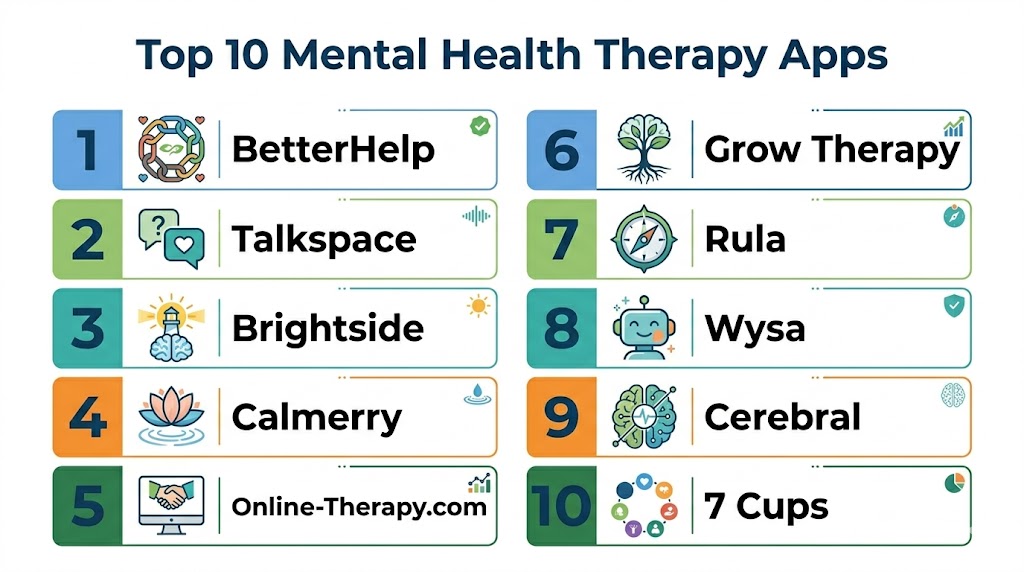
Top 10 Mental Health Therapy Apps
#1 — BetterHelp
Short description: BetterHelp is the world’s largest therapy platform, offering access to over 30,000 licensed, accredited, and experienced therapists. It is designed for maximum accessibility, allowing users to connect with a therapist via text, phone, or video sessions at a price point that is often lower than traditional in-person therapy.
Key Features
- Massive Therapist Network: Thousands of providers covering nearly every specialty and identity.
- Unlimited Messaging: Send a message to your therapist anytime, and they will respond as soon as they are available.
- Live Weekly Sessions: Every subscription includes a dedicated live session via video or phone.
- Financial Aid Program: One of the few platforms that offers significant discounts based on income level.
- Flexible Matching: Easily switch therapists with the click of a button if the initial match doesn’t feel right.
Pros
- Unmatched therapist availability and matching speed.
- Extremely user-friendly mobile and desktop interface.
- Strong financial aid options for those on a tight budget.
Cons
- Does not accept insurance directly for most users.
- Therapists cannot prescribe medication or provide official medical diagnoses.
Platforms / Deployment
- Web / iOS / Android
- Cloud
Security & Compliance
- Data encryption, MFA, and secure login.
- HIPAA-compliant communication.
Integrations & Ecosystem
BetterHelp focuses on a self-contained ecosystem to ensure privacy.
- Google Calendar / iCal for session scheduling.
- Secure internal payment processing.
- Built-in digital journal.
Support & Community
Extensive help center, 24/7 technical support, and a vast library of educational wellness content.
#2 — Talkspace
Short description: Talkspace is a pioneer in the online therapy space, known specifically for its “messaging-first” approach and its extensive partnerships with insurance companies. It provides individual, couples, and teen therapy, as well as specialized psychiatric services for medication management.
Key Features
- Insurance In-Network: Partners with many major national insurance providers to lower out-of-pocket costs.
- Psychiatry Services: Dedicated providers who can manage and prescribe medications.
- Asynchronous Texting: A “room” where you can leave messages for your therapist 24/7.
- Business/Enterprise Focus: Often offered as a subsidized benefit through employers.
- Secure Video Sessions: High-quality live video for face-to-face clinical work.
Pros
- Excellent for those who prefer to use their health insurance.
- Offers a “one-stop-shop” for both therapy and medication management.
- Strong support for teens and adolescents with parental consent.
Cons
- The messaging-only plan can feel impersonal for some users.
- Matching process can sometimes take longer than competitors.
Platforms / Deployment
- Web / iOS / Android
- Cloud
Security & Compliance
- Banking-grade encryption and MFA.
- HIPAA and SOC 2 compliant.
Integrations & Ecosystem
Talkspace is designed to integrate with corporate wellness systems and insurance portals.
- Integration with major EAP (Employee Assistance Programs).
- Sync with internal health tracking modules.
- Varies / N/A.
Support & Community
Professional clinical support team and a detailed onboarding process for new users.
#3 — Brightside
Short description: Brightside focuses specifically on treating anxiety and depression using an evidence-based approach that combines therapy with precision psychiatry. It is highly data-driven, using clinical tools to measure progress and adjust treatment plans in real-time.
Key Features
- Precision Psychiatry: Uses data-driven tools to find the right medication for your specific symptoms.
- Crisis Care Program: A specialized track for those with elevated suicide risk.
- Evidence-Based CBT: Therapy plans are rooted in Cognitive Behavioral Therapy principles.
- Progress Tracking: Regular clinical assessments to monitor improvement levels.
- Insurance Acceptance: Now accepting many major plans, including some state-based options.
Pros
- Best-in-class for severe or clinical-level anxiety and depression.
- Highly structured treatment plans with clear milestones.
- Integration of therapy and medication management is seamless.
Cons
- More expensive than “general” wellness apps if paying out of pocket.
- Less focus on general life coaching or relationship issues.
Platforms / Deployment
- Web / iOS / Android
- Cloud
Security & Compliance
- Medical-grade data protection.
- HIPAA compliant.
Integrations & Ecosystem
Brightside integrates with clinical lab systems for medication monitoring.
- Pharmacy fulfillment networks.
- Clinical outcome databases.
- Varies / N/A.
Support & Community
High-touch clinical support and a focus on long-term symptom remission.
#4 — Calmerry
Short description: Calmerry is a budget-friendly therapy platform that prioritizes simplicity and professional licensure. It is designed for those who want a straightforward experience without the “clutter” of many additional app features, focusing purely on the relationship between user and therapist.
Key Features
- Transparent Pricing: Clear, affordable tiers with no hidden fees.
- Licensed Professionals: Every therapist is verified and state-licensed.
- Daily Messaging: Unlimited text messaging with guaranteed daily responses.
- Free Therapist Switching: Change your provider at any time for any reason.
- Bespoke Matching: A human-led matching process rather than just algorithms.
Pros
- One of the most affordable options for text-based therapy.
- Very simple and easy-to-use interface for non-technical users.
- High emphasis on the human connection during the intake process.
Cons
- Fewer “extra” tools like journals or meditation guides compared to others.
- Does not currently offer psychiatry or medication management.
Platforms / Deployment
- Web / iOS / Android
- Cloud
Security & Compliance
- Encryption and secure server hosting.
- HIPAA compliant.
Integrations & Ecosystem
Calmerry maintains a lean ecosystem to keep costs low.
- Stripe for secure payments.
- Varies / Not publicly stated.
- N/A.
Support & Community
Responsive customer support via email and live chat.
#5 — Online-Therapy.com
Short description: Based on a comprehensive CBT toolbox, Online-Therapy.com provides a structured, educational approach to therapy. It is ideal for users who want “homework” and active exercises to complete between their live sessions with a counselor.
Key Features
- CBT Toolbox: Includes worksheets, a digital journal, and activity plans.
- Worksheet Feedback: Therapists provide written feedback on your exercises daily.
- Live Video/Yoga: Unique integration of physical movement and mental exercises.
- Progress Dashboard: Visual tracking of your worksheet completion and mood.
- Affordable Entry Point: Offers a very competitive price for those focused on CBT.
Pros
- Excellent for those who like a structured, educational style of therapy.
- High level of therapist interaction through the worksheet feedback system.
- Includes bonus wellness content like yoga sessions.
Cons
- The “homework” aspect may be overwhelming for those looking for simple venting.
- The interface is more functional than modern or “sleek.”
Platforms / Deployment
- Web / iOS / Android
- Cloud
Security & Compliance
- SSL encryption and secure data storage.
- HIPAA compliant.
Integrations & Ecosystem
Online-Therapy.com functions as a standalone therapeutic course.
- Internal payment gateway.
- Secure worksheet storage system.
- Varies / N/A.
Support & Community
Strong educational community and high-quality therapist-led tutorials.
#6 — Grow Therapy
Short description: Grow Therapy is a bridge between a traditional therapist directory and a management platform. It allows users to find local therapists who take their insurance and book online video or in-person sessions through a centralized portal.
Key Features
- Insurance Directory: Focuses heavily on finding providers who are in-network.
- Provider Choice: Unlike many apps, you choose your therapist from a detailed list.
- Local or Remote: Options for both telehealth and in-person visits.
- Simple Billing: Handles the insurance claims and copay processing automatically.
- Intake Matching: Filters for specialty, gender, and language.
Pros
- Best for people who want to use their health insurance copay ($0 – $30).
- Gives the user more control over exactly who their therapist is.
- Transparent pricing before you book the session.
Cons
- It is more of a directory than a “therapeutic app” with tools.
- No asynchronous messaging “room” between sessions on most plans.
Platforms / Deployment
- Web / iOS / Android
- Cloud
Security & Compliance
- Secure patient portal and encrypted communications.
- HIPAA compliant.
Integrations & Ecosystem
Grow Therapy integrates with national insurance databases to verify coverage.
- Major insurance carrier portals (Aetna, Blue Cross, etc.).
- Google Calendar / Outlook.
- Varies / N/A.
Support & Community
Customer success team to help with insurance verification issues.
#7 — Rula
Short description: Rula (formerly Path Mental Health) focuses on the “perfect match” between therapist and patient. By analyzing deep clinical data and personal preferences, Rula seeks to reduce the “trial and error” often associated with starting therapy.
Key Features
- Deep Clinical Matching: Uses a detailed questionnaire to find specific expertise.
- Insurance Specialist: In-network with a massive variety of insurance plans.
- Telehealth Focus: Streamlined video platform built for clinical work.
- Rapid Onboarding: Often match and book a session within 48 hours.
- Diverse Provider Pool: Strong focus on cultural competency and diverse backgrounds.
Pros
- Very high success rate for the first therapist match.
- Exceptional handling of insurance and billing paperwork.
- Focuses on evidence-based clinicians.
Cons
- No native “wellness app” tools like mood tracking.
- Focused solely on the US market.
Platforms / Deployment
- Web
- Cloud
Security & Compliance
- Enterprise-grade security and MFA.
- HIPAA compliant.
Integrations & Ecosystem
Rula connects directly with insurance payer systems for real-time verification.
- Zocdoc for discovery.
- Major medical insurance carriers.
- Varies / N/A.
Support & Community
Dedicated support for both therapists and patients to ensure a smooth connection.
#8 — Wysa
Short description: Wysa is an AI-first platform that provides emotional support and behavioral coaching. It is not “therapy” in the traditional sense initially, but it acts as a 24/7 bridge, providing human-led therapy as an upgrade path for those who need it.
Key Features
- AI Coach: A conversational bot that uses CBT and DBT to help you process feelings.
- SOS Safety Plan: Immediate tools for grounding during intense moments.
- Exercise Library: 100+ evidence-based self-care tools.
- Anonymity: No personal identifying information is required for the AI chat.
- Human Therapist Upgrade: Access to a licensed professional for deeper work.
Pros
- Available 24/7 for immediate venting and coping.
- Zero stigma due to the initial AI-led interface.
- Excellent for those who aren’t ready for a human therapist yet.
Cons
- The AI can occasionally feel repetitive for complex emotional issues.
- The “free” tier is helpful but limited in clinical depth.
Platforms / Deployment
- iOS / Android / Web
- Cloud
Security & Compliance
- Encrypted chat logs and anonymous access.
- HIPAA compliant clinical tier.
Integrations & Ecosystem
Wysa integrates with enterprise health systems to provide frontline support.
- Apple Health / Google Fit.
- Microsoft Teams (for enterprise users).
- Varies / N/A.
Support & Community
Very active user community and regular content updates.
#9 — Cerebral
Short description: Cerebral is a digital mental health company that provides medication management, therapy, and counseling. It is designed for those who require a clinical approach to conditions like ADHD, insomnia, and bipolar disorder, where medication is often a core component.
Key Features
- Medication Management: Board-certified providers who can prescribe.
- Care Counselors: Regular check-ins to monitor progress and symptoms.
- Mobile Medication Tracking: Reminders to take and refill prescriptions.
- Direct Shipping: Medications can be shipped directly to the user’s home.
- Comprehensive Plans: Bundles therapy and psychiatry into one monthly cost.
Pros
- Extremely convenient for those requiring ongoing prescriptions.
- One of the few platforms to handle complex conditions like ADHD and bipolar.
- Very polished mobile application for managing all aspects of care.
Cons
- Has faced regulatory scrutiny regarding some prescribing practices in the past.
- Higher monthly cost than non-medication platforms.
Platforms / Deployment
- Web / iOS / Android
- Cloud
Security & Compliance
- High-level encryption and secure medical record storage.
- HIPAA compliant.
Integrations & Ecosystem
Cerebral integrates with nationwide pharmacy networks.
- Pharmacy fulfillment systems.
- Telehealth diagnostic tools.
- Varies / N/A.
Support & Community
Extensive clinical oversight and a dedicated care management team.
#10 — 7 Cups
Short description: 7 Cups is a unique platform that offers both professional therapy and free emotional support from trained “active listeners.” It is a community-driven model designed to ensure that no one feels alone, regardless of their ability to pay.
Key Features
- Free Active Listeners: Connect with a volunteer listener for free 24/7.
- Affordable Paid Therapy: Access to licensed therapists for a monthly fee.
- Community Forums: Moderated groups for various mental health topics.
- Self-Help Paths: Interactive “growth paths” with steps for recovery.
- Confidential Chat: Anonymous environment for expressing thoughts.
Pros
- The “active listener” service is completely free and immediate.
- Excellent for those who just need a sympathetic ear rather than clinical therapy.
- Very strong sense of community and peer support.
Cons
- Volunteers are not therapists and cannot give clinical advice.
- Professional therapy matching is less sophisticated than specialized apps.
Platforms / Deployment
- Web / iOS / Android
- Cloud
Security & Compliance
- Data encryption and anonymous usernames.
- Varies / Not publicly stated for volunteer tiers.
Integrations & Ecosystem
7 Cups functions as a large, social mental health community.
- Internal messaging ecosystem.
- Educational wellness modules.
- Varies / N/A.
Support & Community
Massive community of listeners and users with hundreds of specialized chat rooms.
Comparison Table (Top 10)
| Tool Name | Best For | Platform(s) Supported | Deployment | Standout Feature | Public Rating |
|---|---|---|---|---|---|
| BetterHelp | Overall Accessibility | Web, iOS, Android | Cloud | Financial Aid Program | N/A |
| Talkspace | Insurance Coverage | Web, iOS, Android | Cloud | 24/7 Messaging “Room” | N/A |
| Brightside | Clinical Depression | Web, iOS, Android | Cloud | Precision Psychiatry | N/A |
| Calmerry | Simple Affordability | Web, iOS, Android | Cloud | Human-Led Matching | N/A |
| Online-Therapy.com | CBT Exercises | Web, iOS, Android | Cloud | Homework Worksheet Feedback | N/A |
| Grow Therapy | Insurance Directory | Web, iOS, Android | Cloud | Local In-Network Providers | N/A |
| Rula | Rapid Matching | Web | Cloud | 48-Hour Matching Guarantee | N/A |
| Wysa | AI Bridge Support | iOS, Android, Web | Cloud | 24/7 AI Behavioral Coach | N/A |
| Cerebral | Medication Management | Web, iOS, Android | Cloud | Direct Medication Shipping | N/A |
| 7 Cups | Peer Support | Web, iOS, Android | Cloud | Free Volunteer Listeners | N/A |
Export to Sheets
Evaluation & Scoring of Mental Health Therapy Apps
| Tool Name | Core (25%) | Ease (15%) | Integrations (15%) | Security (10%) | Performance (10%) | Support (10%) | Value (15%) | Weighted Total |
|---|---|---|---|---|---|---|---|---|
| BetterHelp | 10 | 10 | 7 | 9 | 10 | 9 | 9 | 9.2 |
| Talkspace | 9 | 9 | 10 | 10 | 9 | 8 | 8 | 8.9 |
| Brightside | 9 | 8 | 8 | 9 | 9 | 9 | 7 | 8.3 |
| Calmerry | 8 | 9 | 6 | 8 | 9 | 8 | 10 | 8.1 |
| Online-Therapy.com | 8 | 7 | 6 | 8 | 9 | 8 | 9 | 7.7 |
| Grow Therapy | 7 | 9 | 9 | 9 | 10 | 8 | 10 | 8.5 |
| Rula | 7 | 9 | 9 | 9 | 10 | 9 | 9 | 8.5 |
| Wysa | 6 | 10 | 8 | 9 | 10 | 9 | 10 | 8.2 |
| Cerebral | 9 | 8 | 8 | 9 | 9 | 8 | 7 | 8.1 |
| 7 Cups | 6 | 9 | 6 | 7 | 9 | 10 | 10 | 7.7 |
Export to Sheets
How to Interpret the Scores
The scoring model above is designed to provide a objective view of how these apps serve different user needs within the mental health ecosystem. A high Core (25%) score indicates that the platform provides high-quality, human-led therapy with licensed professionals. The Weighted Total reflects the overall versatility and reliability of the platform. For example, BetterHelp ranks highest overall due to its massive network, ease of use, and strong value proposition through financial aid.
When using this table, prioritize the columns that match your current situation. If you have high-quality health insurance, the Integrations (15%) column is your most important metric, as it reflects the platform’s ability to work with insurance payers (giving Talkspace or Grow Therapy the edge). If you are in a financial crunch, focus on the Value (15%) column. The weighted total is a global benchmark for the platform’s operational excellence, but your individual preference for a specific feature (like AI support or medication) may overrule the total score.
Which Mental Health Therapy App Is Right for You?
Solo / Personal Use
If you are an individual looking for general therapy to navigate life’s stressors, BetterHelp is the most robust starting point. Its matching algorithm and variety of communication methods ensure you can find someone who fits your schedule. If your primary goal is to use your existing health insurance copay, Grow Therapy or Talkspace will likely offer the best financial outcome.
For Busy Professionals
If you only have time for quick interactions between meetings, the “messaging-first” model of Talkspace or Calmerry allows you to vent and receive feedback without the pressure of a fixed video appointment. For those who want active self-improvement during their commute, Online-Therapy.com provides structured exercises that can be completed in short bursts.
For Students and Teens
Younger users often prefer the anonymity and familiarity of texting. TeenCounseling (a sister site of BetterHelp) or the specialized teen track at Talkspace are designed with this demographic in mind. For students on a very tight budget or those looking for peer connection, 7 Cups offers a safe, moderated environment to find support.
For Severe Depression or Anxiety
If you find that talk therapy alone isn’t providing enough relief, a platform that integrates psychiatry is essential. Brightside and Cerebral are the leaders here, providing the medical oversight necessary for pharmaceutical intervention alongside therapeutic support.
Budget vs Premium
- Budget: 7 Cups (free for listeners) and Calmerry (affordable messaging) are the best low-cost entries.
- Premium: Cerebral and Brightside represent premium, clinically-intensive services that include medication costs and physician time.
Feature Depth vs Ease of Use
- Feature Depth: Online-Therapy.com offers the most structured content and “homework” for those who want to study their way to wellness.
- Ease of Use: BetterHelp and Wysa offer the most seamless, “one-click” experience for getting immediate help.
Integrations & Scalability
If you are an employer looking to provide mental health as a benefit, Talkspace and Healthie (for back-end management) offer the most mature enterprise integration tools. For individuals, Rula offers the best integration with existing medical insurance networks.
Frequently Asked Questions (FAQs)
1. Are these apps actually effective compared to in-person therapy?
Extensive clinical research has shown that online therapy can be just as effective as in-person therapy for conditions like anxiety, depression, and stress. The key factors for success are the quality of the therapist-patient relationship and the user’s commitment to the process. For many, the added convenience of being in their own home actually leads to more honest and productive sessions.
2. How much do these therapy apps typically cost?
The cost varies significantly based on the platform and the plan you choose. On average, you can expect to pay between $60 and $90 per week for professional therapy, often billed monthly. This is frequently less than the $150 to $250 per session charged for traditional in-office visits. Some apps offer specialized pricing for messaging only, which can be even more affordable.
3. Will my health insurance cover the cost of a therapy app?
This depends on both your insurance provider and the platform. Apps like Talkspace, Grow Therapy, and Rula have established large in-network partnerships, meaning you might only pay your standard mental health copay. Other platforms like BetterHelp do not typically take insurance but offer financial aid to lower the cost to a manageable level for most users.
4. How long does it take to get matched with a therapist?
Most top-tier apps can match you with a provider within 24 to 48 hours. In many cases, you can start messaging your therapist immediately after being matched. This is significantly faster than the weeks-long or even months-long wait times often found in traditional community mental health clinics or private practices.
5. Can these apps prescribe medications like antidepressants?
Only platforms that offer psychiatric services with board-certified psychiatrists or nurse practitioners can prescribe medication. Apps like Cerebral and Brightside specialize in this area. It is important to note that most general therapy apps do not offer prescribing services and focus purely on talk therapy and behavioral interventions.
6. Is my data and conversation history really private?
Reputable therapy apps use medical-grade encryption and are fully HIPAA-compliant. This means your personal health information and session transcripts are protected by the same legal standards as your doctor’s office. You should always check the app’s privacy policy to ensure they do not sell your data to third parties or advertisers.
7. What happens if I don’t like the therapist I am matched with?
One of the biggest advantages of therapy apps is the ability to switch therapists easily. In most platforms, you can simply click a button to request a new match, and you don’t even have to have an awkward conversation with your current provider. The apps encourage finding the right “fit,” as it is the most important factor in therapeutic success.
8. Can I use these apps if I am in a state of emergency?
No, these apps are not designed for immediate crisis intervention. If you are experiencing thoughts of self-harm or are in a medical emergency, you should contact local emergency services or a dedicated crisis hotline immediately. Most apps will provide you with these resources as part of their initial safety screening during sign-up.
9. Are the therapists on these apps really licensed?
Yes, the leading platforms have rigorous vetting processes to ensure every therapist is fully licensed and in good standing with their state board. They typically require a background check and verification of thousands of hours of clinical experience. You can usually view your therapist’s specific license number and credentials within the app’s portal.
10. Can couples use these apps for joint therapy sessions?
Several platforms, including ReGain (a BetterHelp affiliate) and Talkspace, offer specialized tracks for couples therapy. These apps allow two people to join a session from different locations, which is a significant advantage for long-distance couples or those with conflicting schedules. The billing is typically a single flat fee for the couple.
Conclusion
Mental Health Therapy Apps have revolutionized the way we access emotional support, making it more affordable, private, and convenient than ever before. By leveraging technology to connect licensed professionals with those in need, these platforms are bridging a critical gap in the global healthcare system. Whether you are looking for long-term clinical care, medication management, or just a safe space to vent, there is a digital solution that fits your specific needs. Your next step should be to shortlist two platforms that align with your budget and preferred communication style, and take advantage of their initial consultation or matching process to see which one feels like the right fit for your journey toward wellness.
