Introduction
WebAssembly (WASM) runtimes and toolchains are technologies that allow developers to run code written in languages like Rust, C, C++, and Go across browsers, servers, and edge environments with near-native performance. Instead of being limited to JavaScript in the browser, WASM provides a portable, secure, and efficient execution layer that works across platforms.
WASM has become increasingly important as organizations move toward cloud-native architectures, edge computing, and microservices. Its ability to deliver fast startup times, strong sandboxing, and cross-platform compatibility makes it a powerful alternative to traditional container-based workloads in certain scenarios.
Real-world use cases:
- Running secure third-party plugins in SaaS platforms
- Building high-performance web applications like video editors or games
- Deploying edge functions in CDNs
- Creating portable microservices across environments
What buyers should evaluate:
- Runtime performance and execution speed
- Startup latency and resource efficiency
- Security isolation and sandboxing
- Language support and developer tooling
- Integration with cloud, edge, and DevOps tools
- Ecosystem maturity and community support
- Deployment flexibility
- Observability and debugging capabilities
Best for: Developers, DevOps engineers, and enterprises building high-performance, portable, and secure applications across cloud, edge, and browser environments.
Not ideal for: Simple applications that do not require high performance or portability, or teams heavily dependent on traditional monolithic architectures.
Key Trends in WebAssembly (WASM) Runtimes & Toolchains
- Edge computing dominance: WASM is becoming a preferred runtime for edge workloads due to its lightweight nature
- Serverless transformation: WASM-based serverless platforms are reducing cold-start times significantly
- AI at the edge: Lightweight inference workloads are increasingly deployed using WASM
- Growing WASI adoption: Standardization is improving cross-runtime compatibility
- Multi-language ecosystem expansion: Support for more programming languages continues to grow
- Kubernetes + WASM convergence: Integration with container orchestration platforms is increasing
- Security-first design: Sandboxed execution is driving adoption for untrusted code environments
- Plugin architectures: SaaS platforms are using WASM for extensibility
- Improved developer tooling: Better debugging and packaging tools are emerging
How We Selected These Tools (Methodology)
- Evaluated developer adoption and ecosystem popularity
- Compared runtime performance and execution benchmarks
- Assessed security capabilities and sandboxing models
- Reviewed feature completeness and WASI support
- Analyzed integration capabilities with cloud and DevOps tools
- Considered ease of use and developer experience
- Evaluated community support and documentation quality
- Balanced open-source and enterprise-ready solutions
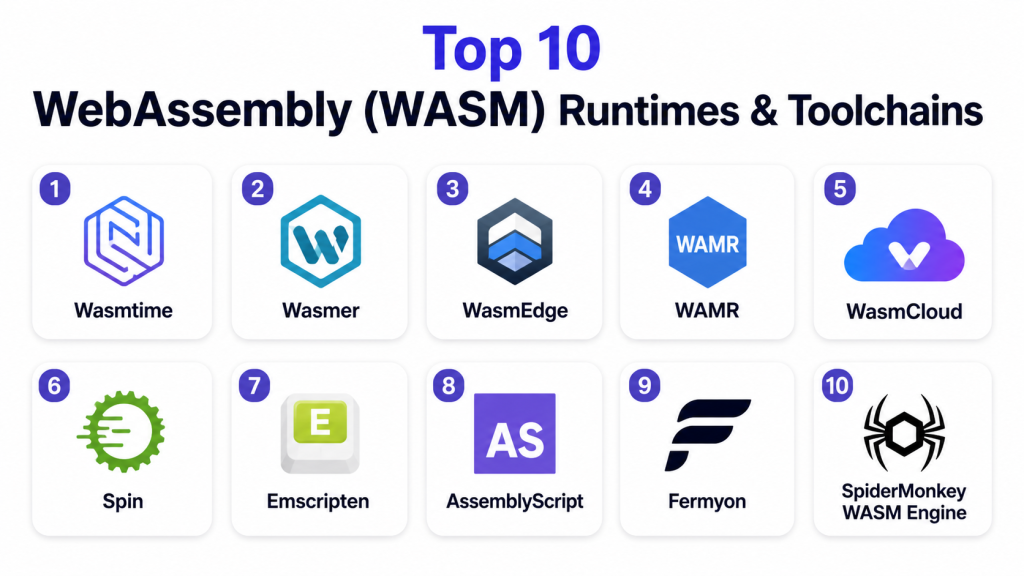
Top 10 WebAssembly (WASM) Runtimes & Toolchains Tools
#1 — Wasmtime
Short description: Wasmtime is a high-performance runtime designed for secure and efficient WASM execution. It is widely used for server-side workloads and supports WASI standards, making it a strong choice for portable applications.
Key Features
- WASI support for system-level integration
- High-performance JIT execution
- Secure sandboxing
- Cross-platform compatibility
- Lightweight runtime
Pros
- Strong security model
- High performance
- Mature ecosystem
Cons
- Limited GUI tools
- Learning curve for beginners
- Enterprise features vary
Platforms / Deployment
Linux / macOS / Windows
Cloud / Self-hosted
Security & Compliance
Sandboxing, memory isolation
Not publicly stated
Integrations & Ecosystem
Works well with modern cloud-native environments and developer tools.
- Rust ecosystem
- Kubernetes environments
- WASI-compatible tools
Support & Community
Strong open-source community with active development and good documentation.
#2 — Wasmer
Short description: Wasmer is a developer-friendly runtime focused on portability and ease of use. It enables running WASM applications across multiple environments with a strong tooling ecosystem.
Key Features
- Multi-language support
- WASM package manager
- CLI tools
- Cross-platform execution
- Edge deployment support
Pros
- Easy onboarding
- Flexible deployment
- Strong developer tools
Cons
- Performance varies
- Smaller enterprise adoption
- Some advanced features evolving
Platforms / Deployment
Linux / macOS / Windows
Cloud / Self-hosted / Hybrid
Security & Compliance
Sandboxed execution
Not publicly stated
Integrations & Ecosystem
Offers a growing ecosystem for developers and cloud integration.
- SDKs
- CLI tools
- Cloud services
Support & Community
Active community with good learning resources.
#3 — WAMR (WebAssembly Micro Runtime)
Short description: WAMR is a lightweight runtime designed for embedded systems and IoT devices. It focuses on minimal resource usage and fast startup times.
Key Features
- Ultra-lightweight runtime
- Low memory footprint
- Fast startup
- WASI support
- Optimized for embedded systems
Pros
- Ideal for IoT
- Minimal resource consumption
- High portability
Cons
- Limited advanced features
- Smaller ecosystem
- Not enterprise-focused
Platforms / Deployment
Embedded / Linux
Self-hosted
Security & Compliance
Sandboxing
Not publicly stated
Integrations & Ecosystem
Primarily focused on embedded and edge environments.
- IoT platforms
- Edge systems
Support & Community
Moderate community with niche focus.
#4 — WasmEdge
Short description: WasmEdge is optimized for cloud-native and edge applications. It is known for high performance and support for modern workloads like AI inference.
Key Features
- High-performance runtime
- AI inference capabilities
- Serverless integration
- WASI support
- Kubernetes compatibility
Pros
- Strong edge capabilities
- Fast execution
- Modern architecture
Cons
- Smaller ecosystem
- Learning curve
- Limited enterprise tooling
Platforms / Deployment
Linux / macOS
Cloud / Edge / Hybrid
Security & Compliance
Sandboxing
Not publicly stated
Integrations & Ecosystem
Designed for cloud-native workflows and edge computing.
- Kubernetes
- Serverless frameworks
- AI tools
Support & Community
Growing community with increasing adoption.
#5 — Lucet
Short description: Lucet is designed for fast and secure WASM execution, especially in serverless environments. It focuses on ahead-of-time compilation for speed.
Key Features
- Ahead-of-time compilation
- Fast startup
- Secure sandbox
- Optimized for serverless
Pros
- High performance
- Strong isolation
- Good for edge workloads
Cons
- Limited updates
- Smaller ecosystem
- Fewer integrations
Platforms / Deployment
Linux
Self-hosted
Security & Compliance
Sandboxing
Not publicly stated
Integrations & Ecosystem
Focused on serverless and edge use cases.
- Edge platforms
- CDN systems
Support & Community
Limited community activity.
#6 — Wasmtime Component Model
Short description: This extension of Wasmtime focuses on modular application design, enabling reusable and composable WASM components.
Key Features
- Component-based architecture
- Modular design
- WASI extensions
- Interoperability support
Pros
- Future-ready design
- Flexible architecture
- Strong standard alignment
Cons
- Still evolving
- Limited tooling
- Requires expertise
Platforms / Deployment
Linux / macOS / Windows
Cloud / Self-hosted
Security & Compliance
Sandboxing
Not publicly stated
Integrations & Ecosystem
Aligned with emerging WASM standards and ecosystems.
- WASI tools
- Rust ecosystem
Support & Community
Backed by strong open-source contributors.
#7 — Node.js WASM Runtime
Short description: Node.js includes built-in support for running WASM modules, making it accessible for JavaScript developers without requiring new infrastructure.
Key Features
- Native WASM support
- JavaScript interoperability
- Large ecosystem
- Easy integration
Pros
- Familiar environment
- Extensive community
- Quick adoption
Cons
- Not optimized for WASM-first use
- Limited sandboxing
- Performance trade-offs
Platforms / Deployment
Windows / macOS / Linux
Cloud / Self-hosted
Security & Compliance
Varies / N/A
Integrations & Ecosystem
Leverages a massive ecosystem of tools and libraries.
- npm packages
- Web frameworks
Support & Community
Very strong global developer community.
#8 — Fastly Compute@Edge
Short description: A WASM-based edge computing platform that enables fast, scalable execution of applications at the network edge.
Key Features
- Edge execution
- CDN integration
- Fast startup
- Secure sandbox
Pros
- Excellent performance
- Scalable
- Secure
Cons
- Vendor lock-in
- Pricing complexity
- Limited flexibility
Platforms / Deployment
Cloud (Edge)
Security & Compliance
Sandboxing
Not publicly stated
Integrations & Ecosystem
Deep integration with edge and CDN environments.
- Edge APIs
- CDN tools
Support & Community
Enterprise-level support with limited open community.
#9 — WasmCloud
Short description: WasmCloud is a distributed runtime designed for building scalable cloud-native applications using WASM.
Key Features
- Distributed architecture
- Actor model
- Cloud-native design
- WASI support
Pros
- Highly scalable
- Flexible deployment
- Modern architecture
Cons
- Learning curve
- Smaller ecosystem
- Limited adoption
Platforms / Deployment
Cloud / Hybrid
Security & Compliance
Sandboxing
Not publicly stated
Integrations & Ecosystem
Built for distributed systems and cloud environments.
- Kubernetes
- Cloud platforms
Support & Community
Active but niche community.
#10 — SpiderMonkey WASM Engine
Short description: SpiderMonkey is a browser-based engine that supports WASM execution, enabling high-performance applications directly in web browsers.
Key Features
- Browser-native execution
- High performance
- JavaScript integration
- Mature engine
Pros
- Widely used
- Stable
- Optimized for web
Cons
- Limited to browsers
- Not suitable for backend
- Limited standalone use
Platforms / Deployment
Web (Browser)
Security & Compliance
Browser sandboxing
Integrations & Ecosystem
Integrated within web development ecosystems.
- Web APIs
- JavaScript frameworks
Support & Community
Strong support via browser ecosystem.
Comparison Table (Top 10)
| Tool Name | Best For | Platform(s) Supported | Deployment | Standout Feature | Public Rating |
|---|---|---|---|---|---|
| Wasmtime | Secure runtimes | Linux/macOS/Windows | Self-hosted | WASI support | N/A |
| Wasmer | Developer portability | Cross-platform | Hybrid | Package manager | N/A |
| WAMR | IoT systems | Embedded/Linux | Self-hosted | Lightweight runtime | N/A |
| WasmEdge | Edge workloads | Linux/macOS | Hybrid | AI support | N/A |
| Lucet | Serverless | Linux | Self-hosted | AOT compilation | N/A |
| Wasmtime Component | Modular apps | Cross-platform | Hybrid | Component model | N/A |
| Node.js WASM | JS integration | Cross-platform | Hybrid | Native support | N/A |
| Fastly Edge | CDN workloads | Cloud | Cloud | Edge execution | N/A |
| WasmCloud | Distributed apps | Cloud | Hybrid | Actor model | N/A |
| SpiderMonkey | Web apps | Browser | Browser | Web integration | N/A |
Evaluation & Scoring of WebAssembly (WASM) Runtimes & Toolchains
| Tool Name | Core (25%) | Ease (15%) | Integrations (15%) | Security (10%) | Performance (10%) | Support (10%) | Value (15%) | Weighted Total |
|---|---|---|---|---|---|---|---|---|
| Wasmtime | 9 | 7 | 8 | 9 | 9 | 8 | 8 | 8.5 |
| Wasmer | 8 | 9 | 8 | 8 | 8 | 8 | 9 | 8.4 |
| WAMR | 7 | 7 | 6 | 8 | 9 | 6 | 8 | 7.5 |
| WasmEdge | 8 | 7 | 8 | 8 | 9 | 7 | 8 | 8.1 |
| Lucet | 7 | 6 | 6 | 8 | 9 | 6 | 7 | 7.3 |
| Wasmtime Component | 8 | 6 | 7 | 9 | 8 | 7 | 7 | 7.8 |
| Node.js WASM | 7 | 9 | 9 | 6 | 7 | 9 | 9 | 8.0 |
| Fastly Edge | 8 | 7 | 8 | 9 | 9 | 8 | 7 | 8.3 |
| WasmCloud | 8 | 6 | 8 | 8 | 8 | 7 | 8 | 7.9 |
| SpiderMonkey | 7 | 8 | 9 | 8 | 8 | 9 | 8 | 8.1 |
How to interpret the scores:
These scores are comparative benchmarks designed to help you evaluate tools based on practical usage scenarios. A higher score indicates stronger overall capabilities, but not necessarily the best fit for every use case. For example, Wasmtime scores highly in security and performance, while Wasmer excels in ease of use and developer experience. Tools like Node.js rank well due to ecosystem strength, even if they are not WASM-first platforms. Use these scores as a guideline, and always align your choice with your specific technical requirements, deployment environment, and team expertise.
Which WebAssembly (WASM) Runtimes & Toolchains Tool Is Right for You?
Solo / Freelancer
If you are working independently or building small projects, Wasmer or Node.js WASM are the best choices due to their simplicity, ease of setup, and strong developer tooling.
SMB
Small and growing businesses should consider Wasmtime or WasmEdge for a balance of performance, scalability, and security without excessive complexity.
Mid-Market
Organizations scaling their infrastructure can benefit from WasmCloud or Fastly Compute@Edge, especially for distributed and edge-based applications.
Enterprise
Large enterprises should focus on Wasmtime, WasmEdge, or Fastly Compute@Edge due to their performance, scalability, and ability to handle production-grade workloads.
Budget vs Premium
Open-source tools like Wasmtime and Wasmer provide cost-effective solutions. Managed edge platforms may require higher investment but offer better scalability and performance.
Feature Depth vs Ease of Use
If ease of use is a priority, Node.js and Wasmer are better options. For advanced features and deeper control, Wasmtime and WasmEdge are more suitable.
Integrations & Scalability
WasmCloud and WasmEdge excel in scalable architectures with strong integration capabilities for cloud-native environments.
Security & Compliance Needs
For security-sensitive applications, Wasmtime and edge platforms provide strong sandboxing and isolation capabilities.
Frequently Asked Questions (FAQs)
1. What is WebAssembly mainly used for?
WebAssembly is primarily used to run high-performance applications across browsers, servers, and edge environments. It enables developers to use languages other than JavaScript while maintaining speed and efficiency. It is especially useful for compute-heavy tasks and portable workloads.
2. How is WASM different from JavaScript?
JavaScript is interpreted, while WASM is compiled, making WASM significantly faster for heavy computations. WASM runs alongside JavaScript and complements it rather than replacing it. It is ideal for performance-critical components.
3. Can WASM replace containers?
WASM is not a full replacement for containers but can complement them. It offers faster startup times and lower resource usage. However, containers still provide a more mature ecosystem for many workloads.
4. Is WASM secure for running untrusted code?
Yes, WASM is designed with a sandboxed execution model, which isolates code from the host system. This makes it suitable for running untrusted or third-party code. Security still depends on proper runtime configuration.
5. Which languages work best with WASM?
Rust is the most popular language for WASM due to its performance and safety. C, C++, and Go are also widely used. Support for other languages continues to improve over time.
6. What is WASI and why is it important?
WASI is the WebAssembly System Interface that allows WASM modules to interact with system resources. It enables WASM to run outside the browser. This is critical for server-side and edge computing use cases.
7. Can WASM be used for backend development?
Yes, WASM runtimes like Wasmtime and Wasmer allow backend development. It is increasingly used for microservices and serverless architectures. Many cloud platforms are adopting it for backend workloads.
8. Is WASM suitable for AI workloads?
WASM can be used for lightweight AI inference at the edge. It helps reduce latency and improve performance. However, large-scale AI training is still better suited for traditional environments.
9. What are the main limitations of WASM?
WASM still has a smaller ecosystem compared to containers. Debugging can be more complex, and some features are still evolving. Tooling is improving but not yet fully mature.
10. How should I choose the right WASM runtime?
Focus on performance, security, integrations, and ease of use. Consider your deployment environment and team expertise. Start with open-source tools and test them before scaling to production.
Conclusion
WebAssembly runtimes and toolchains are transforming how modern applications are built, deployed, and scaled across cloud, edge, and browser environments. Tools like Wasmtime and Wasmer provide strong foundations for portability and performance, while platforms like WasmEdge and Fastly Compute@Edge enable advanced edge and serverless use cases. Each tool has its own strengths depending on whether you prioritize ease of use, scalability, or security. There is no universal winner, and the best choice depends on your specific requirements, architecture, and team capabilities. The smartest approach is to shortlist a few tools, run real-world tests, and validate performance, integrations, and security before making a final decision.
