Introduction
Research Data Management Platforms are digital systems that help researchers collect, organize, store, share, and preserve research data throughout its entire lifecycle. These platforms ensure that datasets remain structured, reusable, secure, and compliant with institutional or funding body requirements.
In modern research environments, data is generated at a massive scale across universities, laboratories, healthcare systems, and corporate R&D teams. Without proper management, valuable datasets can become fragmented, inaccessible, or non-reproducible. Research Data Management Platforms solve this problem by providing centralized repositories, metadata standards, version control, collaboration tools, and long-term preservation capabilities.
Common use cases include:
- Managing datasets for academic research projects
- Sharing research outputs with collaborators
- Storing clinical, scientific, and experimental data
- Ensuring compliance with funding agencies
- Enabling reproducible research workflows
Key evaluation criteria:
- Data storage and lifecycle management
- Metadata support and standardization
- Collaboration and sharing capabilities
- Security and access control
- Integration with research tools and systems
- Scalability for large datasets
- Compliance and audit readiness
- Ease of use for researchers
Best for: Universities, research institutes, laboratories, healthcare organizations, and enterprise R&D teams.
Not ideal for: Small personal projects with minimal data or non-structured workflows.
Key Trends in Research Data Management Platforms
- Rapid adoption of cloud-based research repositories
- Integration with AI for metadata tagging and data discovery
- Strong focus on open science and data sharing policies
- Increasing use of FAIR data principles (Findable, Accessible, Interoperable, Reusable)
- Support for reproducible research workflows
- Expansion of APIs for automation and data pipelines
- Hybrid storage models combining local and cloud systems
- Stronger compliance with GDPR and research ethics regulations
- Version control for datasets and experiments
- Collaboration-first design for global research teams
How We Selected These Tools Methodology
- Evaluated global adoption across research institutions
- Assessed data management and lifecycle capabilities
- Reviewed metadata and cataloging strength
- Considered integration with scientific workflows
- Analyzed scalability for large datasets
- Included both open-source and enterprise platforms
- Focused on reproducibility and collaboration features
- Balanced usability with advanced research needs
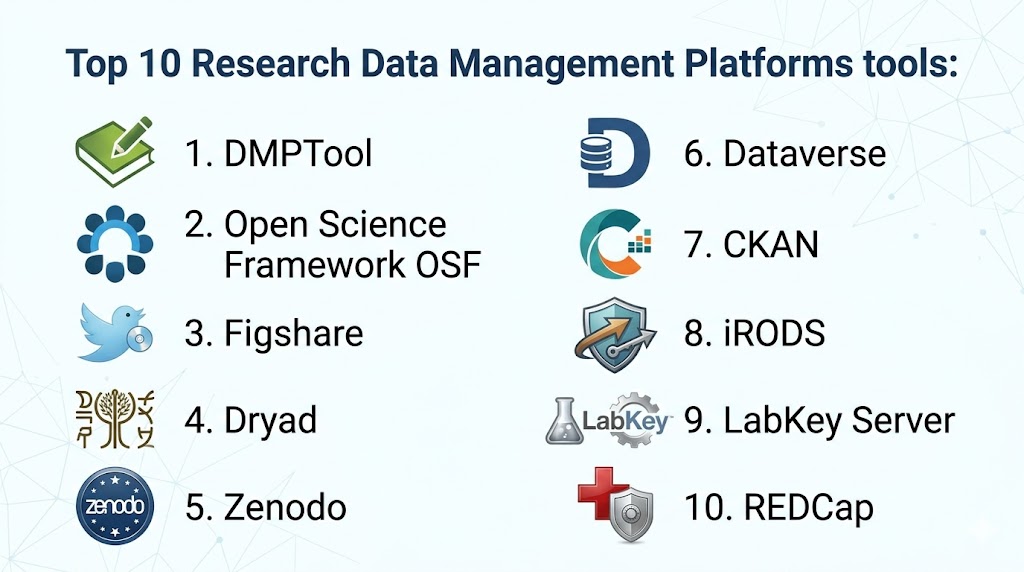
Top 10 Research Data Management Platforms
#1 — Open Science Framework OSF
Short description:
OSF is a widely used open-source platform that supports research collaboration, data storage, and project management. It enables researchers to organize workflows, share datasets, and ensure reproducibility. The platform is highly flexible and supports integration with multiple tools. It is ideal for academic research teams.
Key Features
- Project and data management
- Version control for research files
- Collaboration tools
- Public and private project sharing
- Integration with research tools
- DOI assignment for datasets
Pros
- Free and open-source
- Strong collaboration features
- Highly flexible
Cons
- Limited advanced analytics
- Requires setup for complex workflows
- Interface can feel basic
Platforms / Deployment
Web / Cloud
Security & Compliance
Encryption and access control
Integrations & Ecosystem
Supports integrations with research tools and repositories.
- APIs
- External research platforms
Support & Community
Strong academic community support
#2 — Figshare
Short description:
Figshare is a research data repository that allows users to store, share, and publish datasets in multiple formats. It provides DOI assignment for citations and supports open science initiatives. It is widely used in academic publishing. It is suitable for researchers and institutions.
Key Features
- Dataset storage and sharing
- DOI generation
- Metadata management
- Version control
- Public and private access
- Analytics tracking
Pros
- Easy to use
- Strong visibility for research outputs
- Supports multiple file types
Cons
- Limited customization in free version
- Storage limits for free users
- Less suited for complex workflows
Platforms / Deployment
Cloud
Security & Compliance
GDPR compliant, encrypted storage
Integrations & Ecosystem
Integrates with publishing and research tools.
- ORCID integration
- API support
Support & Community
Strong institutional support
#3 — Dataverse
Short description:
Dataverse is an open-source platform designed for sharing, preserving, and analyzing research data. It supports structured metadata and dataset citation. It is widely used in academic institutions. It is suitable for social sciences and large datasets.
Key Features
- Dataset hosting and sharing
- Metadata management
- Citation support with persistent identifiers
- Access control and permissions
- Versioning system
- Search and discovery
Pros
- Open-source
- Strong metadata support
- Scalable
Cons
- Requires technical setup
- Limited UI modernity
- Maintenance overhead
Platforms / Deployment
Web / Self-hosted
Security & Compliance
Role-based access control
Integrations & Ecosystem
Supports academic and institutional integrations.
- APIs
- Institutional repositories
Support & Community
Active research community
#4 — CKAN
Short description:
CKAN is an open-source data management system designed for publishing and sharing datasets. It is widely used by governments and research institutions. The platform supports structured data catalogs. It is ideal for open data initiatives.
Key Features
- Data cataloging
- Dataset publishing
- Metadata management
- Search functionality
- API access
- Data visualization support
Pros
- Open-source
- Highly customizable
- Strong adoption
Cons
- Requires technical expertise
- Setup complexity
- Limited built-in analytics
Platforms / Deployment
Web / Self-hosted
Security & Compliance
Not publicly stated
Integrations & Ecosystem
Supports integration with data portals and APIs.
- REST APIs
- Open data systems
Support & Community
Strong developer community
#5 — REDCap
Short description:
REDCap is a secure research data capture platform widely used in clinical and biomedical research. It supports structured data collection and management. The platform is highly secure and compliant. It is suitable for healthcare and clinical studies.
Key Features
- Data collection forms
- Clinical research support
- Audit trails
- Role-based access
- Survey tools
- Data export options
Pros
- Highly secure
- Trusted in healthcare
- Strong compliance features
Cons
- Limited flexibility
- Institutional dependency
- Not open-source
Platforms / Deployment
Web / On-premise
Security & Compliance
HIPAA compliant, audit logging
Integrations & Ecosystem
Integrates with clinical systems and research tools.
- APIs
- Healthcare systems
Support & Community
Strong institutional support
#6 — Zenodo
Short description:
Zenodo is an open-access repository developed for research data sharing and preservation. It allows researchers to upload datasets and assign DOIs. It is widely used for open science. It is suitable for all disciplines.
Key Features
- Dataset archiving
- DOI generation
- Open-access sharing
- Version control
- Metadata support
- Large file uploads
Pros
- Free to use
- Easy publishing
- Strong visibility
Cons
- Limited advanced workflow tools
- Storage limits
- Basic analytics
Platforms / Deployment
Cloud
Security & Compliance
Not publicly stated
Integrations & Ecosystem
Supports integration with research publishing platforms.
- GitHub integration
- API access
Support & Community
Strong open science community
#7 — Dryad
Short description:
Dryad is a curated research data repository focused on making datasets discoverable and reusable. It emphasizes data quality and publication readiness. It is widely used in scientific publishing. It is suitable for academic researchers.
Key Features
- Data publishing
- Curated datasets
- Metadata enrichment
- DOI assignment
- Peer-reviewed data support
- Open access publishing
Pros
- High data quality
- Trusted repository
- Strong publishing integration
Cons
- Paid submission fees
- Limited flexibility
- Focused scope
Platforms / Deployment
Cloud
Security & Compliance
Not publicly stated
Integrations & Ecosystem
Integrates with academic publishing systems.
- Journal integrations
- API support
Support & Community
Editorial and research support
#8 — iRODS
Short description:
iRODS is a data management software framework designed for distributed storage and research data control. It allows automated data workflows and policies. It is highly customizable. It is suitable for advanced research infrastructure.
Key Features
- Data virtualization
- Policy-based management
- Workflow automation
- Distributed storage support
- Metadata control
- Rule engine
Pros
- Highly flexible
- Scalable
- Powerful automation
Cons
- Complex setup
- Requires technical expertise
- Steep learning curve
Platforms / Deployment
Linux / Cloud / Self-hosted
Security & Compliance
Role-based policies
Integrations & Ecosystem
Integrates with research storage systems.
- APIs
- Cloud storage
Support & Community
Technical community support
#9 — LabKey Server
Short description:
LabKey Server is a biomedical research data platform that supports secure data integration and analysis. It enables collaboration across research teams. The platform is widely used in life sciences. It is suitable for clinical and experimental research.
Key Features
- Biomedical data management
- Secure collaboration
- Data integration
- Reporting tools
- Workflow support
- Custom applications
Pros
- Strong biomedical focus
- Secure
- Flexible architecture
Cons
- Requires setup
- Technical complexity
- Limited general use
Platforms / Deployment
Web / Self-hosted
Security & Compliance
Access control and audit logging
Integrations & Ecosystem
Integrates with scientific data tools.
- APIs
- Research pipelines
Support & Community
Research-focused support
#10 — DMPTool
Short description:
DMPTool is a platform that helps researchers create and manage data management plans required by funding agencies. It supports structured planning for data lifecycle management. It is widely used in academia. It is suitable for grant compliance.
Key Features
- Data management planning
- Template-based workflows
- Compliance support
- Collaboration tools
- Exportable plans
- Institutional templates
Pros
- Easy compliance support
- Free to use
- Widely adopted
Cons
- Not a storage platform
- Limited functionality
- Planning-focused only
Platforms / Deployment
Web
Security & Compliance
Institution-level access control
Integrations & Ecosystem
Integrates with academic funding systems.
- Institutional templates
- API support
Support & Community
Strong academic support
Comparison Table
| Tool Name | Best For | Platform Supported | Deployment | Standout Feature | Public Rating |
|---|---|---|---|---|---|
| OSF | Collaboration | Web | Cloud | Research workflows | N/A |
| Figshare | Data publishing | Web | Cloud | DOI assignment | N/A |
| Dataverse | Academic datasets | Web | Self-hosted | Metadata control | N/A |
| CKAN | Open data portals | Web | Self-hosted | Data cataloging | N/A |
| REDCap | Clinical research | Web | On-premise | Secure data capture | N/A |
| Zenodo | Open science | Web | Cloud | Free publishing | N/A |
| Dryad | Academic publishing | Web | Cloud | Curated datasets | N/A |
| iRODS | Data infrastructure | Web | Hybrid | Policy automation | N/A |
| LabKey | Biomedical data | Web | Self-hosted | Research integration | N/A |
| DMPTool | Data planning | Web | Cloud | Compliance planning | N/A |
Evaluation & Scoring
| Tool Name | Core | Ease | Integrations | Security | Performance | Support | Value | Weighted Total |
|---|---|---|---|---|---|---|---|---|
| OSF | 9 | 8 | 8 | 8 | 8 | 8 | 9 | 8.3 |
| Figshare | 8 | 9 | 8 | 8 | 8 | 8 | 8 | 8.2 |
| Dataverse | 9 | 7 | 8 | 9 | 9 | 8 | 8 | 8.4 |
| CKAN | 8 | 6 | 8 | 8 | 8 | 7 | 9 | 7.8 |
| REDCap | 9 | 7 | 8 | 10 | 9 | 9 | 7 | 8.5 |
| Zenodo | 8 | 9 | 7 | 8 | 8 | 8 | 9 | 8.2 |
| Dryad | 8 | 8 | 7 | 8 | 8 | 8 | 7 | 7.9 |
| iRODS | 9 | 6 | 9 | 9 | 9 | 7 | 8 | 8.3 |
| LabKey | 9 | 7 | 8 | 9 | 9 | 8 | 7 | 8.3 |
| DMPTool | 7 | 9 | 7 | 8 | 7 | 8 | 9 | 7.9 |
Which Research Data Management Platform Is Right for You
Solo Researcher
Use Zenodo or DMPTool for simple storage and planning.
SMB Research Teams
Use Figshare or OSF for collaboration and sharing.
Mid Market Institutions
Dataverse or LabKey provide structured and scalable solutions.
Enterprise Research Organizations
REDCap or iRODS offer high security and advanced workflows.
Budget vs Premium
Open platforms reduce cost, while enterprise tools provide governance and compliance.
Feature Depth vs Ease of Use
Advanced tools offer more control, while simple tools improve usability.
Integrations & Scalability
API-driven platforms scale better across research ecosystems.
Security & Compliance Needs
Clinical and regulated research requires strong compliance-focused tools.
Frequently Asked Questions
1 What is a research data management platform
It is a system that helps researchers store, organize, and manage research data throughout its lifecycle. It ensures data is structured and reusable. It improves collaboration. It supports long-term preservation.
2 Why are these platforms important
They help maintain data integrity and reproducibility. They reduce data loss risks. They improve research efficiency. They support compliance requirements.
3 Can they store large datasets
Yes, many platforms are designed for large-scale datasets. Cloud systems support scalability. Storage capacity varies. Institutions choose based on needs.
4 Are they secure
Most platforms include encryption and access controls. Clinical tools like REDCap provide advanced security. Security depends on configuration. Compliance is important.
5 Are they free
Some tools like OSF and Zenodo are free. Others require institutional licensing. Pricing depends on features. Open-source options are widely available.
6 Can they integrate with other tools
Yes, most platforms offer APIs and integrations. They connect with research workflows. Integration improves efficiency. Ecosystem support varies.
7 Who uses these platforms
Universities, labs, healthcare organizations, and research institutes use them. They are essential for structured research. Adoption is global. They support collaboration.
8 What is metadata in these systems
Metadata describes research data such as author, date, and type. It improves searchability. It ensures proper organization. It supports data reuse.
9 Do they support collaboration
Yes, most platforms support multi-user collaboration. Teams can share and manage datasets together. It improves productivity. It enables global research.
10 How do I choose the right platform
Evaluate features, scalability, security, and ease of use. Consider your research type. Test multiple platforms. Choose based on workflow needs.
Conclusion
Research Data Management Platforms are essential for modern scientific and academic ecosystems because they enable structured, secure, and scalable handling of research data while improving collaboration, reproducibility, and compliance across disciplines. These platforms ensure that valuable datasets are not only stored safely but also remain accessible, reusable, and properly documented throughout their lifecycle. While open-source tools provide flexibility and cost efficiency for research teams, enterprise-grade systems offer advanced security, governance, and scalability for large institutions and regulated environments. The best platform ultimately depends on the complexity of research workflows, data sensitivity, and collaboration requirements. A practical approach is to shortlist a few solutions, test them in real-world research scenarios, and evaluate how well they align with long-term data management and compliance needs.
