Introduction
Reverse proxy tools act as intermediaries between client requests and backend servers, helping manage traffic, improve performance, and enhance security. Instead of clients directly accessing application servers, requests are routed through a reverse proxy, which handles load balancing, SSL termination, caching, and access control.
In modern cloud-native and microservices architectures, reverse proxies are critical for scaling applications, protecting infrastructure, and ensuring high availability. They enable organizations to distribute traffic efficiently, secure applications from threats, and optimize performance across distributed systems.
Real-world use cases:
- Load balancing across multiple application servers
- SSL/TLS termination for secure communication
- API gateway and microservices routing
- Protecting backend services from direct exposure
What buyers should evaluate:
- Load balancing capabilities
- Performance and latency handling
- Security features such as TLS and access control
- Integration with cloud and container environments
- Ease of configuration and management
- Scalability for high traffic environments
- Observability and monitoring features
- Support for modern protocols like HTTP/2 and gRPC
Best for: DevOps teams, system administrators, cloud architects, and organizations running web applications, APIs, or microservices.
Not ideal for: Small applications with minimal traffic or systems that do not require traffic routing or load balancing.
Key Trends in Reverse Proxy Tools
- Cloud-native adoption: Reverse proxies are becoming core components in Kubernetes and microservices
- Service mesh integration: Tools like Envoy are powering service mesh architectures
- Automatic configuration: Dynamic routing and auto-discovery features are increasing
- Security enhancements: Built-in WAF and authentication capabilities
- Edge computing support: Proxies deployed closer to users for low latency
- API gateway convergence: Reverse proxies evolving into full API management platforms
- Zero Trust integration: Access control and identity-aware routing
- Performance optimization: Improved caching and compression mechanisms
- Observability improvements: Metrics, tracing, and logging integration
How We Selected These Tools (Methodology)
- Evaluated industry adoption and community popularity
- Compared performance and scalability capabilities
- Assessed security and traffic management features
- Reviewed integration with cloud and container platforms
- Analyzed ease of use and configuration
- Considered support for modern protocols and architectures
- Evaluated open-source and enterprise options
- Balanced simplicity and advanced capabilities
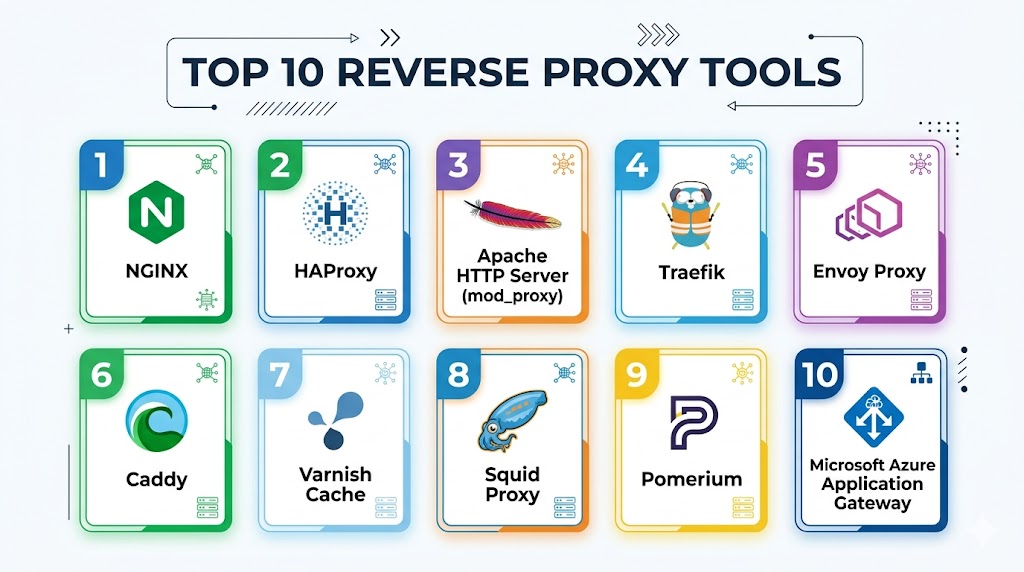
Top 10 Reverse Proxy Tools
#1 — NGINX
Short description: NGINX is one of the most widely used reverse proxy and web server solutions, known for its high performance and scalability.
Key Features
- Load balancing
- SSL/TLS termination
- Caching and compression
- High concurrency handling
- Reverse proxy routing
Pros
- Extremely fast
- Highly scalable
- Mature ecosystem
Cons
- Configuration complexity
- Advanced features require paid version
- Learning curve
Platforms / Deployment
Linux / Windows
Cloud / Self-hosted
Security & Compliance
TLS, access control
Not publicly stated
Integrations & Ecosystem
Works across modern web and cloud environments.
- Kubernetes
- DevOps tools
Support & Community
Very strong global community.
#2 — HAProxy
Short description: HAProxy is a high-performance load balancer and reverse proxy designed for reliability and efficiency.
Key Features
- Advanced load balancing
- High availability
- Traffic routing
- Health checks
- SSL termination
Pros
- Very reliable
- High performance
- Flexible configuration
Cons
- Complex setup
- Limited UI
- Requires expertise
Platforms / Deployment
Linux
Cloud / Self-hosted
Security & Compliance
TLS support
Not publicly stated
Integrations & Ecosystem
Integrates with cloud and enterprise systems.
- Kubernetes
- Cloud platforms
Support & Community
Strong open-source community.
#3 — Apache HTTP Server (mod_proxy)
Short description: Apache HTTP Server provides reverse proxy capabilities through its mod_proxy module, offering flexibility and compatibility.
Key Features
- Reverse proxy module
- Load balancing
- URL rewriting
- SSL support
- Modular architecture
Pros
- Highly flexible
- Widely used
- Mature ecosystem
Cons
- Lower performance compared to NGINX
- Complex configuration
- Resource-heavy
Platforms / Deployment
Windows / Linux
Cloud / Self-hosted
Security & Compliance
SSL/TLS support
Not publicly stated
Integrations & Ecosystem
Works with a wide range of web technologies.
- Web frameworks
- Hosting platforms
Support & Community
Very strong community support.
#4 — Traefik
Short description: Traefik is a modern reverse proxy designed for microservices and cloud-native environments with automatic configuration.
Key Features
- Auto service discovery
- Kubernetes integration
- Dynamic configuration
- Load balancing
- SSL automation
Pros
- Easy to use
- Cloud-native
- Automatic configuration
Cons
- Limited advanced features
- Smaller ecosystem
- Learning curve for beginners
Platforms / Deployment
Linux / Cloud
Security & Compliance
TLS, authentication
Not publicly stated
Integrations & Ecosystem
Strong integration with container platforms.
- Docker
- Kubernetes
Support & Community
Growing community.
#5 — Envoy Proxy
Short description: Envoy is a high-performance proxy designed for service mesh and microservices architectures.
Key Features
- Service mesh support
- Advanced routing
- Observability
- gRPC support
- Security features
Pros
- Powerful features
- Cloud-native
- Strong observability
Cons
- Complex setup
- Requires expertise
- Resource-intensive
Platforms / Deployment
Linux / Cloud
Security & Compliance
TLS, mTLS
Not publicly stated
Integrations & Ecosystem
Works within service mesh ecosystems.
- Kubernetes
- Istio
Support & Community
Strong enterprise and open-source support.
#6 — Caddy
Short description: Caddy is a modern web server and reverse proxy known for its simplicity and automatic HTTPS support.
Key Features
- Automatic HTTPS
- Simple configuration
- Reverse proxy
- HTTP/2 support
- Extensibility
Pros
- Easy to use
- Secure by default
- Lightweight
Cons
- Limited advanced features
- Smaller ecosystem
- Less enterprise adoption
Platforms / Deployment
Windows / macOS / Linux
Security & Compliance
Automatic TLS
Not publicly stated
Integrations & Ecosystem
Works with web applications and APIs.
- Web apps
- APIs
Support & Community
Active community.
#7 — Varnish Cache
Short description: Varnish Cache is a reverse proxy focused on high-performance HTTP caching.
Key Features
- HTTP caching
- Load balancing
- High performance
- Custom configuration
- Content delivery optimization
Pros
- Extremely fast caching
- Improves performance
- Flexible
Cons
- No native HTTPS
- Complex setup
- Limited security features
Platforms / Deployment
Linux
Security & Compliance
Not publicly stated
Integrations & Ecosystem
Works with web servers and CDNs.
- Web servers
- CDN systems
Support & Community
Strong community.
#8 — Squid Proxy
Short description: Squid is a caching proxy that can also function as a reverse proxy for improving performance.
Key Features
- Caching
- Access control
- Traffic filtering
- Reverse proxy support
- Performance optimization
Pros
- Reliable
- Flexible
- Good caching
Cons
- Complex configuration
- Outdated UI
- Limited modern features
Platforms / Deployment
Linux
Security & Compliance
Access control
Not publicly stated
Integrations & Ecosystem
Works with network and web systems.
- Network tools
Support & Community
Established community.
#9 — Pomerium
Short description: Pomerium is a secure reverse proxy focused on identity-aware access and Zero Trust security.
Key Features
- Identity-aware proxy
- Access control
- Zero Trust architecture
- Authentication integration
- Secure routing
Pros
- Strong security
- Easy integration with identity providers
- Modern architecture
Cons
- Limited general-purpose features
- Smaller ecosystem
- Requires setup
Platforms / Deployment
Cloud / Self-hosted
Security & Compliance
Identity-based access
Not publicly stated
Integrations & Ecosystem
Works with identity and access systems.
- Identity providers
- Security tools
Support & Community
Growing community.
#10 — Microsoft Azure Application Gateway
Short description: A cloud-based reverse proxy and load balancer designed for Azure environments.
Key Features
- Layer 7 load balancing
- SSL termination
- Web application firewall
- Autoscaling
- Cloud-native
Pros
- Fully managed
- Scalable
- Integrated security
Cons
- Azure dependency
- Pricing complexity
- Limited customization
Platforms / Deployment
Cloud
Security & Compliance
WAF, TLS
Not publicly stated
Integrations & Ecosystem
Deep integration with Azure ecosystem.
- Azure services
Support & Community
Strong enterprise support.
Comparison Table (Top 10)
| Tool Name | Best For | Platform(s) Supported | Deployment | Standout Feature | Public Rating |
|---|---|---|---|---|---|
| NGINX | Web performance | Linux/Windows | Hybrid | High performance | N/A |
| HAProxy | Load balancing | Linux | Hybrid | Reliability | N/A |
| Apache | Flexibility | Cross-platform | Hybrid | Modular design | N/A |
| Traefik | Cloud-native | Linux/Cloud | Cloud | Auto config | N/A |
| Envoy | Service mesh | Linux/Cloud | Cloud | Advanced routing | N/A |
| Caddy | Simplicity | Cross-platform | Local | Auto HTTPS | N/A |
| Varnish | Caching | Linux | Local | High-speed cache | N/A |
| Squid | Filtering | Linux | Local | Access control | N/A |
| Pomerium | Security | Cloud/Local | Hybrid | Identity proxy | N/A |
| Azure Gateway | Cloud apps | Cloud | Cloud | WAF | N/A |
Evaluation & Scoring of Reverse Proxy Tools
| Tool Name | Core | Ease | Integrations | Security | Performance | Support | Value | Weighted Total |
|---|---|---|---|---|---|---|---|---|
| NGINX | 9 | 7 | 9 | 8 | 9 | 9 | 8 | 8.6 |
| HAProxy | 9 | 6 | 8 | 8 | 9 | 8 | 8 | 8.4 |
| Apache | 8 | 7 | 8 | 8 | 7 | 9 | 8 | 8.0 |
| Traefik | 8 | 9 | 8 | 8 | 8 | 8 | 9 | 8.4 |
| Envoy | 9 | 6 | 9 | 9 | 9 | 8 | 7 | 8.5 |
| Caddy | 8 | 9 | 7 | 8 | 8 | 7 | 9 | 8.2 |
| Varnish | 8 | 6 | 7 | 6 | 9 | 7 | 8 | 7.7 |
| Squid | 7 | 6 | 7 | 7 | 7 | 7 | 8 | 7.3 |
| Pomerium | 8 | 7 | 8 | 9 | 8 | 7 | 8 | 8.0 |
| Azure Gateway | 9 | 8 | 9 | 9 | 8 | 9 | 7 | 8.6 |
How to interpret the scores:
These scores reflect relative strengths across performance, usability, security, and integration capabilities. A higher score indicates a well-rounded tool, but the best choice depends on your use case. For example, NGINX excels in performance, while Traefik is easier for cloud-native environments. Always match the tool with your architecture, traffic requirements, and operational expertise.
Which Reverse Proxy Tool Is Right for You?
Solo / Freelancer
Choose Caddy or Traefik for simplicity and quick setup.
SMB
NGINX or HAProxy provide strong performance and reliability.
Mid-Market
Envoy or Traefik offer scalability and cloud-native features.
Enterprise
NGINX, Envoy, or Azure Application Gateway are best for large-scale deployments.
Budget vs Premium
Open-source tools are cost-effective, while managed services require investment.
Feature Depth vs Ease of Use
Caddy is easiest, while Envoy offers advanced features.
Integrations & Scalability
Cloud-native tools provide better integration and scalability.
Security & Compliance Needs
Pomerium and Azure Gateway provide strong security features.
Frequently Asked Questions (FAQs)
1. What is a reverse proxy?
A reverse proxy sits between clients and servers, forwarding requests to backend systems. It improves performance and security. It is widely used in web architectures.
2. Why use a reverse proxy?
It helps with load balancing, caching, and security. It protects backend servers. It also improves scalability.
3. Is NGINX better than Apache?
NGINX is generally faster and more efficient. Apache is more flexible. The choice depends on use case.
4. Can reverse proxies improve security?
Yes, they provide features like SSL termination and access control. They help protect backend systems. Security depends on configuration.
5. What is load balancing?
Load balancing distributes traffic across multiple servers. It improves performance and availability. Reverse proxies often include this feature.
6. Do reverse proxies support HTTPS?
Yes, most support SSL/TLS termination. This enables secure communication. It is a standard feature.
7. Are reverse proxies cloud-ready?
Yes, many tools are cloud-native. They integrate with cloud platforms. This supports modern architectures.
8. What is a service mesh?
A service mesh manages communication between microservices. Tools like Envoy are used in service meshes. It enhances observability and security.
9. Can reverse proxies cache content?
Yes, tools like Varnish specialize in caching. This improves performance. It reduces backend load.
10. How do I choose the right reverse proxy?
Consider performance, scalability, and security needs. Evaluate integration and ease of use. Test tools before deployment.
Conclusion
Reverse proxy tools are essential components of modern application architectures, enabling efficient traffic management, improved performance, and enhanced security across distributed systems. Solutions like NGINX and HAProxy provide high-performance load balancing for traditional and scalable environments, while tools like Envoy and Traefik are designed for cloud-native and microservices-based architectures. Lightweight options like Caddy simplify deployment with automatic HTTPS, and specialized tools like Pomerium add identity-based security for Zero Trust environments. Managed services such as Azure Application Gateway offer scalability and integrated security for cloud applications. Each tool serves a different purpose depending on your infrastructure, performance requirements, and security needs. The best approach is to identify your architecture goals, shortlist a few tools, and test them in real-world scenarios to ensure they meet your performance, integration, and scalability expectations.

I found this comparison very useful. The article presents the reverse proxy tools in a clear and organized manner, making it easy to understand their strengths and select the most suitable option for different use cases.