Introduction
Sales Tax Automation Tools are software platforms that help businesses automatically calculate, collect, report, and file sales tax across multiple jurisdictions. Instead of manually tracking tax rates and compliance rules, these tools apply the correct tax logic in real time and ensure accurate filings.
Sales tax compliance has become increasingly complex due to frequent regulatory changes, multi-state operations, and digital commerce expansion. Manual processes are error-prone and time-consuming, often leading to penalties or compliance risks. Automation solves this by applying up-to-date tax rates and rules automatically, reducing errors and improving efficiency.
These tools integrate with billing, eCommerce, and ERP systems to provide real-time tax calculation, nexus tracking, and automated filing workflows, making them essential for modern businesses.
Common use cases include:
- Real-time sales tax calculation at checkout
- Multi-state or multi-country tax compliance
- Automated tax reporting and filing
- Nexus tracking and threshold monitoring
- Audit preparation and documentation
What buyers should evaluate:
- Accuracy of tax calculation engine
- Coverage across jurisdictions
- Integration with ERP, billing, and eCommerce platforms
- Automation of filing and reporting
- Real-time compliance updates
- Ease of implementation and usability
- Audit trail and reporting capabilities
- Scalability for growing businesses
- Security and compliance controls
Best for: SaaS companies, eCommerce businesses, enterprises, and finance teams managing multi-jurisdiction tax compliance.
Not ideal for: Small businesses operating in a single jurisdiction with simple tax requirements.
Key Trends in Sales Tax Automation Tools
- Real-time tax calculation engines: Automatically apply correct tax rates per jurisdiction
- AI-driven automation: Reducing manual entry and repetitive calculations
- API-first architecture: Seamless integration with modern tech stacks
- Global tax compliance expansion: Supporting VAT, GST, and digital taxes
- Nexus tracking automation: Monitoring tax obligations across regions
- Cloud-native platforms: Scalable and accessible solutions
- Automated filing & remittance: Reducing compliance workload
- Centralized tax data hubs: Single source of truth for tax operations
- Audit-ready systems: Detailed logs and documentation
- Continuous regulatory updates: Adapting to changing tax laws automatically
How We Selected These Tools (Methodology)
- Evaluated market adoption and credibility
- Assessed tax calculation accuracy and compliance coverage
- Reviewed automation capabilities (filing, reporting, nexus tracking)
- Analyzed integration ecosystem and APIs
- Considered ease of use and onboarding experience
- Checked security and compliance readiness
- Compared scalability across SMB to enterprise
- Reviewed performance and reliability indicators
- Ensured coverage across SaaS, eCommerce, and enterprise tools
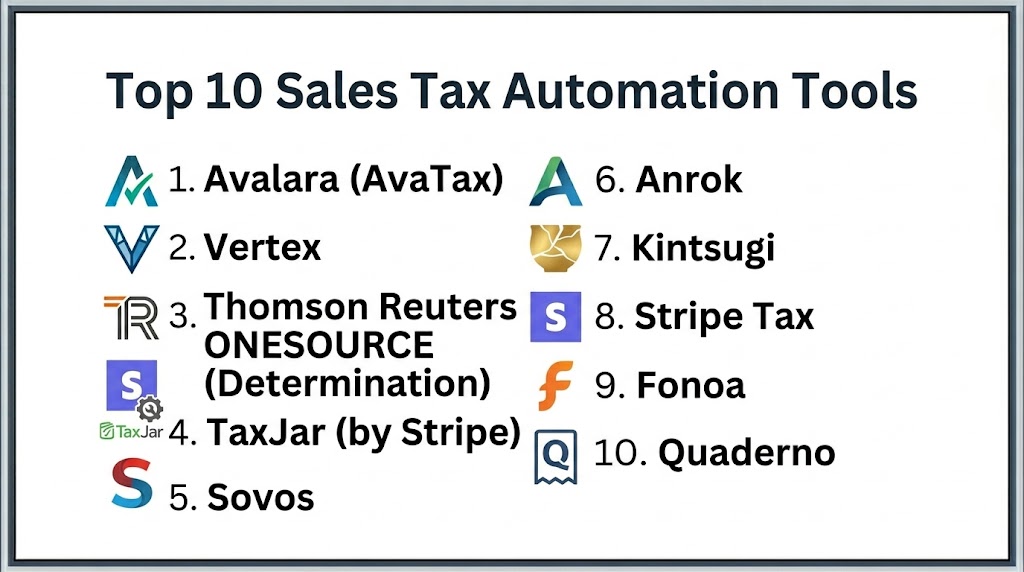
Top 10 Sales Tax Automation Tools
#1 — Avalara (AvaTax)
Short description: Avalara is a leading global sales tax automation platform that provides real-time tax calculation, filing, and compliance across multiple jurisdictions.
Key Features
- Real-time tax calculation
- Automated filing and remittance
- Nexus tracking
- Global tax coverage
- Reporting dashboards
- API integrations
Pros
- Strong global coverage
- Scalable
- Extensive integrations
Cons
- Expensive
- Complex setup
- Limited customization
Platforms / Deployment
Cloud
Security & Compliance
Encryption, audit logs; certifications not publicly stated
Integrations & Ecosystem
Integrates with ERP, eCommerce, and billing platforms.
- 1000+ integrations
- API-first architecture
Support & Community
Enterprise-level support
#2 — Vertex
Short description: Vertex provides enterprise-grade tax automation with advanced calculation engines and compliance features.
Key Features
- Tax calculation engine
- Compliance automation
- Multi-country support
- Reporting tools
- Workflow automation
Pros
- Enterprise-ready
- Accurate tax engine
- Scalable
Cons
- Complex implementation
- Expensive
- Requires expertise
Platforms / Deployment
Cloud / Hybrid
Security & Compliance
Not publicly stated
Integrations & Ecosystem
Integrates with ERP systems like SAP and Oracle
Support & Community
Strong enterprise support
#3 — Thomson Reuters ONESOURCE (Determination)
Short description: ONESOURCE offers comprehensive tax automation with strong reporting and compliance capabilities.
Key Features
- Tax determination engine
- Reporting dashboards
- Compliance automation
- Audit support
- Workflow tools
Pros
- Reliable
- Enterprise-grade
- Strong compliance
Cons
- Expensive
- Complex
- Requires training
Platforms / Deployment
Cloud
Security & Compliance
Not publicly stated
Integrations & Ecosystem
Integrates with financial systems and ERP platforms
Support & Community
Strong support
#4 — TaxJar (by Stripe)
Short description: TaxJar is a popular tool for eCommerce businesses, offering automated sales tax calculations and filing.
Key Features
- Sales tax calculation
- Automated filing
- Reporting dashboards
- Nexus tracking
- API integrations
Pros
- Easy to use
- Great for eCommerce
- Quick setup
Cons
- Limited enterprise features
- Smaller ecosystem
- Pricing varies
Platforms / Deployment
Cloud
Security & Compliance
Not publicly stated
Integrations & Ecosystem
Integrates with eCommerce platforms like Shopify
Support & Community
Strong documentation
#5 — Sovos
Short description: Sovos provides global tax compliance and reporting solutions for enterprises.
Key Features
- Tax automation
- E-invoicing
- Reporting tools
- Compliance workflows
- Audit trails
Pros
- Strong compliance
- Global capabilities
- Scalable
Cons
- Expensive
- Complex setup
- Service-heavy
Platforms / Deployment
Cloud
Security & Compliance
Not publicly stated
Integrations & Ecosystem
Integrates with ERP systems
Support & Community
Enterprise support
#6 — Anrok
Short description: Anrok focuses on SaaS companies, automating global sales tax and VAT compliance.
Key Features
- Sales tax automation
- VAT compliance
- Reporting dashboards
- Nexus tracking
- Analytics
Pros
- SaaS-focused
- Easy automation
- Modern UI
Cons
- Limited enterprise features
- Narrow scope
- Pricing varies
Platforms / Deployment
Cloud
Security & Compliance
Not publicly stated
Integrations & Ecosystem
Integrates with SaaS billing tools
Support & Community
Growing support
#7 — Kintsugi
Short description: Kintsugi is an AI-powered sales tax automation platform designed for fast-growing SaaS businesses.
Key Features
- AI-driven tax calculations
- Nexus tracking
- Reporting tools
- Compliance automation
- Real-time updates
Pros
- Modern platform
- Easy to use
- Strong automation
Cons
- Smaller ecosystem
- Limited enterprise features
- Pricing varies
Platforms / Deployment
Cloud
Security & Compliance
Not publicly stated
Integrations & Ecosystem
Integrates with SaaS and billing platforms
Support & Community
Moderate support
#8 — Stripe Tax
Short description: Stripe Tax automates tax calculation directly within payment workflows for online businesses.
Key Features
- Real-time tax calculation
- Integration with payments
- Reporting tools
- API support
- Compliance automation
Pros
- Seamless integration
- Easy setup
- Developer-friendly
Cons
- Limited features
- Not enterprise-ready
- Narrow scope
Platforms / Deployment
Cloud
Security & Compliance
Not publicly stated
Integrations & Ecosystem
Part of Stripe ecosystem
Support & Community
Strong developer support
#9 — Fonoa
Short description: Fonoa is an API-first platform for real-time tax compliance and e-invoicing.
Key Features
- E-invoicing
- Tax calculation
- API integrations
- Reporting dashboards
- Compliance automation
Pros
- Developer-friendly
- Modern architecture
- Strong automation
Cons
- Requires technical setup
- Limited coverage
- Smaller ecosystem
Platforms / Deployment
Cloud
Security & Compliance
Not publicly stated
Integrations & Ecosystem
API-first integrations
Support & Community
Developer-focused
#10 — Quaderno
Short description: Quaderno provides automated sales tax compliance for online businesses and digital services.
Key Features
- Tax calculation
- Automated invoicing
- Reporting tools
- Compliance automation
- Multi-country support
Pros
- Easy to use
- Good for SMBs
- Affordable
Cons
- Limited enterprise features
- Smaller ecosystem
- Basic analytics
Platforms / Deployment
Cloud
Security & Compliance
Not publicly stated
Integrations & Ecosystem
Integrates with eCommerce and billing tools
Support & Community
Good support
Comparison Table
| Tool Name | Best For | Platform(s) Supported | Deployment | Standout Feature | Public Rating |
|---|---|---|---|---|---|
| Avalara | Global businesses | Web | Cloud | Global tax engine | N/A |
| Vertex | Enterprise | Web | Cloud/Hybrid | Tax engine accuracy | N/A |
| ONESOURCE | Enterprise | Web | Cloud | Full compliance suite | N/A |
| TaxJar | eCommerce | Web | Cloud | Easy setup | N/A |
| Sovos | Enterprise | Web | Cloud | Regulatory reporting | N/A |
| Anrok | SaaS | Web | Cloud | SaaS-focused | N/A |
| Kintsugi | SaaS | Web | Cloud | AI automation | N/A |
| Stripe Tax | SaaS | API | Cloud | Payment integration | N/A |
| Fonoa | Developers | API | Cloud | E-invoicing | N/A |
| Quaderno | SMB | Web | Cloud | Simplicity | N/A |
Evaluation & Scoring of Sales Tax Automation Tools
| Tool | Core | Ease | Integrations | Security | Performance | Support | Value | Weighted Total |
|---|---|---|---|---|---|---|---|---|
| Avalara | 9 | 7 | 9 | 8 | 9 | 8 | 7 | 8.3 |
| Vertex | 9 | 6 | 9 | 8 | 9 | 8 | 6 | 8.1 |
| ONESOURCE | 9 | 6 | 8 | 8 | 9 | 8 | 6 | 8.0 |
| TaxJar | 8 | 9 | 8 | 7 | 8 | 7 | 8 | 8.1 |
| Sovos | 8 | 6 | 8 | 8 | 8 | 8 | 6 | 7.8 |
| Anrok | 7 | 8 | 7 | 7 | 7 | 7 | 8 | 7.5 |
| Kintsugi | 7 | 8 | 7 | 7 | 7 | 7 | 8 | 7.5 |
| Stripe Tax | 7 | 9 | 8 | 7 | 7 | 7 | 8 | 7.7 |
| Fonoa | 7 | 7 | 9 | 7 | 8 | 7 | 7 | 7.6 |
| Quaderno | 7 | 8 | 7 | 7 | 7 | 7 | 8 | 7.5 |
How to interpret scores:
- Higher Core = stronger tax automation capabilities
- Higher Ease = better usability
- Higher Value = better ROI
- Enterprises prioritize Core + Security, SMBs prioritize Ease + Value
Which Sales Tax Automation Tool Is Right for You?
Solo / Freelancer
Basic tax tools are sufficient; full automation is not required.
SMB
Quaderno, TaxJar, and Stripe Tax provide simplicity and affordability.
Mid-Market
Avalara and Anrok offer scalability and automation.
Enterprise
Vertex, ONESOURCE, and Sovos provide advanced compliance capabilities.
Budget vs Premium
- Budget: Quaderno, Stripe Tax
- Premium: Vertex, Avalara
Feature Depth vs Ease of Use
- Feature-rich: Vertex, ONESOURCE
- Easy-to-use: TaxJar, Stripe Tax
Integrations & Scalability
Choose tools with strong ERP and API integrations.
Security & Compliance Needs
Enterprises should prioritize audit-ready platforms with compliance controls.
Frequently Asked Questions (FAQs)
1. What are sales tax automation tools?
These tools automate tax calculation, reporting, and filing across jurisdictions. They reduce manual work and improve accuracy. This ensures compliance.
2. Why are they important?
Sales tax rules vary by location and change frequently. Automation ensures correct rates are applied. This reduces errors and penalties.
3. How do these tools work?
They integrate with billing or eCommerce systems and apply tax rates in real time. They also generate reports and filings automatically.
4. Who should use them?
Businesses operating in multiple states or countries benefit the most. SaaS and eCommerce companies rely heavily on them.
5. What features should I look for?
Look for real-time calculation, filing automation, integrations, and reporting. Nexus tracking is also important.
6. Are these tools secure?
Most offer encryption and access controls. Security varies by provider. Enterprises should evaluate compliance features.
7. Can they integrate with ERP systems?
Yes, most tools integrate with ERP and accounting systems. This ensures seamless workflows.
8. How long does implementation take?
SMB tools can be deployed quickly. Enterprise tools may take longer due to integrations.
9. What pricing models are used?
Most tools use subscription or usage-based pricing. Costs depend on features and scale.
10. What mistakes should be avoided?
Ignoring integration capabilities and scalability is a common mistake. Businesses should also evaluate compliance coverage.
Conclusion
Sales Tax Automation Tools have become essential for businesses dealing with complex and evolving tax regulations. These platforms eliminate manual calculations, reduce compliance risks, and ensure accurate tax collection and reporting across jurisdictions. As businesses expand into multiple regions, managing sales tax manually becomes inefficient and risky, making automation a necessity rather than an option. From enterprise solutions like Vertex and Avalara to SMB-friendly tools like TaxJar and Quaderno, there are options for every business size. The right choice depends on your operational complexity, geographic reach, and integration needs. Businesses should prioritize automation, real-time accuracy, and scalability when selecting a solution. Security and compliance should also be key considerations. Instead of choosing based on popularity alone, organizations should evaluate how well a platform fits their workflows. Shortlisting a few tools and running pilot implementations is the best approach. This ensures long-term compliance, efficiency, and financial accuracy.
