Introduction
Last-mile Delivery Platforms are software solutions that manage the final stage of the delivery process, where goods move from a local hub or warehouse to the customer’s doorstep. This stage is the most visible part of the supply chain and has a direct impact on customer satisfaction and brand experience.
With the rise of eCommerce and on-demand services, businesses must deliver faster, cheaper, and more reliably than ever. Last-mile delivery is also one of the most complex and costly stages, making optimization essential for profitability and operational efficiency.
Common use cases include:
- eCommerce order delivery
- Food and grocery delivery
- Courier and logistics operations
- Field service dispatch
- Healthcare and pharmacy delivery
Key evaluation criteria:
- Route optimization and dispatch automation
- Real-time tracking and visibility
- Proof of delivery capabilities
- Driver and fleet management
- Integration with ERP, OMS, and WMS
- Customer communication tools
- Scalability across regions
- Reporting and analytics
- Ease of use and onboarding
Best for: eCommerce companies, logistics providers, retailers, and delivery-focused businesses managing high-volume shipments.
Not ideal for: Businesses with very low delivery volume or those relying entirely on third-party carriers without operational control.
Key Trends in Last-mile Delivery Platforms
- AI-driven dispatch and route optimization
- Real-time tracking and live ETA updates
- Automation of delivery workflows
- Integration with multiple logistics partners
- Mobile-first apps for drivers
- Contactless delivery and digital proof of delivery
- Predictive analytics for delivery planning
- Sustainability tracking for emissions and fuel usage
- API-first platforms for ecosystem integration
- Increasing use of automation and AI agents in logistics
How We Selected These Tools
- Market adoption and credibility
- Feature completeness for last-mile operations
- Real-world performance and scalability
- Integration ecosystem strength
- Ease of use and onboarding
- Security and compliance considerations
- Vendor support and documentation
- Coverage across SMB to enterprise
- Practical logistics use cases
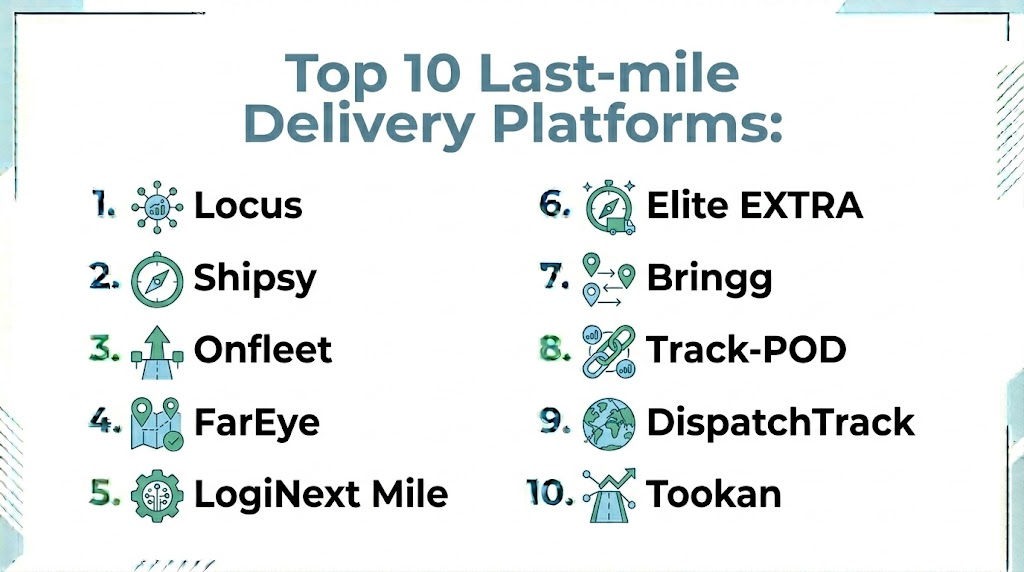
Top 10 Last-mile Delivery Platforms
#1 — Locus
Short description: A logistics optimization platform designed for enterprise delivery operations. It provides AI-powered routing, real-time tracking, and automation capabilities. Ideal for large-scale logistics teams.
Key Features
- AI route optimization
- Real-time tracking
- Dispatch automation
- Analytics dashboards
- Delivery performance insights
Pros
- Strong AI capabilities
- Enterprise scalability
Cons
- Higher cost
- Complex setup
Platforms / Deployment
- Web / Mobile
- Cloud
Security & Compliance
- Not publicly stated
Integrations & Ecosystem
Supports integration with logistics and enterprise systems.
- APIs
- ERP systems
- Supply chain tools
Support & Community
Enterprise-level support.
#2 — Shipsy
Short description: A modern logistics platform focused on multi-carrier and high-volume delivery operations. It offers strong automation and visibility features. Suitable for enterprise and mid-market businesses.
Key Features
- Multi-stop optimization
- Real-time tracking
- Proof of delivery
- Delivery analytics
- Automated workflows
Pros
- Strong multi-carrier support
- High scalability
Cons
- Learning curve
- Pricing varies
Platforms / Deployment
- Web
- Cloud
Security & Compliance
- Not publicly stated
Integrations & Ecosystem
- APIs
- ERP and logistics systems
Support & Community
Strong onboarding and support.
#3 — Onfleet
Short description: A last-mile delivery platform designed for businesses needing real-time tracking and dispatch management. It is widely used in food and retail delivery.
Key Features
- Real-time tracking
- Route optimization
- Driver management
- Proof of delivery
- Notifications
Pros
- Easy to use
- Strong tracking features
Cons
- Limited enterprise depth
- Customization limits
Platforms / Deployment
- Web / Mobile
- Cloud
Security & Compliance
- Not publicly stated
Integrations & Ecosystem
- APIs
- eCommerce tools
Support & Community
Good documentation and support.
#4 — FarEye
Short description: A delivery orchestration platform offering automation, predictive analytics, and real-time visibility. Designed for enterprise logistics operations.
Key Features
- Delivery automation
- Predictive analytics
- Real-time visibility
- Dispatch management
- Performance tracking
Pros
- Advanced analytics
- Enterprise-ready
Cons
- Complex implementation
- Higher pricing
Platforms / Deployment
- Web
- Cloud
Security & Compliance
- Not publicly stated
Integrations & Ecosystem
- APIs
- Supply chain systems
Support & Community
Enterprise support.
#5 — LogiNext Mile
Short description: A delivery automation platform designed to optimize last-mile logistics and improve delivery efficiency. Suitable for growing logistics operations.
Key Features
- Route optimization
- Dispatch automation
- Real-time tracking
- Analytics
- Alerts
Pros
- Scalable
- Good analytics
Cons
- Learning curve
- Pricing varies
Platforms / Deployment
- Web
- Cloud
Security & Compliance
- Not publicly stated
Integrations & Ecosystem
- APIs
- Logistics tools
Support & Community
Good support.
#6 — Bringg
Short description: A delivery orchestration platform that manages multiple delivery fleets and partners. Ideal for enterprises managing complex delivery networks.
Key Features
- Multi-carrier management
- Delivery orchestration
- Real-time tracking
- Customer notifications
- Analytics
Pros
- Strong orchestration
- Enterprise scalability
Cons
- Complex setup
- Premium pricing
Platforms / Deployment
- Web
- Cloud
Security & Compliance
- Not publicly stated
Integrations & Ecosystem
- APIs
- Retail and logistics systems
Support & Community
Enterprise-level support.
#7 — Track-POD
Short description: A delivery management platform focused on proof of delivery and tracking. Suitable for SMB logistics operations.
Key Features
- Proof of delivery
- Route optimization
- Tracking
- Reporting
- Mobile app
Pros
- Easy to use
- Affordable
Cons
- Limited enterprise features
- Basic analytics
Platforms / Deployment
- Web / Mobile
- Cloud
Security & Compliance
- Not publicly stated
Integrations & Ecosystem
- APIs
Support & Community
Good SMB support.
#8 — DispatchTrack
Short description: A delivery management platform designed for route optimization and customer communication. Suitable for mid-market and enterprise businesses.
Key Features
- Route optimization
- Delivery tracking
- Customer notifications
- Analytics
- Scheduling
Pros
- Strong customer communication
- Scalable
Cons
- UI complexity
- Pricing varies
Platforms / Deployment
- Web
- Cloud
Security & Compliance
- Not publicly stated
Integrations & Ecosystem
- APIs
- Enterprise systems
Support & Community
Good support.
#9 — Tookan
Short description: A delivery management platform focused on small and mid-sized businesses. It offers dispatching, tracking, and workflow automation.
Key Features
- Task management
- Route optimization
- Real-time tracking
- Proof of delivery
- Notifications
Pros
- Easy to use
- Affordable
Cons
- Limited scalability
- Basic features
Platforms / Deployment
- Web / Mobile
- Cloud
Security & Compliance
- Not publicly stated
Integrations & Ecosystem
- APIs
- Basic integrations
Support & Community
SMB-focused support.
#10 — Elite EXTRA
Short description: A routing and delivery management platform designed for logistics and distribution businesses. It focuses on route optimization and dispatch efficiency.
Key Features
- Route optimization
- Dispatch management
- Driver tracking
- Analytics
- Reporting
Pros
- Strong routing capabilities
- Reliable
Cons
- Limited UI flexibility
- Setup effort
Platforms / Deployment
- Web
- Cloud
Security & Compliance
- Not publicly stated
Integrations & Ecosystem
- APIs
- Logistics tools
Support & Community
Good support.
Comparison Table
| Tool Name | Best For | Platform Supported | Deployment | Standout Feature | Public Rating |
|---|---|---|---|---|---|
| Locus | Enterprise | Web/Mobile | Cloud | AI routing | N/A |
| Shipsy | Enterprise | Web | Cloud | Multi-carrier | N/A |
| Onfleet | SMB | Web/Mobile | Cloud | Real-time tracking | N/A |
| FarEye | Enterprise | Web | Cloud | Automation | N/A |
| LogiNext | Mid-market | Web | Cloud | Analytics | N/A |
| Bringg | Enterprise | Web | Cloud | Orchestration | N/A |
| Track-POD | SMB | Web/Mobile | Cloud | Proof of delivery | N/A |
| DispatchTrack | Mid-market | Web | Cloud | Customer communication | N/A |
| Tookan | SMB | Web/Mobile | Cloud | Ease of use | N/A |
| Elite EXTRA | Logistics | Web | Cloud | Routing | N/A |
Evaluation & Scoring of Last-mile Delivery Platforms
| Tool Name | Core 25% | Ease 15% | Integrations 15% | Security 10% | Performance 10% | Support 10% | Value 15% | Weighted Total |
|---|---|---|---|---|---|---|---|---|
| Locus | 9 | 7 | 9 | 7 | 9 | 8 | 6 | 8.1 |
| Shipsy | 9 | 7 | 8 | 7 | 8 | 8 | 7 | 8.0 |
| Onfleet | 7 | 9 | 7 | 6 | 7 | 7 | 8 | 7.5 |
| FarEye | 9 | 6 | 8 | 7 | 8 | 8 | 6 | 7.9 |
| LogiNext | 8 | 7 | 8 | 7 | 8 | 7 | 7 | 7.7 |
| Bringg | 9 | 6 | 9 | 7 | 8 | 8 | 6 | 7.9 |
| Track-POD | 7 | 9 | 6 | 6 | 7 | 7 | 8 | 7.4 |
| DispatchTrack | 8 | 7 | 7 | 6 | 7 | 7 | 7 | 7.3 |
| Tookan | 7 | 9 | 6 | 6 | 7 | 7 | 8 | 7.4 |
| Elite EXTRA | 8 | 7 | 7 | 6 | 7 | 7 | 7 | 7.3 |
How to interpret scores:
- Higher scores indicate stronger capabilities
- Enterprise tools lead in integrations and scalability
- SMB tools perform better in ease of use and value
- Scores are comparative, not absolute
- Choose based on delivery volume and complexity
Which Last-mile Delivery Platform Is Right for You
Solo / Freelancer
Tookan or Track-POD are simple and affordable.
SMB
Onfleet and Tookan provide ease of use and scalability.
Mid-Market
LogiNext and DispatchTrack offer balanced features.
Enterprise
Locus, Shipsy, and Bringg are best for large operations.
Budget vs Premium
- Budget tools include Tookan and Track-POD
- Premium tools include Locus and Bringg
Feature Depth vs Ease of Use
- Advanced tools include FarEye and Locus
- Easy tools include Onfleet and Tookan
Integrations & Scalability
- Strong integrations in enterprise tools
- Moderate in SMB tools
Security & Compliance Needs
- Enterprise tools for high compliance
- SMB tools for basic needs
Frequently Asked Questions
1. What is last-mile delivery software
It is software that manages the final stage of delivery from a warehouse to the customer. It helps with routing, tracking, and delivery execution. It improves efficiency and customer experience.
2. Why is last-mile delivery important
It directly impacts customer satisfaction and delivery success. It is also one of the most expensive parts of logistics. Efficient systems reduce costs and improve performance.
3. Who should use these platforms
eCommerce companies, logistics providers, and delivery businesses benefit the most. Any business managing deliveries can use them. They are useful for both small and large operations.
4. Can these platforms reduce delivery costs
Yes, they optimize routes and automate dispatching. This reduces fuel consumption and manual work. Over time, it improves efficiency.
5. Do these platforms provide real-time tracking
Yes, most platforms offer live tracking and updates. Customers can see delivery status in real time. This improves transparency and trust.
6. Are these tools cloud-based
Most modern platforms are cloud-based. They provide flexibility and real-time access. Many also offer mobile apps.
7. How long does implementation take
Simple tools can be implemented quickly. Enterprise platforms take longer due to customization. It depends on business size.
8. Can they integrate with other systems
Yes, they integrate with ERP, WMS, and eCommerce platforms. This ensures seamless operations. Integration improves efficiency.
9. Do they support multiple delivery partners
Yes, many platforms support multi-carrier operations. They help manage internal fleets and external partners. This improves scalability.
10. Are last-mile delivery platforms expensive
Pricing varies based on features and scale. SMB tools are affordable. Enterprise solutions require higher investment.
Conclusion
Last-mile Delivery Platforms have become essential for modern logistics and eCommerce businesses. They help manage the most critical stage of the supply chain, where customer expectations are highest. These platforms provide automation, real-time visibility, and route optimization. Businesses can reduce delivery costs while improving efficiency and customer satisfaction. This makes them a key investment for growth. Choosing the right platform depends on your delivery volume, operational complexity, and integration needs. Enterprise tools offer advanced capabilities, while smaller tools focus on simplicity and affordability. It is important to evaluate how well a platform fits your workflow. Testing a few tools before final selection is always recommended.
