Introduction
PII Detection & Redaction Tools help organizations find, classify, mask, anonymize, redact, or remove personally identifiable information from text, documents, logs, databases, cloud storage, AI prompts, support tickets, emails, forms, call transcripts, and analytics pipelines. In simple terms, these tools help teams answer: Where is sensitive personal data located? Who can access it? Is it being shared safely? Can it be hidden before storage, analysis, or AI processing?
These tools matter because companies now handle personal data across more systems than ever before. Customer support platforms, CRM tools, SaaS apps, AI chatbots, document repositories, data lakes, and developer logs can all contain names, emails, phone numbers, addresses, IDs, financial details, health information, or other sensitive fields. Without proper detection and redaction, organizations risk privacy violations, compliance issues, data leaks, and unsafe AI workflows.
Common use cases include privacy compliance, document redaction, AI prompt protection, log sanitization, customer support data masking, cloud storage discovery, and test data anonymization. Buyers should evaluate detection accuracy, redaction methods, supported data types, file support, APIs, deployment model, integrations, security controls, audit logs, scalability, and pricing flexibility.
Best for: security teams, privacy teams, compliance leaders, legal teams, data engineers, AI teams, healthcare organizations, financial services, SaaS companies, and enterprises handling sensitive customer data. Not ideal for: very small teams with limited personal data, teams that only need manual document editing, or organizations that already have strong built-in controls inside a single platform and do not need cross-system discovery or automated redaction.
Key Trends in PII Detection & Redaction Tools
- AI prompt redaction is becoming a major use case: Organizations want to remove names, emails, IDs, payment details, health data, and confidential information before sending prompts to AI models.
- Document redaction is becoming more automated: Legal, finance, healthcare, and public-sector teams are moving away from manual redaction toward automated discovery and masking across large document sets.
- Data discovery and redaction are converging: Buyers increasingly want tools that not only find sensitive data but also classify, label, mask, delete, or remediate it.
- Cloud storage scanning is now essential: Sensitive personal data often lives in object storage, databases, SaaS tools, data warehouses, and shared drives, making cloud-native scanning more important.
- Developer-friendly APIs are gaining adoption: Engineering teams need simple APIs and SDKs to redact PII from logs, chat messages, analytics events, and AI application pipelines.
- Privacy teams want stronger audit trails: Compliance requires evidence, so audit logs, policy history, detection reports, and remediation records are becoming important buying criteria.
- Structured and unstructured data support matters: Modern tools must handle databases, CSV files, PDFs, images, emails, chat transcripts, JSON payloads, and free-form text.
- Redaction quality is being measured more carefully: Buyers are paying attention to false positives, missed entities, multilingual detection, custom entity support, and context-aware classification.
- Data anonymization is expanding beyond masking: Some teams need pseudonymization, tokenization, synthetic data generation, and reversible or irreversible anonymization based on use case.
- Privacy engineering is becoming part of AI governance: PII detection and redaction tools are now used inside AI pipelines, RAG systems, customer chatbots, and model monitoring workflows.
How We Selected These Tools
The tools below were selected based on practical relevance for PII detection, redaction, masking, anonymization, privacy engineering, and sensitive data governance. The category includes enterprise privacy platforms, developer APIs, open-source frameworks, cloud-native services, and document-focused redaction tools.
- Feature completeness: Preference was given to tools that support detection, classification, masking, redaction, anonymization, or remediation workflows.
- Market adoption and mindshare: Widely recognized platforms in data privacy, security, cloud, AI, and developer ecosystems were prioritized.
- Use-case coverage: The list balances document redaction, cloud data scanning, AI prompt protection, application APIs, and enterprise data discovery.
- Integration strength: Tools with APIs, SDKs, cloud integrations, SaaS connectors, data warehouse support, or workflow automation were rated higher.
- Security posture signals: Admin controls, audit logs, RBAC, encryption, identity integration, and enterprise governance capabilities were considered.
- Deployment flexibility: Cloud, self-hosted, hybrid, and open-source options were included to support different buyer needs.
- Scalability: Tools that can support high-volume data scanning, enterprise repositories, or production application traffic were prioritized.
- Buyer fit: The list includes options for security teams, developers, compliance teams, legal teams, data teams, and AI engineering teams.
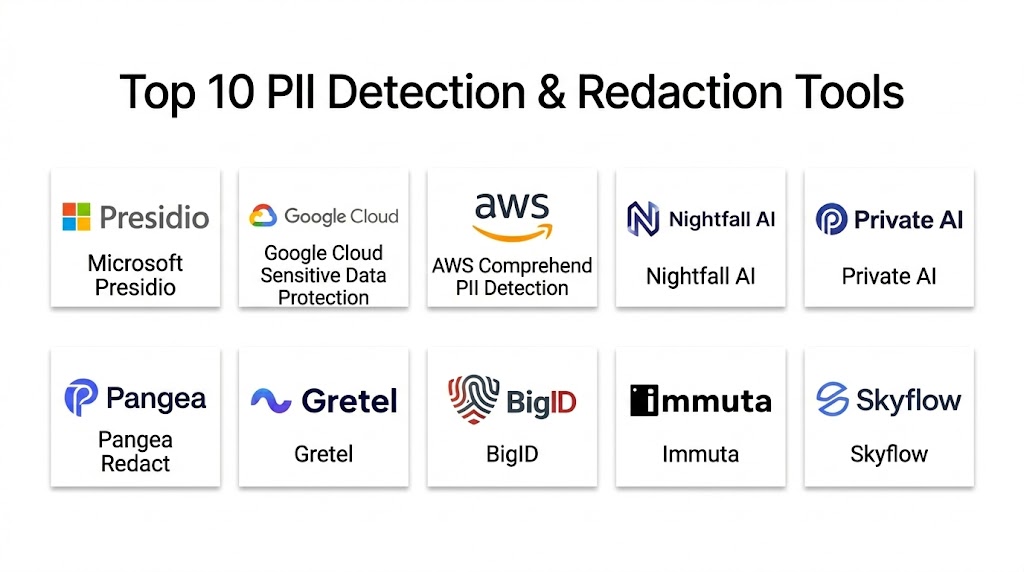
Top 10 PII Detection & Redaction Tools
#1 — Microsoft Presidio
Short description: Microsoft Presidio is an open-source framework for detecting, anonymizing, and redacting sensitive information in text and images. It is especially useful for developers and privacy engineering teams that want customizable PII detection pipelines. Presidio supports recognizers, anonymizers, and extensible workflows that can be adapted for different regions, entities, and business needs. It is best for technical teams that want flexibility and control rather than a fully managed SaaS-only product.
Key Features
- Detects sensitive entities such as names, emails, phone numbers, locations, and IDs.
- Supports text anonymization and redaction workflows.
- Allows custom recognizers for organization-specific data types.
- Can be extended with NLP models and pattern-based detection.
- Useful for AI prompt redaction and log sanitization.
- Supports image redaction use cases.
- Open-source and developer-friendly architecture.
Pros
- Highly flexible for technical teams.
- Strong fit for custom privacy engineering workflows.
- Useful in AI, analytics, and application pipelines.
- Open-source model reduces vendor lock-in.
Cons
- Requires engineering setup and maintenance.
- Not a full enterprise privacy platform by itself.
- Accuracy depends on configuration and custom recognizers.
- Non-technical teams may need developer support.
Platforms / Deployment
Self-hosted / Cloud / Hybrid depending on implementation. Commonly used in Python-based application and data workflows.
Security & Compliance
Security depends on deployment architecture, hosting environment, access controls, and logging setup. Compliance certifications are not automatically provided by using the open-source framework. Use: Varies / N/A.
Integrations & Ecosystem
Microsoft Presidio works well inside custom applications, data pipelines, AI systems, and internal privacy workflows. It can be integrated wherever developers need programmable PII detection and anonymization.
- Python applications
- AI prompt pipelines
- Data processing workflows
- Log redaction systems
- Internal APIs
- Image redaction workflows
Support & Community
Presidio has open-source documentation and community support. Enterprise support depends on internal engineering capability or external implementation partners. It is strongest for teams comfortable building and operating their own privacy tooling.
#2 — Google Cloud Sensitive Data Protection
Short description: Google Cloud Sensitive Data Protection helps organizations discover, classify, inspect, mask, tokenize, and protect sensitive data across cloud and application environments. It is useful for teams that need scalable PII detection across structured and unstructured data. The platform supports inspection and transformation workflows for privacy, compliance, analytics, and security teams. It is best for organizations already using Google Cloud or teams that need API-based sensitive data inspection.
Key Features
- Sensitive data inspection across text, storage, and data workloads.
- Built-in detectors for common PII and sensitive data types.
- De-identification, masking, tokenization, and transformation options.
- API-based inspection for applications and data pipelines.
- Supports large-scale scanning and classification workflows.
- Helps privacy and security teams identify risky data exposure.
- Useful for compliance-oriented data governance programs.
Pros
- Strong cloud-native sensitive data detection capabilities.
- Scales well for large data environments.
- Useful for both security teams and developers.
- Offers flexible de-identification options.
Cons
- Best fit for teams already using cloud-based workflows.
- Configuration can require privacy engineering knowledge.
- Costs may vary based on scanning and API usage.
- May need additional tools for non-cloud repositories and workflows.
Platforms / Deployment
Cloud / API-based. Primarily aligned with Google Cloud environments, with application-level API usage possible.
Security & Compliance
Supports cloud security controls such as identity management, access control, encryption, logging, and policy configuration depending on setup. Specific compliance requirements should be verified directly. If uncertain, write: Not publicly stated.
Integrations & Ecosystem
Google Cloud Sensitive Data Protection integrates well with cloud storage, data processing, analytics, and application workflows. It is useful when teams want sensitive data inspection inside cloud-native pipelines.
- Cloud storage
- Data warehouses
- Data pipelines
- Application APIs
- Security monitoring workflows
- Analytics environments
Support & Community
Google Cloud offers documentation, enterprise support options, training resources, and partner ecosystem support. Community knowledge is strong among cloud engineers and data teams.
#3 — Amazon Comprehend PII Detection
Short description: Amazon Comprehend PII Detection helps teams detect personally identifiable information in text using managed natural language processing capabilities. It is useful for developers and cloud teams that need to identify sensitive information in documents, messages, support tickets, or application data. The service can support privacy workflows where detected entities are masked, redacted, or routed through additional controls. It is best for organizations already using AWS-based applications and data systems.
Key Features
- Detects PII entities in text using managed NLP capabilities.
- Useful for analyzing customer messages, documents, and support content.
- Can be integrated into serverless and application workflows.
- Supports API-driven detection for developer use cases.
- Helps build redaction and privacy automation pipelines.
- Fits well with AWS storage, compute, and security services.
- Useful for cloud-native privacy engineering.
Pros
- Practical for AWS-first engineering teams.
- Reduces need to build detection models from scratch.
- Works well in event-driven data pipelines.
- Easy to connect with AWS application workflows.
Cons
- Redaction workflows may require additional implementation.
- Best value is for teams already using AWS.
- Not a complete enterprise privacy governance platform alone.
- Accuracy should be validated against specific data formats and regions.
Platforms / Deployment
Cloud / API-based, primarily aligned with AWS environments.
Security & Compliance
Security depends on AWS identity, access management, encryption, logging, and service configuration. Specific compliance requirements should be verified for the selected workload and region. If uncertain, write: Not publicly stated.
Integrations & Ecosystem
Amazon Comprehend PII Detection fits naturally into AWS application and data architectures. It can be used with storage, compute, workflow automation, and monitoring services.
- Object storage workflows
- Serverless functions
- Application APIs
- Data processing pipelines
- Security monitoring systems
- Customer support content analysis
Support & Community
AWS provides service documentation, support plans, learning resources, and a large cloud community. Implementation support is strong for teams already familiar with AWS services.
#4 — Nightfall AI
Short description: Nightfall AI is a data loss prevention and sensitive data protection platform that helps organizations discover, classify, and protect sensitive information across SaaS apps, cloud environments, and developer workflows. It is useful for detecting PII, secrets, credentials, and regulated data in business systems. Nightfall is often considered by security and compliance teams that need automated detection and remediation. It is best for organizations that want SaaS-friendly data protection with workflow integrations.
Key Features
- Detects sensitive data such as PII, secrets, and regulated information.
- Supports scanning across SaaS and cloud-based workflows.
- Provides automated remediation and policy-based protection.
- Useful for security, compliance, and privacy teams.
- Offers API-based detection for developer workflows.
- Helps reduce data leakage risks in collaboration systems.
- Supports monitoring and reporting for governance teams.
Pros
- Strong fit for SaaS and cloud data protection.
- Useful for both security teams and developers.
- Helps automate sensitive data remediation.
- Can support modern AI and application privacy workflows.
Cons
- Best fit depends on supported integrations.
- Pricing and packaging may vary by use case.
- May need tuning to reduce false positives.
- Larger deployments may require careful policy design.
Platforms / Deployment
Cloud / API-based / SaaS integrations. Deployment options may vary by customer requirements.
Security & Compliance
Supports enterprise security features depending on plan and configuration. Specific certifications, identity controls, audit logs, and compliance mappings should be verified directly. If uncertain, write: Not publicly stated.
Integrations & Ecosystem
Nightfall AI is designed to connect with SaaS, developer, and security workflows. It is useful when sensitive data needs to be detected across collaboration, productivity, and engineering systems.
- SaaS applications
- Cloud environments
- Developer APIs
- Security workflows
- Collaboration tools
- Compliance reporting processes
Support & Community
Nightfall provides vendor-led support, documentation, onboarding resources, and customer success options. Community depth may vary, but it has strong visibility in the data security and DLP market.
#5 — BigID
Short description: BigID is an enterprise data discovery, privacy, security, and governance platform that helps organizations find and manage sensitive data across many systems. It supports PII discovery, classification, labeling, remediation, and privacy workflows. BigID is especially useful for large organizations that need broad visibility across cloud, SaaS, on-premises, and data platforms. It is best for enterprises that need data inventory, privacy compliance, and sensitive data protection at scale.
Key Features
- Enterprise data discovery across multiple repositories.
- PII classification and sensitive data mapping.
- Supports privacy, security, governance, and compliance workflows.
- Helps identify data risk, access exposure, and data ownership.
- Provides remediation workflows such as labeling, masking, and deletion.
- Useful for data subject request and privacy operations.
- Broad integration ecosystem for enterprise environments.
Pros
- Strong fit for large enterprises with complex data estates.
- Combines privacy, security, and governance capabilities.
- Useful for data inventory and sensitive data mapping.
- Helps connect discovery with remediation actions.
Cons
- May be too complex for smaller teams.
- Implementation can require cross-functional planning.
- Cost and deployment scope may be significant.
- Requires strong data governance ownership to maximize value.
Platforms / Deployment
Cloud / Hybrid / Enterprise data environments. Deployment options may vary by customer requirements.
Security & Compliance
Enterprise-focused platform with security and governance controls depending on configuration. Specific certifications, compliance claims, and control details should be verified directly. If uncertain, write: Not publicly stated.
Integrations & Ecosystem
BigID integrates with cloud platforms, SaaS tools, databases, data warehouses, storage systems, and governance workflows. It is strongest when organizations need broad enterprise data visibility.
- Cloud storage
- Databases and data warehouses
- SaaS applications
- Data governance platforms
- Security tools
- Privacy operation workflows
Support & Community
BigID provides enterprise support, onboarding, documentation, and customer success resources. It is best suited for organizations that can support a structured implementation and long-term governance program.
#6 — Private AI
Short description: Private AI provides PII detection, redaction, and de-identification tools designed for text, documents, and AI workflows. It is useful for teams that need to remove or transform sensitive data before it reaches third-party systems, analytics platforms, or AI models. Private AI is commonly considered for privacy-first application development and secure AI pipelines. It is best for organizations that need API-based redaction with strong focus on personal data protection.
Key Features
- Detects and redacts PII from text and documents.
- Supports de-identification and anonymization workflows.
- Useful for AI prompt protection and LLM pipelines.
- Can support privacy-preserving data processing.
- API-first design for developer integration.
- Supports multiple sensitive entity types.
- Helps reduce risk before data reaches external systems.
Pros
- Strong fit for AI and application privacy workflows.
- Developer-friendly API approach.
- Useful for preventing sensitive data leakage.
- Supports privacy-by-design engineering patterns.
Cons
- Buyers should validate entity coverage for their region and industry.
- May require integration work in existing systems.
- Enterprise governance depth may vary by plan.
- Pricing and deployment options should be reviewed carefully.
Platforms / Deployment
Cloud / API-based / Deployment options may vary. Some environments may support flexible deployment depending on customer needs.
Security & Compliance
Security and privacy controls should be verified directly based on deployment model and plan. If certifications or control details are not confirmed, use: Not publicly stated.
Integrations & Ecosystem
Private AI fits well into AI applications, chatbots, document workflows, and privacy engineering pipelines. It is useful where sensitive data must be removed before processing.
- AI application workflows
- LLM prompt pipelines
- Document processing systems
- Customer support tools
- Data engineering pipelines
- Developer APIs
Support & Community
Private AI provides documentation and vendor-led support resources. Buyers should evaluate onboarding, technical support, and implementation guidance during a proof of concept.
#7 — Gretel
Short description: Gretel helps teams create privacy-preserving data workflows through synthetic data generation, data transformation, and sensitive data handling. It is useful when organizations need to replace real personal data with safer synthetic or anonymized alternatives for testing, analytics, machine learning, and development. Gretel is especially relevant for data teams that want usable datasets without exposing raw PII. It is best for engineering, analytics, and data science teams working with sensitive datasets.
Key Features
- Synthetic data generation for privacy-safe development and analytics.
- Sensitive data detection and transformation workflows.
- Supports de-identification and privacy-preserving data pipelines.
- Useful for test data management and machine learning workflows.
- API and developer-friendly platform approach.
- Helps reduce exposure of production customer data.
- Supports structured and semi-structured data use cases.
Pros
- Strong for synthetic data and privacy-preserving data sharing.
- Useful for development, testing, analytics, and AI teams.
- Helps reduce dependence on raw production data.
- Flexible for data engineering workflows.
Cons
- Not primarily a document redaction platform.
- Requires validation to ensure synthetic data quality.
- May not replace enterprise-wide data discovery tools.
- Best value comes from mature data engineering practices.
Platforms / Deployment
Cloud / API-based / Developer workflows. Deployment options may vary by plan and customer requirements.
Security & Compliance
Security features and compliance claims should be verified directly based on selected deployment and plan. If uncertain, write: Not publicly stated.
Integrations & Ecosystem
Gretel fits into data engineering, analytics, development, and AI pipelines where sensitive data must be transformed or replaced with safer alternatives.
- Data warehouses
- Databases
- Data science workflows
- Machine learning pipelines
- Developer APIs
- Test data environments
Support & Community
Gretel provides documentation, developer resources, and vendor support. It is especially useful for teams with data engineering and data science expertise.
#8 — Immuta
Short description: Immuta is a data security and access governance platform that helps organizations control access to sensitive data across analytics and cloud data environments. While it is not only a redaction tool, it supports privacy-aware data access policies, masking, and governance controls. It is useful for organizations that need to manage who can see sensitive data and under what conditions. It is best for data platform teams, analytics teams, and compliance-focused enterprises.
Key Features
- Policy-based data access control.
- Dynamic data masking and privacy-aware access rules.
- Sensitive data governance for analytics platforms.
- Helps enforce consistent policies across data environments.
- Supports auditability and governance workflows.
- Useful for regulated data analytics.
- Helps reduce manual permission management.
Pros
- Strong fit for data access governance.
- Useful for cloud analytics and data platform teams.
- Helps control sensitive data exposure at query time.
- Supports scalable policy management.
Cons
- Not a standalone PII discovery tool for every file or app.
- Best suited for data platform environments.
- Requires thoughtful policy design.
- May need complementary tools for document redaction or AI prompt redaction.
Platforms / Deployment
Cloud / Hybrid / Data platform environments. Deployment options vary by customer architecture.
Security & Compliance
Supports enterprise data access governance features such as access control, policy management, auditability, and masking depending on configuration. Specific certifications should be verified directly. If uncertain, write: Not publicly stated.
Integrations & Ecosystem
Immuta integrates with data platforms and analytics environments where sensitive data access must be governed consistently.
- Cloud data warehouses
- Data lakehouses
- Analytics platforms
- Identity systems
- Governance workflows
- Data security operations
Support & Community
Immuta provides enterprise documentation, onboarding, support resources, and customer success options. It is best suited for organizations with mature data platform teams.
#9 — Foxit Smart Redact
Short description: Foxit Smart Redact is designed to help teams find and redact sensitive information in documents at scale. It is especially useful for legal, finance, healthcare, and compliance teams that process large volumes of files. The tool focuses on automated document redaction, reducing manual review time and helping teams protect personal or confidential information. It is best for organizations with document-heavy privacy and compliance workflows.
Key Features
- Automated sensitive data discovery in documents.
- Redaction workflows for personal and confidential information.
- Useful for legal, finance, healthcare, and compliance teams.
- Supports batch-oriented document processing workflows.
- Helps reduce manual redaction effort.
- Designed for document privacy and compliance operations.
- Works well for teams handling large document repositories.
Pros
- Strong fit for document-heavy redaction use cases.
- Helpful for legal and compliance review workflows.
- Reduces manual redaction workload.
- Practical for organizations dealing with PDFs and business documents.
Cons
- Not primarily designed for AI prompt or API pipeline redaction.
- May need other tools for cloud-wide data discovery.
- Best value depends on document volume and workflow maturity.
- Integration depth should be validated for each environment.
Platforms / Deployment
Web / Desktop / Cloud or server-based options may vary by product packaging and customer setup.
Security & Compliance
Security controls depend on deployment and product configuration. Specific compliance certifications and enterprise control details should be verified directly. If uncertain, write: Not publicly stated.
Integrations & Ecosystem
Foxit Smart Redact fits best into document management, legal operations, and compliance review workflows where sensitive information must be redacted before sharing or archiving.
- Document repositories
- PDF workflows
- Legal review processes
- Compliance document workflows
- Cloud storage platforms
- Enterprise content management systems
Support & Community
Foxit provides documentation, product support, and customer resources. Community strength is stronger among document management and PDF users than developer-first privacy engineering teams.
#10 — Anonymization API
Short description: Anonymization API provides API-based detection and anonymization of sensitive information across text, documents, and other content types. It is designed for teams that need fast integration into applications, data pipelines, or privacy workflows. The platform focuses on transforming sensitive information into safer outputs through masking, redaction, or anonymization. It is best for developers and organizations that need a privacy API rather than a large enterprise governance suite.
Key Features
- Detects and anonymizes PII and sensitive data.
- API-based integration for applications and workflows.
- Supports masking, redaction, and anonymization use cases.
- Useful for AI prompts, logs, forms, and documents.
- Can help teams process sensitive data more safely.
- Fits developer-first privacy engineering patterns.
- Supports automated privacy workflows.
Pros
- Simple API-first approach for developers.
- Useful for embedding redaction into applications.
- Good fit for AI and data processing workflows.
- Can reduce manual privacy operations.
Cons
- Buyers should validate supported entity types and languages.
- Enterprise governance features may vary.
- May need additional tools for broad data discovery.
- Security and compliance details should be verified carefully.
Platforms / Deployment
Cloud / API-based. Deployment options may vary by customer requirements.
Security & Compliance
Security controls, retention policies, and compliance claims should be verified directly. If uncertain, write: Not publicly stated.
Integrations & Ecosystem
Anonymization API works best where developers need to add PII protection directly into applications, pipelines, or AI systems.
- Application APIs
- AI prompt workflows
- Document processing systems
- Log redaction pipelines
- Customer data platforms
- Data engineering workflows
Support & Community
Support is typically vendor-led with API documentation and onboarding resources. Buyers should evaluate technical documentation, response times, and support options before production use.
Comparison Table
| Tool Name | Best For | Platform Supported | Deployment | Standout Feature | Public Rating |
|---|---|---|---|---|---|
| Microsoft Presidio | Developers and privacy engineers | Python / Applications / Images | Self-hosted / Hybrid | Open-source customizable PII redaction | N/A |
| Google Cloud Sensitive Data Protection | Cloud data privacy teams | Cloud / API / Data platforms | Cloud | Scalable inspection and de-identification | N/A |
| Amazon Comprehend PII Detection | AWS application teams | Cloud / API | Cloud | Managed PII detection for text workflows | N/A |
| Nightfall AI | SaaS and cloud data protection | SaaS / API / Cloud | Cloud | Sensitive data detection across workflows | N/A |
| BigID | Enterprise data discovery and governance | Cloud / SaaS / Data systems | Cloud / Hybrid | Broad sensitive data discovery at scale | N/A |
| Private AI | AI prompt and application privacy | API / Applications / Documents | Cloud / Varies | PII redaction for AI and apps | N/A |
| Gretel | Synthetic data and privacy engineering | API / Data platforms | Cloud / Varies | Privacy-safe synthetic data workflows | N/A |
| Immuta | Data access governance | Data platforms / Analytics | Cloud / Hybrid | Dynamic data masking and access policies | N/A |
| Foxit Smart Redact | Document redaction teams | Web / Desktop / Server-based options | Cloud / Varies | Automated document redaction | N/A |
| Anonymization API | Developer API-based anonymization | API / Applications | Cloud | Fast PII anonymization API | N/A |
Evaluation & Scoring of PII Detection & Redaction Tools
| Tool Name | Core 25% | Ease 15% | Integrations 15% | Security 10% | Performance 10% | Support 10% | Value 15% | Weighted Total |
|---|---|---|---|---|---|---|---|---|
| Microsoft Presidio | 8 | 6 | 8 | 7 | 8 | 7 | 9 | 7.65 |
| Google Cloud Sensitive Data Protection | 9 | 7 | 9 | 9 | 9 | 8 | 8 | 8.35 |
| Amazon Comprehend PII Detection | 8 | 8 | 8 | 8 | 8 | 8 | 8 | 8.00 |
| Nightfall AI | 9 | 8 | 8 | 8 | 8 | 8 | 8 | 8.20 |
| BigID | 9 | 7 | 9 | 9 | 8 | 9 | 7 | 8.35 |
| Private AI | 8 | 8 | 8 | 8 | 8 | 7 | 8 | 7.95 |
| Gretel | 8 | 7 | 8 | 8 | 8 | 7 | 8 | 7.75 |
| Immuta | 8 | 7 | 9 | 9 | 8 | 8 | 7 | 8.00 |
| Foxit Smart Redact | 8 | 8 | 7 | 8 | 8 | 8 | 7 | 7.75 |
| Anonymization API | 8 | 8 | 7 | 7 | 8 | 7 | 8 | 7.65 |
These scores are comparative and based on category fit, not absolute product quality. A higher score means the tool aligns strongly with this evaluation model, but it does not mean it is the best choice for every organization. Enterprise platforms score well for governance and scale, while developer APIs score well for flexibility and implementation speed. Buyers should adjust the score weighting based on whether they need document redaction, cloud discovery, AI prompt protection, data masking, or test data anonymization.
Which PII Detection & Redaction Tool Is Right for You?
Solo / Freelancer
Solo professionals usually do not need a large enterprise privacy platform. If you only need to redact documents, a document-focused tool may be enough. If you are building applications or AI workflows, Microsoft Presidio can be a strong technical option because it is flexible and open-source. For simple API-based anonymization, Anonymization API or similar developer-first tools may be easier to adopt.
SMB
SMBs should focus on ease of deployment, predictable pricing, and practical coverage. If the business mainly uses cloud applications and SaaS tools, Nightfall AI can be useful for sensitive data protection across workflows. If the team builds applications on AWS or Google Cloud, Amazon Comprehend PII Detection or Google Cloud Sensitive Data Protection may be easier to integrate. For document-heavy businesses, Foxit Smart Redact may be more practical.
Mid-Market
Mid-market companies often need a combination of redaction, discovery, and governance. Nightfall AI is useful for SaaS and cloud data protection, while Private AI can support AI prompt and application privacy. Gretel is a good fit when teams need privacy-safe datasets for analytics, testing, or AI development. If data access governance is a priority, Immuta can help apply policies and masking inside analytics environments.
Enterprise
Enterprises usually need broad discovery, governance, auditability, and integration depth. BigID is a strong fit for enterprise-wide sensitive data discovery and privacy operations. Google Cloud Sensitive Data Protection works well for cloud-native data inspection and transformation. Immuta is valuable for data access control and dynamic masking across analytics environments. Enterprises may also combine these with developer tools such as Microsoft Presidio or Private AI for application-level redaction.
Budget vs Premium
Budget-conscious teams with technical skills can start with Microsoft Presidio, especially when custom development is acceptable. Cloud-native teams may prefer managed services such as Amazon Comprehend PII Detection or Google Cloud Sensitive Data Protection, where cost depends on usage. Premium enterprise options such as BigID, Nightfall AI, and Immuta are better suited when governance, automation, visibility, support, and compliance workflows matter more than lowest initial cost.
Feature Depth vs Ease of Use
For deep customization, Microsoft Presidio is a strong choice because teams can build custom recognizers and workflows. For ease of use, managed platforms such as Nightfall AI, Private AI, and Anonymization API may reduce engineering effort. For enterprise depth, BigID and Immuta provide broader governance capabilities but require more planning. For document teams, Foxit Smart Redact offers a more focused user experience.
Integrations & Scalability
If your main data lives in cloud platforms, choose tools that integrate closely with your cloud and data environment. Google Cloud Sensitive Data Protection and Amazon Comprehend PII Detection fit cloud-native applications and pipelines. BigID is stronger for large, mixed enterprise data estates. Nightfall AI is useful for SaaS workflows, while Gretel works well for data engineering and synthetic data pipelines.
Security & Compliance Needs
For regulated environments, prioritize tools with strong audit logs, access controls, encryption, policy management, retention controls, and clear deployment options. BigID, Immuta, Google Cloud Sensitive Data Protection, and Nightfall AI are strong candidates for governance-heavy environments. For AI application safety, Private AI and Microsoft Presidio can help redact sensitive data before it enters prompts, logs, or model workflows. Always verify security and compliance claims directly before purchase.
Frequently Asked Questions
1. What are PII detection and redaction tools?
PII detection and redaction tools identify sensitive personal information and help remove, mask, anonymize, or transform it. They can work across documents, databases, logs, cloud storage, SaaS apps, AI prompts, and application data. These tools help organizations reduce privacy risk and protect customer information. They are commonly used by security, privacy, legal, compliance, and engineering teams.
2. What types of PII can these tools detect?
Most tools can detect common personal data such as names, emails, phone numbers, addresses, government IDs, credit card numbers, and location details. Some tools also detect health data, financial data, credentials, secrets, and custom business identifiers. Entity coverage varies by product, language, region, and configuration. Buyers should test detection accuracy using real examples from their own environment.
3. How do PII redaction tools work?
PII redaction tools usually scan content using pattern matching, rules, dictionaries, machine learning, natural language processing, or a combination of methods. Once sensitive information is found, the tool can mask it, replace it with placeholders, remove it, tokenize it, or transform it into synthetic values. Some tools operate in real time through APIs, while others scan repositories in batches. The right method depends on speed, accuracy, and compliance needs.
4. Are PII detection tools accurate?
Accuracy depends on the data type, language, context, document quality, and tool configuration. Structured data such as emails or card numbers is usually easier to detect than context-heavy entities such as names or addresses. False positives and missed entities can happen, so testing is important. Organizations should validate tools with sample data before deploying them into production workflows.
5. What is the difference between redaction, masking, anonymization, and tokenization?
Redaction usually removes or hides sensitive information permanently. Masking hides part or all of a value, such as showing only the last few characters. Anonymization transforms data so individuals cannot be identified, while tokenization replaces real values with controlled tokens. The best method depends on whether the data must be reused, restored, analyzed, or permanently protected.
6. Can these tools protect AI prompts and LLM applications?
Yes, many PII detection and redaction tools can be used before prompts are sent to AI models. They can detect sensitive data in user inputs, redact it, and send safer text to the AI system. This is useful for chatbots, RAG systems, support copilots, analytics assistants, and internal AI tools. Teams should also log redaction decisions and define clear policies for what data can enter AI workflows.
7. How are PII detection and redaction tools priced?
Pricing models vary by product type. Some tools charge by users, data volume, API calls, scanned records, scanned storage, or platform modules. Open-source tools may reduce license costs but require engineering and infrastructure effort. Enterprise platforms may cost more but provide governance, support, integrations, and audit features. Buyers should estimate both software and implementation costs before choosing.
8. What are common mistakes when implementing PII redaction?
A common mistake is relying on default detectors without testing them against real business data. Another mistake is redacting too aggressively, which can reduce data usefulness for analytics or support teams. Some organizations forget to monitor logs, backups, AI prompts, and unstructured documents. Teams should define redaction policies, test accuracy, monitor results, and update detection rules as data changes.
9. Do PII detection tools support integrations with cloud and SaaS platforms?
Many modern tools support integrations with cloud storage, data warehouses, SaaS applications, APIs, security tools, and data pipelines. Cloud-native tools work well in their own cloud ecosystems, while enterprise platforms often support broader connectors. Developer-first tools usually integrate through APIs and SDKs. Buyers should confirm connector coverage before committing, especially for legacy systems and niche SaaS apps.
10. What is the best PII detection and redaction tool overall?
There is no single best tool for every organization. Microsoft Presidio is strong for developers, BigID is strong for enterprise discovery, Nightfall AI is useful for SaaS protection, Google Cloud Sensitive Data Protection fits cloud data workflows, and Foxit Smart Redact is practical for document redaction. The best choice depends on your data sources, compliance needs, team skills, budget, and deployment preferences. A focused pilot is the safest way to validate fit.
Conclusion
PII Detection & Redaction Tools are essential for organizations that need to protect personal data across documents, applications, cloud platforms, AI systems, logs, and analytics workflows. The right tool depends on the problem you are solving: developers may prefer Microsoft Presidio or Private AI, cloud teams may choose Google Cloud Sensitive Data Protection or Amazon Comprehend PII Detection, enterprises may need BigID or Immuta, and document-heavy teams may benefit from Foxit Smart Redact. For SaaS and workflow protection, Nightfall AI can be a strong option, while Gretel supports privacy-safe data generation and transformation. Buyers should avoid choosing based only on feature lists and instead test detection accuracy, integration fit, redaction quality, security controls, and total cost. Start by identifying your highest-risk data flows, shortlist two or three tools, run a pilot with real sample data, validate compliance and security needs, then scale the chosen solution across teams and systems.

Helpful overview of PII detection and redaction tools, highlighting their role in identifying sensitive information and supporting stronger privacy compliance efforts.