Introduction
Infrastructure monitoring tools help IT, DevOps, SRE, and platform teams track the health, performance, availability, and capacity of servers, cloud resources, networks, containers, databases, virtual machines, and core business systems. These tools collect infrastructure signals such as CPU usage, memory consumption, disk performance, network latency, uptime, service availability, and resource saturation. They matter because modern infrastructure is no longer limited to one data center or one cloud platform. Businesses now run workloads across hybrid cloud, multi-cloud, Kubernetes, remote offices, edge systems, and third-party services, making real-time visibility essential for reliability and operational control.
Common real-world use cases include monitoring cloud infrastructure, detecting server performance issues, tracking Kubernetes cluster health, identifying network bottlenecks, forecasting capacity needs, and reducing downtime through faster alerts.
Buyers should evaluate:
- Infrastructure coverage across cloud, on-prem, and hybrid environments
- Server, network, container, and database monitoring depth
- Alerting accuracy and noise reduction
- Dashboard flexibility and reporting options
- Integrations with cloud, DevOps, ITSM, and incident tools
- Scalability for growing infrastructure
- Security controls such as SSO, MFA, RBAC, and audit logs
- Pricing model and cost predictability
- Ease of setup and daily administration
- Support, documentation, and community strength
Best for: Infrastructure monitoring tools are best for IT managers, DevOps engineers, SRE teams, platform teams, MSPs, cloud operations teams, and enterprises that need continuous visibility across critical infrastructure.
Not ideal for: Very small teams with only a few simple websites or basic cloud resources may not need a full infrastructure monitoring platform. In those cases, lightweight uptime monitoring, built-in cloud dashboards, or simple open-source monitoring may be enough.
Key Trends in Infrastructure Monitoring Tools for the Future
- AI-assisted monitoring is becoming more useful: Modern platforms increasingly use anomaly detection, alert correlation, and intelligent recommendations to help teams detect issues faster.
- Hybrid and multi-cloud visibility is now essential: Many businesses operate across public cloud, private cloud, data centers, and distributed offices.
- Kubernetes monitoring has become a core requirement: Teams need visibility into nodes, pods, containers, namespaces, workloads, and cluster health.
- Infrastructure and observability are merging: Buyers increasingly prefer platforms that connect metrics, logs, traces, events, and user experience data.
- Alert fatigue reduction is a major priority: Teams want smarter alerts, deduplication, escalation rules, and incident context instead of noisy notifications.
- Open telemetry standards are gaining importance: Organizations want flexible data collection without being fully locked into one vendor.
- Security expectations are rising: SSO, MFA, RBAC, audit logs, encryption, and secure data handling are now important buying factors.
- Automation is moving beyond notifications: Monitoring tools are increasingly connected with runbooks, auto-remediation workflows, and incident response systems.
- Cost governance matters more: Usage-based pricing, high-cardinality metrics, and log volume can create budget pressure if not managed properly.
- MSP and multi-tenant monitoring needs are growing: Service providers need client separation, centralized dashboards, reporting, and remote monitoring.
How We Selected These Tools
The tools in this list were selected using practical buyer-focused evaluation criteria:
- Market adoption and recognition: Tools widely used by IT, DevOps, SRE, and enterprise teams were prioritized.
- Feature completeness: We considered server monitoring, network monitoring, cloud monitoring, dashboards, alerting, reporting, and capacity planning.
- Hybrid infrastructure support: Tools with strong cloud, on-prem, container, and virtual infrastructure coverage ranked higher.
- Ease of implementation: Platforms that reduce onboarding complexity and provide clear dashboards were favored.
- Integration ecosystem: We looked at integrations with cloud platforms, DevOps pipelines, incident response tools, ITSM systems, and collaboration platforms.
- Security posture: Tools with role-based access, authentication controls, auditability, and enterprise administration capabilities were preferred.
- Scalability: We considered how well each tool supports growing environments and distributed infrastructure.
- Support and community: Documentation, onboarding resources, support tiers, and user communities were part of the evaluation.
- Value for different buyers: The final list balances enterprise platforms, SMB-friendly tools, open-source options, and IT operations-focused products.
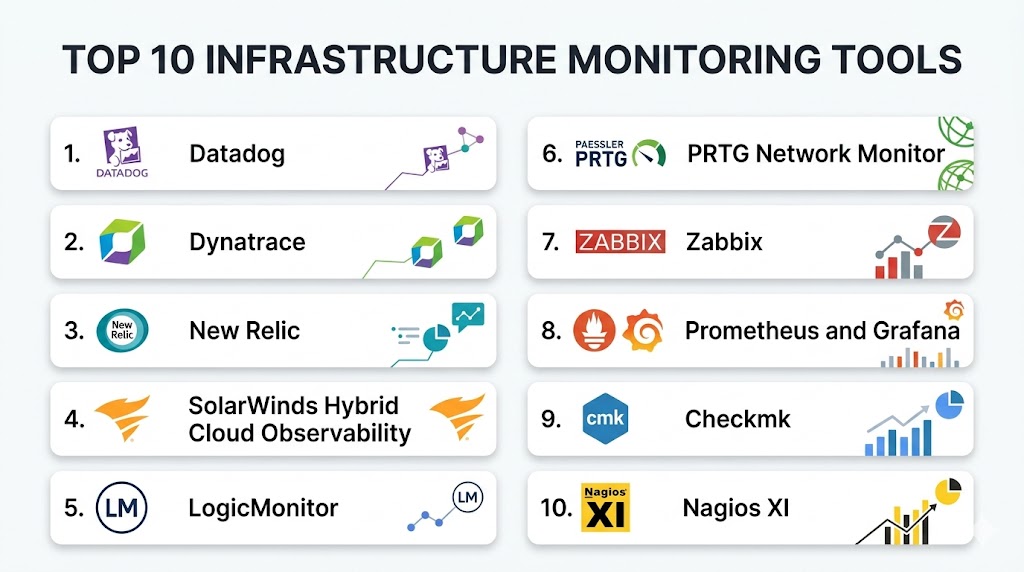
Top 10 Infrastructure Monitoring Tools Tools
#1 — Datadog
Short description: Datadog is a cloud-based infrastructure monitoring and observability platform designed for cloud-native, hybrid, and containerized environments. It helps teams monitor servers, cloud resources, Kubernetes clusters, databases, networks, logs, traces, and application performance from one platform. Datadog is especially useful for DevOps, SRE, and platform teams that need fast visibility across distributed systems. It is powerful and highly integrated, but buyers should manage usage carefully because costs can grow with scale.
Key Features
- Infrastructure monitoring for hosts, containers, services, and cloud resources
- Kubernetes, Docker, database, and network monitoring
- Custom dashboards, monitors, alerts, and service views
- Logs, APM, synthetic monitoring, RUM, and security modules available
- Large integration ecosystem across cloud and DevOps tools
- Tag-based filtering for infrastructure and service analysis
- Anomaly detection and intelligent alerting capabilities
Pros
- Strong visibility for cloud-native and hybrid infrastructure
- Excellent integration ecosystem
- Combines infrastructure monitoring with broader observability
- Good fit for engineering-led teams and enterprises
Cons
- Pricing can become complex at scale
- Many features may feel overwhelming for smaller teams
- Requires governance to manage telemetry volume
- Advanced setup may need careful planning
Platforms / Deployment
Web / Windows / macOS / Linux / iOS / Android
Cloud
Security & Compliance
Supports enterprise security features such as SSO/SAML, MFA, RBAC, encryption, and audit logs. Specific compliance coverage should be validated by buyers based on plan, region, and contract.
Integrations & Ecosystem
Datadog has a broad integration ecosystem for cloud infrastructure, containers, databases, CI/CD pipelines, incident response, and collaboration workflows. It works well for teams that want infrastructure signals connected with logs, traces, and application performance.
- AWS, Azure, and Google Cloud
- Kubernetes and Docker
- CI/CD and DevOps platforms
- Slack, Microsoft Teams, and incident tools
- Databases, queues, and caching systems
- APIs and custom metric ingestion
Support & Community
Datadog provides documentation, onboarding resources, enterprise support options, training material, and a large practitioner community. Support quality may vary by plan, but the ecosystem is mature and widely adopted.
#2 — Dynatrace
Short description: Dynatrace is an enterprise-grade observability and infrastructure monitoring platform built for complex environments where applications, services, cloud resources, and infrastructure are deeply connected. It provides automated discovery, dependency mapping, anomaly detection, and AI-assisted root-cause analysis. Dynatrace is a strong fit for large enterprises, regulated organizations, and teams that need full-stack visibility with less manual correlation. It may be more advanced than what smaller teams need.
Key Features
- Full-stack infrastructure, application, cloud, and Kubernetes monitoring
- Automatic discovery and dependency mapping
- AI-assisted root-cause analysis
- Anomaly detection and intelligent alerting
- Cloud, container, host, process, and service monitoring
- Digital experience and synthetic monitoring options
- Enterprise-grade dashboards and reporting
Pros
- Excellent for complex enterprise environments
- Strong automation and dependency visibility
- Helps reduce manual troubleshooting effort
- Connects infrastructure issues with application impact
Cons
- Can be expensive for smaller organizations
- Advanced features may require onboarding time
- May be more complex than basic monitoring needs require
- Best value appears in mature IT and enterprise environments
Platforms / Deployment
Web / Windows / Linux
Cloud / Hybrid
Security & Compliance
Supports enterprise security controls such as SSO, RBAC, encryption, and auditability. Buyers should confirm specific compliance requirements directly during procurement.
Integrations & Ecosystem
Dynatrace integrates with cloud platforms, DevOps systems, ITSM workflows, incident response tools, and enterprise operations platforms. It is designed for large-scale infrastructure and application environments.
- AWS, Azure, and Google Cloud
- Kubernetes and container platforms
- ServiceNow and ITSM workflows
- CI/CD and deployment tools
- Incident response and collaboration tools
- APIs and automation workflows
Support & Community
Dynatrace provides enterprise documentation, training, professional services, onboarding resources, and support tiers. It has a strong enterprise customer base and mature operational guidance.
#3 — New Relic
Short description: New Relic is a cloud observability platform that includes infrastructure monitoring, APM, logs, distributed tracing, browser monitoring, mobile monitoring, synthetic monitoring, and dashboards. It is useful for engineering teams that want to connect infrastructure health with application performance and user experience. New Relic fits SaaS companies, DevOps teams, and cloud-native organizations that need flexible telemetry analysis. Pricing and data volume should be reviewed carefully during adoption.
Key Features
- Infrastructure monitoring for hosts, containers, services, and cloud resources
- APM, logs, traces, browser, mobile, and synthetic monitoring
- Custom dashboards and query-based analytics
- Kubernetes and cloud monitoring support
- Alert policies and incident workflow integrations
- OpenTelemetry support
- Service maps and performance correlation
Pros
- Strong fit for engineering and application teams
- Good balance of infrastructure and observability capabilities
- Flexible telemetry analysis and dashboards
- Useful for cloud-native environments
Cons
- Broad feature set may require learning time
- Pricing can increase with data volume
- Alert tuning may require iteration
- Some teams may need governance around telemetry ingestion
Platforms / Deployment
Web / Windows / macOS / Linux / iOS / Android
Cloud
Security & Compliance
Supports common enterprise security features such as SSO, role-based access, encryption, and access controls. Buyers should verify compliance details based on plan and region.
Integrations & Ecosystem
New Relic integrates with cloud services, application frameworks, DevOps pipelines, incident response tools, and OpenTelemetry-based environments. It is often used as a central observability layer for engineering teams.
- AWS, Azure, and Google Cloud
- Kubernetes and container platforms
- OpenTelemetry data collection
- Slack, PagerDuty, and incident tools
- CI/CD and deployment platforms
- APIs and custom telemetry ingestion
Support & Community
New Relic provides documentation, learning resources, onboarding content, community resources, and support options. It is especially helpful for developer-led teams that want practical observability guidance.
#4 — SolarWinds Hybrid Cloud Observability
Short description: SolarWinds Hybrid Cloud Observability is designed for IT teams that need visibility across on-prem infrastructure, cloud resources, networks, applications, servers, and hybrid environments. SolarWinds is widely recognized in IT operations and network monitoring. This platform is useful for organizations managing traditional infrastructure alongside modern cloud services. It is especially suitable for IT operations teams that need strong infrastructure and network depth.
Key Features
- Server, network, application, and cloud monitoring
- Hybrid infrastructure visibility
- Topology, dependency, and performance views
- Dashboards, alerts, reports, and capacity insights
- Network device and traffic monitoring
- Application and database visibility depending on modules
- IT operations-focused workflows
Pros
- Strong fit for traditional IT and hybrid operations
- Good network and infrastructure monitoring depth
- Useful for on-prem and cloud environments
- Mature IT operations background
Cons
- May feel less developer-first than newer observability platforms
- Licensing and modules may require careful review
- Setup can take planning in complex environments
- User experience depends on selected product configuration
Platforms / Deployment
Web / Windows / Linux
Cloud / Self-hosted / Hybrid
Security & Compliance
Security features may include role-based access, authentication controls, encryption, and audit-related capabilities depending on product and deployment. Specific compliance claims should be verified during procurement.
Integrations & Ecosystem
SolarWinds integrates with IT operations systems, network devices, servers, cloud platforms, and reporting workflows. It is useful when infrastructure monitoring and network monitoring need to work together.
- Network devices and SNMP monitoring
- Windows and Linux server monitoring
- Cloud infrastructure integrations
- ITSM and alert workflows
- Database and application monitoring modules
- APIs and reporting tools
Support & Community
SolarWinds offers product documentation, customer support, training resources, knowledge base content, and a large IT administrator community. Support strength is strongest for teams already familiar with SolarWinds products.
#5 — LogicMonitor
Short description: LogicMonitor is a SaaS-based infrastructure monitoring platform built for hybrid IT, cloud infrastructure, networks, servers, storage, applications, and managed service providers. It offers automated discovery, centralized dashboards, alerting, and reporting across distributed environments. LogicMonitor is useful for organizations that want broad infrastructure visibility without managing a fully self-hosted monitoring stack. It is especially strong for IT operations and MSP use cases.
Key Features
- Hybrid infrastructure monitoring across cloud, data center, and networks
- Automated discovery and onboarding
- Network, server, storage, cloud, and application monitoring
- Dashboards, alerts, reports, and forecasting
- MSP-friendly monitoring capabilities
- Cloud and SaaS infrastructure integrations
- Anomaly detection and root-cause support features
Pros
- Strong fit for hybrid IT and MSP teams
- Good automated discovery capabilities
- Broad infrastructure and network coverage
- SaaS deployment reduces operational overhead
Cons
- May be less developer-first than some observability platforms
- Pricing should be reviewed for large environments
- Advanced customization may require expertise
- Some application observability use cases may need extra tools
Platforms / Deployment
Web / Windows / Linux
Cloud / Hybrid
Security & Compliance
Supports enterprise administration features such as role-based access, authentication controls, encryption, and audit-related capabilities. Buyers should confirm specific compliance needs during evaluation.
Integrations & Ecosystem
LogicMonitor connects with cloud providers, network systems, ITSM platforms, collaboration tools, and operations workflows. It is helpful for teams that need centralized infrastructure monitoring across many systems.
- AWS, Azure, and Google Cloud
- Network devices and infrastructure systems
- ServiceNow and ITSM tools
- Slack, Microsoft Teams, and alerting tools
- Storage, virtualization, and server systems
- APIs and automation integrations
Support & Community
LogicMonitor provides documentation, onboarding resources, customer support, and success services. It is commonly used by IT operations teams and MSPs that need structured monitoring processes.
#6 — PRTG Network Monitor
Short description: PRTG Network Monitor by Paessler is a practical monitoring tool for networks, servers, applications, devices, bandwidth, and infrastructure performance. It uses a sensor-based model to track different infrastructure components and services. PRTG is well suited for SMBs, mid-market companies, schools, public sector teams, and IT departments with mixed infrastructure. It is easy to understand for traditional IT monitoring, though it may not be as deep for cloud-native observability.
Key Features
- Sensor-based monitoring for infrastructure components
- Network bandwidth and uptime monitoring
- Server, application, and device performance monitoring
- Dashboards, maps, alerts, and reporting
- SNMP, WMI, NetFlow, and common monitoring protocols
- Remote probes for distributed environments
- Mobile apps and notification workflows
Pros
- Easy for IT teams to understand and deploy
- Strong network and device monitoring capabilities
- Good fit for SMB and mid-market use cases
- Flexible sensor model for many infrastructure types
Cons
- Sensor-based licensing needs careful planning
- Less suited for deep microservices observability
- Kubernetes and cloud-native depth may be limited
- Large deployments may need careful architecture
Platforms / Deployment
Web / Windows / iOS / Android
Self-hosted / Cloud options vary
Security & Compliance
Security capabilities vary by deployment and product edition. Authentication controls, user roles, and encryption options are available, but specific compliance claims should be verified.
Integrations & Ecosystem
PRTG integrates with common infrastructure protocols and monitoring workflows. It is practical for teams monitoring devices, networks, servers, and bandwidth through standard IT signals.
- SNMP, WMI, SSH, and HTTP sensors
- NetFlow, sFlow, and traffic monitoring
- Virtualization and server monitoring
- Notification and alerting channels
- Maps, dashboards, and reports
- APIs and custom sensors
Support & Community
PRTG offers documentation, support resources, knowledge base content, and an active user base. It is widely known among IT administrators and network operations teams.
#7 — Zabbix
Short description: Zabbix is an open-source infrastructure monitoring platform used for servers, networks, virtual machines, applications, cloud resources, and services. It is a strong choice for organizations that want self-hosted control, flexibility, and lower dependency on commercial licensing. Zabbix works well for IT teams, service providers, enterprises, and technical teams comfortable managing their own monitoring platform. It can be powerful, but setup, scaling, and maintenance require internal expertise.
Key Features
- Open-source monitoring for servers, networks, applications, and cloud
- Agent-based and agentless monitoring options
- Dashboards, triggers, templates, maps, and alerting
- SNMP, IPMI, JMX, HTTP, and custom checks
- Distributed monitoring with proxies
- Template-driven monitoring configuration
- Self-hosted control over monitoring data
Pros
- Strong open-source value
- Flexible for many infrastructure types
- Good for teams that need data control
- Large community and template ecosystem
Cons
- Requires technical setup and maintenance
- Configuration may feel complex for beginners
- Scaling needs careful architecture
- Advanced analytics may require extra integrations
Platforms / Deployment
Web / Linux / Windows agents
Self-hosted / Hybrid
Security & Compliance
Security depends heavily on deployment, configuration, and hosting environment. Supports user roles and authentication controls, but compliance posture is mainly the responsibility of the deploying organization.
Integrations & Ecosystem
Zabbix has a broad ecosystem of templates, agents, APIs, and community extensions. It is suitable for teams that want strong customization and infrastructure control.
- Linux and Windows server monitoring
- SNMP network device monitoring
- Cloud and virtualization templates
- Web checks and custom scripts
- API integrations and automation
- Alerting integrations with messaging tools
Support & Community
Zabbix has strong community documentation, forums, templates, and commercial support options. It is a good fit for teams with technical monitoring skills and self-hosting experience.
#8 — Prometheus and Grafana
Short description: Prometheus and Grafana are commonly used together as a flexible open-source monitoring and visualization stack. Prometheus collects time-series metrics, while Grafana provides dashboards, visualization, alerting, and reporting. This stack is widely used for Kubernetes, cloud-native infrastructure, microservices, and engineering-led monitoring. It offers strong flexibility and community support, but teams must manage scaling, retention, security, and governance carefully.
Key Features
- Open-source metrics collection and time-series monitoring
- Strong Kubernetes and cloud-native ecosystem support
- Grafana dashboards and visualizations
- PromQL query language for metric analysis
- Alerting through Prometheus and Grafana workflows
- Exporter ecosystem for infrastructure and application metrics
- Flexible self-hosted and managed deployment options
Pros
- Excellent for Kubernetes and cloud-native teams
- Strong open-source community
- Highly flexible dashboards and metrics queries
- Good value for technical teams
Cons
- Scaling high-cardinality metrics can be challenging
- Self-hosted setups require operational expertise
- Logs and traces usually need additional tools
- Governance is needed to avoid dashboard and alert sprawl
Platforms / Deployment
Web / Linux / macOS / Windows components vary
Cloud / Self-hosted / Hybrid
Security & Compliance
Security depends on deployment model. Managed offerings may include enterprise security features, while self-hosted setups require careful configuration for authentication, access control, encryption, and auditability.
Integrations & Ecosystem
Prometheus and Grafana have a large ecosystem of exporters, plugins, dashboards, and data sources. They are popular when teams want flexible monitoring and visualization.
- Kubernetes and Docker exporters
- Node exporter and infrastructure exporters
- Cloud monitoring integrations
- Database and queue exporters
- Alerting and incident workflows
- Grafana plugins and data sources
Support & Community
The open-source community is very strong. Commercial support depends on the chosen managed or enterprise offering, while self-hosted teams rely on internal expertise and community resources.
#9 — Checkmk
Short description: Checkmk is an infrastructure and IT monitoring platform for servers, networks, applications, cloud resources, containers, and hybrid infrastructure. It is known for auto-discovery, rule-based configuration, and efficient monitoring of large IT environments. Checkmk is a good option for IT operations teams that want broad monitoring coverage without building every check manually. It offers both open-source flexibility and enterprise upgrade options.
Key Features
- Server, network, application, cloud, and container monitoring
- Auto-discovery and rule-based configuration
- Dashboards, alerts, reports, and availability views
- Agent-based and agentless monitoring
- Distributed monitoring support
- Strong network and infrastructure monitoring
- Open-source and enterprise editions available
Pros
- Good balance of automation and control
- Strong for traditional IT and hybrid infrastructure
- Efficient for monitoring many services
- Flexible deployment options
Cons
- Interface and configuration require learning
- Advanced use cases may need tuning
- Less developer-first than cloud observability tools
- Enterprise features may require paid editions
Platforms / Deployment
Web / Linux / Windows agents
Self-hosted / Hybrid
Security & Compliance
Security features vary by edition and deployment. Role-based access and authentication controls are available, but specific compliance details should be confirmed during evaluation.
Integrations & Ecosystem
Checkmk integrates with many infrastructure systems and supports plugins, agents, and extensions. It is useful for organizations managing mixed IT environments.
- Linux and Windows server monitoring
- Network devices and SNMP monitoring
- Cloud and container monitoring
- Databases and application services
- Notification and incident workflows
- Plugin and extension ecosystem
Support & Community
Checkmk provides documentation, forums, community resources, and commercial support options. It is suitable for IT teams that want practical infrastructure monitoring with upgrade flexibility.
#10 — Nagios XI
Short description: Nagios XI is a commercial infrastructure monitoring platform built around the long-standing Nagios monitoring ecosystem. It helps teams monitor servers, networks, applications, services, and infrastructure availability. Nagios XI is useful for organizations that need plugin-based monitoring, custom checks, and traditional IT operations visibility. It remains relevant for teams with existing Nagios knowledge, though it may feel less modern than newer observability platforms.
Key Features
- Server, network, application, and service monitoring
- Plugin-based extensibility
- Dashboards, reports, alerts, and availability tracking
- Network protocol and service monitoring
- Performance graphing and capacity planning features
- User management and administrative controls
- Large plugin ecosystem
Pros
- Mature and widely recognized monitoring ecosystem
- Highly extensible through plugins
- Good for traditional infrastructure and service checks
- Useful for teams with existing Nagios skills
Cons
- May feel less modern than SaaS observability platforms
- Setup and tuning can require expertise
- Cloud-native and Kubernetes visibility may need extra work
- Plugin quality can vary by source and maintenance
Platforms / Deployment
Web / Linux
Self-hosted / Hybrid
Security & Compliance
Supports administrative access controls and authentication-related configuration. Specific compliance claims are not broadly assumed and should be validated by buyers.
Integrations & Ecosystem
Nagios XI benefits from a long-running plugin ecosystem and broad infrastructure monitoring patterns. It is useful when teams need custom service checks and traditional IT visibility.
- Server and network monitoring plugins
- SNMP and service checks
- Custom scripts and plugin extensions
- Notification and alerting integrations
- Reporting and availability views
- Community and commercial plugin ecosystem
Support & Community
Nagios XI has documentation, commercial support, and a large historical community. It is strongest for teams familiar with traditional monitoring concepts and plugin-based workflows.
Comparison Table
| Tool Name | Best For | Platform(s) Supported | Deployment | Standout Feature | Public Rating |
|---|---|---|---|---|---|
| Datadog | Cloud-native DevOps and SRE teams | Web, Windows, macOS, Linux, iOS, Android | Cloud | Unified infrastructure and observability monitoring | N/A |
| Dynatrace | Large enterprises and complex systems | Web, Windows, Linux | Cloud / Hybrid | AI-assisted root-cause analysis | N/A |
| New Relic | Engineering and SaaS teams | Web, Windows, macOS, Linux, iOS, Android | Cloud | Infrastructure-to-application observability | N/A |
| SolarWinds Hybrid Cloud Observability | IT operations and hybrid infrastructure | Web, Windows, Linux | Cloud / Self-hosted / Hybrid | Strong network and IT infrastructure depth | N/A |
| LogicMonitor | Hybrid IT and MSP teams | Web, Windows, Linux | Cloud / Hybrid | Automated discovery and broad infrastructure coverage | N/A |
| PRTG Network Monitor | SMB and mid-market IT teams | Web, Windows, iOS, Android | Self-hosted / Cloud options vary | Sensor-based network and device monitoring | N/A |
| Zabbix | Self-hosted open-source monitoring | Web, Linux, Windows agents | Self-hosted / Hybrid | Flexible open-source monitoring | N/A |
| Prometheus and Grafana | Kubernetes and cloud-native teams | Web, Linux, macOS, Windows components vary | Cloud / Self-hosted / Hybrid | Open-source metrics and dashboards | N/A |
| Checkmk | Hybrid IT infrastructure teams | Web, Linux, Windows agents | Self-hosted / Hybrid | Auto-discovery and rule-based monitoring | N/A |
| Nagios XI | Traditional IT and custom checks | Web, Linux | Self-hosted / Hybrid | Mature plugin-based ecosystem | N/A |
Evaluation & Scoring of Infrastructure Monitoring Tools
| Tool Name | Core (25%) | Ease (15%) | Integrations (15%) | Security (10%) | Performance (10%) | Support (10%) | Value (15%) | Weighted Total (0–10) |
|---|---|---|---|---|---|---|---|---|
| Datadog | 9.5 | 8.5 | 9.5 | 9.0 | 9.0 | 8.5 | 7.5 | 8.75 |
| Dynatrace | 9.5 | 8.0 | 9.0 | 9.0 | 9.5 | 9.0 | 7.5 | 8.75 |
| New Relic | 9.0 | 8.5 | 8.8 | 8.5 | 8.8 | 8.2 | 8.0 | 8.56 |
| LogicMonitor | 8.8 | 8.2 | 8.5 | 8.3 | 8.5 | 8.5 | 8.0 | 8.42 |
| Prometheus and Grafana | 8.8 | 7.2 | 9.0 | 7.5 | 8.5 | 8.5 | 9.0 | 8.40 |
| SolarWinds Hybrid Cloud Observability | 8.7 | 7.8 | 8.2 | 8.0 | 8.5 | 8.5 | 8.0 | 8.26 |
| Checkmk | 8.2 | 7.8 | 8.0 | 7.8 | 8.2 | 8.0 | 8.5 | 8.10 |
| PRTG Network Monitor | 8.0 | 8.7 | 7.8 | 7.5 | 8.0 | 8.0 | 8.5 | 8.09 |
| Zabbix | 8.3 | 7.0 | 8.2 | 7.2 | 8.0 | 8.0 | 9.0 | 8.03 |
| Nagios XI | 7.8 | 7.2 | 8.0 | 7.2 | 7.8 | 7.8 | 8.2 | 7.70 |
The scoring table is comparative and should be used as a practical guide, not as a universal ranking for every business. A tool with a higher weighted total may be better for broad enterprise use, while a lower-scoring tool may still be the best fit for a specific team, budget, or deployment model.
Core features carry the highest weight because infrastructure monitoring must first provide strong visibility, alerting, dashboards, and coverage. Ease of use, integrations, and value also matter because a powerful tool can fail if teams cannot adopt it or afford it at scale.
Security and compliance scores reflect available enterprise controls such as access management, auditability, and secure administration. Self-hosted tools may offer more control, but they also require stronger internal security ownership.
Performance and reliability matter because monitoring tools must remain dependable during incidents. Support and community are also important because teams often need help with onboarding, scaling, tuning alerts, and troubleshooting complex environments.
Which Infrastructure Monitoring Tools Tool Is Right for You?
Solo / Freelancer
Solo users and freelancers should avoid overly complex enterprise monitoring unless they manage production systems for clients. Lightweight tools such as PRTG, Zabbix, Checkmk, or Prometheus with Grafana can work well if technical setup is manageable. For a very small environment, built-in cloud dashboards or basic uptime monitoring may be enough. The main goal should be simple alerts, clear dashboards, and low maintenance.
SMB
SMBs should prioritize easy onboarding, predictable pricing, and practical dashboards. PRTG is a strong fit for network-heavy SMB environments, while LogicMonitor works well for growing hybrid infrastructure. New Relic or Datadog can be useful for cloud-native SMBs, but usage should be monitored carefully. Open-source tools can reduce licensing costs, but they require internal skills.
Mid-Market
Mid-market teams usually need stronger scalability, better integrations, and more organized alerting. Datadog, New Relic, LogicMonitor, SolarWinds, and Checkmk are strong candidates depending on infrastructure style. Prometheus and Grafana are especially useful for Kubernetes-heavy teams. Mid-market buyers should run a pilot with real infrastructure before selecting a platform.
Enterprise
Enterprises should focus on scalability, governance, security, automation, support, and integration depth. Dynatrace, Datadog, LogicMonitor, SolarWinds, and New Relic are strong enterprise options. Large organizations should validate RBAC, SSO, audit logs, ITSM integrations, data retention, access control, and reporting. The best choice is usually the tool that fits the operating model and compliance requirements.
Budget vs Premium
Budget-focused teams may prefer Zabbix, Prometheus with Grafana, Checkmk, Nagios XI, or PRTG. These tools can offer strong value, especially when teams have the skills to manage setup and maintenance. Premium tools such as Datadog, Dynatrace, New Relic, and LogicMonitor can reduce operational effort and provide faster time to value. The best choice depends on whether licensing cost or engineering time is the bigger constraint.
Feature Depth vs Ease of Use
For maximum feature depth, Datadog, Dynatrace, New Relic, and Prometheus with Grafana are strong options. They provide rich monitoring, correlation, dashboards, and observability workflows. For ease of use, PRTG and LogicMonitor may be more approachable for IT operations teams. Checkmk offers a practical balance between control and automation.
Integrations & Scalability
Teams with many cloud services, DevOps tools, incident platforms, and distributed systems should prioritize integrations. Datadog, New Relic, Dynatrace, LogicMonitor, and Prometheus with Grafana are strong in this area. Scalability should be tested with real telemetry volume, not only sample dashboards. Buyers should also evaluate data retention, alert volume, API access, and long-term cost growth.
Security & Compliance Needs
Security-sensitive organizations should validate SSO, MFA, RBAC, audit logs, encryption, data retention, and user access controls. SaaS tools may simplify administration, but buyers should review vendor security documentation. Self-hosted tools may help with control and data residency, but internal teams must manage patching, hardening, and access security. Compliance needs should be checked before production rollout.
Frequently Asked Questions
1. What are infrastructure monitoring tools?
Infrastructure monitoring tools track the health, availability, and performance of servers, cloud resources, networks, databases, containers, and applications.
They collect metrics such as CPU usage, memory, disk space, latency, traffic, and uptime.
These tools help teams detect problems early and respond before users are affected.
They are important for maintaining reliable IT and cloud operations.
2. How do infrastructure monitoring tools usually charge?
Pricing varies by vendor and deployment model.
Common pricing models include per-host, per-device, per-sensor, per-user, data-volume, and enterprise contract pricing.
Open-source tools may reduce license fees but still require hosting, maintenance, and skilled administration.
Buyers should estimate real usage before choosing a tool.
3. What is the difference between monitoring and observability?
Monitoring focuses on known signals such as CPU, memory, uptime, disk usage, and alerts.
Observability connects metrics, logs, traces, events, and service context to explain why something is happening.
Monitoring tells teams that something is wrong, while observability helps teams investigate the cause.
Many modern tools now combine both approaches.
4. Which infrastructure monitoring tool is best for Kubernetes?
Prometheus and Grafana are widely used for Kubernetes because of their open-source ecosystem and strong metrics model.
Datadog, Dynatrace, and New Relic also provide strong Kubernetes monitoring with managed dashboards and alerting.
The best choice depends on whether the team wants self-hosted flexibility or managed convenience.
Teams should test cluster scale, metric volume, and alert quality before deciding.
5. Are open-source infrastructure monitoring tools reliable?
Open-source tools such as Zabbix, Prometheus, Grafana, and Checkmk can be very reliable when configured and maintained well.
They offer flexibility, strong communities, and good value for technical teams.
However, the organization must handle setup, scaling, security, upgrades, and troubleshooting.
They are best for teams with internal monitoring expertise.
6. What are common mistakes when implementing monitoring?
A common mistake is creating too many alerts without clear ownership.
Teams also often monitor too many low-value metrics while missing key service health indicators.
Another mistake is not testing alerts, dashboards, escalation paths, and integrations before production use.
Good monitoring requires both the right tool and the right operating process.
7. How long does implementation take?
Small environments can often be monitored quickly with basic agents, dashboards, and alerts.
Larger organizations may need more time to connect cloud accounts, servers, networks, users, dashboards, and ITSM workflows.
Enterprise rollouts can take longer due to access control, governance, compliance, and reporting needs.
A phased rollout is usually safer than trying to monitor everything at once.
8. What security features should buyers look for?
Buyers should look for SSO, MFA, RBAC, encryption, audit logs, secure agent communication, and user access controls.
For SaaS platforms, data retention, data residency, and vendor security documentation should also be reviewed.
For self-hosted tools, internal teams must manage patching, hardening, backups, and access security.
Security should be validated before full production adoption.
9. Can infrastructure monitoring tools prevent downtime?
Infrastructure monitoring tools can reduce downtime by detecting issues early and alerting teams quickly.
They can identify capacity risks, failing systems, network problems, and resource saturation before major incidents occur.
However, the tool alone does not prevent downtime without good alert design and incident response.
Teams need clear ownership, escalation rules, and review processes.
10. How do monitoring tools integrate with incident management?
Most monitoring tools can send alerts to incident response, collaboration, and ITSM platforms.
These integrations help route alerts to the right teams and create tickets or incidents automatically.
Good integrations reduce manual work during outages and improve response speed.
Alert quality still matters because noisy integrations can overwhelm teams.
11. When should a company switch monitoring tools?
A company should consider switching when the current tool misses important incidents, creates too much noise, becomes too expensive, or cannot support modern infrastructure.
Switching may also make sense during cloud migration, Kubernetes adoption, or consolidation of multiple monitoring systems.
Before switching, teams should document required dashboards, alerts, integrations, and reports.
A controlled migration reduces operational risk.
12. What are alternatives to infrastructure monitoring tools?
Alternatives include basic uptime monitoring, built-in cloud dashboards, log management tools, APM platforms, and custom scripts.
These may work for small teams or narrow use cases.
However, they usually become limited as infrastructure grows across servers, networks, containers, and cloud services.
A dedicated infrastructure monitoring tool is better for larger or business-critical environments.
Conclusion
Infrastructure monitoring tools give teams the visibility they need to keep servers, networks, cloud systems, containers, and hybrid infrastructure reliable. The best tool depends on your company size, technical maturity, deployment model, budget, security needs, and integration requirements. Datadog, Dynatrace, and New Relic are strong for modern cloud and observability use cases, while LogicMonitor, SolarWinds, PRTG, Zabbix, Prometheus with Grafana, Checkmk, and Nagios XI serve different IT operations, open-source, hybrid, and budget-focused needs. The right next steps are to shortlist two or three tools, run a pilot with real infrastructure, test alert quality and dashboards, verify integrations and security controls, compare pricing against expected usage, and then scale the selected platform across the environments that matter most.

Very informative and easy to follow. The side-by-side comparison helped me quickly understand the capabilities of each infrastructure monitoring tool and identify the best fit for different monitoring needs.