Introduction
Voice AI Agent Platforms are specialized solutions that allow businesses to build, deploy, and manage intelligent voice-based assistants. These platforms use natural language processing (NLP), speech recognition, and AI-driven decision-making to enable interactive voice experiences for customer support, sales, and internal workflows. By automating voice interactions, organizations can reduce operational costs, improve response times, and provide consistent experiences across channels.
In today’s business landscape, Voice AI is becoming critical for call centers, virtual assistants, and interactive voice response (IVR) systems. Real-world use cases include automating customer service calls, voice-driven appointment scheduling, hands-free task execution in enterprises, personalized marketing via voice, and multilingual support.
Evaluation criteria for buyers include accuracy of speech recognition, natural language understanding, multi-language support, integration with existing CRM or contact center tools, scalability, deployment flexibility, security and compliance, analytics capabilities, and ease of use.
Best for: contact centers, customer support teams, marketing and sales departments, enterprises deploying large-scale voice experiences.
Not ideal for: small businesses with low call volumes or simple workflows where standard IVR or chatbots suffice.
Key Trends in Voice AI Agent Platforms
- AI-driven natural language understanding to improve conversation accuracy.
- Multi-language and regional accent recognition for global operations.
- Integration with CRM, helpdesk, and enterprise workflow tools.
- Cloud-first, hybrid, and on-premises deployment options for flexibility.
- Emotion and sentiment analysis to enhance user experience.
- Voice personalization and context-aware conversation management.
- Real-time analytics and call summarization dashboards.
- Low-code/no-code design interfaces for rapid voice app creation.
- Omnichannel support integrating voice, chat, and messaging.
- Compliance with GDPR, HIPAA, and data privacy regulations.
How We Selected These Tools (Methodology)
- Evaluated market adoption and mindshare in the voice AI category.
- Reviewed feature completeness, including voice recognition, NLP, and analytics.
- Assessed accuracy, latency, and reliability in live environments.
- Considered security posture and compliance features.
- Analyzed integrations with CRM, contact center software, and APIs.
- Measured scalability and performance for enterprise deployment.
- Reviewed developer and user experience, including low-code options.
- Checked deployment flexibility: cloud, hybrid, or on-premises.
- Examined pricing models and total cost of ownership.
- Verified support tiers and community resources.
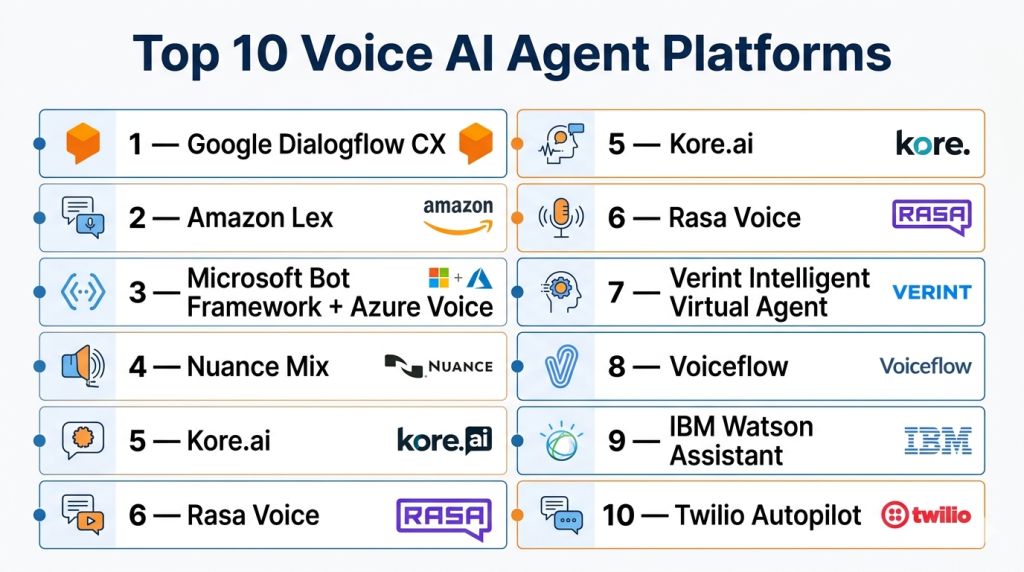
Top 10 Voice AI Agent Platforms
#1 — Google Dialogflow CX
Short description: Dialogflow CX is a comprehensive voice and conversational AI platform by Google Cloud. It enables enterprises to design multi-turn voice experiences with NLP and AI-powered intent recognition.
Key Features
- Multi-turn conversation flow builder
- NLP and sentiment analysis
- Integration with telephony and chat platforms
- Multilingual support
- Analytics dashboards
Pros
- Scales easily for enterprise needs
- Strong NLP accuracy
- Integrates with Google Cloud services
Cons
- Learning curve for complex flows
- Enterprise features may require Google Cloud knowledge
- Limited offline capabilities
Platforms / Deployment
- Web / Cloud
Security & Compliance
- SSO, encryption in transit
- GDPR, SOC 2 compliance
Integrations & Ecosystem
Supports CRM, telephony, and messaging platforms.
- Twilio, Genesys Cloud, Avaya
- Salesforce, HubSpot
- Google Cloud APIs
Support & Community
- Extensive documentation
- Google Cloud support tiers
- Active developer community
#2 — Amazon Lex
Short description: Amazon Lex powers voice and text chatbots using the same NLP technology behind Alexa. Ideal for enterprises needing scalable voice AI agents integrated with AWS services.
Key Features
- Automatic speech recognition (ASR)
- Natural language understanding (NLU)
- Multi-turn conversation support
- Integration with AWS Lambda for backend logic
- Analytics and monitoring dashboards
Pros
- Seamless AWS ecosystem integration
- Scales for high traffic
- Easy deployment with Lambda functions
Cons
- Can be complex outside AWS ecosystem
- Limited pre-built templates for specific industries
- Pricing can scale with high usage
Platforms / Deployment
- Web / Cloud
Security & Compliance
- SSO, encryption, IAM roles
- GDPR, SOC 2
Integrations & Ecosystem
- AWS services: Lambda, Polly, Comprehend
- CRM and contact center platforms
- Telephony: Twilio, Amazon Connect
Support & Community
- AWS enterprise support
- Extensive documentation
- Large developer community
#3 — Microsoft Azure Bot Service
Short description: Azure Bot Service enables the creation of intelligent voice and text agents on Microsoft’s cloud. It is suited for enterprises already using Microsoft ecosystems.
Key Features
- NLP with LUIS integration
- Multi-channel voice and chat deployment
- Bot Framework SDK for custom development
- Built-in analytics and telemetry
- Integration with Microsoft Teams and Dynamics 365
Pros
- Strong Microsoft ecosystem integration
- Scales for enterprise workloads
- Flexible development with SDKs
Cons
- Requires Microsoft ecosystem knowledge
- Advanced voice capabilities need custom implementation
- Pricing complexity
Platforms / Deployment
- Web / Cloud
Security & Compliance
- SSO/SAML, encryption
- HIPAA, GDPR compliance
Integrations & Ecosystem
- Microsoft Teams, Dynamics 365
- Azure Cognitive Services
- Third-party telephony APIs
Support & Community
- Enterprise-level support available
- Documentation comprehensive
- Active developer forums
#4 — Nuance Mix
Short description: Nuance Mix is a voice AI platform for building conversational voice agents and IVR systems. It is popular in healthcare, finance, and customer service industries.
Key Features
- Voice recognition and NLP
- Context-aware conversations
- Multi-language support
- IVR automation
- Analytics and call monitoring
Pros
- High recognition accuracy
- Industry-specific solutions
- Supports large enterprise deployments
Cons
- Enterprise pricing is high
- Steeper learning curve
- Limited low-code features
Platforms / Deployment
- Web / Cloud / On-premises
Security & Compliance
- HIPAA, SOC 2
- SSO/SAML, encryption
Integrations & Ecosystem
- CRM and contact center platforms
- API integrations for enterprise apps
- Analytics dashboards
Support & Community
- Enterprise support tiers
- Detailed documentation
- Industry-focused community
#5 — IBM Watson Assistant
Short description: Watson Assistant provides AI-powered voice agents with conversational AI capabilities. It is suitable for enterprises looking for AI-driven customer support and call automation.
Key Features
- Multi-turn dialogues
- NLP and sentiment analysis
- Integration with telephony and messaging platforms
- Pre-built templates for customer service
- Analytics dashboards
Pros
- Strong AI capabilities
- Integrates with IBM Cloud services
- Multilingual support
Cons
- Complexity for custom implementations
- Enterprise features can be expensive
- Learning curve for advanced AI customization
Platforms / Deployment
- Web / Cloud
Security & Compliance
- SSO, RBAC, encryption
- GDPR, SOC 2, ISO 27001
Integrations & Ecosystem
- CRM: Salesforce, Zendesk
- Telephony: Twilio, Avaya
- IBM Cloud APIs
Support & Community
- IBM enterprise support
- Documentation detailed
- Active developer forums
#6 — Kore.ai
Short description: Kore.ai provides a platform for designing intelligent voice and chatbots with enterprise-grade AI capabilities. It is ideal for customer support and employee automation.
Key Features
- NLP and AI-driven dialogues
- Multi-channel deployment
- Voice recognition
- Analytics and reporting dashboards
- Integration APIs
Pros
- Strong enterprise-grade features
- Supports omnichannel experiences
- AI-driven insights and analytics
Cons
- Higher cost for small businesses
- Setup complexity for large deployments
- Limited open-source ecosystem
Platforms / Deployment
- Web / Cloud / On-premises
Security & Compliance
- SOC 2, GDPR
- SSO, RBAC
Integrations & Ecosystem
- CRM: Salesforce, Microsoft Dynamics
- Telephony: Twilio, Genesys
- Analytics dashboards
Support & Community
- Enterprise support
- Detailed documentation
- Active user community
#7 — Replicant
Short description: Replicant specializes in autonomous voice agents that can handle customer support calls entirely without human intervention. It’s suitable for high-volume call centers.
Key Features
- Fully autonomous voice conversations
- NLP and speech recognition
- Real-time call analytics
- Multi-channel support
- Integration with CRM
Pros
- Reduces human agent workload
- Scales for high-volume calls
- Real-time analytics
Cons
- Expensive for smaller operations
- Limited customization outside core workflows
- Requires enterprise support
Platforms / Deployment
- Web / Cloud
Security & Compliance
- SSO, encryption
- GDPR, SOC 2
Integrations & Ecosystem
- CRM: Salesforce, HubSpot
- Telephony platforms
- Analytics APIs
Support & Community
- Enterprise support available
- Documentation provided
- Growing community
#8 — Voiceflow
Short description: Voiceflow is a low-code platform to design voice assistants for multiple channels. It targets teams building voice experiences without heavy coding knowledge.
Key Features
- Drag-and-drop voice flow builder
- Multi-channel voice deployment
- Analytics and reporting
- Collaboration tools for teams
- API integrations
Pros
- Low-code, user-friendly
- Rapid prototyping
- Multi-channel support
Cons
- Less suited for enterprise-scale AI
- Limited advanced AI capabilities
- Requires cloud deployment
Platforms / Deployment
- Web / Cloud
Security & Compliance
- SSO/SAML, encryption
- Not publicly stated
Integrations & Ecosystem
- Telephony APIs
- CRM integrations
- Analytics dashboards
Support & Community
- Documentation clear
- Community active
- Enterprise support tiers
#9 — Rasa
Short description: Rasa is an open-source conversational AI platform that supports both chat and voice agents. It is ideal for developers who need complete control over AI models and data privacy.
Key Features
- Open-source NLP and dialogue management
- Voice integration via speech-to-text
- Multi-language support
- Customizable AI models
- Analytics and logging
Pros
- Open-source and fully customizable
- Strong developer control and data privacy
- Flexible deployment options
Cons
- Requires technical expertise
- Steep learning curve
- Limited pre-built templates
Platforms / Deployment
- Web / Cloud / On-premises
Security & Compliance
- Not publicly stated
- Can implement custom security
Integrations & Ecosystem
- Telephony APIs
- CRM and workflow integrations
- Analytics dashboards
Support & Community
- Strong developer community
- Extensive documentation
- Community support
#10 — Avaamo
Short description: Avaamo provides enterprise-focused voice AI agents for customer service, IT support, and employee workflows. It emphasizes AI-driven automation and multi-channel communication.
Key Features
- NLP and AI-driven dialogues
- Voice and chat deployment
- Integration with enterprise systems
- Analytics and reporting dashboards
- Multi-language support
Pros
- Enterprise-ready solutions
- AI automation reduces operational costs
- Multi-channel support
Cons
- Pricing can be high
- Less suited for SMBs
- Limited open-source support
Platforms / Deployment
- Web / Cloud / On-premises
Security & Compliance
- SSO/SAML, RBAC
- GDPR, SOC 2
Integrations & Ecosystem
- CRM integrations
- Telephony APIs
- Analytics dashboards
Support & Community
- Enterprise support tiers
- Documentation provided
- Active community
Comparison Table (Top 10)
| Tool Name | Best For | Platform(s) Supported | Deployment | Standout Feature | Public Rating |
|---|---|---|---|---|---|
| Google Dialogflow CX | Enterprise voice assistants | Web | Cloud | Multi-turn conversation builder | N/A |
| Amazon Lex | AWS ecosystem users | Web | Cloud | AI voice automation | N/A |
| Microsoft Azure Bot Service | Microsoft ecosystem | Web | Cloud | LUIS NLP integration | N/A |
| Nuance Mix | Healthcare & finance | Web | Cloud / On-prem | Industry-specific IVR | N/A |
| IBM Watson Assistant | Customer service automation | Web | Cloud | AI-powered voice agents | N/A |
| Kore.ai | Enterprise omnichannel | Web | Cloud / On-prem | AI-driven analytics | N/A |
| Replicant | High-volume call centers | Web | Cloud | Fully autonomous voice AI | N/A |
| Voiceflow | Low-code voice apps | Web | Cloud | Drag-and-drop voice builder | N/A |
| Rasa | Developer-controlled AI | Web | Cloud / On-prem | Open-source NLP & dialogue | N/A |
| Avaamo | Enterprise workflows | Web | Cloud / On-prem | Multi-channel automation | N/A |
Evaluation & Scoring of Voice AI Agent Platforms
| Tool Name | Core (25%) | Ease (15%) | Integrations (15%) | Security (10%) | Performance (10%) | Support (10%) | Value (15%) | Weighted Total |
|---|---|---|---|---|---|---|---|---|
| Google Dialogflow CX | 9 | 8 | 8 | 8 | 9 | 8 | 8 | 8.5 |
| Amazon Lex | 9 | 7 | 8 | 8 | 9 | 8 | 7 | 8.3 |
| Microsoft Azure Bot Service | 8 | 7 | 8 | 8 | 8 | 7 | 7 | 7.6 |
| Nuance Mix | 9 | 6 | 7 | 8 | 9 | 7 | 6 | 7.6 |
| IBM Watson Assistant | 8 | 7 | 8 | 8 | 8 | 7 | 7 | 7.6 |
| Kore.ai | 8 | 7 | 7 | 8 | 8 | 7 | 7 | 7.4 |
| Replicant | 9 | 6 | 7 | 8 | 9 | 7 | 6 | 7.5 |
| Voiceflow | 7 | 9 | 7 | 6 | 7 | 6 | 8 | 7.3 |
| Rasa | 8 | 7 | 7 | 7 | 8 | 7 | 7 | 7.4 |
| Avaamo | 8 | 7 | 7 | 8 | 8 | 7 | 7 | 7.5 |
Interpretation: Weighted totals reflect the platform’s overall balance between AI capabilities, integrations, ease of use, and enterprise readiness.
Which Voice AI Agent Platform Is Right for You?
Solo / Freelancer
- Voiceflow or Rasa for rapid prototyping and low-cost development.
SMB
- Dialogflow CX or Amazon Lex for scalable cloud-based voice agents.
Mid-Market
- IBM Watson Assistant or Kore.ai for multi-channel deployment and analytics.
Enterprise
- Nuance Mix, Replicant, Avaamo, or Microsoft Azure Bot Service for large-scale, AI-driven automation and compliance.
Budget vs Premium
- Open-source Rasa or Voiceflow for low-cost projects.
- Premium platforms like Nuance Mix, IBM Watson Assistant, or Replicant offer enterprise-grade features.
Feature Depth vs Ease of Use
- Voiceflow emphasizes ease-of-use and low-code design.
- Nuance Mix, IBM Watson, and Replicant focus on enterprise-grade AI capabilities and analytics.
Integrations & Scalability
- Amazon Lex, Dialogflow CX, and Microsoft Azure integrate well with CRMs, telephony systems, and analytics tools.
- Open-source Rasa provides flexibility but requires development effort.
Security & Compliance Needs
- Enterprises with regulatory requirements should prioritize Nuance Mix, IBM Watson, or Avaamo for SOC 2, HIPAA, and GDPR compliance.
Frequently Asked Questions (FAQs)
1. What is a Voice AI Agent Platform?
A platform enabling the creation and deployment of AI-driven voice assistants that interact naturally with users using speech recognition and NLP.
2. How do pricing models vary?
Pricing ranges from free or open-source platforms to enterprise subscriptions based on usage, channels, and advanced AI features.
3. How easy is onboarding for teams?
Low-code platforms like Voiceflow are quick to deploy, while enterprise platforms may require developer or platform engineering knowledge.
4. Can these platforms handle multi-language support?
Yes. Leading platforms like Dialogflow CX, IBM Watson, and Kore.ai support multiple languages and accents.
5. Are analytics included?
Most provide dashboards to monitor conversation flows, agent performance, sentiment analysis, and call summaries.
6. How do they integrate with CRMs or telephony?
They offer APIs or native integrations with Salesforce, HubSpot, Twilio, Genesys, and other enterprise systems.
7. Which platforms are best for high call volumes?
Replicant, Nuance Mix, and IBM Watson Assistant are designed for large-scale, high-volume deployments.
8. Can small businesses use these platforms?
Yes, low-code or open-source options like Voiceflow or Rasa provide cost-effective solutions for smaller operations.
9. How secure are voice AI platforms?
Most offer encryption, SSO, RBAC, and enterprise compliance like GDPR, HIPAA, or SOC 2 depending on the platform.
10. What common mistakes should organizations avoid?
Overlooking deployment testing, ignoring multilingual or accent variations, underestimating integration complexity, and choosing platforms without adequate support.
Conclusion
Voice AI Agent Platforms empower businesses to automate voice interactions, improve customer experience, and reduce operational costs. Selecting the right platform depends on organization size, use case, budget, and integration requirements. SMBs may prefer Voiceflow or Rasa for low-cost and rapid deployment, while enterprises benefit from Nuance Mix, IBM Watson, or Replicant for full-scale AI voice automation. Use the comparison and scoring tables to shortlist 2–3 tools, run pilots, and validate integrations and compliance. A carefully implemented Voice AI platform enhances efficiency, scales operations, and delivers superior voice-driven experiences.

Very insightful article. The comparison was easy to follow and gave a clear understanding of how each voice AI agent platform can support different business requirements.