Introduction
Seismic Interpretation Software helps geoscientists, petroleum engineers, and exploration teams analyze subsurface seismic data to identify geological structures, hydrocarbon reservoirs, fault systems, and drilling opportunities. These platforms are essential in oil & gas exploration, carbon capture projects, geothermal studies, and geological research operations.
Modern seismic interpretation platforms now combine AI-assisted interpretation, 3D visualization, machine learning workflows, cloud computing, and real-time collaboration capabilities to improve exploration accuracy and reduce uncertainty. Organizations increasingly rely on integrated seismic ecosystems that connect interpretation workflows with reservoir modeling, well planning, and geological analysis.
Real-world use cases include:
- Hydrocarbon exploration and reservoir identification
- Fault and horizon interpretation
- 3D seismic visualization and analysis
- Reservoir characterization workflows
- Geological modeling and drilling planning
Evaluation criteria for buyers:
- 2D and 3D seismic interpretation capabilities
- AI and machine learning support
- Visualization and rendering performance
- Reservoir modeling integrations
- Scalability for large datasets
- Cloud and HPC compatibility
- Collaboration and workflow management
- GIS and geological integration support
- Automation and scripting flexibility
- Security and enterprise deployment options
Best for: Oil & gas exploration companies, geophysical service providers, energy enterprises, geological research teams, and reservoir engineering organizations handling large seismic datasets and advanced interpretation workflows.
Not ideal for: Small engineering teams with limited seismic analysis needs, organizations requiring only lightweight geological visualization, or businesses without dedicated geoscience expertise.
Key Trends in Seismic Interpretation Software
- AI-assisted fault detection and horizon interpretation are reducing manual interpretation workloads.
- Cloud-native seismic processing and interpretation platforms are improving collaboration across distributed teams.
- GPU-accelerated visualization is enabling faster rendering of large seismic datasets.
- Machine learning models are improving reservoir characterization accuracy.
- Integrated geological and reservoir modeling workflows are becoming standard.
- Digital twin environments are improving drilling and production simulations.
- Automation and scripting support are helping geoscientists streamline repetitive workflows.
- High-performance computing infrastructure is improving processing speed for large exploration projects.
- Real-time collaborative interpretation environments are growing in adoption.
- Carbon capture and geothermal exploration are expanding software use cases beyond oil & gas.
How We Selected These Tools
The tools in this list were selected using operational and industry-focused evaluation criteria:
- Strong adoption in seismic interpretation and exploration workflows
- Proven performance with large seismic datasets
- Advanced 2D and 3D visualization capabilities
- AI and automation innovation
- Integration with reservoir and geological modeling tools
- Scalability across enterprise exploration environments
- High-performance computing compatibility
- Security and enterprise deployment flexibility
- Workflow customization and scripting support
- Vendor reputation and geoscience ecosystem maturity
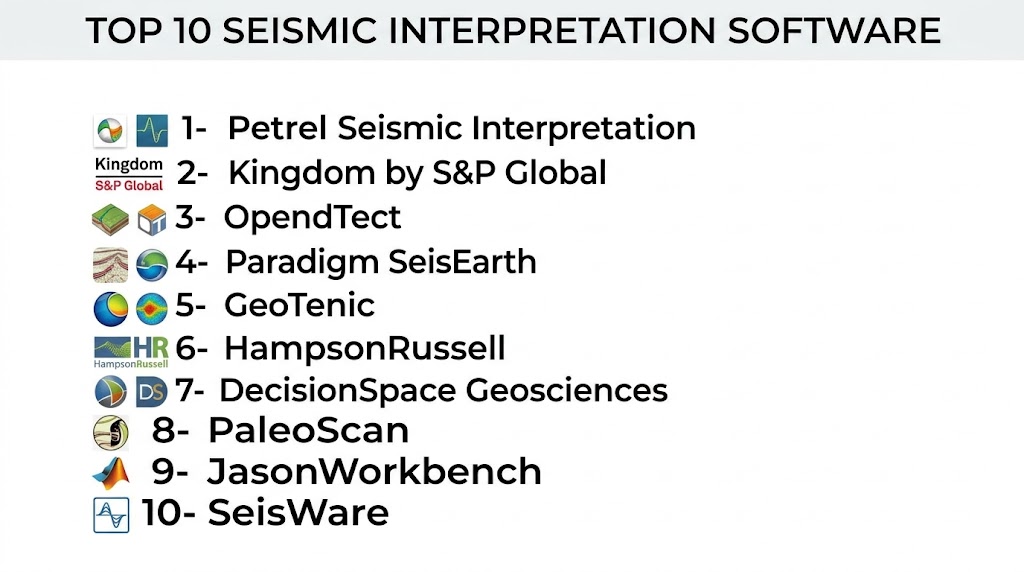
Top 10 Seismic Interpretation Software
1- Schlumberger Petrel
Short description: Petrel is one of the most widely used seismic interpretation and geological modeling platforms in the oil and gas industry. It combines seismic interpretation, reservoir characterization, well planning, and production workflows into a unified environment. Large enterprises rely heavily on Petrel for integrated subsurface analysis and exploration projects.
Key Features
- 2D and 3D seismic interpretation
- Reservoir modeling workflows
- Fault and horizon analysis
- Well correlation tools
- AI-assisted interpretation
- Advanced visualization engine
- Collaborative subsurface workflows
Pros
- Industry-leading integrated workflows
- Strong enterprise scalability
- Excellent visualization capabilities
- Broad ecosystem and partner support
Cons
- High licensing costs
- Requires specialized training
- Resource-intensive deployments
- Complex for smaller teams
Platforms / Deployment
- Windows
- Cloud / Hybrid
Security & Compliance
- RBAC
- Encryption
- Audit capabilities
- Enterprise deployment controls
Integrations & Ecosystem
Petrel integrates with reservoir simulation, geological modeling, production systems, and interpretation environments.
- DELFI ecosystem
- Reservoir simulators
- Geological databases
- APIs
- HPC environments
- Well planning tools
Support & Community
Extensive enterprise support ecosystem with global training, consulting, and partner services.
2- Halliburton DecisionSpace Geosciences
Short description: DecisionSpace Geosciences provides integrated seismic interpretation, geological modeling, and reservoir analysis capabilities for exploration and production environments. The platform focuses on improving interpretation efficiency and operational collaboration.
Key Features
- Seismic interpretation workflows
- Geological modeling
- Reservoir analysis tools
- AI-assisted interpretation
- Real-time collaborative workflows
- Advanced visualization
- Data management capabilities
Pros
- Strong oil & gas industry specialization
- Good collaborative workflows
- Integrated geoscience environment
- Flexible interpretation capabilities
Cons
- Enterprise-oriented pricing
- Requires onboarding and training
- Smaller ecosystem than Petrel
- Complex advanced workflows
Platforms / Deployment
- Windows
- Cloud / Hybrid
Security & Compliance
- RBAC
- Encryption
- SSO support
- Audit logging
Integrations & Ecosystem
DecisionSpace integrates with drilling systems, geological databases, and reservoir analysis environments.
- Reservoir simulators
- Geological tools
- APIs
- Data management platforms
- HPC infrastructure
Support & Community
Strong enterprise support with oil and gas consulting expertise and training programs.
3- Kingdom by IHS Markit
Short description: Kingdom is widely used for seismic interpretation, geological analysis, and well correlation workflows. The platform is known for balancing usability with advanced geophysical functionality, making it popular among exploration teams and independent operators.
Key Features
- Seismic interpretation
- Well correlation workflows
- Geological mapping
- Fault visualization
- Horizon tracking
- Production data integration
- Basin analysis support
Pros
- User-friendly workflows
- Strong geological analysis tools
- Good interpretation performance
- Suitable for various company sizes
Cons
- Less enterprise breadth than Petrel
- Some advanced workflows require add-ons
- Visualization depth varies
- Limited broader operational integration
Platforms / Deployment
- Windows
- Cloud / Hybrid
Security & Compliance
- RBAC
- Encryption
- Not publicly stated for additional certifications
Integrations & Ecosystem
Kingdom integrates with well databases, geological tools, and exploration workflows.
- Well databases
- GIS systems
- APIs
- Geological modeling tools
- Reservoir analysis systems
Support & Community
Well-established geoscience user community with strong training resources.
4- Paradigm Epos
Short description: Paradigm Epos delivers seismic interpretation, geological analysis, and reservoir characterization workflows designed for exploration and production teams. The platform focuses on operational efficiency and high-performance seismic processing environments.
Key Features
- 3D seismic visualization
- Reservoir characterization
- Seismic attribute analysis
- Geological interpretation
- HPC-enabled processing
- AI-assisted workflows
- Structural modeling
Pros
- Strong seismic processing performance
- Good visualization quality
- Flexible interpretation workflows
- Suitable for complex datasets
Cons
- Technical learning curve
- Enterprise pricing structure
- Smaller ecosystem visibility
- Resource-intensive environments
Platforms / Deployment
- Windows / Linux
- Cloud / Hybrid
Security & Compliance
- RBAC
- Encryption
- Audit capabilities
Integrations & Ecosystem
Paradigm integrates with interpretation environments, geological systems, and HPC infrastructures.
- Reservoir simulators
- APIs
- Geological databases
- HPC platforms
- Visualization tools
Support & Community
Enterprise support model with technical consulting and operational training.
5- OpendTect
Short description: OpendTect is a seismic interpretation platform known for open architecture flexibility and strong visualization capabilities. It supports seismic interpretation, attribute analysis, and geological workflows for both commercial and academic environments.
Key Features
- 2D and 3D seismic interpretation
- Open plugin architecture
- Attribute analysis
- Fault interpretation
- Visualization tools
- Machine learning extensions
- Multi-volume seismic support
Pros
- Flexible open architecture
- Good cost efficiency
- Strong visualization functionality
- Active geoscience community
Cons
- Smaller enterprise ecosystem
- Some advanced workflows require plugins
- Limited integrated enterprise tooling
- Support quality may vary
Platforms / Deployment
- Windows / Linux
- Cloud / Self-hosted / Hybrid
Security & Compliance
- RBAC
- Encryption
- Not publicly stated for broader compliance certifications
Integrations & Ecosystem
OpendTect supports plugin extensions and integration with seismic processing and geological workflows.
- Plugin ecosystem
- Geological tools
- APIs
- Machine learning integrations
- Visualization systems
Support & Community
Strong academic and technical community with documentation and plugin support.
6- Aspen SKUA-GOCAD
Short description: Aspen SKUA-GOCAD specializes in geological modeling, structural interpretation, and reservoir characterization. It is commonly used in complex geological environments requiring advanced subsurface modeling.
Key Features
- Geological modeling
- Structural interpretation
- Reservoir characterization
- Fault modeling
- Surface generation
- Geological simulation support
- Data integration tools
Pros
- Strong geological modeling depth
- Excellent structural interpretation
- Suitable for complex reservoirs
- Advanced subsurface analysis
Cons
- Steeper learning curve
- Technical workflows may require expertise
- Premium enterprise positioning
- Smaller broader ecosystem
Platforms / Deployment
- Windows / Linux
- Cloud / Hybrid
Security & Compliance
- RBAC
- Encryption
- Audit controls
Integrations & Ecosystem
SKUA-GOCAD integrates with seismic interpretation, reservoir modeling, and geological analysis systems.
- Reservoir simulators
- Geological databases
- APIs
- HPC infrastructure
- Interpretation tools
Support & Community
Specialized enterprise support focused on advanced geological workflows.
7- GeoTeric
Short description: GeoTeric focuses on AI-driven seismic interpretation and cognitive interpretation workflows. The platform emphasizes automation and machine learning to improve interpretation speed and reduce manual analysis workloads.
Key Features
- AI-assisted interpretation
- Cognitive interpretation workflows
- Fault detection automation
- Horizon extraction
- Seismic attribute analysis
- Advanced visualization
- Collaborative workflows
Pros
- Strong AI-driven capabilities
- Faster interpretation workflows
- Good visualization quality
- Reduced manual effort
Cons
- Smaller ecosystem compared to enterprise leaders
- Enterprise adoption still growing
- Advanced workflows require expertise
- Limited broader operational tooling
Platforms / Deployment
- Windows
- Cloud / Hybrid
Security & Compliance
- RBAC
- Encryption
- SSO support
Integrations & Ecosystem
GeoTeric integrates with seismic interpretation environments and geological analysis workflows.
- APIs
- Geological systems
- Interpretation platforms
- Visualization tools
- Data management systems
Support & Community
Focused technical support with growing adoption in geoscience environments.
8- DUG Insight
Short description: DUG Insight provides seismic interpretation and visualization software optimized for high-performance seismic analysis workflows. The platform emphasizes performance, usability, and large dataset handling.
Key Features
- 2D and 3D interpretation
- Seismic attribute analysis
- Horizon interpretation
- Fault analysis
- GPU-accelerated visualization
- Large dataset support
- Interactive analysis workflows
Pros
- Excellent performance optimization
- Strong visualization engine
- Good handling of large datasets
- Relatively intuitive workflows
Cons
- Smaller ecosystem footprint
- Limited broader geological tooling
- Enterprise deployments may require tuning
- Some advanced integrations vary
Platforms / Deployment
- Windows / Linux
- Cloud / Hybrid
Security & Compliance
- RBAC
- Encryption
- Audit capabilities
Integrations & Ecosystem
DUG Insight supports integration with interpretation workflows and seismic processing environments.
- APIs
- Geological systems
- HPC infrastructure
- Seismic processing tools
- Visualization environments
Support & Community
Strong technical support with HPC and seismic expertise.
9- Emerson Roxar RMS
Short description: Roxar RMS is a reservoir modeling and seismic interpretation platform designed for integrated subsurface workflows. It combines seismic analysis, reservoir characterization, and production modeling capabilities.
Key Features
- Reservoir modeling
- Seismic interpretation
- Geological analysis
- Structural modeling
- Production integration
- Uncertainty analysis
- Collaborative workflows
Pros
- Strong reservoir modeling capabilities
- Integrated subsurface workflows
- Good uncertainty analysis tools
- Enterprise-ready deployments
Cons
- Technical onboarding requirements
- Complex enterprise workflows
- Premium licensing costs
- Resource-intensive environments
Platforms / Deployment
- Windows / Linux
- Cloud / Hybrid
Security & Compliance
- RBAC
- Encryption
- Audit logging
Integrations & Ecosystem
Roxar RMS integrates with production systems, reservoir simulators, and seismic analysis tools.
- Reservoir simulators
- APIs
- Geological databases
- Production systems
- Interpretation tools
Support & Community
Enterprise-grade support with reservoir engineering and geoscience expertise.
10- SeisWare
Short description: SeisWare provides seismic interpretation and geological mapping software designed for exploration workflows and operational efficiency. The platform is often used by independent operators and exploration-focused geoscience teams.
Key Features
- Seismic interpretation
- Geological mapping
- Well correlation
- Data visualization
- Mapping workflows
- Horizon interpretation
- Reporting tools
Pros
- Easier learning curve
- Good usability
- Cost-effective for smaller teams
- Suitable for exploration workflows
Cons
- Less enterprise scalability
- Limited advanced AI capabilities
- Smaller ecosystem
- Fewer integrated reservoir workflows
Platforms / Deployment
- Windows
- Cloud / Hybrid
Security & Compliance
- RBAC
- Encryption
- Not publicly stated for broader certifications
Integrations & Ecosystem
SeisWare integrates with geological databases and exploration workflows to improve seismic interpretation efficiency.
- Geological databases
- APIs
- Mapping systems
- Reporting tools
- Interpretation workflows
Support & Community
Good customer support and onboarding for exploration-focused teams.
Comparison Table
| Tool Name | Best For | Platform(s) Supported | Deployment | Standout Feature | Public Rating |
|---|---|---|---|---|---|
| Schlumberger Petrel | Enterprise exploration | Windows | Cloud, Hybrid | Integrated subsurface workflows | N/A |
| DecisionSpace Geosciences | Collaborative interpretation | Windows | Cloud, Hybrid | Geoscience collaboration | N/A |
| Kingdom | Exploration workflows | Windows | Cloud, Hybrid | User-friendly interpretation | N/A |
| Paradigm Epos | High-performance interpretation | Windows, Linux | Cloud, Hybrid | HPC seismic analysis | N/A |
| OpendTect | Flexible open architecture | Windows, Linux | Cloud, Hybrid, Self-hosted | Plugin ecosystem | N/A |
| Aspen SKUA-GOCAD | Geological modeling | Windows, Linux | Cloud, Hybrid | Structural interpretation | N/A |
| GeoTeric | AI-driven interpretation | Windows | Cloud, Hybrid | Cognitive interpretation | N/A |
| DUG Insight | Large seismic datasets | Windows, Linux | Cloud, Hybrid | GPU visualization | N/A |
| Emerson Roxar RMS | Reservoir modeling | Windows, Linux | Cloud, Hybrid | Reservoir characterization | N/A |
| SeisWare | Exploration teams | Windows | Cloud, Hybrid | Simpler usability | N/A |
Evaluation & Scoring of Seismic Interpretation Software
| Tool Name | Core | Ease | Integrations | Security | Performance | Support | Value | Weighted Total |
|---|---|---|---|---|---|---|---|---|
| Schlumberger Petrel | 9.7 | 7.8 | 9.5 | 9.1 | 9.5 | 9.2 | 7.4 | 8.99 |
| DecisionSpace Geosciences | 9.2 | 7.9 | 8.9 | 8.8 | 9.0 | 8.7 | 7.7 | 8.57 |
| Kingdom | 8.7 | 8.6 | 8.1 | 8.0 | 8.5 | 8.5 | 8.4 | 8.42 |
| Paradigm Epos | 9.0 | 7.5 | 8.6 | 8.4 | 9.1 | 8.4 | 7.8 | 8.45 |
| OpendTect | 8.5 | 8.3 | 7.9 | 7.8 | 8.6 | 8.1 | 8.8 | 8.29 |
| Aspen SKUA-GOCAD | 8.9 | 7.2 | 8.4 | 8.3 | 8.8 | 8.3 | 7.6 | 8.22 |
| GeoTeric | 8.8 | 8.0 | 8.0 | 8.1 | 8.7 | 8.2 | 8.1 | 8.32 |
| DUG Insight | 8.7 | 8.2 | 7.8 | 8.0 | 9.0 | 8.2 | 8.3 | 8.34 |
| Emerson Roxar RMS | 9.1 | 7.6 | 8.8 | 8.7 | 8.9 | 8.5 | 7.7 | 8.49 |
| SeisWare | 8.0 | 8.7 | 7.3 | 7.6 | 8.0 | 8.0 | 8.8 | 8.06 |
These scores are comparative and designed to help organizations evaluate strengths across seismic interpretation platforms. Enterprise-focused systems generally score higher in integrations, scalability, and advanced modeling capabilities, while smaller platforms may perform better in usability and operational simplicity. Buyers should prioritize evaluation criteria based on exploration scale, data complexity, and integration requirements.
Which Seismic Interpretation Software Tool Is Right for You?
Solo / Freelancer
Independent geoscientists and smaller exploration consultants often benefit from more lightweight and cost-effective solutions such as SeisWare or OpendTect due to easier deployment and manageable operational complexity.
SMB
Small and mid-sized exploration companies may prefer Kingdom, OpendTect, or GeoTeric because they balance interpretation capabilities with usability and lower infrastructure requirements.
Mid-Market
Mid-market organizations handling larger seismic datasets and collaborative interpretation projects should evaluate DecisionSpace Geosciences, Paradigm Epos, and DUG Insight.
Enterprise
Large multinational exploration and production companies typically require integrated enterprise-grade platforms such as Petrel, Roxar RMS, or DecisionSpace Geosciences for scalability, collaboration, and operational depth.
Budget vs Premium
Budget-oriented buyers should prioritize usability, deployment efficiency, and essential interpretation workflows. Premium enterprise platforms provide stronger integrations, scalability, and advanced modeling but involve higher implementation and licensing costs.
Feature Depth vs Ease of Use
Advanced geological and reservoir workflows often increase platform complexity. Organizations should balance operational sophistication with user adoption and training requirements.
Integrations & Scalability
Companies operating integrated reservoir modeling, geological databases, and HPC environments should prioritize platforms with mature API ecosystems and workflow interoperability.
Security & Compliance Needs
Exploration companies managing sensitive subsurface and operational data should prioritize platforms with RBAC, encryption, audit logging, and centralized governance capabilities.
Frequently Asked Questions
1. What is Seismic Interpretation Software?
Seismic Interpretation Software helps geoscientists analyze seismic datasets to identify subsurface geological structures, reservoirs, faults, and drilling opportunities. These platforms support exploration, production planning, and reservoir characterization workflows.
2. Why is AI becoming important in seismic interpretation?
AI reduces manual interpretation workloads by automating fault detection, horizon extraction, and seismic analysis tasks. Machine learning also improves interpretation accuracy and operational efficiency across large seismic datasets.
3. What industries use seismic interpretation platforms?
Oil and gas exploration remains the primary use case, but these platforms are also used in geothermal energy, carbon capture projects, mining, and geological research environments.
4. Are cloud deployments becoming more common?
Yes. Cloud adoption is increasing because it improves collaboration, scalability, and access to high-performance computing infrastructure for seismic processing and interpretation workflows.
5. What integrations should organizations prioritize?
Important integrations include reservoir simulators, geological databases, GIS systems, production environments, HPC infrastructure, and operational analytics platforms.
6. How important is visualization performance?
Visualization performance is critical because seismic datasets are extremely large and computationally demanding. GPU acceleration and high-performance rendering significantly improve workflow efficiency.
7. What are the biggest implementation challenges?
Common challenges include large dataset management, infrastructure requirements, integration complexity, user training, and migration from legacy interpretation systems.
8. Are these platforms suitable for small exploration companies?
Some solutions such as SeisWare and OpendTect are more accessible for smaller exploration teams. Enterprise-grade platforms may be excessive for organizations with limited seismic analysis requirements.
9. How does seismic interpretation improve drilling decisions?
Accurate interpretation helps organizations identify reservoir structures, minimize drilling uncertainty, reduce operational risks, and optimize well placement strategies.
10. How should buyers shortlist vendors?
Organizations should evaluate scalability, interpretation workflows, integration maturity, visualization performance, AI capabilities, deployment flexibility, and support quality before making a final selection.
Conclusion
Seismic Interpretation Software has evolved into a critical technology foundation for modern exploration and subsurface analysis workflows. Enterprise-grade platforms such as Schlumberger Petrel, DecisionSpace Geosciences, and Emerson Roxar RMS deliver strong scalability, integrated reservoir workflows, and advanced interpretation capabilities for complex exploration environments. Mid-market and specialized teams may benefit more from platforms such as Kingdom, OpendTect, or GeoTeric due to their balance of usability, flexibility, and operational efficiency. The best platform ultimately depends on dataset complexity, geological requirements, collaboration needs, infrastructure maturity, and integration priorities. Rather than selecting software based only on market reputation, organizations should shortlist a few strong candidates, validate workflow compatibility through pilot projects, assess integration and visualization performance carefully, and measure operational efficiency improvements before expanding deployments across exploration environments.

Seismic interpretation software provides the greatest long-term value when it helps teams manage interpretation uncertainty rather than simply generating subsurface models. Different interpreters may reach different conclusions from the same seismic dataset, making validation and collaboration essential. Including insights on interpretation confidence scoring, version comparison, collaborative review workflows, and integration with drilling results would give readers a more practical understanding of how these platforms reduce exploration risk and improve decision-making throughout the asset lifecycle.
Seismic interpretation can become difficult when multiple geological interpretations are technically plausible and teams need to understand why a particular interpretation was selected. Keeping versioned horizons, faults, attributes, interpretation changes, and confidence levels can make peer review much more meaningful than simply comparing final maps. It is also valuable to connect interpretation decisions with well results and subsequent drilling outcomes, creating a feedback loop that shows which assumptions held up in practice. This kind of traceability helps geoscientists refine their workflows while making uncertainty more visible to the wider subsurface team.