Introduction
Supply Chain Management SCM Suites are end-to-end enterprise platforms that help organizations plan, execute, monitor, and optimize the flow of goods, data, and finances across procurement, production, warehousing, logistics, and distribution networks. These systems connect suppliers, manufacturers, distributors, and retailers into a unified digital supply chain ecosystem.
In today’s volatile global market, supply chains face disruptions from demand fluctuations, geopolitical risks, raw material shortages, and logistics bottlenecks. Modern SCM suites address these challenges using AI-driven forecasting, real-time visibility, automation, predictive analytics, and cloud-based orchestration.
Key real-world use cases include:
- Demand forecasting and supply planning
- Inventory optimization across multi-location networks
- Procurement and supplier collaboration
- Warehouse and transportation management
- End-to-end supply chain visibility and control towers
Evaluation criteria for buyers:
- Demand planning and forecasting accuracy
- End-to-end visibility capabilities
- Logistics and transportation management strength
- AI and predictive analytics maturity
- ERP and third-party integration support
- Scalability for global operations
- Multi-enterprise collaboration features
- Real-time execution and tracking
- Security and compliance controls
- Ease of deployment and usability
Best for: Large enterprises, global manufacturers, retail chains, logistics providers, pharmaceutical companies, and organizations managing complex multi-tier supply networks.
Not ideal for: Small businesses with simple inventory needs, startups without global supply chains, or companies that only require basic accounting or standalone warehouse tools.
Key Trends in Supply Chain Management SCM Suites
- AI-powered demand forecasting is becoming standard across enterprise SCM platforms
- Real-time supply chain control towers are improving end-to-end visibility
- Multi-enterprise collaboration networks are replacing siloed supplier systems
- Cloud-native SCM suites are replacing legacy on-premise planning tools
- Digital twin technology is improving supply chain simulation and scenario planning
- Automation is reducing manual planning and procurement tasks
- Sustainability tracking is becoming a core supply chain KPI
- Risk intelligence is being integrated into planning workflows
- Embedded analytics and dashboards are improving decision-making speed
- ERP-native SCM integration is increasing across enterprise ecosystems
How We Selected These Tools
The tools included in this list were evaluated based on:
- Global adoption across industries and enterprise scale usage
- Breadth of SCM capabilities (planning, execution, logistics, procurement)
- AI, ML, and predictive analytics maturity
- Integration depth with ERP and enterprise systems
- Supply chain visibility and control tower capabilities
- Scalability for multi-region operations
- Cloud readiness and modernization level
- Vendor ecosystem maturity and enterprise support strength
- Real-time operational execution capabilities
- Industry recognition and deployment footprint
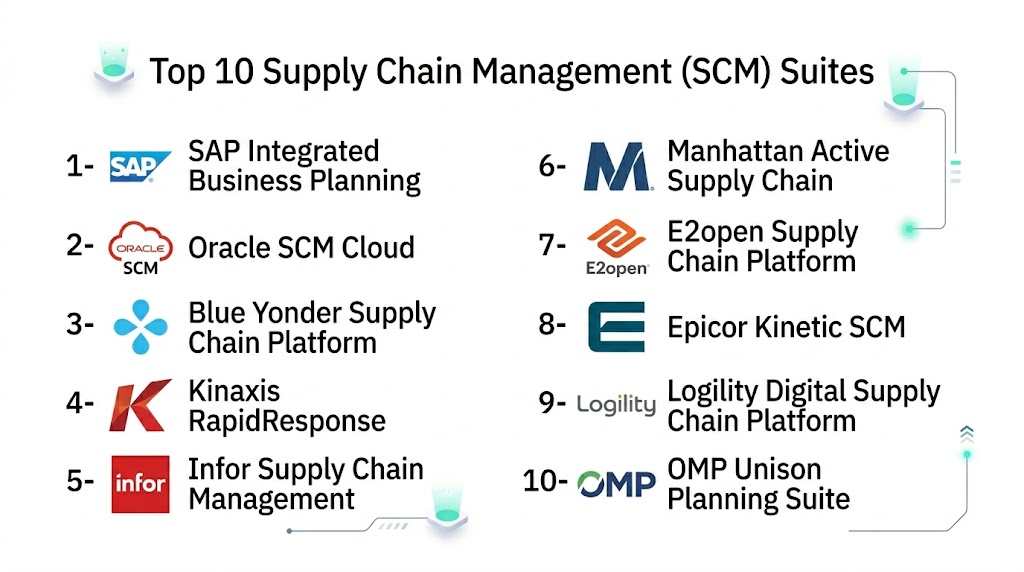
Top 10 Supply Chain Management SCM Suites
1- SAP Integrated Business Planning IBP
Short description: SAP IBP is a cloud-based supply chain planning suite that integrates demand forecasting, inventory optimization, supply planning, and sales & operations planning. It is widely used by global enterprises already operating in SAP ecosystems. The platform focuses on improving forecast accuracy and aligning supply chain operations with business goals through real-time analytics.
Key Features
- Demand forecasting and planning
- Inventory optimization across networks
- Supply planning and S&OP workflows
- Real-time analytics and dashboards
- Scenario simulation and planning
- AI-powered demand sensing
- ERP integration with SAP systems
Pros
- Deep ERP integration with SAP ecosystem
- Strong global enterprise adoption
- Advanced forecasting capabilities
- Excellent planning and scenario modeling
Cons
- Complex implementation process
- High cost of ownership
- Requires skilled configuration teams
- Less suitable for small organizations
Platforms / Deployment
- Web
- Cloud
Security & Compliance
- RBAC
- Encryption
- SSO integration
- Audit logging
Integrations & Ecosystem
SAP IBP integrates deeply with enterprise ERP systems and supply chain execution tools, making it ideal for organizations already using SAP infrastructure.
- SAP ERP systems
- SAP S/4HANA
- Analytics platforms
- Data warehouses
- APIs
Support & Community
Strong global enterprise support, consulting partners, and extensive SAP ecosystem documentation.
2- Oracle SCM Cloud
Short description: Oracle SCM Cloud is an end-to-end supply chain management suite that connects planning, procurement, manufacturing, logistics, and order management. It uses AI and analytics to improve forecasting, execution, and operational efficiency across global supply chains.
Key Features
- End-to-end supply chain planning
- Procurement and supplier management
- Order management and fulfillment
- Transportation and logistics planning
- AI-driven demand forecasting
- Inventory optimization
- Real-time visibility dashboards
Pros
- Comprehensive end-to-end SCM coverage
- Strong cloud-native architecture
- Advanced analytics and AI capabilities
- Suitable for global operations
Cons
- Complex enterprise implementation
- Requires integration expertise
- High deployment cost
- Learning curve for users
Platforms / Deployment
- Web
- Cloud
Security & Compliance
- RBAC
- MFA
- Encryption
- Audit controls
Integrations & Ecosystem
Oracle SCM Cloud integrates tightly with Oracle ERP and supports broad enterprise supply chain operations.
- Oracle ERP Cloud
- Logistics systems
- Manufacturing systems
- APIs
- Analytics tools
Support & Community
Enterprise-grade support with global implementation partners and strong documentation.
3- Blue Yonder Luminate Platform
Short description: Blue Yonder is an AI-powered supply chain suite focused on demand planning, inventory optimization, warehouse management, and transportation planning. It is widely used in retail, manufacturing, and logistics-heavy industries.
Key Features
- AI-driven demand forecasting
- Inventory optimization
- Warehouse management system
- Transportation planning
- Supply chain control tower
- Real-time analytics
- Multi-channel fulfillment optimization
Pros
- Strong AI and machine learning capabilities
- Excellent retail and logistics fit
- End-to-end planning and execution support
- High automation potential
Cons
- Complex implementation cycles
- Best value when full suite is used
- UI complexity in some modules
- Requires strong integration planning
Platforms / Deployment
- Web
- Cloud
Security & Compliance
- RBAC
- Encryption
- Enterprise audit logging
Integrations & Ecosystem
Blue Yonder connects planning and execution systems across retail and logistics environments for unified supply chain visibility.
- ERP systems
- WMS platforms
- TMS systems
- APIs
- Data analytics tools
Support & Community
Strong enterprise support with global consulting and implementation services.
4- Kinaxis RapidResponse
Short description: Kinaxis RapidResponse is a real-time supply chain planning platform designed for fast scenario modeling and decision-making. It enables organizations to simulate supply chain changes and respond quickly to disruptions.
Key Features
- Real-time supply chain planning
- Scenario simulation and modeling
- Demand and supply alignment
- Inventory optimization
- Risk analysis and mitigation
- Collaborative planning
- Analytics dashboards
Pros
- Extremely fast scenario planning
- Strong real-time responsiveness
- Good for disruption management
- Flexible planning model
Cons
- Requires mature planning processes
- Enterprise pricing structure
- Integration complexity in large setups
- Not execution-focused
Platforms / Deployment
- Web
- Cloud
Security & Compliance
- RBAC
- Encryption
- Audit logging
Integrations & Ecosystem
Kinaxis integrates with enterprise planning systems and data platforms for real-time decision support.
- ERP systems
- Data warehouses
- APIs
- BI tools
- Planning systems
Support & Community
Strong enterprise support with supply chain planning expertise and global consulting partners.
5- Infor Nexus
Short description: Infor Nexus is a multi-enterprise supply chain network platform that provides global visibility, supplier collaboration, and logistics orchestration. It is widely used in retail, fashion, and manufacturing industries.
Key Features
- Multi-enterprise collaboration
- Supplier network visibility
- Logistics tracking
- Inventory visibility across partners
- Risk management tools
- Financial supply chain workflows
- Real-time analytics
Pros
- Strong global collaboration features
- Excellent supplier visibility
- Good logistics tracking capabilities
- Useful for extended supply chains
Cons
- Complex supplier onboarding
- Requires ecosystem participation
- Advanced features need setup effort
- Not ideal for small supply chains
Platforms / Deployment
- Web
- Cloud
Security & Compliance
- RBAC
- Encryption
- Audit controls
Integrations & Ecosystem
Infor Nexus connects suppliers, logistics providers, and manufacturers into a unified collaboration network.
- ERP systems
- Logistics platforms
- Supplier systems
- APIs
- Data analytics tools
Support & Community
Enterprise support with supply chain collaboration expertise and onboarding assistance.
6- Manhattan Active Supply Chain
Short description: Manhattan Active SCM is a cloud-native suite focused on warehouse management, transportation optimization, and supply chain execution. It is widely used in retail and logistics-heavy industries.
Key Features
- Warehouse management system
- Transportation optimization
- Inventory management
- Order fulfillment workflows
- Real-time supply chain visibility
- Labor optimization tools
- Unified control tower
Pros
- Strong warehouse and logistics execution
- Cloud-native architecture
- Excellent retail supply chain fit
- High scalability
Cons
- Less focus on upstream planning
- Complex enterprise deployment
- Requires integration planning
- Premium pricing structure
Platforms / Deployment
- Web
- Cloud
Security & Compliance
- RBAC
- Encryption
- Audit logging
Integrations & Ecosystem
Manhattan integrates logistics execution, warehouse systems, and transportation planning into a unified supply chain execution environment.
- ERP systems
- WMS systems
- TMS platforms
- APIs
- Logistics networks
Support & Community
Strong enterprise logistics support with global implementation expertise.
7- E2open Supply Chain Platform
Short description: E2open is a cloud-based supply chain platform that connects planning, sourcing, logistics, and execution in a unified network. It is designed for global enterprises managing complex multi-tier supply chains.
Key Features
- End-to-end supply chain planning
- Demand sensing and forecasting
- Supplier collaboration
- Logistics optimization
- Inventory management
- Trade compliance tools
- Network visibility
Pros
- Strong multi-enterprise connectivity
- Good global supply chain visibility
- Integrated planning and execution
- Scalable cloud platform
Cons
- Complex onboarding process
- Requires ecosystem adoption
- Integration-heavy deployments
- Learning curve for users
Platforms / Deployment
- Web
- Cloud
Security & Compliance
- RBAC
- Encryption
- Audit logging
Integrations & Ecosystem
E2open integrates across global supply chain ecosystems to connect suppliers, logistics providers, and manufacturers.
- ERP systems
- Logistics platforms
- Supplier networks
- APIs
- Analytics tools
Support & Community
Enterprise support with global supply chain network expertise.
8- Infor SCM Suite
Short description: Infor SCM Suite provides supply chain planning, logistics, and inventory management capabilities with strong cloud-based scalability. It is widely used in manufacturing and distribution industries.
Key Features
- Demand and supply planning
- Inventory optimization
- Logistics management
- Warehouse operations
- Supplier collaboration
- Analytics dashboards
- Production planning
Pros
- Strong manufacturing fit
- Good cloud scalability
- Flexible supply chain planning
- Integrated analytics
Cons
- Requires configuration effort
- Complex enterprise workflows
- Limited out-of-box simplicity
- Integration complexity in large ecosystems
Platforms / Deployment
- Web
- Cloud
Security & Compliance
- RBAC
- Encryption
- Audit logging
Integrations & Ecosystem
Infor SCM connects manufacturing, logistics, and supply chain planning workflows into a unified system.
- ERP systems
- Warehouse systems
- Logistics platforms
- APIs
- Data analytics tools
Support & Community
Enterprise support with strong industry-specific implementation expertise.
9- Coupa Supply Chain Design & Planning
Short description: Coupa provides supply chain design, planning, and procurement visibility tools that help organizations optimize sourcing, risk management, and spend efficiency. It focuses heavily on financial and procurement alignment.
Key Features
- Supply chain planning
- Procurement optimization
- Supplier risk analysis
- Spend visibility
- Network optimization
- Demand forecasting
- Scenario modeling
Pros
- Strong procurement integration
- Good financial alignment
- Useful risk visibility tools
- Cloud-native platform
Cons
- Less logistics execution focus
- Requires ecosystem adoption
- Advanced planning requires setup
- Not a full execution suite
Platforms / Deployment
- Web
- Cloud
Security & Compliance
- RBAC
- Encryption
- Audit controls
Integrations & Ecosystem
Coupa integrates procurement, supply chain planning, and financial systems for end-to-end visibility.
- ERP systems
- Procurement systems
- Financial tools
- APIs
- Analytics platforms
Support & Community
Strong enterprise procurement-focused support and advisory services.
10- Microsoft Dynamics 365 Supply Chain Management
Short description: Microsoft Dynamics 365 SCM is a cloud-based supply chain solution that integrates planning, manufacturing, warehousing, and logistics with the broader Microsoft ecosystem. It is widely adopted by mid-market and enterprise organizations.
Key Features
- Supply chain planning
- Warehouse management
- Manufacturing execution
- Inventory optimization
- Demand forecasting
- Logistics management
- Analytics dashboards
Pros
- Strong Microsoft ecosystem integration
- Flexible and scalable platform
- Good mid-market to enterprise fit
- Strong analytics via Power BI
Cons
- Requires Microsoft ecosystem alignment
- Advanced customization may need expertise
- Complex enterprise deployments
- Some modules require configuration depth
Platforms / Deployment
- Web
- Cloud
Security & Compliance
- RBAC
- MFA
- Encryption
- Audit logging
Integrations & Ecosystem
Dynamics 365 integrates deeply with Microsoft enterprise tools and cloud services.
- Microsoft ERP systems
- Power BI
- Azure services
- APIs
- Business applications
Support & Community
Strong global Microsoft support ecosystem with extensive partner network.
Comparison Table
| Tool Name | Best For | Platform(s) Supported | Deployment | Standout Feature | Public Rating |
|---|---|---|---|---|---|
| SAP IBP | Enterprise planning | Web | Cloud | Advanced S&OP planning | N/A |
| Oracle SCM Cloud | End-to-end SCM | Web | Cloud | Full lifecycle SCM suite | N/A |
| Blue Yonder | Retail & logistics | Web | Cloud | AI demand forecasting | N/A |
| Kinaxis RapidResponse | Real-time planning | Web | Cloud | Scenario simulation | N/A |
| Infor Nexus | Supplier collaboration | Web | Cloud | Multi-enterprise network | N/A |
| Manhattan Active SCM | Logistics execution | Web | Cloud | Warehouse optimization | N/A |
| E2open | Global supply chain | Web | Cloud | Network visibility | N/A |
| Infor SCM Suite | Manufacturing supply chain | Web | Cloud | Flexible planning tools | N/A |
| Coupa SCM | Procurement-focused SCM | Web | Cloud | Spend optimization | N/A |
| Microsoft Dynamics 365 SCM | Mid-market + enterprise | Web | Cloud | Microsoft ecosystem integration | N/A |
Evaluation & Scoring of Supply Chain Management SCM Suites
| Tool Name | Core | Ease | Integrations | Security | Performance | Support | Value | Weighted Total |
|---|---|---|---|---|---|---|---|---|
| SAP IBP | 9.6 | 7.5 | 9.5 | 9.2 | 9.3 | 9.0 | 7.4 | 8.94 |
| Oracle SCM Cloud | 9.5 | 7.6 | 9.4 | 9.1 | 9.2 | 9.0 | 7.5 | 8.92 |
| Blue Yonder | 9.3 | 7.8 | 9.0 | 8.8 | 9.0 | 8.8 | 7.6 | 8.71 |
| Kinaxis RapidResponse | 9.2 | 8.2 | 8.9 | 8.7 | 9.1 | 8.9 | 8.0 | 8.83 |
| Infor Nexus | 9.0 | 8.0 | 8.7 | 8.6 | 8.8 | 8.7 | 8.1 | 8.56 |
| Manhattan Active SCM | 9.1 | 7.9 | 8.8 | 8.7 | 9.0 | 8.8 | 7.8 | 8.67 |
| E2open | 9.0 | 7.7 | 8.9 | 8.6 | 8.9 | 8.7 | 7.9 | 8.60 |
| Infor SCM Suite | 8.8 | 8.0 | 8.6 | 8.5 | 8.7 | 8.5 | 8.2 | 8.47 |
| Coupa SCM | 8.7 | 8.3 | 8.5 | 8.6 | 8.6 | 8.6 | 8.3 | 8.52 |
| Microsoft Dynamics 365 SCM | 8.9 | 8.4 | 8.9 | 8.8 | 8.9 | 8.8 | 8.4 | 8.73 |
These scores are comparative and reflect enterprise SCM capabilities across planning, execution, integration, and scalability dimensions. Organizations should prioritize based on whether they need planning depth, logistics execution, supplier collaboration, or full end-to-end orchestration.
Which Supply Chain Management SCM Suite Is Right for You?
Solo / Freelancer
Not typically applicable, but small consultants or analysts may use lightweight planning tools instead of full SCM suites.
SMB
Small and mid-sized businesses should consider Microsoft Dynamics 365 SCM or Infor SCM Suite due to easier deployment, scalability, and integration flexibility.
Mid-Market
Mid-sized enterprises benefit from Blue Yonder, Coupa SCM, or Manhattan Active SCM depending on whether their focus is retail, logistics, or procurement optimization.
Enterprise
Large global organizations should prioritize SAP IBP, Oracle SCM Cloud, Kinaxis RapidResponse, or E2open for full-scale planning, execution, and multi-enterprise orchestration.
Budget vs Premium
Budget-focused organizations should prioritize modular SCM systems, while premium enterprise suites offer full end-to-end supply chain orchestration, automation, and AI-driven intelligence.
Feature Depth vs Ease of Use
Advanced suites provide deeper forecasting, planning, and execution capabilities but require longer implementation cycles. Simpler tools are easier to adopt but may lack full supply chain coverage.
Integrations & Scalability
Organizations should prioritize integration with ERP, WMS, TMS, procurement, and analytics systems to ensure end-to-end visibility and control.
Security & Compliance Needs
Enterprise SCM platforms must support RBAC, encryption, audit logs, SSO, and global compliance standards for secure multi-enterprise operations.
Frequently Asked Questions
1. What is a Supply Chain Management SCM Suite?
A Supply Chain Management SCM Suite is an integrated software platform that manages planning, sourcing, production, logistics, and delivery across the supply chain. It helps organizations improve efficiency, visibility, and decision-making across global operations.
2. Why are SCM suites important today?
SCM suites are important because global supply chains face disruptions, demand volatility, and increasing complexity. These platforms help organizations respond faster, reduce costs, and improve resilience through AI and real-time analytics.
3. What are the core modules of an SCM suite?
Core modules typically include demand planning, supply planning, procurement, inventory management, warehouse management, transportation management, and supply chain analytics.
4. What industries use SCM suites?
Industries include manufacturing, retail, logistics, automotive, pharmaceuticals, consumer goods, energy, and electronics manufacturing.
5. How do SCM suites improve forecasting?
They use AI and machine learning models to analyze historical demand, market trends, and real-time data to improve forecast accuracy and reduce inventory imbalances.
6. What is supply chain visibility?
Supply chain visibility refers to the ability to track goods, materials, and information across the entire supply chain in real time, improving responsiveness and decision-making.
7. Are SCM suites cloud-based?
Most modern SCM suites are cloud-based or hybrid, offering scalability, real-time collaboration, and faster deployment compared to legacy on-premise systems.
8. What is the difference between SCM and ERP?
ERP systems manage core business functions like finance and HR, while SCM suites focus specifically on supply chain planning, logistics, and execution.
9. How long does SCM implementation take?
Implementation can range from a few months for mid-market tools to over a year for enterprise suites depending on complexity, integrations, and data readiness.
10. What are common SCM implementation challenges?
Challenges include data integration, change management, process alignment, system complexity, and ensuring accurate demand and supply data across the organization.
Conclusion
Supply Chain Management SCM Suites are essential for modern enterprises operating in complex, global, and highly dynamic environments. Platforms like SAP IBP, Oracle SCM Cloud, Kinaxis RapidResponse, and Blue Yonder lead the enterprise space with advanced AI-driven planning and execution capabilities, while solutions like Microsoft Dynamics 365 SCM and Infor SCM Suite offer strong flexibility for mid-market organizations. The right choice depends on operational scale, integration requirements, and whether the focus is planning, execution, or end-to-end orchestration. Organizations should begin by identifying their biggest supply chain pain points, shortlist two to three platforms, and run controlled pilots to validate forecasting accuracy, integration capability, and operational impact before full-scale deployment.

Great comparison of supply chain management suites—this article gives a clear understanding of how SCM platforms help businesses improve planning, logistics, and overall operational efficiency.