Introduction
Predictive Maintenance Platforms help organizations monitor equipment health, predict failures, reduce downtime, and optimize maintenance schedules using sensor data, AI, machine learning, IoT, and asset performance analytics. These platforms are used in manufacturing, energy, utilities, oil and gas, mining, transportation, aviation, and industrial operations where equipment uptime is critical.
Instead of waiting for equipment to fail or following fixed maintenance calendars, predictive maintenance tools analyze vibration, temperature, pressure, acoustic, electrical, and operational data to identify early warning signs. This helps maintenance teams act before breakdowns happen and reduce unnecessary maintenance costs.
Real-world use cases include:
- Monitoring rotating equipment such as pumps, motors, turbines, and compressors
- Predicting failures in production lines and industrial machinery
- Reducing unplanned downtime in factories and plants
- Optimizing spare parts and maintenance scheduling
- Improving asset reliability across multiple sites
Evaluation criteria for buyers:
- AI and machine learning accuracy
- IoT and sensor data integration
- Asset health monitoring depth
- Real-time alerting and anomaly detection
- CMMS and EAM integration
- Ease of deployment
- Scalability across sites
- Reporting and analytics quality
- Security and access controls
- Support for industrial environments
Best for: Manufacturing plants, energy companies, utilities, oil and gas operators, mining companies, transportation firms, facilities teams, and industrial enterprises managing expensive or mission-critical assets.
Not ideal for: Very small teams with limited equipment, organizations without reliable asset data, or businesses that only need simple maintenance ticketing instead of predictive analytics.
Key Trends in Predictive Maintenance Platforms
- AI-driven anomaly detection is becoming more common for identifying early equipment failure signals.
- IoT sensor adoption is helping companies monitor equipment continuously instead of relying on manual inspections.
- Edge analytics is reducing latency by processing maintenance signals near the equipment.
- Predictive maintenance is becoming more connected with CMMS, EAM, ERP, and field service systems.
- Digital twins are helping teams simulate asset behavior and maintenance scenarios.
- Cloud-based platforms are making multi-site asset monitoring easier.
- Prescriptive maintenance is growing, where platforms recommend the best corrective action.
- Vibration, thermal, acoustic, and electrical data are being combined for richer asset diagnostics.
- Maintenance teams are using dashboards to prioritize work based on risk and asset criticality.
- Sustainability goals are increasing demand for efficient asset utilization and reduced waste.
How We Selected These Tools
The tools below were selected using practical enterprise and industrial maintenance criteria:
- Strong recognition in predictive maintenance or asset performance management
- AI and machine learning capabilities for failure prediction
- Industrial IoT and sensor data support
- Asset health monitoring and anomaly detection features
- Integration with CMMS, EAM, ERP, and operational systems
- Scalability for multi-site operations
- Reliability in industrial environments
- Reporting, dashboards, and decision support
- Security and governance capabilities
- Fit across manufacturing, energy, utilities, and heavy industry
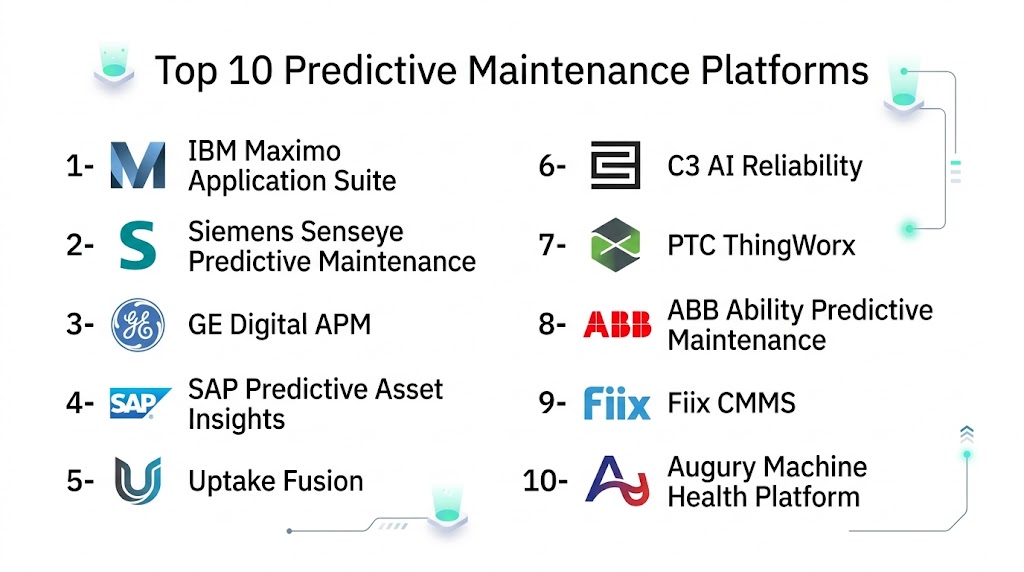
Top 10 Predictive Maintenance Platforms
1- IBM Maximo Application Suite
Short description: IBM Maximo Application Suite is a leading enterprise asset management and asset performance platform used by asset-heavy industries. It supports predictive maintenance, condition monitoring, asset health scoring, inspections, work management, and reliability analytics. It is best suited for organizations that need a full enterprise-grade maintenance and asset management environment.
Key Features
- Predictive maintenance analytics
- Asset health monitoring
- AI-assisted anomaly detection
- Work order management
- IoT sensor integration
- Inspection and reliability workflows
- Enterprise asset lifecycle management
Pros
- Strong enterprise asset management depth
- Excellent fit for asset-heavy industries
- Broad integration ecosystem
- Mature analytics and reliability workflows
Cons
- Complex implementation
- Higher total cost of ownership
- Requires skilled administrators
- May be too advanced for smaller teams
Platforms / Deployment
- Web / iOS / Android
- Cloud / Hybrid
Security & Compliance
- RBAC
- SSO
- Encryption
- Audit logging
- Enterprise access controls
Integrations & Ecosystem
IBM Maximo integrates predictive maintenance, asset management, IoT monitoring, and work execution into one ecosystem. It is especially useful for organizations that need to connect equipment health data with maintenance execution.
- ERP systems
- IoT platforms
- SCADA systems
- CMMS workflows
- APIs
- Analytics tools
Support & Community
IBM provides enterprise support, technical documentation, implementation partners, and consulting services. The ecosystem is mature and suitable for large-scale industrial deployments.
2- SAP Asset Performance Management
Short description: SAP Asset Performance Management helps companies improve asset reliability, maintenance planning, and operational performance. It is especially useful for organizations already using SAP ERP, SAP EAM, or SAP maintenance workflows. The platform supports risk-based maintenance, asset strategy, performance analysis, and predictive insights.
Key Features
- Asset health monitoring
- Predictive maintenance planning
- Risk-based maintenance strategy
- Reliability analytics
- Integration with SAP maintenance workflows
- Asset lifecycle visibility
- Operational performance dashboards
Pros
- Strong SAP ecosystem integration
- Good fit for enterprise asset-heavy operations
- Reliable governance and process control
- Useful for standardized maintenance programs
Cons
- Best suited for SAP-centric organizations
- Implementation can be complex
- Requires structured asset data
- May be costly for smaller companies
Platforms / Deployment
- Web
- Cloud / Hybrid
Security & Compliance
- SSO
- MFA
- RBAC
- Encryption
- Audit logging
Integrations & Ecosystem
SAP Asset Performance Management works well in organizations using SAP maintenance, finance, procurement, and operations systems. It connects asset strategy with enterprise workflows.
- SAP ERP
- SAP EAM
- IoT systems
- Maintenance workflows
- Analytics platforms
- APIs
Support & Community
SAP offers enterprise support, implementation partners, documentation, and training programs. Support strength is strongest for organizations already using SAP environments.
3- Siemens Senseye Predictive Maintenance
Short description: Siemens Senseye Predictive Maintenance is designed to help manufacturers and industrial teams predict equipment failures at scale. It uses machine learning and asset behavior analysis to identify maintenance risks before breakdowns occur. The platform is suitable for manufacturers that need faster deployment and scalable predictive maintenance workflows.
Key Features
- AI-based failure prediction
- Asset behavior modeling
- Automated anomaly detection
- Maintenance risk scoring
- Fleet-wide asset monitoring
- Industrial analytics dashboards
- Scalable deployment across sites
Pros
- Strong predictive maintenance focus
- Good manufacturing fit
- Scalable asset monitoring
- Designed for practical maintenance teams
Cons
- Best results depend on data quality
- May require integration planning
- Advanced use cases need domain expertise
- Broader EAM features may require other tools
Platforms / Deployment
- Web
- Cloud / Hybrid
Security & Compliance
- RBAC
- Encryption
- Audit controls
- Additional certifications: Not publicly stated
Integrations & Ecosystem
Siemens Senseye integrates with industrial data systems, equipment sources, and maintenance environments to turn asset data into predictive insights.
- IoT platforms
- CMMS systems
- Manufacturing systems
- Sensor data streams
- APIs
- Analytics tools
Support & Community
Siemens provides industrial support, implementation guidance, and engineering expertise. The platform is well aligned with manufacturing and industrial automation environments.
4- GE Digital Asset Performance Management
Short description: GE Digital Asset Performance Management supports reliability, maintenance strategy, asset health monitoring, and predictive analytics for industrial organizations. It is commonly used in energy, utilities, manufacturing, aviation, and heavy industrial environments. The platform focuses on reducing risk, improving reliability, and extending asset life.
Key Features
- Asset performance analytics
- Predictive maintenance insights
- Reliability strategy management
- Risk-based inspection workflows
- Asset health dashboards
- Failure mode analysis
- Operational intelligence
Pros
- Strong industrial reliability focus
- Good fit for energy and utilities
- Useful risk and performance analytics
- Enterprise-ready asset management depth
Cons
- Complex implementation for large environments
- Requires mature asset data
- Premium enterprise positioning
- May need specialist configuration
Platforms / Deployment
- Web
- Cloud / Hybrid
Security & Compliance
- RBAC
- Encryption
- Audit logging
- Enterprise security controls
Integrations & Ecosystem
GE Digital connects asset performance data with industrial systems and maintenance workflows. It is especially useful for organizations focused on reliability engineering and risk reduction.
- SCADA systems
- EAM systems
- IoT platforms
- Historian databases
- APIs
- Analytics platforms
Support & Community
GE Digital provides enterprise support, industrial consulting, documentation, and reliability engineering expertise for complex asset environments.
5- Uptake
Short description: Uptake provides industrial AI and predictive analytics for asset-intensive industries. The platform helps teams detect failure patterns, monitor equipment health, and prioritize maintenance actions. It is used in industries such as transportation, energy, manufacturing, mining, and heavy equipment operations.
Key Features
- Industrial AI analytics
- Asset failure prediction
- Equipment health monitoring
- Maintenance prioritization
- Fleet analytics
- Operational dashboards
- Risk-based alerts
Pros
- Strong industrial AI capabilities
- Useful for fleet and heavy equipment monitoring
- Good predictive analytics focus
- Helps prioritize high-risk assets
Cons
- Requires reliable operational data
- Implementation may need integration support
- Not a complete CMMS replacement
- Pricing transparency may vary
Platforms / Deployment
- Web
- Cloud
Security & Compliance
- RBAC
- Encryption
- Audit controls
- Additional certifications: Not publicly stated
Integrations & Ecosystem
Uptake connects asset data, sensor signals, and operational analytics to support better maintenance decisions. It is useful when companies need AI-driven insights across complex equipment fleets.
- Fleet systems
- IoT data sources
- Maintenance systems
- APIs
- Operational dashboards
- Analytics platforms
Support & Community
Uptake provides enterprise support and implementation guidance for industrial analytics programs. Support depth may vary based on deployment scope.
6- Augury
Short description: Augury is a predictive maintenance and machine health platform focused on industrial equipment reliability. It uses sensors, AI diagnostics, and expert support to monitor machine health and identify early signs of failure. It is especially strong for manufacturers that want practical condition monitoring and actionable recommendations.
Key Features
- Machine health monitoring
- Vibration and acoustic analysis
- AI-powered diagnostics
- Failure detection alerts
- Maintenance recommendations
- Remote monitoring
- Reliability dashboards
Pros
- Strong machine health specialization
- Practical recommendations for maintenance teams
- Useful sensor-based monitoring
- Good fit for manufacturing environments
Cons
- Hardware and sensor deployment required
- Best suited for monitored equipment types
- May not replace broader EAM systems
- Coverage depends on asset selection
Platforms / Deployment
- Web / Mobile
- Cloud / Edge
Security & Compliance
- RBAC
- Encryption
- Access controls
- Additional certifications: Not publicly stated
Integrations & Ecosystem
Augury connects equipment sensors, AI diagnostics, and maintenance workflows to help teams act before failures occur.
- CMMS systems
- Sensor hardware
- Maintenance workflows
- APIs
- Reporting dashboards
- Industrial equipment data
Support & Community
Augury provides customer success support, reliability expertise, and guidance for condition monitoring programs. Its support model is useful for teams building predictive maintenance maturity.
7- SparkCognition Visual AI Advisor and Industrial AI
Short description: SparkCognition provides industrial AI solutions for predictive maintenance, asset reliability, anomaly detection, and operational risk reduction. The platform uses machine learning to analyze industrial data and identify patterns that may indicate equipment failure or process issues.
Key Features
- AI-driven anomaly detection
- Predictive asset analytics
- Industrial risk monitoring
- Failure prediction models
- Operational intelligence dashboards
- Machine learning workflows
- Asset performance insights
Pros
- Strong AI and machine learning depth
- Good fit for industrial analytics programs
- Useful for complex operational data
- Flexible across multiple asset types
Cons
- Requires data science and domain alignment
- Implementation may be complex
- Not a traditional maintenance system
- Advanced workflows require expertise
Platforms / Deployment
- Web
- Cloud / Hybrid
Security & Compliance
- RBAC
- Encryption
- Audit controls
- Additional certifications: Not publicly stated
Integrations & Ecosystem
SparkCognition integrates industrial data streams and analytics environments to support predictive maintenance and operational decision-making.
- IoT platforms
- Operational databases
- Industrial sensors
- APIs
- Analytics systems
- Maintenance workflows
Support & Community
Support is enterprise-focused and often includes implementation guidance, AI model support, and industrial analytics expertise.
8- Aspen Mtell
Short description: Aspen Mtell is a predictive maintenance platform designed to detect equipment degradation and predict failures using industrial data. It is commonly used in process industries such as chemicals, energy, refining, and manufacturing. The platform focuses on early fault detection and maintenance decision support.
Key Features
- Equipment failure prediction
- Anomaly detection
- Pattern recognition
- Asset health monitoring
- Maintenance alerts
- Process data analytics
- Operational dashboards
Pros
- Strong process industry fit
- Useful early-warning capabilities
- Good analytics for complex assets
- Supports reliability improvement programs
Cons
- Requires quality historical data
- Best suited for mature industrial environments
- Implementation may need expert support
- Less suitable for simple maintenance teams
Platforms / Deployment
- Web / Windows
- Cloud / Hybrid
Security & Compliance
- RBAC
- Encryption
- Audit controls
- Additional certifications: Not publicly stated
Integrations & Ecosystem
Aspen Mtell integrates with process data sources, historians, and maintenance systems to detect early signs of asset failure.
- Process historians
- SCADA systems
- IoT platforms
- Maintenance systems
- APIs
- Analytics platforms
Support & Community
Aspen provides enterprise support, implementation resources, and process industry expertise for predictive maintenance deployments.
9- C3 AI Reliability
Short description: C3 AI Reliability is an enterprise AI application designed to predict asset failures, improve reliability, and optimize maintenance decisions. It is built for large organizations managing complex equipment fleets and operational systems. The platform is best suited for companies with strong data infrastructure and enterprise AI goals.
Key Features
- AI-driven reliability analytics
- Failure prediction models
- Asset health scoring
- Maintenance optimization
- Enterprise data integration
- Operational dashboards
- Risk-based prioritization
Pros
- Strong enterprise AI capabilities
- Good for large-scale asset environments
- Flexible data integration model
- Supports advanced reliability analytics
Cons
- Requires mature data architecture
- Implementation can be complex
- Premium enterprise positioning
- Smaller teams may find it excessive
Platforms / Deployment
- Web
- Cloud / Hybrid
Security & Compliance
- RBAC
- SSO
- Encryption
- Audit logging
- Enterprise governance controls
Integrations & Ecosystem
C3 AI Reliability connects enterprise data sources, industrial systems, and AI models to support predictive asset management at scale.
- ERP systems
- EAM platforms
- IoT sources
- SCADA systems
- APIs
- Data lakes
Support & Community
C3 AI provides enterprise support, implementation services, and AI deployment guidance for large organizations.
10- Fiix
Short description: Fiix is a cloud-based CMMS platform with maintenance management, asset tracking, work orders, and analytics features. While it is not only a predictive maintenance platform, it can support preventive and condition-based maintenance workflows when connected with equipment data and integrations. It is a practical option for maintenance teams that want a simpler entry point.
Key Features
- Work order management
- Asset maintenance tracking
- Preventive maintenance scheduling
- Parts and inventory management
- Maintenance analytics
- Mobile access
- Integration support
Pros
- Easy to use for maintenance teams
- Good CMMS foundation
- Faster deployment than enterprise suites
- Strong value for SMB and mid-market teams
Cons
- Predictive capabilities depend on integrations
- Less advanced AI than specialist platforms
- Not ideal for complex industrial analytics
- Enterprise reliability workflows may be limited
Platforms / Deployment
- Web / iOS / Android
- Cloud
Security & Compliance
- RBAC
- Encryption
- Audit logs
- SSO support may vary by plan
- Additional certifications: Not publicly stated
Integrations & Ecosystem
Fiix integrates with maintenance, operational, and industrial systems to connect work execution with equipment information.
- IoT platforms
- ERP systems
- Parts and inventory systems
- APIs
- Business intelligence tools
- Maintenance workflows
Support & Community
Fiix offers documentation, onboarding resources, support services, and a practical maintenance-focused user experience for teams modernizing maintenance operations.
Comparison Table
| Tool Name | Best For | Platform(s) Supported | Deployment | Standout Feature | Public Rating |
|---|---|---|---|---|---|
| IBM Maximo Application Suite | Enterprise asset management | Web, iOS, Android | Cloud, Hybrid | Full asset lifecycle management | N/A |
| SAP Asset Performance Management | SAP-centric enterprises | Web | Cloud, Hybrid | Risk-based asset strategy | N/A |
| Siemens Senseye Predictive Maintenance | Manufacturing reliability | Web | Cloud, Hybrid | Scalable failure prediction | N/A |
| GE Digital Asset Performance Management | Energy and heavy industry | Web | Cloud, Hybrid | Reliability strategy analytics | N/A |
| Uptake | Industrial AI analytics | Web | Cloud | Asset failure prediction | N/A |
| Augury | Machine health monitoring | Web, Mobile | Cloud, Edge | Sensor-based diagnostics | N/A |
| SparkCognition Industrial AI | AI-driven anomaly detection | Web | Cloud, Hybrid | Industrial machine learning | N/A |
| Aspen Mtell | Process industries | Web, Windows | Cloud, Hybrid | Early fault detection | N/A |
| C3 AI Reliability | Enterprise AI reliability | Web | Cloud, Hybrid | Large-scale AI reliability analytics | N/A |
| Fiix | Maintenance teams | Web, iOS, Android | Cloud | CMMS with analytics | N/A |
Evaluation & Scoring of Predictive Maintenance Platforms
| Tool Name | Core | Ease | Integrations | Security | Performance | Support | Value | Weighted Total |
|---|---|---|---|---|---|---|---|---|
| IBM Maximo Application Suite | 9.6 | 7.5 | 9.4 | 9.1 | 9.3 | 9.0 | 7.4 | 8.91 |
| SAP Asset Performance Management | 9.2 | 7.4 | 9.3 | 9.0 | 9.0 | 8.8 | 7.5 | 8.65 |
| Siemens Senseye Predictive Maintenance | 9.0 | 8.2 | 8.5 | 8.4 | 8.8 | 8.5 | 8.1 | 8.59 |
| GE Digital Asset Performance Management | 9.1 | 7.6 | 8.8 | 8.7 | 9.0 | 8.7 | 7.6 | 8.52 |
| Uptake | 8.8 | 8.0 | 8.2 | 8.3 | 8.6 | 8.1 | 8.2 | 8.35 |
| Augury | 8.9 | 8.5 | 8.0 | 8.2 | 8.8 | 8.6 | 8.3 | 8.53 |
| SparkCognition Industrial AI | 8.8 | 7.7 | 8.1 | 8.4 | 8.7 | 8.1 | 7.9 | 8.27 |
| Aspen Mtell | 8.9 | 7.8 | 8.4 | 8.5 | 8.8 | 8.4 | 7.8 | 8.41 |
| C3 AI Reliability | 9.0 | 7.3 | 9.0 | 9.0 | 8.9 | 8.5 | 7.3 | 8.48 |
| Fiix | 7.8 | 8.9 | 8.0 | 8.1 | 8.1 | 8.3 | 8.8 | 8.21 |
These scores are comparative and should be used as a practical starting point rather than a final buying decision. Enterprise platforms usually score higher in scalability, integrations, and governance, while focused machine health tools often score well in usability and actionable diagnostics. Buyers should adjust priorities based on asset criticality, data maturity, industry requirements, and maintenance team capabilities.
Which Predictive Maintenance Platform Is Right for You?
Solo / Freelancer
Independent consultants or very small maintenance teams usually do not need a heavy enterprise platform. Fiix can be a practical option for basic maintenance tracking, while smaller AI or sensor-based tools may be useful for focused condition monitoring projects.
SMB
Small and mid-sized companies should prioritize ease of use, fast deployment, and clear maintenance outcomes. Fiix, Augury, and Siemens Senseye can be strong options depending on whether the priority is CMMS workflows, machine health monitoring, or scalable prediction.
Mid-Market
Mid-market organizations often need predictive analytics, asset health dashboards, and integration with existing maintenance systems. Siemens Senseye, Aspen Mtell, Uptake, and GE Digital Asset Performance Management can fit teams that need stronger analytics without building everything internally.
Enterprise
Large industrial organizations should prioritize governance, scalability, multi-site visibility, and integration with EAM, ERP, and OT systems. IBM Maximo Application Suite, SAP Asset Performance Management, C3 AI Reliability, and GE Digital Asset Performance Management are strong enterprise-focused options.
Budget vs Premium
Budget-focused buyers should start with high-impact assets and avoid overbuilding the program too early. Premium platforms make sense when the organization needs multi-site scale, enterprise integrations, advanced analytics, and strong governance across critical assets.
Feature Depth vs Ease of Use
Deep predictive maintenance platforms can deliver powerful insights, but they often require clean data, integration work, and reliability engineering maturity. Easier tools may deliver faster adoption but might not support complex industrial analytics at the same depth.
Integrations & Scalability
Predictive maintenance works best when connected to CMMS, EAM, ERP, SCADA, historians, IoT sensors, and operational dashboards. Buyers should confirm integration paths before deployment because disconnected systems limit the value of predictions.
Security & Compliance Needs
Industrial organizations should prioritize RBAC, encryption, audit logs, identity management, and secure integration with operational technology environments. Security is especially important when platforms connect to plant systems, equipment telemetry, or critical infrastructure data.
Frequently Asked Questions
1. What is a Predictive Maintenance Platform?
A Predictive Maintenance Platform is software that analyzes equipment data to identify early signs of failure before breakdowns happen. It uses sensors, machine learning, asset history, and operational data to predict maintenance needs. This helps organizations reduce downtime, improve reliability, and plan maintenance more efficiently.
2. How is predictive maintenance different from preventive maintenance?
Preventive maintenance follows a fixed schedule, such as servicing equipment every set number of hours or months. Predictive maintenance uses real asset condition data to decide when maintenance is actually needed. This can reduce unnecessary work while still preventing unexpected failures.
3. What data is needed for predictive maintenance?
Common data sources include vibration, temperature, pressure, current, acoustic signals, oil analysis, equipment history, work orders, and operational conditions. The more accurate and consistent the data, the better the prediction quality. Poor data quality often reduces platform effectiveness.
4. What industries use predictive maintenance platforms?
Predictive maintenance is widely used in manufacturing, energy, utilities, oil and gas, mining, aviation, transportation, facilities, and heavy equipment operations. Any organization with expensive or critical equipment can benefit from better failure prediction and asset reliability.
5. Do predictive maintenance platforms require IoT sensors?
Many platforms use IoT sensors, but not all deployments require new hardware. Some organizations start with existing historian data, maintenance records, equipment logs, or SCADA data. Sensor deployment becomes more important when real-time condition monitoring is required.
6. How long does implementation usually take?
Implementation depends on asset complexity, data availability, integrations, and the number of sites involved. A focused pilot on a few critical assets can be deployed faster than an enterprise-wide rollout. Large industrial programs often require phased implementation, data preparation, and team training.
7. What are common mistakes when adopting predictive maintenance?
Common mistakes include starting without clean asset data, monitoring too many assets at once, ignoring maintenance team workflows, and failing to integrate predictions with work order systems. Another mistake is expecting AI to replace reliability engineering instead of supporting it.
8. How do predictive maintenance platforms integrate with CMMS or EAM tools?
They usually send alerts, asset health scores, or recommended actions into CMMS or EAM systems. This helps maintenance teams convert predictions into work orders, inspections, and corrective tasks. Integration is important because predictions only create value when teams act on them.
9. Are predictive maintenance platforms expensive?
Pricing varies widely depending on asset count, modules, sensors, deployment model, integrations, and support needs. Enterprise platforms can be expensive, while focused machine health tools or CMMS-based analytics may be more affordable. Buyers should evaluate cost against downtime reduction and asset reliability gains.
10. What alternatives exist to predictive maintenance platforms?
Alternatives include preventive maintenance schedules, manual inspections, condition monitoring tools, basic CMMS systems, and reliability engineering programs without AI. These approaches can work for simpler environments, but predictive platforms are stronger when assets are critical, failures are costly, and data is available.
Conclusion
Predictive Maintenance Platforms help organizations move from reactive repairs and fixed schedules toward smarter, data-driven asset reliability. The best choice depends on asset complexity, data maturity, industry needs, integration requirements, and maintenance team capabilities. Enterprise platforms such as IBM Maximo Application Suite, SAP Asset Performance Management, GE Digital Asset Performance Management, and C3 AI Reliability are strong for large industrial environments, while Siemens Senseye, Augury, Aspen Mtell, Uptake, and Fiix can fit teams with more focused or phased maintenance goals. Buyers should avoid choosing based only on AI claims and instead validate real asset data, integration with maintenance workflows, and the quality of actionable recommendations. A practical next step is to shortlist two or three platforms, run a pilot on critical assets, measure downtime reduction potential, and confirm security, integration, and user adoption before scaling.
