Introduction
Materials Informatics Platforms help scientists, R&D teams, manufacturers, and innovation leaders use data, AI, simulation, and analytics to discover, design, test, and optimize materials faster. These platforms combine experimental data, computational models, lab workflows, machine learning, chemical information, and property prediction into one digital environment.
They are especially useful for industries working with batteries, polymers, alloys, semiconductors, coatings, chemicals, electronics, aerospace materials, and sustainable materials. Instead of relying only on slow trial-and-error experimentation, teams can use these tools to identify promising candidates, predict material behavior, manage research knowledge, and accelerate product development.
Real-world use cases include:
- Battery material discovery
- Polymer and formulation optimization
- Alloy design and performance prediction
- Semiconductor materials research
- Sustainable materials development
Key evaluation criteria buyers should consider:
- AI and machine learning depth
- Materials database coverage
- Simulation and modeling capabilities
- Lab data management
- Integration with ELN and LIMS tools
- Collaboration workflows
- API and data export options
- Security and access controls
- Ease of use for scientists
- Scalability for enterprise R&D
Best for: materials scientists, R&D teams, chemical manufacturers, battery companies, semiconductor firms, aerospace companies, universities, and enterprises investing in data-driven materials discovery.
Not ideal for: teams that only need simple spreadsheet tracking, basic lab documentation, or one-off material property lookup without AI, modeling, or workflow integration needs.
Key Trends in Materials Informatics Platforms
- AI-driven material discovery is becoming central for identifying promising candidates faster.
- Generative AI for materials design is helping teams explore new formulations and molecular structures.
- Battery and energy materials workflows are receiving major platform attention.
- Cloud-based research collaboration is replacing isolated desktop and spreadsheet workflows.
- Integration with ELN, LIMS, and lab automation tools is becoming a major buyer requirement.
- Physics-informed machine learning is improving prediction reliability for complex material behavior.
- High-throughput experimentation data integration is helping labs connect physical experiments with AI models.
- Sustainability-focused material screening is gaining importance for circular economy and low-carbon innovation.
- Knowledge graph approaches are improving material-property relationship discovery.
- Enterprise data governance is becoming more important as R&D teams scale AI-based research.
How We Selected These Tools
The tools in this list were selected based on market relevance, research adoption, enterprise usability, and practical materials informatics capabilities.
- Evaluated adoption across materials science, chemicals, energy, and manufacturing industries.
- Reviewed AI, machine learning, and predictive modeling capabilities.
- Considered support for structured materials databases and experimental data.
- Assessed integration with lab systems, ELN, LIMS, and simulation environments.
- Reviewed usability for scientists, engineers, and data science teams.
- Considered scalability for enterprise R&D organizations.
- Evaluated collaboration, data governance, and workflow management.
- Reviewed support for polymers, batteries, alloys, chemicals, and advanced materials.
- Considered API availability and extensibility.
- Assessed vendor maturity, documentation, and support strength.
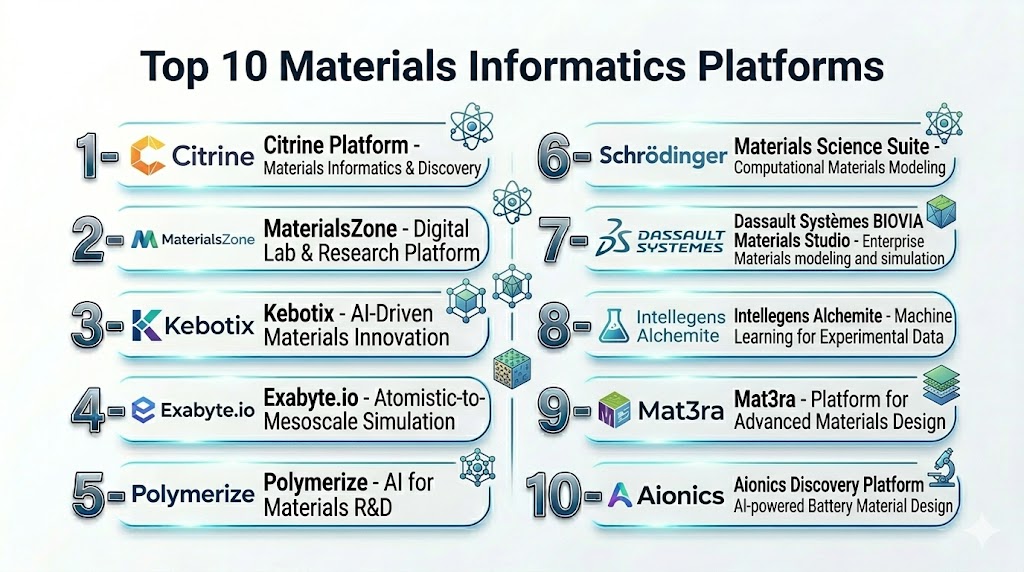
Top 10 Materials Informatics Platforms
#1 — Citrine Platform
Short description: Citrine Platform is a well-known materials informatics solution focused on AI-powered materials and chemicals development. It helps R&D teams organize experimental data, build predictive models, and optimize material formulations. The platform is especially useful for industrial teams working on polymers, chemicals, batteries, and advanced manufacturing materials. It supports faster decision-making by connecting data science with domain expertise.
Key Features
- AI-driven materials property prediction
- Experimental data management
- Formulation optimization workflows
- Materials knowledge graph capabilities
- Collaboration tools for R&D teams
- Model training and deployment support
- Enterprise materials data infrastructure
Pros
- Strong focus on industrial materials R&D
- Useful for formulation and property optimization
- Good fit for enterprise innovation teams
- Supports data-driven decision-making
Cons
- May require clean and structured datasets
- Enterprise implementation can take planning
- Pricing is not publicly simple
- Advanced workflows may need data science support
Platforms / Deployment
- Web
- Cloud
Security & Compliance
- RBAC
- Enterprise access controls
- Not publicly stated for certifications
Integrations & Ecosystem
Citrine can support integration with research data systems, laboratory workflows, and enterprise data environments.
- ELN and LIMS integration potential
- API-based data exchange
- Experimental data pipelines
- Enterprise R&D systems
- Analytics and reporting workflows
Support & Community
Citrine provides enterprise-focused onboarding and support. Community visibility is more vendor-led than open-source driven.
#2 — Materials Studio
Short description: Materials Studio is a molecular modeling and simulation platform used by researchers in chemicals, polymers, catalysts, pharmaceuticals, and advanced materials. It supports atomistic simulation, molecular dynamics, quantum mechanics, and property prediction workflows. The platform is widely used in scientific and industrial research environments. It is best suited for teams needing deep simulation capabilities alongside informatics workflows.
Key Features
- Molecular modeling and simulation
- Quantum mechanics workflows
- Molecular dynamics simulation
- Polymer and crystal modeling
- Catalysis and surface science support
- Materials property prediction
- Visualization and analysis tools
Pros
- Strong scientific modeling capabilities
- Useful for molecular and atomistic research
- Mature research ecosystem
- Good fit for advanced R&D teams
Cons
- Requires scientific expertise
- Not a lightweight informatics platform
- Licensing can be expensive
- Learning curve may be high
Platforms / Deployment
- Windows / Linux
- Desktop / Hybrid
Security & Compliance
- User authentication
- Enterprise controls vary by deployment
- Not publicly stated for certifications
Integrations & Ecosystem
Materials Studio integrates with scientific computing workflows and enterprise research environments.
- Simulation workflows
- Scientific data exports
- HPC environments
- Research reporting tools
- Chemical modeling workflows
Support & Community
Strong documentation and enterprise support are available. It is widely used in academic and industrial research communities.
#3 — Mat3ra
Short description: Mat3ra is a cloud-based materials modeling and informatics platform designed for computational materials research. It helps teams run simulations, organize workflows, and collaborate on materials discovery projects. The platform is useful for researchers working with semiconductors, nanomaterials, batteries, and advanced functional materials. It combines cloud computing with materials modeling workflows.
Key Features
- Cloud-based materials modeling
- Computational workflow automation
- Simulation data management
- Collaboration tools
- Materials structure visualization
- API and scripting support
- Support for high-performance computing workflows
Pros
- Good cloud-native research workflow
- Useful for computational materials teams
- Flexible for custom workflows
- Strong collaboration support
Cons
- Best suited for technical users
- Requires simulation knowledge
- Smaller ecosystem than large enterprise suites
- Advanced workflows may require scripting
Platforms / Deployment
- Web
- Cloud
Security & Compliance
- User authentication
- Access controls
- Not publicly stated for certifications
Integrations & Ecosystem
Mat3ra supports computational materials workflows and connects with scientific modeling environments.
- HPC workflow integration
- API support
- Simulation engines
- Data export tools
- Custom scripting workflows
Support & Community
Support is focused on computational materials users. Documentation and technical guidance are available for modeling workflows.
#4 — Materials Project
Short description: Materials Project is a widely used materials data platform that provides access to computed material properties and discovery datasets. It is especially valuable for researchers who need reference data, screening workflows, and computational insights. While it is not a full commercial enterprise platform, it is highly useful for academic, research, and early-stage discovery work. It helps teams identify promising materials before deeper experimentation.
Key Features
- Large computed materials database
- Crystal structure data
- Material property screening
- API access
- Phase diagram tools
- Battery and electronic materials data
- Research workflow support
Pros
- Strong scientific data foundation
- Useful for early discovery and screening
- API-friendly for researchers
- Valuable for academic and industrial R&D
Cons
- Not a complete enterprise workflow platform
- Limited commercial support
- Requires technical knowledge
- Experimental data management is limited
Platforms / Deployment
- Web
- Cloud
Security & Compliance
- Varies / N/A
Integrations & Ecosystem
Materials Project is commonly used with research scripts, computational workflows, and scientific data pipelines.
- API integrations
- Python workflows
- Computational screening
- Research notebooks
- Data export tools
Support & Community
Strong academic and scientific community support. Enterprise-style onboarding is limited.
#5 — AiiDA
Short description: AiiDA is an open-source workflow and data management platform for computational materials science. It helps researchers automate simulations, track provenance, and manage complex computational workflows. It is especially useful for universities, research labs, and technical teams building custom materials informatics pipelines. AiiDA is powerful but requires technical expertise to implement effectively.
Key Features
- Workflow automation
- Data provenance tracking
- Computational materials support
- Plugin ecosystem
- Reproducible research workflows
- Python-based extensibility
- HPC integration
Pros
- Open-source and flexible
- Strong provenance tracking
- Good for reproducible research
- Highly customizable
Cons
- Requires technical setup
- Not ideal for non-technical users
- Limited commercial-style support
- UI experience may be less polished
Platforms / Deployment
- Linux / macOS
- Self-hosted / Hybrid
Security & Compliance
- Varies / N/A
Integrations & Ecosystem
AiiDA integrates with computational codes, databases, and scientific research environments.
- Python ecosystem
- HPC systems
- Simulation engines
- Plugin-based integrations
- Research databases
Support & Community
Strong open-source and academic community support. Best for technical teams comfortable with scientific computing.
#6 — Schrödinger Materials Science Suite
Short description: Schrödinger Materials Science Suite provides molecular simulation and computational chemistry tools for materials research. It is used in polymers, electronics, energy storage, catalysts, and molecular materials design. The suite helps researchers model molecular behavior, predict properties, and optimize structures. It is best suited for organizations needing advanced simulation combined with scientific informatics.
Key Features
- Molecular simulation tools
- Polymer modeling
- Electronic materials analysis
- Battery and energy materials workflows
- Property prediction
- Visualization and analysis
- Computational chemistry support
Pros
- Strong molecular modeling capabilities
- Useful for advanced materials discovery
- Mature scientific software ecosystem
- Good visualization and analysis tools
Cons
- Requires domain expertise
- Premium licensing model
- Not a simple data management platform
- Advanced workflows may require training
Platforms / Deployment
- Windows / Linux / macOS
- Desktop / Hybrid
Security & Compliance
- User authentication
- Enterprise controls vary by deployment
- Not publicly stated for certifications
Integrations & Ecosystem
Schrödinger supports computational chemistry and molecular modeling workflows across research environments.
- HPC integration
- Scientific computing workflows
- Data exports
- Molecular modeling tools
- API and scripting support
Support & Community
Strong enterprise and scientific support ecosystem with documentation and training resources.
#7 — Kebotix Platform
Short description: Kebotix Platform focuses on AI-driven materials discovery and autonomous lab workflows. It combines machine learning, robotics, computational screening, and experimental planning to accelerate materials innovation. The platform is especially relevant for companies exploring automated R&D and high-throughput discovery. It is best suited for advanced teams ready to modernize materials research pipelines.
Key Features
- AI-based materials discovery
- Autonomous experimentation workflows
- High-throughput screening support
- Computational and experimental data integration
- Predictive modeling
- Research workflow automation
- Closed-loop optimization support
Pros
- Strong automation vision
- Useful for advanced R&D teams
- Supports AI-driven discovery
- Good fit for high-throughput workflows
Cons
- May be too advanced for smaller teams
- Requires structured data and process maturity
- Pricing is not publicly simple
- Implementation may require consulting
Platforms / Deployment
- Web
- Cloud / Hybrid
Security & Compliance
- Access controls
- User authentication
- Not publicly stated for certifications
Integrations & Ecosystem
Kebotix can connect AI models, lab automation workflows, and experimental planning processes.
- Lab automation systems
- Experimental databases
- AI modeling workflows
- API integrations
- High-throughput systems
Support & Community
Support is vendor-driven and suited for advanced research teams. Public community depth is limited.
#8 — Uncountable Platform
Short description: Uncountable Platform is an enterprise R&D data and AI platform used by materials, chemicals, food, and formulation teams. It helps organizations centralize experiments, analyze results, and apply machine learning to product development. The platform is especially useful for formulation-heavy workflows where teams need better data structure and faster iteration. It works well for industrial R&D groups looking to replace spreadsheet-based processes.
Key Features
- R&D data management
- Formulation tracking
- Machine learning analysis
- Experiment planning
- Collaboration workflows
- Searchable knowledge base
- Reporting dashboards
Pros
- Strong for formulation-driven R&D
- Helps reduce spreadsheet dependency
- Good collaboration features
- Useful for industrial product development
Cons
- Not purely materials simulation focused
- Requires data migration effort
- Best value comes with team adoption
- Pricing is not publicly stated
Platforms / Deployment
- Web
- Cloud
Security & Compliance
- User access controls
- Enterprise security features
- Not publicly stated for certifications
Integrations & Ecosystem
Uncountable integrates with research workflows and enterprise R&D systems.
- ELN and lab data workflows
- API-based integrations
- Reporting exports
- Formulation databases
- Enterprise research systems
Support & Community
Enterprise onboarding and vendor support are available. Community is mainly customer and vendor-driven.
#9 — Polymerize
Short description: Polymerize is an AI-powered materials informatics platform focused on polymer and formulation development. It helps R&D teams manage experimental data, predict material properties, and accelerate formulation optimization. The platform is especially useful for coatings, plastics, specialty chemicals, and advanced polymer applications. It is designed for teams that want practical AI support without building everything internally.
Key Features
- Polymer data management
- AI-based property prediction
- Formulation optimization
- Experiment planning
- R&D collaboration tools
- Data visualization dashboards
- Knowledge management
Pros
- Strong polymer-focused workflows
- Practical AI features for R&D teams
- Useful for formulation optimization
- Good fit for chemical manufacturers
Cons
- Less broad than general simulation suites
- Best suited for polymer-heavy use cases
- Data quality strongly affects output
- Public technical depth may vary
Platforms / Deployment
- Web
- Cloud
Security & Compliance
- User authentication
- Access controls
- Not publicly stated for certifications
Integrations & Ecosystem
Polymerize supports materials data workflows and AI-powered research environments.
- Experimental data imports
- R&D workflow systems
- API support
- Analytics exports
- Lab data integration potential
Support & Community
Vendor-led onboarding and support are available. Public community footprint is still developing.
#10 — Citrination
Short description: Citrination is a materials data and AI environment associated with materials informatics workflows and research data-driven discovery. It is useful for organizing materials datasets, building predictive models, and enabling AI-assisted exploration. Teams working on materials discovery, chemicals, and formulation development can use it to connect data with decision-making. It is best suited for research organizations that want informatics-driven materials innovation.
Key Features
- Materials data management
- Machine learning model support
- Property prediction workflows
- Data search and discovery
- Research collaboration
- Dataset structuring
- API-enabled access
Pros
- Useful for materials data science
- Supports predictive research workflows
- Good fit for data-driven R&D
- Helps centralize research knowledge
Cons
- May require data science expertise
- Not a full simulation suite
- Public product details may vary
- Enterprise setup may need planning
Platforms / Deployment
- Web
- Cloud
Security & Compliance
- Access controls
- User authentication
- Not publicly stated for certifications
Integrations & Ecosystem
Citrination-style workflows connect materials datasets, AI models, and research decision systems.
- API support
- Materials datasets
- Analytics workflows
- Research data pipelines
- Model development workflows
Support & Community
Support availability varies by deployment and product package. Enterprise users should validate onboarding and support details before selection.
Comparison Table
| Tool Name | Best For | Platform(s) Supported | Deployment | Standout Feature | Public Rating |
|---|---|---|---|---|---|
| Citrine Platform | Enterprise materials R&D | Web | Cloud | AI-driven materials optimization | N/A |
| Materials Studio | Molecular simulation | Windows, Linux | Desktop, Hybrid | Atomistic modeling workflows | N/A |
| Mat3ra | Computational materials teams | Web | Cloud | Cloud-based simulation workflows | N/A |
| Materials Project | Research data screening | Web | Cloud | Large computed materials database | N/A |
| AiiDA | Open-source research workflows | Linux, macOS | Self-hosted, Hybrid | Provenance-driven workflow automation | N/A |
| Schrödinger Materials Science Suite | Molecular materials design | Windows, Linux, macOS | Desktop, Hybrid | Advanced molecular simulation | N/A |
| Kebotix Platform | Autonomous materials discovery | Web | Cloud, Hybrid | AI and lab automation workflows | N/A |
| Uncountable Platform | Industrial R&D data management | Web | Cloud | Formulation data intelligence | N/A |
| Polymerize | Polymer and formulation R&D | Web | Cloud | Polymer property prediction | N/A |
| Citrination | Materials data science | Web | Cloud | Materials AI model workflows | N/A |
Evaluation & Scoring of Materials Informatics Platforms
| Tool Name | Core 25% | Ease 15% | Integrations 15% | Security 10% | Performance 10% | Support 10% | Value 15% | Weighted Total |
|---|---|---|---|---|---|---|---|---|
| Citrine Platform | 9 | 8 | 8 | 7 | 8 | 8 | 7 | 8.0 |
| Materials Studio | 9 | 6 | 8 | 7 | 9 | 8 | 6 | 7.7 |
| Mat3ra | 8 | 7 | 8 | 7 | 8 | 7 | 7 | 7.5 |
| Materials Project | 7 | 8 | 8 | 6 | 8 | 7 | 9 | 7.6 |
| AiiDA | 8 | 5 | 8 | 5 | 8 | 7 | 9 | 7.2 |
| Schrödinger Materials Science Suite | 9 | 6 | 8 | 7 | 9 | 8 | 6 | 7.7 |
| Kebotix Platform | 8 | 7 | 8 | 7 | 8 | 7 | 7 | 7.6 |
| Uncountable Platform | 8 | 8 | 7 | 7 | 7 | 8 | 8 | 7.7 |
| Polymerize | 8 | 8 | 7 | 7 | 7 | 7 | 8 | 7.6 |
| Citrination | 8 | 7 | 8 | 7 | 8 | 7 | 7 | 7.6 |
These scores are comparative and should be interpreted based on your organization’s research maturity, data readiness, and material domain. Simulation-heavy platforms score higher for modeling depth, while R&D data platforms score better for usability and collaboration. Open-source platforms can provide strong value but may require technical setup and internal expertise. The best choice depends on whether your priority is discovery, simulation, formulation, data management, or enterprise R&D governance.
Which Materials Informatics Platform Is Right for You?
Solo / Freelancer
Solo researchers, consultants, and academic users may prefer Materials Project or AiiDA because they offer strong research value without heavy enterprise licensing. These tools are useful for screening, experimentation, and custom computational workflows. However, they require technical comfort and may not provide polished enterprise support.
SMB
Small and mid-sized R&D teams should consider Polymerize, Uncountable Platform, or Mat3ra depending on their workflow. Polymerize is strong for polymer-focused development, Uncountable is useful for formulation and R&D data organization, and Mat3ra is suitable for computational materials research.
Mid-Market
Mid-market organizations often need a balance of AI, collaboration, simulation, and data governance. Citrine Platform, Uncountable Platform, and Schrödinger Materials Science Suite are strong options depending on whether the team prioritizes informatics, formulation workflows, or molecular modeling.
Enterprise
Large enterprises should prioritize scalable platforms with strong data governance, integration options, enterprise support, and advanced modeling capabilities. Citrine Platform, Materials Studio, Schrödinger Materials Science Suite, and Kebotix Platform are better suited for enterprise-level R&D transformation.
Budget vs Premium
Budget-focused teams may start with Materials Project, AiiDA, or open research workflows before investing in enterprise platforms. Premium tools provide stronger support, collaboration, security controls, and specialized workflows, but they require careful implementation planning.
Feature Depth vs Ease of Use
Highly advanced simulation tools deliver deep scientific capability but may have steep learning curves. R&D data platforms are often easier for cross-functional teams but may not replace deep molecular simulation software. Buyers should match feature depth with user skill level.
Integrations & Scalability
Teams with mature lab environments should prioritize integrations with ELN, LIMS, lab automation, simulation tools, and enterprise data platforms. Scalability becomes important when materials data needs to be reused across multiple research teams and product lines.
Security & Compliance Needs
Enterprise buyers should evaluate RBAC, audit logs, SSO, encryption, data governance, and model access controls. Materials research often involves sensitive intellectual property, so access control and secure collaboration should be part of the buying checklist.
Frequently Asked Questions
1- What is a Materials Informatics Platform?
A Materials Informatics Platform helps teams use data, AI, and computational workflows to discover, design, and optimize materials. It connects experimental results, simulation data, material properties, and machine learning models. These platforms reduce manual trial-and-error and support faster R&D decisions.
2- Who uses Materials Informatics Platforms?
Materials scientists, chemical engineers, battery researchers, polymer scientists, semiconductor teams, and R&D leaders commonly use these platforms. They are also useful for manufacturing companies that need better control over material development, testing, and product innovation workflows.
3- How do these platforms use AI?
They use AI to predict material properties, recommend experiments, optimize formulations, identify promising candidates, and analyze patterns across historical research data. Some platforms also support generative design, autonomous experimentation, and closed-loop optimization.
4- Are Materials Informatics Platforms only for large enterprises?
No, but larger enterprises often benefit most because they have more data, more experiments, and bigger R&D portfolios. Smaller teams can still use open-source tools, research databases, or focused platforms for specific workflows like polymer optimization or computational screening.
5- What data is needed to get value from these tools?
Useful data can include chemical structures, compositions, processing conditions, test results, simulation outputs, experiment notes, and performance properties. Data quality is very important because poor, inconsistent, or incomplete data can reduce model reliability and decision accuracy.
6- Can these platforms replace lab experiments?
No. Materials informatics tools reduce unnecessary experiments and improve experiment planning, but they do not fully replace physical validation. The best results usually come from combining AI prediction, simulation, expert knowledge, and controlled lab testing.
7- What integrations should buyers look for?
Buyers should look for integrations with ELN, LIMS, lab automation tools, simulation software, data warehouses, APIs, and reporting systems. Strong integrations help teams avoid data silos and make research data reusable across projects.
8- What are common mistakes when adopting these platforms?
Common mistakes include starting without clean data, ignoring scientist usability, overestimating AI accuracy, and failing to define measurable R&D goals. Teams should begin with a focused use case, validate model outputs, and expand gradually after proving value.
9- How do pricing models usually work?
Pricing varies by vendor, deployment model, user count, data volume, modules, and enterprise support needs. Some open-source tools are free to use but require internal technical support. Commercial platforms usually use subscription or enterprise licensing models.
10- What alternatives exist to Materials Informatics Platforms?
Alternatives include spreadsheets, ELN systems, LIMS platforms, molecular simulation tools, custom Python workflows, and general-purpose data science platforms. These alternatives may work for narrow needs, but dedicated materials informatics tools are better for integrated discovery and optimization workflows.
Conclusion
Materials Informatics Platforms are becoming essential for organizations that want to accelerate materials discovery, improve R&D productivity, and make better use of scientific data. The best platform depends on whether your team needs AI-driven property prediction, molecular simulation, formulation optimization, experimental data management, or open-source computational workflows. Enterprise teams should focus on governance, integrations, security, and scalability, while smaller teams may prioritize usability, affordability, and fast experimentation. No single tool is the perfect choice for every materials workflow because polymers, batteries, alloys, semiconductors, and molecular materials each require different capabilities. A practical next step is to shortlist two or three platforms, test them with real internal datasets, validate prediction quality, review security controls, and confirm integration fit before scaling across the R&D organization.

Materials informatics platforms are becoming increasingly valuable when they can quantify the confidence of AI-generated predictions rather than simply recommending promising material candidates. R&D teams often need to understand the uncertainty behind predictions before investing in costly experiments or scaling production. Adding discussion around explainable AI, uncertainty estimation, experiment prioritization, and reproducibility would give readers a more practical framework for evaluating platforms that support faster yet scientifically reliable materials innovation.
Materials informatics becomes far more useful when experimental data is captured with enough context to make results reproducible. Material composition alone is rarely sufficient; processing conditions, synthesis methods, measurement techniques, environmental factors, and failed experiments can all influence the outcome. Preserving that metadata allows machine learning models to distinguish meaningful material-property relationships from patterns caused by inconsistent experimental procedures. It also gives researchers a stronger way to validate predictions against historical experiments and decide which new experiments are worth running. Treating experimental provenance as a core part of the data architecture can therefore be just as important as the algorithms used for materials discovery.