Introduction
Dock Scheduling Software helps warehouses, distribution centers, and logistics hubs manage truck arrivals and departures efficiently by assigning time slots to loading and unloading docks. It replaces manual coordination methods like spreadsheets, phone calls, and emails with automated scheduling, real-time visibility, and carrier self-service booking systems.
In modern supply chains, where speed, accuracy, and throughput are critical, dock congestion and poor scheduling can lead to detention costs, delays, and inefficiencies. These platforms improve operational flow by balancing dock capacity, labor availability, and carrier demand in real time.
Real-world use cases include:
- Scheduling inbound and outbound truck appointments
- Reducing dock congestion and wait times
- Improving yard and dock coordination
- Optimizing labor planning for warehouse teams
- Managing carrier communication and compliance
Key evaluation criteria buyers should consider:
- Carrier self-service booking capabilities
- Real-time dock visibility and tracking
- Integration with WMS, TMS, ERP systems
- Rule-based scheduling flexibility
- Analytics and reporting depth
- Multi-site scalability
- Mobile and portal accessibility
- Automation of appointment workflows
- Exception handling and alerts
- Security and access control
Best for: warehouses, 3PL providers, retail distribution centers, e-commerce fulfillment hubs, manufacturing logistics teams, and large supply chain operators.
Not ideal for: very small warehouses with minimal truck traffic or businesses that do not operate structured loading docks.
Key Trends in Dock Scheduling Software
- Carrier self-service portals are reducing manual coordination and improving scheduling efficiency.
- AI-driven scheduling optimization is improving dock utilization and reducing idle time.
- Real-time ETA-based rescheduling is helping handle delays dynamically.
- Integration with WMS and TMS platforms is becoming a standard requirement.
- Cloud-based deployment models are enabling multi-site warehouse coordination.
- Predictive congestion management is reducing peak-hour bottlenecks.
- Mobile-first dock management tools are improving on-floor visibility.
- Automation of detention and compliance tracking is reducing operational penalties.
- Digital yard and dock convergence is creating unified logistics execution platforms.
- Data-driven carrier performance analytics is improving supply chain relationships.
How We Selected These Tools
The tools in this list were selected based on industry adoption, operational capability, scalability, and integration strength.
- Evaluated usage across logistics, retail, manufacturing, and 3PL industries.
- Reviewed dock scheduling automation and rule-based logic capabilities.
- Assessed integration with WMS, TMS, ERP, and yard systems.
- Considered carrier collaboration and self-service functionality.
- Evaluated real-time visibility and scheduling optimization features.
- Reviewed multi-site scalability for enterprise logistics networks.
- Assessed analytics and reporting depth.
- Considered ease of deployment and user adoption.
- Reviewed vendor maturity and logistics domain expertise.
- Evaluated exception handling and operational control capabilities.
Top 10 Dock Scheduling Software Tools
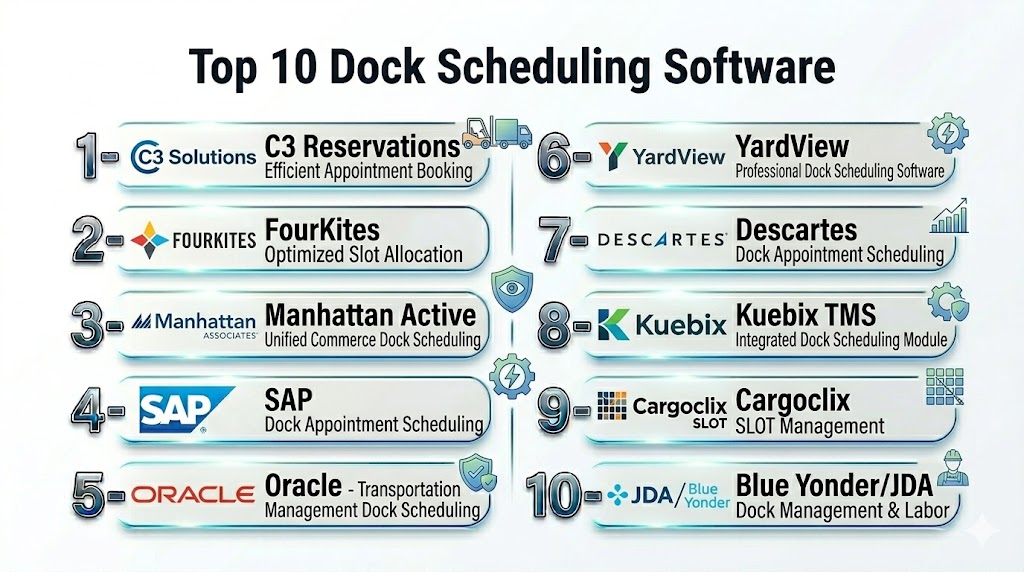
#1 — C3 Reservations (C3 Solutions)
Short description: C3 Reservations is an enterprise dock scheduling platform designed for high-volume distribution centers and logistics operations. It supports advanced rule-based scheduling, carrier self-service, and real-time dock visibility. The platform is widely used in grocery, retail, manufacturing, and 3PL environments where dock congestion management is critical. It helps organizations streamline inbound and outbound logistics operations efficiently.
Key Features
- Rule-based dock scheduling engine
- Carrier self-service booking portal
- Real-time dock visibility
- Appointment automation workflows
- Exception and delay management
- KPI dashboards and analytics
- Multi-site scheduling support
Pros
- Strong enterprise scalability
- Highly configurable scheduling rules
- Excellent carrier collaboration
- Proven logistics adoption
Cons
- Complex implementation for smaller teams
- Higher enterprise cost structure
- Requires onboarding effort
- Best suited for large operations
Platforms / Deployment
- Web
- Cloud
Security & Compliance
- RBAC
- SSO
- Audit logging
- Encryption
Integrations & Ecosystem
C3 integrates with warehouse systems, transportation platforms, and enterprise logistics tools.
- WMS integration
- TMS systems
- ERP platforms
- API-based workflows
- Logistics analytics tools
Support & Community
Strong enterprise logistics support with implementation consulting and global deployment experience.
#2 — Descartes Dock Appointment Scheduling
Short description: Descartes Dock Appointment Scheduling is a collaborative logistics platform that enables shippers, carriers, and consignees to manage dock appointments efficiently. It provides real-time scheduling, carrier collaboration, and network-wide visibility across logistics operations. The platform is widely used in global supply chain networks requiring coordinated dock management.
Key Features
- Online dock appointment booking
- Carrier collaboration tools
- Real-time scheduling updates
- Automated appointment validation
- Logistics network integration
- Exception management workflows
- Performance analytics
Pros
- Strong global logistics ecosystem
- Good carrier collaboration tools
- Reliable enterprise scalability
- Strong integration capabilities
Cons
- Best value within Descartes ecosystem
- Enterprise onboarding required
- Interface may feel complex
- Configuration effort needed
Platforms / Deployment
- Web
- Cloud
Security & Compliance
- Encryption
- SSO
- Role-based access
- Audit logging
Integrations & Ecosystem
Descartes integrates with logistics networks, WMS, TMS, and supply chain platforms.
- Global logistics network
- WMS systems
- Transportation systems
- ERP integrations
- API frameworks
Support & Community
Strong enterprise logistics support with global implementation services.
#3 — FourKites Dock Scheduling
Short description: FourKites provides dock scheduling capabilities as part of its real-time supply chain visibility platform. It enables predictive scheduling, ETA-based adjustments, and intelligent dock planning. The platform is widely used in logistics-intensive industries requiring real-time shipment visibility and optimization.
Key Features
- Predictive dock scheduling
- Real-time ETA updates
- Carrier visibility tools
- AI-driven congestion insights
- Logistics performance analytics
- Exception tracking
- Network-wide coordination
Pros
- Excellent real-time visibility
- Strong predictive capabilities
- Advanced AI analytics
- Good supply chain intelligence
Cons
- Premium pricing model
- Requires data maturity
- Complex setup for small teams
- Best suited for large enterprises
Platforms / Deployment
- Web
- Cloud
Security & Compliance
- RBAC
- MFA
- Encryption
- Audit logging
Integrations & Ecosystem
FourKites integrates with transportation, warehouse, and logistics systems.
- TMS platforms
- WMS systems
- IoT tracking systems
- ERP integration
- API-based workflows
Support & Community
Strong enterprise logistics analytics support with global implementation teams.
#4 — Manhattan Associates Dock Scheduling
Short description: Manhattan Associates Dock Scheduling is part of a broader supply chain execution suite designed for warehouse and logistics optimization. It provides dock appointment scheduling, labor synchronization, and real-time operational visibility. The platform is widely used in retail and distribution environments requiring enterprise-grade warehouse management.
Key Features
- Dock appointment scheduling
- Labor synchronization tools
- Carrier management
- Rule-based scheduling engine
- Real-time visibility dashboards
- WMS integration
- Performance analytics
Pros
- Strong WMS integration
- Enterprise-grade reliability
- Good operational visibility
- Scalable logistics platform
Cons
- Complex implementation process
- High enterprise cost
- Requires technical expertise
- Best for Manhattan ecosystem users
Platforms / Deployment
- Web
- Cloud / Hybrid
Security & Compliance
- RBAC
- MFA
- Audit logging
- Encryption
Integrations & Ecosystem
Manhattan integrates with warehouse and supply chain execution systems.
- WMS systems
- ERP platforms
- Transportation systems
- Logistics analytics tools
- API integrations
Support & Community
Strong enterprise logistics support with global supply chain expertise.
#5 — Oracle Dock Scheduling
Short description: Oracle Dock Scheduling is part of Oracle’s supply chain execution suite, enabling dock appointment planning, carrier coordination, and warehouse optimization. It is designed for enterprise logistics operations that require tight ERP integration and scalable supply chain visibility. The platform supports global logistics planning and execution workflows.
Key Features
- Dock appointment scheduling
- ERP-integrated workflows
- Capacity planning tools
- Carrier coordination
- Real-time tracking
- Analytics dashboards
- Exception handling
Pros
- Strong ERP integration
- Good enterprise scalability
- Reliable analytics tools
- Global supply chain support
Cons
- Best suited for Oracle ecosystem users
- Complex configuration
- High implementation cost
- Requires training
Platforms / Deployment
- Web
- Cloud
Security & Compliance
- SSO
- MFA
- RBAC
- Encryption
Integrations & Ecosystem
Oracle integrates with ERP, warehouse, and supply chain platforms.
- Oracle ERP
- WMS systems
- Supply chain tools
- API frameworks
- Analytics platforms
Support & Community
Strong enterprise support ecosystem with global logistics consulting services.
#6 — Opendock
Short description: Opendock is a cloud-based dock scheduling platform designed to simplify warehouse appointment booking for carriers and logistics providers. It enables self-service scheduling, real-time visibility, and reduced manual coordination. The platform is widely used in distribution centers and logistics networks focused on efficiency and automation.
Key Features
- Carrier self-service booking
- Real-time appointment visibility
- Multi-warehouse scheduling
- Dock availability management
- Automated notifications
- Performance tracking
- Reporting dashboards
Pros
- Easy to deploy and use
- Strong carrier adoption
- Good visibility features
- Reduces manual scheduling workload
Cons
- Less advanced enterprise customization
- Limited deep optimization features
- Best suited for mid-market
- Advanced analytics may vary
Platforms / Deployment
- Web
- Cloud
Security & Compliance
- RBAC
- Authentication controls
- Encryption
Integrations & Ecosystem
Opendock integrates with warehouse systems and logistics tools.
- WMS systems
- Carrier platforms
- ERP systems
- API integrations
- Reporting tools
Support & Community
Good customer support and onboarding resources for logistics teams.
#7 — GoRamp Dock Scheduling
Short description: GoRamp is a dock scheduling and yard management platform that improves logistics coordination and warehouse efficiency. It enables carriers to book appointments online and helps warehouses manage dock capacity in real time. The platform is widely used in distribution, manufacturing, and logistics operations.
Key Features
- Online appointment booking
- Yard and dock coordination
- Real-time scheduling updates
- Carrier communication tools
- Dock capacity management
- Analytics dashboards
- Exception handling
Pros
- Strong yard and dock integration
- Good real-time visibility
- Easy carrier collaboration
- Useful for mid-market logistics
Cons
- Smaller ecosystem than top enterprise tools
- Advanced customization may vary
- Best fit depends on scale
- Requires integration setup
Platforms / Deployment
- Web
- Cloud
Security & Compliance
- RBAC
- MFA
- Encryption
- Audit logging
Integrations & Ecosystem
GoRamp integrates with logistics systems and warehouse platforms.
- WMS systems
- ERP tools
- Carrier systems
- API integrations
- Logistics dashboards
Support & Community
Good logistics-focused support and onboarding assistance.
#8 — Extensiv Dock Scheduling
Short description: Extensiv Dock Scheduling is part of the 3PL Warehouse Manager ecosystem designed for third-party logistics providers. It helps manage dock appointments, improve warehouse throughput, and reduce operational bottlenecks. The platform is widely used in 3PL and fulfillment environments.
Key Features
- Dock appointment scheduling
- 3PL warehouse integration
- Real-time tracking
- Carrier communication tools
- Performance analytics
- Task automation
- Reporting dashboards
Pros
- Strong 3PL focus
- Good warehouse integration
- Useful operational visibility
- Easy to deploy for logistics providers
Cons
- Best for 3PL environments
- Limited enterprise customization
- Requires ecosystem adoption
- Advanced features vary
Platforms / Deployment
- Web
- Cloud
Security & Compliance
- RBAC
- Authentication controls
- Encryption
Integrations & Ecosystem
Extensiv integrates with warehouse, ERP, and logistics systems.
- WMS systems
- ERP tools
- Logistics platforms
- API integrations
- Reporting systems
Support & Community
Strong 3PL-focused support ecosystem with logistics expertise.
#9 — SAP Dock Appointment Scheduling
Short description: SAP Dock Appointment Scheduling enables enterprises to manage loading and unloading appointments efficiently within SAP warehouse environments. It helps coordinate warehouse workload, reduce congestion, and improve carrier planning. The platform is widely used in SAP-centric enterprise logistics operations.
Key Features
- Dock appointment scheduling
- Warehouse workload planning
- Carrier coordination
- SAP EWM integration
- Real-time scheduling visibility
- Operational dashboards
- Capacity management
Pros
- Strong SAP integration
- Reliable enterprise workflows
- Good operational visibility
- Scalable global deployment
Cons
- Best suited for SAP users
- Complex setup process
- Requires configuration expertise
- High enterprise cost
Platforms / Deployment
- Web
- Cloud / Hybrid
Security & Compliance
- SSO
- MFA
- RBAC
- Audit logging
Integrations & Ecosystem
SAP integrates deeply with ERP and warehouse systems.
- SAP ERP
- SAP EWM
- Logistics systems
- API frameworks
- Analytics tools
Support & Community
Strong global enterprise support ecosystem with SAP partners.
#10 — DockMaster
Short description: DockMaster provides dock appointment scheduling and real-time visibility tools for warehouse and logistics operations. It helps manage carrier scheduling, reduce detention, and improve dock efficiency. The platform is suitable for mid-market logistics and distribution environments.
Key Features
- Carrier self-scheduling
- Dock appointment tracking
- Real-time visibility
- Reporting dashboards
- Automated scheduling tools
- Load management support
- Exception handling
Pros
- Easy to use interface
- Good mid-market fit
- Useful scheduling automation
- Improves dock efficiency
Cons
- Smaller ecosystem
- Limited enterprise depth
- Advanced features vary
- Integration scope may differ
Platforms / Deployment
- Web
- Cloud
Security & Compliance
- RBAC
- Authentication controls
- Encryption
Integrations & Ecosystem
DockMaster integrates with warehouse and logistics systems.
- WMS systems
- ERP platforms
- Carrier systems
- API integrations
- Reporting tools
Support & Community
Good mid-market logistics support and onboarding assistance.
Comparison Table
| Tool Name | Best For | Platform(s) Supported | Deployment | Standout Feature | Public Rating |
|---|---|---|---|---|---|
| C3 Reservations | Enterprise dock scheduling | Web | Cloud | Rule-based scheduling engine | N/A |
| Descartes Dock Scheduling | Global logistics networks | Web | Cloud | Carrier collaboration network | N/A |
| FourKites | Real-time supply chain visibility | Web | Cloud | Predictive dock scheduling | N/A |
| Manhattan Associates | Enterprise warehouse ops | Web | Cloud / Hybrid | Integrated WMS scheduling | N/A |
| Oracle Dock Scheduling | ERP-driven enterprises | Web | Cloud | ERP-native integration | N/A |
| Opendock | Mid-market warehouses | Web | Cloud | Carrier self-service booking | N/A |
| GoRamp | Logistics coordination | Web | Cloud | Yard + dock visibility | N/A |
| Extensiv | 3PL operations | Web | Cloud | 3PL warehouse integration | N/A |
| SAP Dock Scheduling | SAP enterprise users | Web | Cloud / Hybrid | SAP EWM integration | N/A |
| DockMaster | Mid-market logistics | Web | Cloud | Simple scheduling automation | N/A |
Evaluation & Scoring of Dock Scheduling Software
| Tool Name | Core 25% | Ease 15% | Integrations 15% | Security 10% | Performance 10% | Support 10% | Value 15% | Weighted Total |
|---|---|---|---|---|---|---|---|---|
| C3 Reservations | 9 | 7 | 9 | 9 | 9 | 9 | 7 | 8.4 |
| Descartes | 9 | 7 | 9 | 9 | 9 | 9 | 7 | 8.4 |
| FourKites | 9 | 7 | 9 | 9 | 9 | 8 | 7 | 8.3 |
| Manhattan | 9 | 7 | 9 | 9 | 9 | 9 | 7 | 8.4 |
| Oracle | 8 | 7 | 9 | 9 | 8 | 8 | 7 | 8.0 |
| Opendock | 8 | 8 | 8 | 8 | 8 | 8 | 8 | 8.0 |
| GoRamp | 7 | 8 | 7 | 7 | 8 | 7 | 8 | 7.4 |
| Extensiv | 7 | 8 | 7 | 7 | 7 | 7 | 8 | 7.3 |
| SAP | 8 | 7 | 10 | 9 | 8 | 9 | 7 | 8.2 |
| DockMaster | 7 | 8 | 7 | 7 | 7 | 7 | 8 | 7.2 |
These scores reflect how well each platform performs across scheduling automation, integration depth, and enterprise readiness. Large enterprise platforms generally score higher in integration and scalability, while mid-market tools score better in ease of use and faster deployment. The right choice depends on operational complexity, warehouse volume, and ecosystem alignment.
Which Dock Scheduling Software Is Right for You?
Solo / Freelancer
Not typically required, but consultants or logistics planners may use lightweight tools like Opendock or DockMaster for small-scale scheduling needs.
SMB
Small and mid-sized warehouses should focus on ease of use, fast setup, and carrier adoption. Opendock, GoRamp, and DockMaster are strong starting points.
Mid-Market
Mid-market logistics operations benefit from a balance of automation and scalability. GoRamp, Extensiv, and FourKites offer strong operational visibility and scheduling efficiency.
Enterprise
Large logistics networks and global supply chains require deep integration, automation, and analytics. C3 Reservations, Manhattan Associates, SAP, Oracle, and Descartes are best suited for enterprise-scale dock operations.
Budget vs Premium
Budget tools offer quick deployment and basic scheduling efficiency, while premium platforms provide AI optimization, deep integrations, and enterprise-grade governance.
Feature Depth vs Ease of Use
Advanced systems provide optimization, predictive scheduling, and analytics but require setup and training. Simpler systems prioritize usability and fast adoption.
Integrations & Scalability
Organizations should prioritize integration with WMS, TMS, ERP, and yard management systems. Scalability is critical for multi-site logistics operations.
Security & Compliance Needs
Enterprise buyers should ensure RBAC, MFA, audit logging, encryption, and secure API integrations for operational data protection.
Frequently Asked Questions
1- What is Dock Scheduling Software?
Dock Scheduling Software is a system that helps warehouses manage truck arrivals and departures by assigning time slots for loading and unloading operations. It reduces congestion and improves efficiency.
2- Why is dock scheduling important?
It helps reduce truck waiting times, improves dock utilization, lowers detention costs, and ensures smoother warehouse operations.
3- How does dock scheduling work?
Carriers or logistics teams book time slots for dock access through a portal, and the system manages scheduling rules, capacity, and real-time updates.
4- What industries use dock scheduling tools?
Retail, e-commerce, manufacturing, 3PL logistics, food distribution, automotive, and pharmaceutical industries commonly use dock scheduling systems.
5- Do these tools integrate with WMS systems?
Yes, most modern dock scheduling platforms integrate with WMS, TMS, and ERP systems to ensure seamless warehouse coordination.
6- Can dock scheduling reduce costs?
Yes, it reduces detention fees, idle time, labor inefficiencies, and operational bottlenecks, leading to significant cost savings.
7- Are these tools cloud-based?
Most modern dock scheduling platforms are cloud-based, with some offering hybrid deployment for enterprise environments.
8- What is carrier self-service scheduling?
It allows carriers to independently book and manage dock appointments through an online portal, reducing manual coordination.
9- What are common challenges in adoption?
Challenges include carrier onboarding, integration with legacy systems, change management, and operational alignment.
10- How do companies measure ROI?
ROI is measured through reduced wait times, improved dock throughput, lower detention charges, and better labor utilization.
Conclusion
Dock Scheduling Software plays a critical role in modern logistics by transforming chaotic dock operations into structured, efficient, and predictable workflows. These platforms improve carrier coordination, reduce congestion, and optimize warehouse performance through automation and real-time visibility. Enterprise solutions deliver deep integration and advanced optimization, while mid-market and SMB tools focus on usability and rapid deployment. The best solution depends on warehouse size, shipment volume, integration needs, and operational maturity. A practical approach is to shortlist a few tools, run pilot deployments, validate carrier adoption, and measure operational improvements before scaling across the supply chain network.

A well-written comparison of dock scheduling software—really helpful for understanding how these tools improve warehouse coordination, reduce delays, and streamline logistics operations.