Introduction
Adversarial Robustness Testing Tools help organizations evaluate how machine learning and AI models behave under malicious, unexpected, manipulated, or adversarial inputs. These tools simulate attacks against AI systems to identify vulnerabilities, model weaknesses, evasion risks, prompt injection exposure, data poisoning issues, and unsafe behaviors before models are deployed into production.
As AI systems become increasingly important in cybersecurity, finance, healthcare, autonomous systems, fraud detection, customer support, and generative AI applications, adversarial robustness has become a major priority for enterprise AI governance. Attackers can manipulate AI models through crafted inputs, misleading prompts, poisoned datasets, or inference attacks, making proactive robustness testing critical for secure AI deployment.
Common real-world use cases include:
- Testing AI models against adversarial attacks
- Evaluating LLM prompt injection risks
- Securing computer vision systems
- Validating AI model resilience
- Supporting responsible AI and governance programs
Key evaluation criteria for buyers include:
- Adversarial attack coverage
- Model evaluation depth
- LLM security testing support
- Automation and scalability
- Integration with MLOps workflows
- Reporting and explainability
- Security and governance controls
- Multi-model compatibility
- Red teaming capabilities
- Enterprise deployment flexibility
Best for: AI security teams, machine learning engineers, cybersecurity teams, AI governance leaders, enterprise AI programs, autonomous systems teams, financial services organizations, and businesses deploying production AI systems.
Not ideal for: Organizations running only basic non-production AI experiments or teams without security, governance, or production AI concerns.
Key Trends in Adversarial Robustness Testing Tools
- Generative AI security testing is becoming a major enterprise requirement.
- Prompt injection testing is increasingly important for LLM deployments.
- AI red teaming workflows are expanding rapidly across enterprises.
- Automated adversarial attack simulation is improving scalability.
- AI governance platforms are integrating robustness testing capabilities.
- Multi-modal AI testing is becoming more common for vision and audio systems.
- Security-focused MLOps pipelines are growing rapidly.
- Continuous AI evaluation is replacing one-time model validation.
- AI safety regulations are increasing demand for robustness auditing.
- Open-source adversarial testing frameworks continue to drive research innovation.
How We Selected These Tools
The platforms in this list were selected based on adversarial testing capabilities, enterprise adoption, AI security coverage, scalability, and integration maturity.
Evaluation factors included:
- Breadth of attack simulation capabilities
- AI and LLM security testing support
- Model evaluation and robustness workflows
- Automation and scalability
- Enterprise security features
- Integration with AI and MLOps ecosystems
- Visualization and reporting quality
- Open-source and enterprise flexibility
- Governance and compliance support
- Support quality and ecosystem maturity
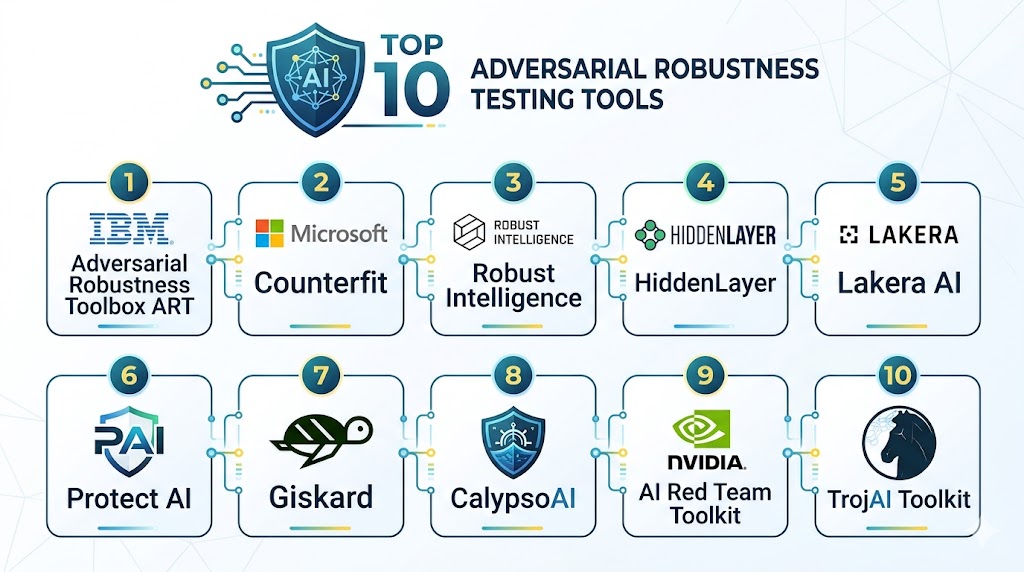
Top 10 Adversarial Robustness Testing Tools
1- IBM Adversarial Robustness Toolbox
Short Description:
IBM Adversarial Robustness Toolbox is one of the most widely used open-source AI security testing frameworks for evaluating machine learning model resilience. It supports adversarial attacks, poisoning simulations, evasion testing, and defense techniques across multiple AI model types and frameworks.
Key Features
- Adversarial attack simulation
- Evasion and poisoning attacks
- Model robustness evaluation
- Defense mechanism testing
- Multi-framework compatibility
- Security benchmarking
- Open-source extensibility
Pros
- Strong AI security research adoption
- Broad attack coverage
- Supports many ML frameworks
- Strong open-source ecosystem
Cons
- Requires AI security expertise
- Technical implementation complexity
- Limited enterprise governance features
- Setup and tuning may take effort
Platforms / Deployment
Self-hosted / Hybrid
Security & Compliance
Varies / Not publicly stated
Integrations & Ecosystem
IBM ART integrates with machine learning frameworks, notebooks, and AI development workflows. It is widely used in research, experimentation, and enterprise AI security validation.
- TensorFlow
- PyTorch
- scikit-learn
- Keras
- Python
- Jupyter notebooks
Support & Community
Strong open-source community, active AI security research adoption, and extensive documentation.
2- Microsoft Counterfit
Short Description:
Microsoft Counterfit is an open-source adversarial AI testing framework designed to automate AI security assessments. It helps organizations simulate attacks against machine learning systems and evaluate model resilience in production and development environments.
Key Features
- Automated adversarial testing
- AI attack orchestration
- Security assessment workflows
- Attack simulation library
- Extensible plugin architecture
- Model evaluation support
- Security-focused automation
Pros
- Strong automation capabilities
- Useful AI red teaming workflows
- Open-source flexibility
- Good security testing focus
Cons
- Requires security expertise
- Enterprise governance is limited
- Operational setup may be complex
- Smaller ecosystem than general ML tools
Platforms / Deployment
Self-hosted / Hybrid
Security & Compliance
Varies / Not publicly stated
Integrations & Ecosystem
Counterfit integrates with AI frameworks, testing workflows, and security validation pipelines.
- Python
- TensorFlow
- PyTorch
- Azure ML
- APIs
- AI development workflows
Support & Community
Growing AI security community with Microsoft ecosystem support.
3- Lakera Guard
Short Description:
Lakera Guard is an AI security platform focused heavily on generative AI protection, prompt injection detection, jailbreak prevention, and LLM robustness testing. It helps enterprises secure AI applications against malicious prompts and unsafe model interactions.
Key Features
- Prompt injection detection
- LLM security testing
- AI application protection
- Jailbreak prevention
- Real-time threat analysis
- AI safety controls
- Security policy enforcement
Pros
- Strong generative AI security focus
- Useful prompt injection protection
- Good real-time monitoring capabilities
- Enterprise AI safety orientation
Cons
- Primarily focused on LLM security
- Less suitable for traditional ML testing
- Enterprise pricing may be high
- Newer ecosystem compared to older AI tooling
Platforms / Deployment
Cloud / Hybrid
Security & Compliance
RBAC, encryption, audit logging, enterprise access controls, and governance support.
Integrations & Ecosystem
Lakera Guard integrates with LLM applications, APIs, AI gateways, and enterprise AI deployment systems.
- OpenAI ecosystems
- APIs
- LLM platforms
- AI gateways
- Cloud infrastructure
- Enterprise AI applications
Support & Community
Growing enterprise AI security ecosystem with onboarding and support resources.
4- Robust Intelligence
Short Description:
Robust Intelligence is an enterprise AI firewall and robustness testing platform designed to protect machine learning and generative AI systems from adversarial threats, unsafe outputs, and model vulnerabilities.
Key Features
- AI firewall functionality
- Adversarial robustness testing
- Prompt security validation
- Policy enforcement workflows
- AI risk monitoring
- Real-time inference protection
- Enterprise governance support
Pros
- Strong enterprise AI security capabilities
- Useful production AI protection
- Good governance and compliance support
- Supports generative AI security workflows
Cons
- Enterprise-focused pricing
- Advanced deployment complexity
- Smaller open-source community
- Requires security and AI maturity
Platforms / Deployment
Cloud / Hybrid
Security & Compliance
SSO, RBAC, encryption, audit logging, governance controls, and enterprise-grade security support.
Integrations & Ecosystem
Robust Intelligence integrates with AI deployment systems, cloud infrastructure, APIs, and enterprise security workflows.
- Cloud platforms
- APIs
- MLOps systems
- AI deployment pipelines
- LLM applications
- Security monitoring systems
Support & Community
Strong enterprise support and AI governance-focused onboarding.
5- Protect AI
Short Description:
Protect AI is an AI security platform focused on securing machine learning pipelines, models, datasets, and AI infrastructure. It provides vulnerability detection, model scanning, governance workflows, and adversarial risk analysis for enterprise AI systems.
Key Features
- AI vulnerability scanning
- Model security analysis
- Pipeline risk detection
- AI governance support
- Security posture monitoring
- Threat analysis workflows
- Enterprise AI protection
Pros
- Strong AI security posture focus
- Useful governance capabilities
- Broad AI pipeline coverage
- Good enterprise integration potential
Cons
- Requires mature AI infrastructure
- Enterprise implementation complexity
- Some workflows require onboarding support
- Pricing may not fit smaller teams
Platforms / Deployment
Cloud / Hybrid
Security & Compliance
SSO, RBAC, encryption, audit logging, and enterprise governance controls.
Integrations & Ecosystem
Protect AI integrates with machine learning pipelines, model registries, cloud platforms, and AI deployment workflows.
- Kubernetes
- Cloud infrastructure
- ML pipelines
- APIs
- AI model registries
- Enterprise security tools
Support & Community
Strong enterprise AI security focus with growing adoption.
6- HiddenLayer
Short Description:
HiddenLayer is an AI security platform designed to monitor, protect, and test machine learning models against adversarial attacks and inference risks. It focuses heavily on runtime AI protection and enterprise AI security operations.
Key Features
- Adversarial threat detection
- Model runtime protection
- AI security monitoring
- Threat intelligence workflows
- Attack surface analysis
- Real-time alerting
- Enterprise AI defense controls
Pros
- Strong runtime AI protection
- Good enterprise security workflows
- Useful threat monitoring capabilities
- Supports production AI environments
Cons
- Enterprise-focused architecture
- Advanced deployment requirements
- Smaller ecosystem than broader MLOps platforms
- Premium pricing model
Platforms / Deployment
Cloud / Hybrid
Security & Compliance
SSO, RBAC, encryption, audit logging, and enterprise-grade security features.
Integrations & Ecosystem
HiddenLayer integrates with enterprise AI systems, cloud infrastructure, and security monitoring workflows.
- APIs
- Cloud platforms
- SIEM systems
- MLOps pipelines
- AI deployment systems
- Monitoring platforms
Support & Community
Enterprise support model with growing AI security ecosystem presence.
7- CalypsoAI
Short Description:
CalypsoAI provides AI security and red teaming capabilities focused on adversarial robustness testing, model evaluation, and AI governance. It helps organizations identify AI vulnerabilities before production deployment.
Key Features
- AI red teaming workflows
- Adversarial testing automation
- Model evaluation support
- AI governance workflows
- Threat simulation
- Security monitoring
- Risk analysis dashboards
Pros
- Strong AI red teaming focus
- Useful governance capabilities
- Good adversarial simulation support
- Enterprise AI security orientation
Cons
- Enterprise deployment complexity
- Smaller community ecosystem
- Requires AI security expertise
- Advanced integrations may require support
Platforms / Deployment
Cloud / Hybrid
Security & Compliance
RBAC, encryption, audit logging, SSO, and enterprise security controls.
Integrations & Ecosystem
CalypsoAI integrates with AI pipelines, enterprise infrastructure, and security operations workflows.
- APIs
- AI deployment systems
- Cloud infrastructure
- Governance platforms
- Security tooling
- MLOps workflows
Support & Community
Enterprise support and AI governance-focused onboarding resources.
8- Garak
Short Description:
Garak is an open-source LLM vulnerability scanning and adversarial testing framework designed to identify weaknesses, prompt injection exposure, and unsafe behavior in generative AI systems.
Key Features
- LLM vulnerability scanning
- Prompt injection testing
- Adversarial prompt generation
- Security benchmarking
- AI behavior evaluation
- Open-source extensibility
- Automated test workflows
Pros
- Strong LLM security testing
- Open-source flexibility
- Useful prompt attack simulations
- Good AI red teaming capabilities
Cons
- Requires technical expertise
- Limited enterprise governance features
- Operational setup can be technical
- Smaller ecosystem compared to mainstream ML tooling
Platforms / Deployment
Self-hosted / Hybrid
Security & Compliance
Varies / Not publicly stated
Integrations & Ecosystem
Garak integrates with LLM APIs, AI evaluation pipelines, and generative AI testing environments.
- OpenAI ecosystems
- Hugging Face
- APIs
- Python
- LLM frameworks
- AI testing workflows
Support & Community
Growing open-source AI security community with active experimentation usage.
9- Promptfoo
Short Description:
Promptfoo is an open-source AI testing framework designed for evaluating prompts, LLM outputs, safety behavior, and adversarial robustness in generative AI systems. It supports automated testing and benchmarking workflows.
Key Features
- Prompt evaluation workflows
- LLM testing automation
- Adversarial prompt simulation
- Benchmarking support
- Safety validation workflows
- Regression testing
- CI/CD integration support
Pros
- Strong LLM evaluation workflows
- Good developer usability
- Open-source flexibility
- Useful automated testing support
Cons
- Focused mostly on LLM workflows
- Enterprise governance limited
- Requires developer expertise
- Smaller enterprise ecosystem
Platforms / Deployment
Cloud / Self-hosted / Hybrid
Security & Compliance
Authentication integration and deployment-dependent security controls.
Integrations & Ecosystem
Promptfoo integrates with LLM APIs, CI/CD pipelines, testing frameworks, and AI development workflows.
- OpenAI
- Anthropic
- APIs
- GitHub Actions
- CI/CD systems
- AI evaluation pipelines
Support & Community
Active AI developer community with growing generative AI adoption.
10- NVIDIA NeMo Guardrails
Short Description:
NVIDIA NeMo Guardrails is a framework for controlling, testing, and securing conversational AI and generative AI systems. It helps enforce safety policies, reduce unsafe outputs, and improve LLM robustness in enterprise AI deployments.
Key Features
- Conversational AI guardrails
- LLM safety workflows
- Policy enforcement
- Prompt management
- AI interaction controls
- Security validation
- Enterprise AI deployment support
Pros
- Strong generative AI control capabilities
- Useful enterprise AI governance support
- Good conversational AI focus
- Flexible deployment options
Cons
- Requires LLM workflow expertise
- Less focused on traditional ML adversarial testing
- Setup may require engineering support
- Advanced customization can be complex
Platforms / Deployment
Cloud / Self-hosted / Hybrid
Security & Compliance
RBAC, encryption, authentication integration, and enterprise governance support.
Integrations & Ecosystem
NeMo Guardrails integrates with NVIDIA AI systems, LLM frameworks, APIs, and enterprise conversational AI deployments.
- NVIDIA AI ecosystem
- APIs
- LLM platforms
- Conversational AI systems
- Cloud platforms
- AI deployment workflows
Support & Community
Growing AI safety ecosystem with NVIDIA enterprise support resources.
Comparison Table
| Tool Name | Best For | Platform(s) Supported | Deployment | Standout Feature | Public Rating |
|---|---|---|---|---|---|
| IBM ART | Open-source adversarial testing | Python / Linux | Self-hosted / Hybrid | Broad adversarial attack coverage | N/A |
| Microsoft Counterfit | Automated AI security testing | Python / Cloud | Self-hosted / Hybrid | AI attack orchestration | N/A |
| Lakera Guard | LLM security testing | Web / Cloud | Cloud / Hybrid | Prompt injection protection | N/A |
| Robust Intelligence | Enterprise AI firewall | Web / Cloud | Cloud / Hybrid | Production AI protection | N/A |
| Protect AI | AI pipeline security | Web / Cloud | Cloud / Hybrid | Model vulnerability scanning | N/A |
| HiddenLayer | Runtime AI defense | Web / Cloud | Cloud / Hybrid | AI threat monitoring | N/A |
| CalypsoAI | AI red teaming | Web / Cloud | Cloud / Hybrid | Adversarial simulation workflows | N/A |
| Garak | Open-source LLM testing | Python / Linux | Self-hosted / Hybrid | LLM vulnerability scanning | N/A |
| Promptfoo | LLM evaluation automation | Web / Cloud | Cloud / Hybrid | Prompt testing workflows | N/A |
| NVIDIA NeMo Guardrails | Conversational AI safety | Cloud / Linux | Cloud / Hybrid | AI guardrail enforcement | N/A |
Evaluation & Scoring of Adversarial Robustness Testing Tools
| Tool Name | Core | Ease | Integrations | Security | Performance | Support | Value | Weighted Total |
|---|---|---|---|---|---|---|---|---|
| IBM ART | 9 | 6 | 8 | 6 | 8 | 8 | 10 | 7.9 |
| Microsoft Counterfit | 8 | 7 | 8 | 7 | 8 | 7 | 9 | 7.8 |
| Lakera Guard | 8 | 8 | 8 | 9 | 8 | 8 | 7 | 8.0 |
| Robust Intelligence | 9 | 7 | 8 | 9 | 9 | 9 | 6 | 8.2 |
| Protect AI | 8 | 7 | 8 | 9 | 8 | 8 | 7 | 7.9 |
| HiddenLayer | 8 | 7 | 8 | 9 | 8 | 8 | 7 | 7.9 |
| CalypsoAI | 8 | 7 | 7 | 8 | 8 | 8 | 7 | 7.7 |
| Garak | 8 | 7 | 7 | 6 | 7 | 7 | 10 | 7.6 |
| Promptfoo | 8 | 8 | 8 | 6 | 7 | 8 | 9 | 7.9 |
| NVIDIA NeMo Guardrails | 8 | 7 | 8 | 8 | 8 | 8 | 8 | 7.9 |
These scores are comparative and intended to help organizations evaluate adversarial robustness tooling across attack simulation depth, usability, integrations, governance, scalability, security, support, and value. The best tool depends heavily on whether the organization is securing traditional machine learning systems, generative AI applications, LLMs, or enterprise AI infrastructure.
Which Adversarial Robustness Testing Tool Is Right for You?
Solo / Freelancer
Independent researchers and developers often benefit from open-source tools such as IBM ART, Garak, Promptfoo, and Microsoft Counterfit. These tools provide flexibility for experimentation, adversarial testing, and AI security research without requiring enterprise infrastructure.
SMB
SMBs should prioritize usability, manageable deployment complexity, and automation support. Promptfoo, Lakera Guard, Microsoft Counterfit, and NVIDIA NeMo Guardrails are practical options for teams building generative AI applications or lightweight AI systems.
Mid-Market
Mid-market organizations usually require AI testing automation, governance visibility, and scalable monitoring. Robust Intelligence, Protect AI, Lakera Guard, and HiddenLayer are strong choices for organizations deploying customer-facing AI applications and production ML systems.
Enterprise
Large enterprises should focus heavily on AI governance, runtime protection, AI red teaming, security integration, and compliance support. Robust Intelligence, HiddenLayer, Protect AI, CalypsoAI, and Lakera Guard are strong enterprise-ready platforms for AI security operations.
Budget vs Premium
Open-source frameworks such as IBM ART, Garak, Promptfoo, and Microsoft Counterfit reduce licensing costs but require more engineering expertise. Enterprise AI security platforms provide stronger governance, support, dashboards, and operational automation but increase ownership cost.
Feature Depth vs Ease of Use
IBM ART and Microsoft Counterfit provide deep adversarial testing capabilities for technical users, while Lakera Guard and Robust Intelligence focus more on enterprise workflows and production AI security usability.
Integrations & Scalability
Organizations deploying AI at scale should prioritize platforms with integration support for MLOps pipelines, APIs, cloud infrastructure, security systems, and AI deployment frameworks. Runtime protection and continuous monitoring are increasingly important for production AI systems.
Security & Compliance Needs
Regulated industries should evaluate audit logging, encryption, RBAC, governance workflows, AI policy controls, model monitoring, and reporting capabilities carefully before selecting a platform.
Frequently Asked Questions
1. What are Adversarial Robustness Testing Tools?
Adversarial Robustness Testing Tools help organizations evaluate how AI and machine learning models behave under malicious, manipulated, or unexpected inputs. These tools simulate attacks, unsafe prompts, data poisoning, and evasion techniques to identify weaknesses in AI systems. They are important for AI security, governance, and reliability.
2. Why is adversarial testing important for AI systems?
AI models can behave unpredictably when exposed to crafted inputs or malicious prompts. Adversarial testing helps organizations identify vulnerabilities before attackers exploit them in production environments. This improves AI trustworthiness, resilience, and operational safety.
3. What types of attacks do these tools simulate?
These platforms can simulate evasion attacks, prompt injection attacks, jailbreak attempts, adversarial examples, model extraction attacks, poisoning attacks, and unsafe output generation. The exact attack coverage depends on the tool and AI model type being tested.
4. Are adversarial testing tools only for generative AI?
No, adversarial testing applies to both traditional machine learning and generative AI systems. Computer vision models, fraud detection systems, recommendation engines, and NLP models all benefit from robustness testing. However, generative AI has increased demand for prompt-focused security testing.
5. Which tools are best for LLM security testing?
Lakera Guard, Garak, Promptfoo, Robust Intelligence, and NVIDIA NeMo Guardrails are especially strong for generative AI and LLM robustness workflows. These platforms focus heavily on prompt injection, jailbreak prevention, and conversational AI safety.
6. Are open-source adversarial testing frameworks enterprise-ready?
Open-source frameworks such as IBM ART, Microsoft Counterfit, Garak, and Promptfoo are widely used in research and experimentation. Enterprises can use them successfully, but they often require additional operational tooling, governance workflows, and security integration for production environments.
7. What security features should organizations prioritize?
Organizations should evaluate RBAC, encryption, audit logging, runtime monitoring, AI policy enforcement, threat detection, governance workflows, and integration with existing security infrastructure. Production AI systems should also support continuous monitoring and alerting.
8. Can adversarial robustness testing improve AI governance?
Yes, robustness testing helps organizations understand AI risk exposure, validate model behavior, and support responsible AI governance programs. It provides evidence that AI systems have been evaluated for safety, reliability, and resilience before deployment.
9. What are common mistakes when implementing AI robustness testing?
Common mistakes include testing only once before deployment, ignoring prompt injection risks, focusing only on accuracy metrics, neglecting runtime monitoring, and failing to integrate AI security into MLOps workflows. Robustness testing should be continuous and integrated into the AI lifecycle.
10. How should organizations evaluate adversarial robustness platforms?
Organizations should begin with pilot testing against real AI workloads and realistic attack scenarios. Buyers should validate attack coverage, automation quality, integration depth, governance features, scalability, and operational complexity before selecting a platform.
Conclusion
Adversarial Robustness Testing Tools are becoming essential for organizations deploying AI and generative AI systems in production environments. As AI adoption grows across finance, healthcare, cybersecurity, customer experience, and enterprise automation, businesses must ensure that models remain resilient against manipulation, unsafe prompts, and adversarial attacks. IBM Adversarial Robustness Toolbox and Microsoft Counterfit remain strong open-source choices for technical AI security testing, while Lakera Guard, Robust Intelligence, HiddenLayer, and Protect AI focus heavily on enterprise AI security operations and runtime protection. Promptfoo, Garak, and NVIDIA NeMo Guardrails are especially relevant for organizations building generative AI and LLM-based applications. The best platform depends on AI maturity, deployment scale, governance requirements, threat exposure, team expertise, and budget priorities. Organizations should shortlist multiple tools, run realistic attack simulations, validate AI monitoring workflows, review governance and reporting capabilities, and choose the solution that best supports long-term AI security and resilience.

This article provides a clear and practical overview of adversarial robustness testing tools with well-structured comparisons. The way each tool is explained makes it easier to understand their real-world use and differences.
This article clearly explains adversarial robustness testing tools and how they help strengthen the reliability and security of machine learning systems.
Valuable comparison guide examining adversarial robustness testing tools and how they help strengthen AI models against attacks, manipulation, and unexpected behavior.