Introduction
Knowledge Base Software is a tool that helps organizations create, manage, and share information in a centralized, searchable system. It acts as a single source of truth where teams and customers can find answers, documentation, FAQs, and guides without needing direct support.
In simple terms, it’s like a digital library for your business—organized, searchable, and always accessible. These systems improve efficiency by reducing repetitive questions and helping users find answers quickly.
As businesses scale, managing knowledge becomes critical. Modern knowledge base tools now include AI-powered search, automation, and collaboration features to make information retrieval faster and smarter.
Why it matters now
- Customers prefer self-service support
- Teams need centralized documentation
- Faster onboarding and training are essential
- Reducing support costs is a priority
- AI is transforming how knowledge is accessed
Common use cases
- Customer help centers and FAQs
- Internal company documentation and SOPs
- Product documentation and API guides
- Employee onboarding and training
- IT and support knowledge management
What buyers should evaluate
- Ease of content creation and editing
- Search functionality and AI capabilities
- Internal vs external knowledge base support
- Integration with support tools (CRM, helpdesk)
- Collaboration and workflow features
- Scalability and performance
- Access control and permissions
- Analytics and reporting
- Deployment options (cloud or self-hosted)
Best for: Customer support teams, SaaS companies, IT teams, startups, and enterprises managing large volumes of documentation.
Not ideal for: Very small teams with minimal documentation needs or businesses that only require basic file storage tools.
Key Trends in Knowledge Base Software
- AI-powered search and suggestions: Faster and more accurate content retrieval
- Self-service customer support: Reducing reliance on support teams
- Integration with chatbots: Automated responses powered by knowledge bases
- Cloud-first platforms: Easy deployment and scalability
- Content collaboration workflows: Multiple contributors and approval systems
- Analytics-driven optimization: Tracking what users search and read
- Headless knowledge bases: API-driven content delivery
- Personalized knowledge delivery: Tailored content based on user roles
- Automation of documentation: AI-assisted content creation and updates
How We Selected These Tools (Methodology)
- Market adoption and brand recognition
- Feature completeness (editing, search, workflows)
- Ease of use for both technical and non-technical users
- Integration capabilities with support and CRM tools
- Scalability for growing organizations
- Security and access control features
- Performance and reliability
- Community and support ecosystem
- Suitability across different business sizes
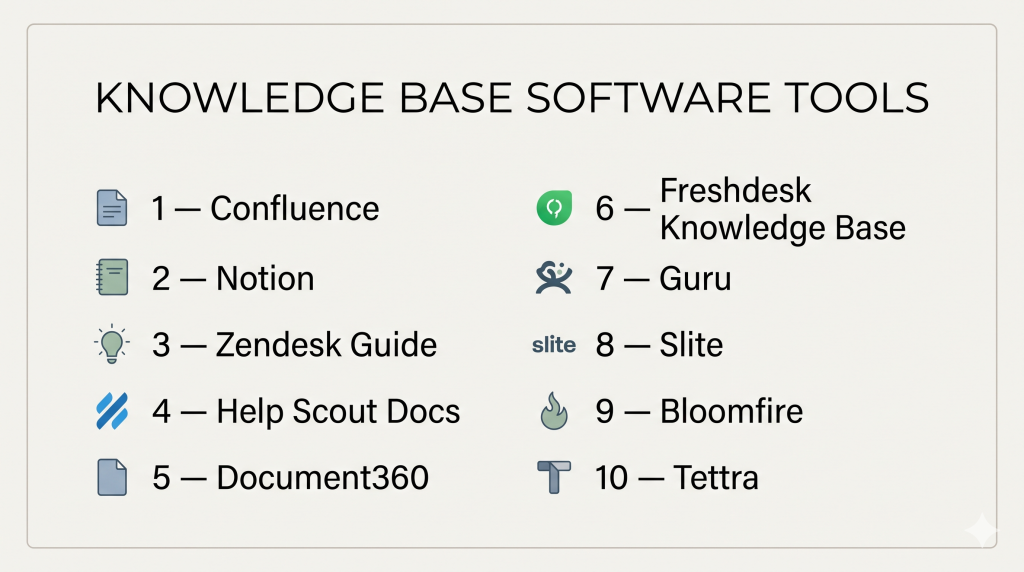
Top 10 Knowledge Base Software Tools
#1 — Confluence
Short description: A popular team collaboration and knowledge base tool widely used for internal documentation.
Key Features
- Collaborative editing
- Page hierarchy and organization
- Templates for documentation
- Integration with project tools
- Version control
- Search functionality
Pros
- Strong collaboration features
- Flexible content structure
- Widely adopted
Cons
- Can become cluttered
- Learning curve for new users
Platforms / Deployment
Web
Cloud / Self-hosted
Security & Compliance
SSO, RBAC
Varies / Not publicly stated
Integrations & Ecosystem
Strong ecosystem for team workflows.
- Project management tools
- APIs
- Developer tools
Support & Community
Large community and strong documentation.
#2 — Notion
Short description: A flexible workspace tool used for internal knowledge bases, documentation, and collaboration.
Key Features
- Drag-and-drop editor
- Databases and pages
- Collaboration tools
- Templates
- Cross-platform support
- Content organization
Pros
- Easy to use
- Highly flexible
- Great UI
Cons
- Limited advanced workflows
- Performance issues with large data
Platforms / Deployment
Web / Windows / macOS / Mobile
Cloud
Security & Compliance
Varies / Not publicly stated
Integrations & Ecosystem
- APIs
- Productivity tools
- Integrations
Support & Community
Strong community and learning resources.
#3 — Zendesk Guide
Short description: A customer-facing knowledge base solution integrated with support ticketing.
Key Features
- Help center creation
- AI-powered suggestions
- Integration with ticketing system
- Content management
- Analytics
- Multi-language support
Pros
- Strong customer support features
- Good automation
- Scalable
Cons
- Pricing can be high
- Requires setup
Platforms / Deployment
Web
Cloud
Security & Compliance
Varies / Not publicly stated
Integrations & Ecosystem
- CRM tools
- Support systems
- APIs
Support & Community
Strong enterprise support.
#4 — Help Scout Docs
Short description: A simple and user-friendly knowledge base tool focused on customer support.
Key Features
- Easy content creation
- Search functionality
- Custom branding
- Analytics
- Help center integration
- Collaboration tools
Pros
- Very easy to use
- Clean interface
- Quick setup
Cons
- Limited advanced features
- Not ideal for complex workflows
Platforms / Deployment
Web
Cloud
Security & Compliance
Varies / Not publicly stated
Integrations & Ecosystem
- Support tools
- APIs
- Business apps
Support & Community
Good support resources.
#5 — Document360
Short description: A dedicated knowledge base platform for creating customer-facing documentation and help centers.
Key Features
- Markdown editor
- Version control
- Category manager
- Analytics
- AI-powered search
- Multi-language support
Pros
- Feature-rich
- Good for documentation
- Scalable
Cons
- Pricing varies
- Requires setup
Platforms / Deployment
Web
Cloud
Security & Compliance
Varies / Not publicly stated
Integrations & Ecosystem
- APIs
- Analytics tools
- Support systems
Support & Community
Strong documentation and support.
#6 — Freshdesk Knowledge Base
Short description: A knowledge base solution integrated within the Freshdesk support platform.
Key Features
- Help center creation
- Ticket integration
- Automation
- Multi-language support
- Analytics
- Role-based access
Pros
- Integrated support system
- Easy to use
- Scalable
Cons
- Limited standalone usage
- Pricing tiers vary
Platforms / Deployment
Web
Cloud
Security & Compliance
Varies / Not publicly stated
Integrations & Ecosystem
- CRM
- Support tools
- APIs
Support & Community
Strong support ecosystem.
#7 — Guru
Short description: A knowledge management platform focused on delivering knowledge within workflows.
Key Features
- AI-powered search
- Browser extensions
- Knowledge verification
- Content organization
- Integrations
- Analytics
Pros
- Great for internal teams
- Easy access to knowledge
- Strong integrations
Cons
- Limited external knowledge base features
- Pricing varies
Platforms / Deployment
Web
Cloud
Security & Compliance
Varies / Not publicly stated
Integrations & Ecosystem
- Collaboration tools
- APIs
- Business apps
Support & Community
Good support and onboarding.
#8 — Slite
Short description: A lightweight documentation and knowledge base tool for teams.
Key Features
- Document editor
- Collaboration tools
- Templates
- Search functionality
- Team workspaces
- Content organization
Pros
- Simple and clean UI
- Easy collaboration
- Quick setup
Cons
- Limited advanced features
- Smaller ecosystem
Platforms / Deployment
Web / Desktop
Cloud
Security & Compliance
Varies / Not publicly stated
Integrations & Ecosystem
- APIs
- Productivity tools
Support & Community
Growing community.
#9 — Bloomfire
Short description: A knowledge sharing platform focused on enterprise collaboration and insights.
Key Features
- Content indexing
- AI-powered search
- Analytics
- Collaboration tools
- Media support
- Content management
Pros
- Strong search capabilities
- Good analytics
- Scalable
Cons
- Enterprise-focused
- Pricing varies
Platforms / Deployment
Web
Cloud
Security & Compliance
Varies / Not publicly stated
Integrations & Ecosystem
- APIs
- Business tools
- Analytics platforms
Support & Community
Enterprise-level support.
#10 — Tettra
Short description: A simple internal knowledge base tool designed for teams using Slack and collaboration tools.
Key Features
- Knowledge sharing
- Slack integration
- Content templates
- Search functionality
- Content verification
- Team collaboration
Pros
- Easy to use
- Great for internal teams
- Good integrations
Cons
- Limited advanced features
- Not ideal for external knowledge bases
Platforms / Deployment
Web
Cloud
Security & Compliance
Varies / Not publicly stated
Integrations & Ecosystem
- Slack
- APIs
- Productivity tools
Support & Community
Good support and onboarding.
Comparison Table (Top 10)
| Tool Name | Best For | Platform(s) Supported | Deployment | Standout Feature | Public Rating |
|---|---|---|---|---|---|
| Confluence | Internal teams | Web | Hybrid | Collaboration | N/A |
| Notion | All users | Web, Mobile | Cloud | Flexibility | N/A |
| Zendesk Guide | Customer support | Web | Cloud | Help center | N/A |
| Help Scout Docs | SMB support | Web | Cloud | Simplicity | N/A |
| Document360 | Documentation | Web | Cloud | AI search | N/A |
| Freshdesk | Support teams | Web | Cloud | Ticket integration | N/A |
| Guru | Internal knowledge | Web | Cloud | Workflow integration | N/A |
| Slite | Small teams | Web | Cloud | Simplicity | N/A |
| Bloomfire | Enterprise | Web | Cloud | Analytics | N/A |
| Tettra | Internal teams | Web | Cloud | Slack integration | N/A |
Evaluation & Scoring of Knowledge Base Software
| Tool Name | Core (25%) | Ease (15%) | Integrations (15%) | Security (10%) | Performance (10%) | Support (10%) | Value (15%) | Weighted Total |
|---|---|---|---|---|---|---|---|---|
| Confluence | 9 | 7 | 9 | 8 | 8 | 9 | 8 | 8.4 |
| Notion | 8 | 9 | 8 | 7 | 7 | 8 | 9 | 8.2 |
| Zendesk Guide | 9 | 8 | 9 | 8 | 8 | 9 | 7 | 8.5 |
| Help Scout | 7 | 9 | 7 | 7 | 7 | 8 | 8 | 7.8 |
| Document360 | 9 | 8 | 8 | 8 | 8 | 8 | 7 | 8.2 |
| Freshdesk | 8 | 8 | 8 | 7 | 8 | 8 | 7 | 8.0 |
| Guru | 8 | 8 | 9 | 7 | 8 | 8 | 7 | 8.0 |
| Slite | 7 | 9 | 7 | 7 | 7 | 7 | 8 | 7.7 |
| Bloomfire | 8 | 7 | 8 | 8 | 8 | 8 | 7 | 8.0 |
| Tettra | 7 | 8 | 7 | 7 | 7 | 7 | 8 | 7.6 |
How to interpret scores:
- Scores are relative comparisons across tools
- Higher scores indicate stronger overall capabilities
- Enterprise tools score higher in integrations and scalability
- Simpler tools score higher in ease of use and value
Which Knowledge Base Software Tool Is Right for You?
Solo / Freelancer
- Best: Notion, Slite
- Focus on simplicity and flexibility
SMB
- Best: Help Scout Docs, Document360
- Balance ease of use with support features
Mid-Market
- Best: Guru, Freshdesk
- Need integrations and scalability
Enterprise
- Best: Confluence, Zendesk Guide, Bloomfire
- Focus on performance, integrations, and security
Budget vs Premium
- Budget: Notion, Slite
- Premium: Zendesk, Bloomfire
Feature Depth vs Ease of Use
- Advanced: Confluence, Zendesk
- Easy: Notion, Help Scout
Integrations & Scalability
- Best: Zendesk, Guru
Security & Compliance Needs
- High: Confluence, Zendesk
- Standard: Notion, Slite
Frequently Asked Questions (FAQs)
What is knowledge base software?
It is a tool that centralizes and organizes information for easy access and sharing.
What is the difference between internal and external knowledge bases?
Internal is for employees; external is for customers.
Why is knowledge base software important?
It improves efficiency and reduces repetitive queries.
Can knowledge base software reduce support tickets?
Yes, self-service content helps users find answers quickly.
Is it suitable for small businesses?
Yes, many tools are designed for SMBs.
Does it support collaboration?
Yes, most tools allow multiple contributors.
Is AI used in knowledge bases?
Yes, for search, suggestions, and automation.
Can it integrate with CRM tools?
Yes, many tools support integrations.
What are common mistakes?
Poor organization and outdated content.
Is it secure?
Security depends on the platform and configuration.
Conclusion
Knowledge Base Software is essential for modern organizations looking to scale efficiently, improve customer support, and centralize knowledge. From simple documentation tools to advanced enterprise platforms, there’s a solution for every need.
