Introduction
AdTech platforms are software solutions designed to help businesses plan, execute, manage, and optimize digital advertising campaigns across channels such as display, search, social media, and video. These platforms bring together data, automation, and media buying into a single system, enabling marketers to reach targeted audiences with measurable precision.
AdTech has become increasingly important as privacy regulations tighten, third-party cookies decline, and AI-driven targeting becomes the norm. Businesses now rely heavily on first-party data and intelligent automation to maintain performance and efficiency in their advertising strategies.
Real-world use cases include:
- Running programmatic ad campaigns across multiple ad exchanges
- Retargeting users based on behavior and engagement signals
- Optimizing ad spend using AI-driven bidding strategies
- Managing omnichannel campaigns across web, mobile, and video
- Tracking and attributing conversions across complex customer journeys
What buyers should evaluate:
- Targeting and segmentation capabilities
- AI and automation features
- Data privacy and compliance readiness
- Integration with analytics and CRM systems
- Reporting and attribution models
- Ease of use and onboarding
- Pricing structure and scalability
- Performance and reliability
- Support for cookieless advertising
- Cross-channel campaign management
Best for: Marketing teams, digital advertisers, agencies, SaaS companies, eCommerce brands, and enterprises managing large-scale advertising operations.
Not ideal for: Very small businesses with minimal ad budgets or organizations focused purely on organic growth strategies.
Key Trends in AdTech Platforms
- AI-first campaign optimization: Automated bidding, targeting, and creative generation using machine learning
- Cookieless targeting approaches: Shift toward contextual advertising and first-party data strategies
- Privacy-centric infrastructure: Built-in compliance with global data protection regulations
- Growth of connected TV advertising: Expansion of ad placements across streaming platforms
- Retail media ecosystems: Brands advertising within eCommerce marketplaces
- Unified data platforms: Integration with customer data platforms and data clean rooms
- Omnichannel orchestration: Managing campaigns across multiple digital channels in one interface
- Real-time analytics and forecasting: Faster insights with predictive performance models
- API-first architectures: Flexible integrations and custom workflows
- Performance-based pricing models: Increasing adoption of outcome-driven pricing structures
How We Selected These Tools (Methodology)
The platforms in this list were selected using a structured evaluation approach:
- Market adoption and overall industry presence
- Breadth and depth of core advertising features
- Performance and scalability under high campaign loads
- Signals around security, privacy, and compliance readiness
- Integration capabilities with broader marketing ecosystems
- Suitability across different business sizes and industries
- Innovation in AI and automation features
- Support for modern channels like mobile, video, and connected TV
- Developer flexibility through APIs and customization
- Overall value compared to cost and complexity
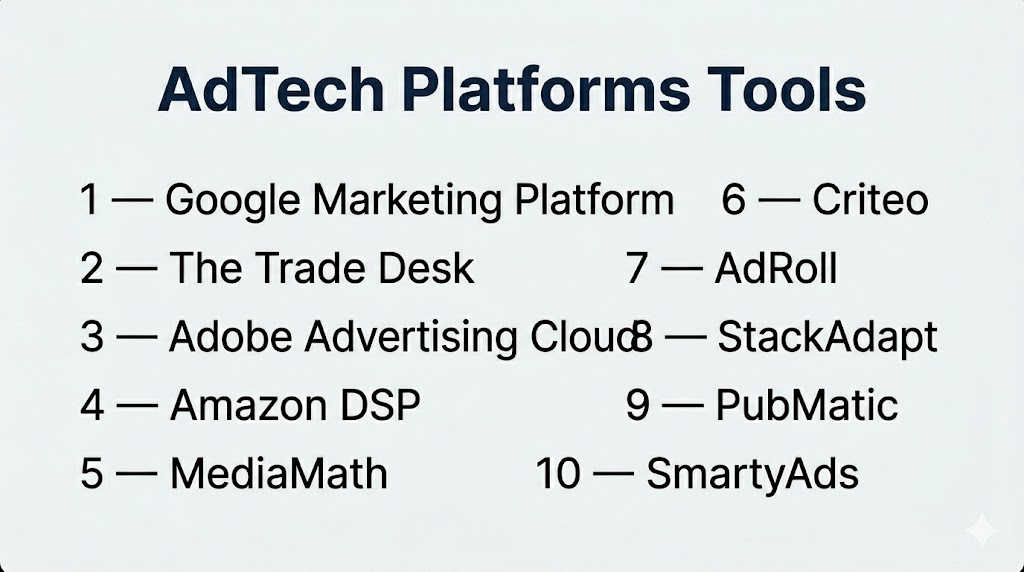
Top 10 AdTech Platforms Tools
#1 — Google Marketing Platform
Short description: A comprehensive suite combining analytics, ad serving, and campaign management tools. Best suited for enterprises and advanced marketing teams.
Key Features
- Integrated analytics and campaign tracking
- Programmatic ad buying
- Cross-channel campaign management
- Advanced attribution modeling
- Audience segmentation
- Real-time reporting
- AI-driven bidding
Pros
- Deep ecosystem integration
- Strong analytics capabilities
- Scales efficiently for large campaigns
Cons
- Complex setup and configuration
- High learning curve
- Pricing not transparent
Platforms / Deployment
Cloud (Web-based)
Security & Compliance
SSO, encryption, GDPR compliance; others Not publicly stated
Integrations & Ecosystem
Strong integration with advertising and analytics ecosystems.
- Analytics platforms
- CRM systems
- Data warehouses
- Advertising tools
Support & Community
Extensive documentation, enterprise-grade support, and a large global user base.
#2 — The Trade Desk
Short description: A leading demand-side platform focused on programmatic advertising and data-driven audience targeting.
Key Features
- Omnichannel ad buying
- Advanced audience segmentation
- Real-time bidding engine
- Data marketplace access
- AI-driven optimization
- Transparent reporting
Pros
- High transparency in reporting
- Strong programmatic capabilities
- Access to premium data sources
Cons
- Requires experienced users
- Enterprise-level pricing
Platforms / Deployment
Cloud
Security & Compliance
GDPR compliance; others Not publicly stated
Integrations & Ecosystem
Integrates with major data providers and ad exchanges.
- Data management platforms
- Supply-side platforms
- Analytics tools
Support & Community
Enterprise-level support with strong industry credibility.
#3 — Adobe Advertising Cloud
Short description: A unified advertising platform within the Adobe ecosystem, designed for managing campaigns across channels.
Key Features
- Cross-channel campaign management
- AI-powered optimization
- Integration with creative workflows
- Advanced reporting tools
- Audience targeting and segmentation
Pros
- Strong integration with creative tools
- Scalable for large organizations
- Advanced analytics capabilities
Cons
- High cost of ownership
- Complex onboarding process
Platforms / Deployment
Cloud
Security & Compliance
SSO, encryption; others Not publicly stated
Integrations & Ecosystem
Deep integration within Adobe’s ecosystem.
- Analytics tools
- Content management systems
- CRM platforms
Support & Community
Comprehensive documentation and enterprise support options.
#4 — Amazon DSP
Short description: A programmatic advertising platform that enables advertisers to reach audiences using commerce data.
Key Features
- Audience targeting based on shopping behavior
- Display and video advertising
- Cross-device tracking
- Real-time performance analytics
- Retail media capabilities
Pros
- Access to high-quality purchase intent data
- Strong performance for eCommerce campaigns
- Scalable advertising reach
Cons
- Limited flexibility outside its ecosystem
- Requires specialized knowledge
Platforms / Deployment
Cloud
Security & Compliance
Not publicly stated
Integrations & Ecosystem
Primarily integrated within its own ecosystem.
- Analytics tools
- Data providers
Support & Community
Support varies; enterprise users receive priority assistance.
#5 — MediaMath
Short description: A programmatic advertising platform focused on transparency, control, and customization.
Key Features
- Demand-side platform capabilities
- Real-time bidding
- Audience targeting tools
- Data management features
- AI optimization
Pros
- Transparent pricing structure
- Flexible campaign configuration
Cons
- Steep learning curve
- Less suitable for smaller teams
Platforms / Deployment
Cloud
Security & Compliance
Not publicly stated
Integrations & Ecosystem
Supports integrations with various ad tech components.
- Data providers
- Ad exchanges
- APIs
Support & Community
Varies / Not publicly stated
#6 — Criteo
Short description: A performance marketing platform specializing in retargeting and commerce-driven advertising.
Key Features
- Dynamic retargeting
- AI-based product recommendations
- Retail media capabilities
- Conversion tracking
- Cross-device targeting
Pros
- Strong retargeting performance
- Relatively easy to deploy
Cons
- Limited full-funnel capabilities
- Costs can scale quickly
Platforms / Deployment
Cloud
Security & Compliance
GDPR compliance; others Not publicly stated
Integrations & Ecosystem
Works well with commerce-focused tools.
- eCommerce platforms
- Analytics tools
- CRM systems
Support & Community
Good documentation and onboarding support.
#7 — AdRoll
Short description: A user-friendly advertising platform designed for small to mid-sized businesses.
Key Features
- Retargeting campaigns
- Audience segmentation
- Cross-channel advertising
- Email marketing integration
- Performance analytics
Pros
- Easy to use interface
- Affordable entry point
Cons
- Limited advanced features
- Not ideal for large-scale campaigns
Platforms / Deployment
Cloud
Security & Compliance
Not publicly stated
Integrations & Ecosystem
Integrates with common marketing tools.
- eCommerce platforms
- Email marketing tools
- CRM systems
Support & Community
Accessible support and beginner-friendly documentation.
#8 — StackAdapt
Short description: A modern demand-side platform focused on native advertising and AI-driven optimization.
Key Features
- Native and programmatic ads
- AI optimization engine
- Real-time reporting
- Audience targeting tools
- Multi-channel support
Pros
- Intuitive user interface
- Strong AI capabilities
Cons
- Limited enterprise depth
- Pricing transparency issues
Platforms / Deployment
Cloud
Security & Compliance
Not publicly stated
Integrations & Ecosystem
Flexible integration options.
- Data providers
- Analytics tools
- APIs
Support & Community
Responsive support with a growing user community.
#9 — PubMatic
Short description: A supply-side platform that helps publishers maximize revenue from their ad inventory.
Key Features
- Inventory management
- Real-time bidding
- Yield optimization
- Analytics dashboard
- Header bidding support
Pros
- Strong publisher monetization tools
- High performance infrastructure
Cons
- Not designed for advertisers
- Requires technical expertise
Platforms / Deployment
Cloud
Security & Compliance
Not publicly stated
Integrations & Ecosystem
Designed for publisher-side integrations.
- Ad exchanges
- Supply-side platforms
- APIs
Support & Community
Enterprise support with technical documentation.
#10 — SmartyAds
Short description: A full-stack AdTech platform offering end-to-end advertising solutions including DSP and SSP capabilities.
Key Features
- Full-stack advertising solution
- Real-time bidding engine
- White-label capabilities
- Campaign analytics
- Cross-channel support
Pros
- Flexible deployment options
- Suitable for custom solutions
Cons
- Lower market visibility
- Complexity for new users
Platforms / Deployment
Cloud / Hybrid
Security & Compliance
Not publicly stated
Integrations & Ecosystem
Offers extensibility through APIs and integrations.
- Ad exchanges
- Data providers
- Custom integrations
Support & Community
Varies / Not publicly stated
Comparison Table (Top 10)
| Tool Name | Best For | Platform(s) Supported | Deployment | Standout Feature | Public Rating |
|---|---|---|---|---|---|
| Google Marketing Platform | Enterprises | Web | Cloud | Unified analytics and ads | N/A |
| The Trade Desk | Programmatic advertising | Web | Cloud | Advanced DSP capabilities | N/A |
| Adobe Advertising Cloud | Enterprises | Web | Cloud | Creative integration | N/A |
| Amazon DSP | eCommerce brands | Web | Cloud | Commerce data targeting | N/A |
| MediaMath | Advanced advertisers | Web | Cloud | Transparent programmatic | N/A |
| Criteo | Retargeting | Web | Cloud | Commerce media focus | N/A |
| AdRoll | SMBs | Web | Cloud | Ease of use | N/A |
| StackAdapt | Modern marketers | Web | Cloud | AI-driven optimization | N/A |
| PubMatic | Publishers | Web | Cloud | SSP monetization | N/A |
| SmartyAds | Custom solutions | Web | Cloud/Hybrid | Full-stack platform | N/A |
Evaluation & Scoring of AdTech Platforms
| Tool Name | Core (25%) | Ease (15%) | Integrations (15%) | Security (10%) | Performance (10%) | Support (10%) | Value (15%) | Weighted Total |
|---|---|---|---|---|---|---|---|---|
| Google Marketing Platform | 9 | 6 | 9 | 8 | 9 | 8 | 7 | 8.1 |
| The Trade Desk | 9 | 6 | 9 | 7 | 9 | 8 | 7 | 8.0 |
| Adobe Advertising Cloud | 9 | 5 | 9 | 8 | 9 | 8 | 6 | 7.9 |
| Amazon DSP | 8 | 6 | 8 | 6 | 9 | 7 | 7 | 7.6 |
| MediaMath | 8 | 5 | 8 | 6 | 8 | 6 | 7 | 7.2 |
| Criteo | 7 | 8 | 7 | 6 | 8 | 7 | 7 | 7.3 |
| AdRoll | 6 | 9 | 7 | 5 | 7 | 7 | 8 | 7.2 |
| StackAdapt | 8 | 8 | 7 | 6 | 8 | 7 | 7 | 7.6 |
| PubMatic | 7 | 5 | 8 | 6 | 8 | 6 | 7 | 7.0 |
| SmartyAds | 7 | 6 | 7 | 6 | 7 | 6 | 7 | 6.9 |
How to interpret scores:
- Scores are comparative within this list, not absolute benchmarks
- Higher scores indicate a better balance of capability and usability
- Enterprise tools rank higher in features but lower in ease of use
- SMB tools prioritize usability over depth
- Always align tool choice with your specific needs
Which AdTech Platforms Tool Is Right for You?
Solo / Freelancer
- Best options: AdRoll, Criteo
- Focus on simplicity and quick deployment
- Avoid complex programmatic platforms
SMB
- Best options: AdRoll, StackAdapt
- Look for cost efficiency and automation
- Prioritize ease of integration
Mid-Market
- Best options: StackAdapt, MediaMath
- Balance between control and usability
- Require better analytics and targeting
Enterprise
- Best options: Google Marketing Platform, Adobe Advertising Cloud, The Trade Desk
- Need scalability, compliance, and deep analytics
- Dedicated teams required for management
Budget vs Premium
- Budget-friendly: AdRoll, Criteo
- Premium solutions: Adobe, Google, The Trade Desk
Feature Depth vs Ease of Use
- Feature-rich: Google Marketing Platform, Adobe
- Easy to use: AdRoll, StackAdapt
Integrations & Scalability
- Strongest ecosystems: Google, Adobe, The Trade Desk
- Moderate flexibility: StackAdapt, Criteo
Security & Compliance Needs
- Enterprise tools are better suited for regulated industries
- Smaller tools may lack detailed compliance transparency
Frequently Asked Questions (FAQs)
What is an AdTech platform?
An AdTech platform is software used to manage, optimize, and measure digital advertising campaigns across multiple channels.
How do these platforms charge?
They typically use subscription fees, percentage of ad spend, or performance-based pricing models.
Are they suitable for beginners?
Some platforms are beginner-friendly, but many require experience with digital advertising concepts.
What is programmatic advertising?
It refers to automated buying and selling of ad space using real-time bidding systems.
How important is AI in AdTech?
AI plays a central role in targeting, bidding, and performance optimization.
What mistakes should buyers avoid?
Choosing overly complex tools, ignoring integration needs, and underestimating onboarding time.
Can I migrate between platforms?
Yes, but it can be complex depending on data and integrations.
Do these tools support privacy regulations?
Many platforms include compliance features, but capabilities vary.
How long does setup take?
It can range from quick onboarding to longer enterprise implementations.
Are there alternatives to AdTech platforms?
Yes, including manual ad buying, social media ad managers, or agency services.
Conclusion
AdTech platforms play a critical role in modern digital marketing by enabling efficient, data-driven advertising strategies. The right platform depends on your business size, technical expertise, and campaign goals. Enterprise tools provide depth and scalability, while smaller platforms offer simplicity and faster setup. Instead of searching for a single “best” tool, focus on aligning capabilities with your needs.
