Introduction
Knowledge Graph Databases help organizations model, connect, query, and analyze complex relationships between data entities. Unlike traditional relational databases that focus mainly on tables and rows, knowledge graph databases store data as interconnected nodes and relationships, making them ideal for representing real-world connections, hierarchies, dependencies, and semantic meaning. These platforms are widely used in AI systems, recommendation engines, fraud detection, semantic search, enterprise knowledge management, and advanced analytics.
As enterprises adopt AI-driven applications, graph-based analytics, and semantic data architectures, knowledge graph platforms have become increasingly important. Organizations now require systems capable of understanding relationships between people, products, systems, documents, transactions, and events across distributed environments.
Common real-world use cases include:
- AI and semantic search systems
- Fraud detection and risk analysis
- Recommendation engines
- Enterprise knowledge management
- Master data and relationship modeling
Key evaluation criteria for buyers include:
- Graph query performance
- Scalability and distributed architecture
- Semantic and ontology support
- AI and analytics integrations
- Security and governance features
- Visualization capabilities
- Multi-model database support
- Developer experience and APIs
- Cloud-native deployment support
- Ecosystem and integration maturity
Best for: AI teams, data scientists, enterprise architects, fraud analytics teams, healthcare organizations, financial institutions, recommendation system developers, and enterprises managing highly connected data environments.
Not ideal for: Organizations with simple transactional workloads, basic reporting requirements, or workloads better suited for traditional relational databases.
Key Trends in Knowledge Graph Databases
- AI and generative AI integrations are becoming a major growth driver for graph databases.
- Graph-powered semantic search is expanding rapidly in enterprise AI systems.
- Real-time graph analytics is becoming more important for fraud and cybersecurity workloads.
- Knowledge graphs are increasingly used for Retrieval-Augmented Generation workflows.
- Multi-model databases are combining graph, document, and relational capabilities.
- Graph visualization and no-code exploration features are improving accessibility.
- Distributed graph processing is becoming critical for large enterprise deployments.
- Metadata and ontology management are becoming more automated.
- Hybrid cloud graph deployments are growing across regulated industries.
- Graph databases are increasingly integrated with machine learning pipelines.
How We Selected These Tools
The platforms in this list were selected based on graph database capabilities, enterprise adoption, scalability, ecosystem maturity, AI compatibility, and query performance.
Evaluation factors included:
- Industry adoption and market visibility
- Graph query engine capabilities
- Semantic and ontology support
- Scalability and distributed architecture
- Integration ecosystem depth
- Security and governance controls
- AI and machine learning compatibility
- Developer tooling and APIs
- Visualization and analytics support
- Enterprise support quality
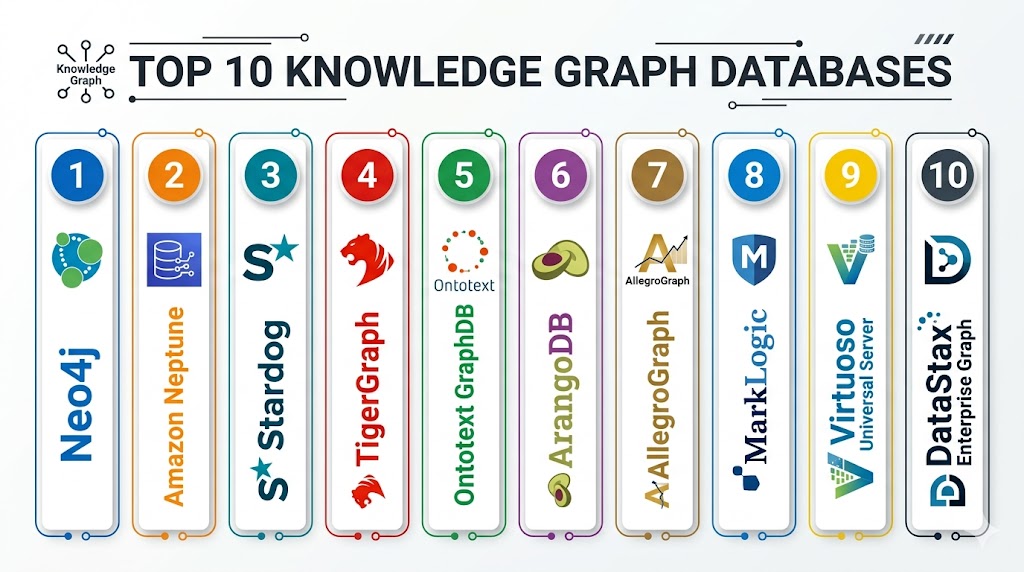
Top 10 Knowledge Graph Databases
1- Neo4j
Short Description:
Neo4j is one of the most widely adopted graph databases for enterprise knowledge graph and relationship-driven applications. It uses a native graph architecture optimized for highly connected data and complex graph traversal queries. Neo4j is commonly used for fraud detection, AI knowledge systems, recommendation engines, and enterprise graph analytics.
Key Features
- Native graph database engine
- Cypher query language
- Graph analytics support
- Real-time relationship traversal
- Knowledge graph modeling
- Graph visualization tools
- Scalable clustering support
Pros
- Strong graph query performance
- Excellent developer ecosystem
- Mature enterprise capabilities
- Widely adopted in AI and analytics projects
Cons
- Enterprise scaling can become expensive
- Requires graph modeling expertise
- Learning curve for Cypher queries
- Some advanced features require enterprise editions
Platforms / Deployment
Cloud / Self-hosted / Hybrid
Security & Compliance
SSO, RBAC, encryption, clustering security, and audit support.
Integrations & Ecosystem
Neo4j integrates with analytics platforms, cloud services, AI systems, and developer tools.
- AWS
- Azure
- Google Cloud
- Spark
- Kafka
- Python ecosystems
Support & Community
Very strong community, extensive documentation, training resources, and enterprise support.
2- Amazon Neptune
Short Description:
Amazon Neptune is a fully managed graph database service designed for highly connected datasets and graph analytics workloads. It supports both property graph and RDF graph models while integrating deeply with AWS cloud services and analytics ecosystems.
Key Features
- Managed graph database service
- RDF and property graph support
- High availability architecture
- Graph query optimization
- Real-time graph processing
- AWS-native integration
- Scalable infrastructure management
Pros
- Minimal infrastructure management
- Strong AWS ecosystem integration
- Good scalability capabilities
- Supports multiple graph models
Cons
- Best suited for AWS-centric environments
- Vendor lock-in concerns
- Advanced tuning may require expertise
- Costs can increase at scale
Platforms / Deployment
Cloud
Security & Compliance
IAM integration, encryption, RBAC, audit logging, and AWS security controls.
Integrations & Ecosystem
Amazon Neptune integrates with AWS analytics, AI, storage, and streaming services.
- Lambda
- S3
- SageMaker
- Glue
- IAM
- CloudWatch
Support & Community
Strong enterprise support through AWS ecosystem and documentation.
3- TigerGraph
Short Description:
TigerGraph is a distributed graph analytics platform designed for large-scale enterprise graph workloads. It focuses heavily on real-time graph analytics, AI, fraud detection, and high-performance distributed processing across massive connected datasets.
Key Features
- Distributed graph architecture
- Parallel graph processing
- Real-time analytics
- AI and ML integration
- High-performance traversal engine
- Graph visualization
- Enterprise clustering support
Pros
- Excellent scalability performance
- Strong real-time analytics capabilities
- Good for large graph workloads
- Strong enterprise AI support
Cons
- Requires graph expertise
- Enterprise pricing may be high
- Smaller ecosystem than Neo4j
- Query language learning curve
Platforms / Deployment
Cloud / Self-hosted / Hybrid
Security & Compliance
RBAC, encryption, SSO, and enterprise governance support.
Integrations & Ecosystem
TigerGraph integrates with AI, analytics, and cloud infrastructure systems.
- Kafka
- Spark
- AWS
- Azure
- Python
- BI tools
Support & Community
Strong enterprise support and growing graph analytics ecosystem.
4- Stardog
Short Description:
Stardog is an enterprise knowledge graph and semantic data platform designed for AI, governance, and enterprise data integration. It combines graph database functionality with semantic reasoning and ontology-driven analytics capabilities.
Key Features
- Semantic graph database
- Knowledge graph modeling
- Ontology and reasoning engine
- Virtual graph support
- Data federation capabilities
- AI-ready graph architecture
- Governance and lineage support
Pros
- Strong semantic reasoning support
- Good enterprise governance capabilities
- Excellent for AI knowledge systems
- Supports federated graph architectures
Cons
- Enterprise-oriented pricing
- Requires semantic modeling expertise
- Smaller ecosystem than mainstream graph vendors
- Complex implementations may require specialists
Platforms / Deployment
Cloud / Self-hosted / Hybrid
Security & Compliance
SSO, RBAC, encryption, audit logging, and governance controls.
Integrations & Ecosystem
Stardog integrates with enterprise systems, cloud platforms, and semantic web technologies.
- Snowflake
- Kafka
- GraphQL
- AWS
- APIs
- BI tools
Support & Community
Strong enterprise support and semantic web expertise ecosystem.
5- ArangoDB
Short Description:
ArangoDB is a multi-model database platform that supports graph, document, and key-value data models within a unified engine. It is widely used for flexible application architectures requiring graph analytics alongside operational database workloads.
Key Features
- Multi-model architecture
- Native graph database support
- Distributed clustering
- Document and graph querying
- Real-time analytics
- Flexible schema design
- Graph traversal engine
Pros
- Flexible multi-model support
- Good scalability capabilities
- Useful for mixed workloads
- Strong developer APIs
Cons
- Smaller enterprise ecosystem
- Advanced graph optimization may require tuning
- Less mature semantic capabilities
- Enterprise features may increase costs
Platforms / Deployment
Cloud / Self-hosted / Hybrid
Security & Compliance
RBAC, encryption, authentication integration, and audit support.
Integrations & Ecosystem
ArangoDB integrates with cloud platforms, APIs, analytics tools, and application frameworks.
- Kubernetes
- AWS
- GraphQL
- Python
- Java
- REST APIs
Support & Community
Active developer community with growing enterprise adoption.
6- Ontotext GraphDB
Short Description:
Ontotext GraphDB is a semantic graph database designed for RDF, linked data, ontology management, and enterprise knowledge graph applications. It is commonly used in regulated industries, semantic AI, and linked data projects.
Key Features
- RDF graph storage
- Semantic reasoning engine
- SPARQL query support
- Ontology management
- Knowledge graph analytics
- Linked data integration
- Semantic search support
Pros
- Strong semantic web capabilities
- Good ontology support
- Suitable for enterprise knowledge graphs
- Strong linked data functionality
Cons
- Requires RDF and semantic expertise
- Smaller ecosystem than mainstream graph databases
- Less beginner-friendly
- Enterprise scaling may require tuning
Platforms / Deployment
Cloud / Self-hosted / Hybrid
Security & Compliance
SSO, RBAC, encryption, and governance support.
Integrations & Ecosystem
GraphDB integrates with semantic tools, AI systems, APIs, and enterprise platforms.
- SPARQL endpoints
- Elasticsearch
- Kafka
- Cloud platforms
- APIs
- BI systems
Support & Community
Strong semantic web community and enterprise semantic consulting ecosystem.
7- Microsoft Azure Cosmos DB
Short Description:
Azure Cosmos DB is a globally distributed multi-model database platform that supports graph workloads through its Gremlin API. It is designed for scalable cloud-native applications requiring low latency and distributed graph processing.
Key Features
- Distributed multi-model database
- Gremlin graph API support
- Global replication
- Low-latency architecture
- Auto-scaling capabilities
- Cloud-native deployment
- High availability support
Pros
- Excellent global scalability
- Strong Azure ecosystem integration
- Flexible multi-model architecture
- Good cloud-native performance
Cons
- Best optimized for Azure environments
- Graph capabilities less specialized than native graph databases
- Pricing can become expensive at scale
- Query optimization may require expertise
Platforms / Deployment
Cloud
Security & Compliance
RBAC, encryption, identity integration, audit logging, and Azure security controls.
Integrations & Ecosystem
Cosmos DB integrates with Azure analytics, AI, and application services.
- Azure AI
- Power BI
- Kubernetes
- Synapse
- Azure Functions
- APIs
Support & Community
Strong Microsoft enterprise support and cloud ecosystem documentation.
8- JanusGraph
Short Description:
JanusGraph is an open-source distributed graph database optimized for large-scale graph processing and analytics. It supports scalable graph workloads across distributed storage backends and cloud infrastructure.
Key Features
- Distributed graph architecture
- Scalable graph processing
- Multiple storage backend support
- Gremlin query language
- Big data ecosystem integration
- Open-source extensibility
- Real-time graph traversal
Pros
- Strong scalability potential
- Open-source flexibility
- Good distributed architecture
- Broad storage backend support
Cons
- Operational complexity can be high
- Requires infrastructure expertise
- Smaller enterprise ecosystem
- Advanced tuning often necessary
Platforms / Deployment
Self-hosted / Hybrid
Security & Compliance
Varies / Not publicly stated
Integrations & Ecosystem
JanusGraph integrates with distributed storage and big data platforms.
- Cassandra
- HBase
- Elasticsearch
- Spark
- Hadoop
- Kubernetes
Support & Community
Active open-source community with strong big data ecosystem alignment.
9- Oracle Spatial and Graph
Short Description:
Oracle Spatial and Graph extends Oracle Database with graph analytics and spatial processing capabilities. It is designed for enterprises already invested in Oracle infrastructure and advanced analytics workflows.
Key Features
- Property graph support
- Graph analytics engine
- Spatial and graph integration
- Enterprise database compatibility
- SQL and graph querying
- Analytics support
- High availability architecture
Pros
- Strong Oracle ecosystem integration
- Mature enterprise reliability
- Good analytics capabilities
- Supports mixed workloads
Cons
- Best suited for Oracle-centric environments
- Enterprise pricing can be high
- Less developer-friendly than modern graph platforms
- Complex administration requirements
Platforms / Deployment
Cloud / Self-hosted / Hybrid
Security & Compliance
Encryption, RBAC, audit logging, and enterprise governance controls.
Integrations & Ecosystem
Oracle Spatial and Graph integrates with Oracle databases, analytics, and enterprise systems.
- Oracle Database
- Oracle Cloud
- SQL tools
- Analytics systems
- BI platforms
- APIs
Support & Community
Strong enterprise support and Oracle partner ecosystem.
10- DataStax Enterprise Graph
Short Description:
DataStax Enterprise Graph is a distributed graph database built on Apache Cassandra for highly scalable enterprise graph workloads. It is designed for organizations managing large-scale distributed applications and graph analytics environments.
Key Features
- Distributed graph database
- Cassandra-based scalability
- Real-time graph traversal
- Gremlin query support
- Multi-data center deployment
- High availability architecture
- Enterprise management tools
Pros
- Excellent distributed scalability
- Strong high-availability capabilities
- Good for large enterprise deployments
- Strong cloud-native architecture
Cons
- Operational complexity
- Requires Cassandra expertise
- Smaller graph ecosystem
- Enterprise licensing costs
Platforms / Deployment
Cloud / Self-hosted / Hybrid
Security & Compliance
RBAC, encryption, authentication integration, and enterprise security support.
Integrations & Ecosystem
DataStax Enterprise Graph integrates with distributed infrastructure, analytics systems, and cloud platforms.
- Cassandra
- Kubernetes
- Kafka
- Spark
- AWS
- APIs
Support & Community
Strong enterprise support and Apache Cassandra ecosystem alignment.
Comparison Table
| Tool Name | Best For | Platform(s) Supported | Deployment | Standout Feature | Public Rating |
|---|---|---|---|---|---|
| Neo4j | Enterprise graph analytics | Web / Cloud | Hybrid | Native graph engine | N/A |
| Amazon Neptune | Managed cloud graph database | Cloud | Cloud | RDF and property graph support | N/A |
| TigerGraph | Large-scale graph analytics | Web / Cloud | Hybrid | Distributed graph processing | N/A |
| Stardog | Semantic enterprise knowledge graphs | Web / Cloud | Hybrid | Ontology reasoning | N/A |
| ArangoDB | Multi-model graph workloads | Web / Cloud | Hybrid | Multi-model architecture | N/A |
| Ontotext GraphDB | Semantic and RDF workloads | Web / Cloud | Hybrid | RDF semantic support | N/A |
| Azure Cosmos DB | Distributed cloud graph workloads | Cloud | Cloud | Global distribution | N/A |
| JanusGraph | Open-source distributed graph systems | Linux / Cloud | Hybrid | Scalable open-source graph engine | N/A |
| Oracle Spatial and Graph | Oracle enterprise analytics | Web / Cloud | Hybrid | Spatial and graph integration | N/A |
| DataStax Enterprise Graph | Distributed enterprise graph systems | Web / Cloud | Hybrid | Cassandra-based scalability | N/A |
Evaluation & Scoring of Knowledge Graph Databases
| Tool Name | Core | Ease | Integrations | Security | Performance | Support | Value | Weighted Total |
|---|---|---|---|---|---|---|---|---|
| Neo4j | 9 | 8 | 9 | 8 | 9 | 9 | 7 | 8.4 |
| Amazon Neptune | 8 | 8 | 9 | 9 | 8 | 9 | 7 | 8.2 |
| TigerGraph | 9 | 7 | 8 | 8 | 10 | 8 | 6 | 8.1 |
| Stardog | 8 | 7 | 8 | 9 | 8 | 8 | 6 | 7.7 |
| ArangoDB | 8 | 8 | 8 | 7 | 8 | 7 | 8 | 7.9 |
| Ontotext GraphDB | 8 | 6 | 7 | 8 | 8 | 7 | 7 | 7.4 |
| Azure Cosmos DB | 8 | 8 | 9 | 9 | 8 | 8 | 6 | 8.0 |
| JanusGraph | 7 | 6 | 8 | 6 | 8 | 7 | 9 | 7.3 |
| Oracle Spatial and Graph | 7 | 6 | 8 | 9 | 8 | 8 | 6 | 7.3 |
| DataStax Enterprise Graph | 8 | 6 | 8 | 8 | 9 | 8 | 6 | 7.6 |
These scores are comparative and intended to help organizations evaluate graph database platforms across functionality, scalability, governance, usability, and operational maturity. Higher totals generally indicate stronger balance for enterprise use cases, but the best choice depends heavily on architecture, cloud strategy, graph complexity, and internal expertise.
Which Knowledge Graph Database Is Right for You?
Solo / Freelancer
ArangoDB and JanusGraph are strong options for developers and smaller teams because they provide flexible graph capabilities with lower entry costs. Neo4j Community Edition is also a popular starting point for graph development and experimentation.
SMB
Neo4j, ArangoDB, and Amazon Neptune are practical options for SMBs because they balance usability, scalability, and modern graph database functionality. Smaller organizations should prioritize simplicity and manageable operational overhead.
Mid-Market
TigerGraph, Neo4j, and Stardog are strong choices for organizations managing recommendation systems, semantic analytics, fraud detection, or AI knowledge graph initiatives at scale.
Enterprise
Large enterprises should prioritize governance, scalability, semantic reasoning, security, and distributed processing capabilities. Neo4j, TigerGraph, Amazon Neptune, Stardog, and Azure Cosmos DB are strong enterprise-focused platforms.
Budget vs Premium
Open-source solutions such as JanusGraph and ArangoDB reduce licensing costs but may increase operational complexity. Premium enterprise platforms provide stronger governance, support, and scalability features.
Feature Depth vs Ease of Use
Neo4j and Amazon Neptune offer more approachable graph database experiences for many teams, while Stardog and Ontotext GraphDB provide deeper semantic and ontology capabilities for specialized enterprise use cases.
Integrations & Scalability
Organizations running distributed analytics, AI pipelines, or cloud-native architectures should prioritize graph databases with strong connector ecosystems and distributed scalability capabilities.
Security & Compliance Needs
Highly regulated industries should prioritize RBAC, encryption, audit logging, identity integration, governance controls, and secure graph access management when evaluating graph platforms.
Frequently Asked Questions
1. What is a Knowledge Graph Database?
A Knowledge Graph Database stores and manages highly connected data using nodes, relationships, and properties rather than traditional tables. It is designed to model real-world relationships and enable fast traversal across connected datasets. These platforms are commonly used in AI, fraud detection, semantic search, and recommendation systems.
2. How is a graph database different from a relational database?
Relational databases organize data into tables with predefined schemas and joins. Graph databases focus on relationships between entities and optimize complex traversal queries. They are generally better suited for highly connected and relationship-driven workloads.
3. What are the main use cases for knowledge graphs?
Knowledge graphs are widely used for semantic search, recommendation engines, fraud detection, cybersecurity analytics, AI assistants, customer intelligence, supply chain mapping, and enterprise knowledge management. They are especially useful when relationships between data entities matter as much as the data itself.
4. Are graph databases suitable for AI workloads?
Yes, graph databases are increasingly important for AI systems because they provide contextual relationships between entities. Many organizations use knowledge graphs to improve Retrieval-Augmented Generation workflows, semantic reasoning, and machine learning data enrichment.
5. Which graph database is best for enterprise deployments?
Neo4j, TigerGraph, Amazon Neptune, and Stardog are among the strongest enterprise-focused graph platforms. The best option depends on graph scale, semantic requirements, cloud strategy, governance needs, and operational expertise.
6. Are graph databases difficult to learn?
Graph databases require a different mindset compared to relational databases because they focus heavily on relationships and traversal patterns. Learning graph query languages such as Cypher or Gremlin can take time, but many developers adapt quickly with practical projects.
7. What security features should organizations prioritize?
Organizations should evaluate RBAC, SSO, encryption, audit logging, governance support, and identity integration when selecting graph database platforms. Regulated industries should also review compliance capabilities and deployment flexibility.
8. Can graph databases scale for large workloads?
Yes, modern graph databases can scale to very large workloads, especially distributed platforms such as TigerGraph, JanusGraph, and DataStax Enterprise Graph. However, scalability depends heavily on graph design, infrastructure, and query optimization strategies.
9. Are graph databases expensive?
Costs vary significantly depending on deployment model, graph size, cloud infrastructure, and enterprise licensing. Managed cloud services reduce operational overhead but may increase infrastructure costs at scale.
10. How should organizations evaluate graph database platforms?
Teams should start with a pilot project using real connected data use cases such as fraud analysis, semantic search, or recommendation systems. Buyers should validate query performance, scalability, governance features, cloud compatibility, and operational complexity before committing to a platform.
Conclusion
Knowledge Graph Databases are becoming increasingly important for organizations building AI-driven systems, semantic search engines, recommendation platforms, fraud analytics, and enterprise knowledge management solutions. As enterprises manage more connected and context-rich data, graph technologies provide significant advantages over traditional relational architectures for relationship-heavy workloads. Neo4j remains one of the strongest and most widely adopted graph database platforms, while TigerGraph focuses heavily on large-scale distributed analytics and real-time graph processing. Stardog and Ontotext GraphDB provide advanced semantic and ontology capabilities for enterprise knowledge systems, while Amazon Neptune and Azure Cosmos DB simplify graph workloads in cloud-native environments. The best graph database ultimately depends on workload complexity, semantic requirements, scalability expectations, governance needs, cloud strategy, and internal expertise. Organizations should shortlist multiple platforms, run pilot graph models using real workloads, validate integration and security requirements, and evaluate long-term operational fit before selecting a strategic graph database solution.

This article clearly explains knowledge graph databases and how they help manage connected data relationships for better search, analytics, and decision-making.
A practical consideration that often gets missed in knowledge graph database comparisons is schema governance and graph evolution over time. Building the initial graph is usually the easy part; maintaining entity resolution, relationship consistency, ontology changes, and data quality across multiple source systems becomes the real challenge at scale. Organizations should evaluate not only query performance and graph features but also how well a platform supports lineage tracking, automated validation, and change management. Without strong governance, knowledge graphs can gradually accumulate inconsistent relationships and duplicate entities, reducing trust in downstream analytics, AI, and RAG applications.
Knowledge graph projects frequently encounter challenges long after the initial deployment phase, particularly when multiple teams contribute data from different domains. As the graph grows, maintaining entity consistency, resolving conflicting relationships, and enforcing governance policies can become more difficult than scaling the database itself. A deeper discussion around automated quality checks, schema evolution, and ownership models would help organizations sustain graph accuracy and business trust over time.