Introduction
SaaS Security Posture Management (SSPM) platforms help organizations monitor, assess, and secure SaaS applications such as Google Workspace, Microsoft 365, Salesforce, and Slack. These tools continuously detect misconfigurations, excessive permissions, identity risks, and compliance gaps across SaaS environments.
As businesses adopt dozens (sometimes hundreds) of SaaS applications, visibility becomes fragmented. SSPM platforms centralize this visibility, enabling security teams to enforce policies, reduce risk, and automate remediation. They are especially critical in environments where SaaS sprawl, shadow IT, and third-party integrations increase the attack surface.
Use Cases:
- Monitoring SaaS configurations and security settings
- Detecting excessive permissions and identity risks
- Managing OAuth and third-party integrations
- Ensuring compliance across SaaS applications
- Reducing shadow SaaS exposure
What buyers should evaluate:
- SaaS app coverage and integration depth
- Identity and access risk visibility
- Automation and remediation workflows
- Compliance monitoring capabilities
- Ease of deployment (agentless preferred)
- Reporting and dashboards
- Integration with SIEM, SOAR, IAM
- Scalability across SaaS ecosystems
Best for: Security teams, SaaS-first organizations, SOC analysts, and enterprises managing multiple SaaS applications.
Not ideal for: Organizations with minimal SaaS usage or those relying solely on traditional security tools like firewalls or antivirus.
Key Trends in SaaS Security Posture Management (SSPM)
- Rapid growth of SaaS ecosystems and shadow IT
- Identity-centric security and access governance focus
- AI-driven risk prioritization and anomaly detection
- Integration with CASB, IAM, and Zero Trust frameworks
- Continuous monitoring of SaaS configurations
- Automation of remediation workflows
- Expansion into SaaS-to-SaaS integration security
- Real-time detection of OAuth and token abuse
- Unified SaaS security dashboards
- Increased compliance automation
How We Selected These Tools (Methodology)
- Market adoption and SaaS ecosystem coverage
- Depth of configuration and identity analysis
- Risk prioritization and automation capabilities
- Integration with security and IT tools
- Security and compliance readiness
- Ease of deployment and usability
- Scalability across SaaS environments
- Innovation in SaaS threat detection
- Customer fit across SMB and enterprise
- Support and documentation quality
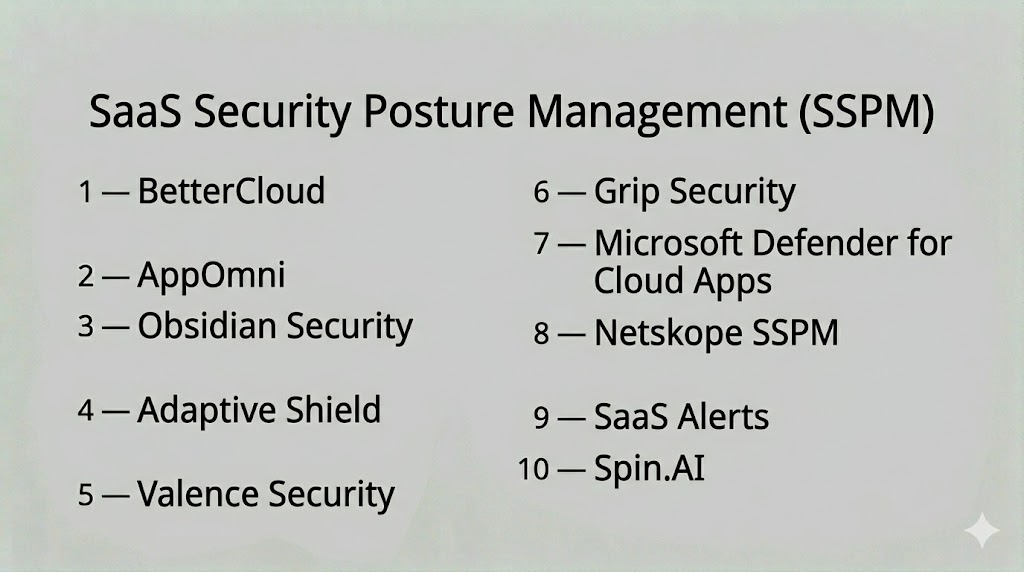
Top 10 SaaS Security Posture Management (SSPM) Tools
#1 — BetterCloud
Short description: A SaaS operations and security platform that provides visibility, automation, and policy enforcement across SaaS applications.
Key Features
- SaaS app management
- Workflow automation
- Access control monitoring
- User lifecycle management
- Policy enforcement
Pros
- Strong automation
- Easy to use
Cons
- Limited deep security analytics
- Focused on SaaS operations
Platforms / Deployment
- Web
- Cloud
Security & Compliance
- SSO, MFA, RBAC
- Not publicly stated
Integrations & Ecosystem
- Google Workspace, Slack, Microsoft 365
- ITSM tools
Support & Community
Good documentation and onboarding.
#2 — AppOmni
Short description: A leading SSPM platform focused on securing SaaS applications through deep configuration monitoring and risk detection.
Key Features
- SaaS configuration monitoring
- Risk detection
- Compliance management
- Data exposure insights
- Continuous monitoring
Pros
- Strong SaaS coverage
- Enterprise-grade security
Cons
- Premium pricing
- Complex setup
Platforms / Deployment
- Web
- Cloud
Security & Compliance
- SSO, MFA
- Not publicly stated
Integrations & Ecosystem
- SaaS apps and security tools
Support & Community
Enterprise support available.
#3 — Obsidian Security
Short description: A SaaS security platform focused on identity, user behavior, and threat detection across SaaS environments.
Key Features
- Identity risk monitoring
- Threat detection
- SaaS activity analysis
- Policy enforcement
- Analytics dashboards
Pros
- Strong identity-focused security
- Advanced analytics
Cons
- Requires tuning
- Learning curve
Platforms / Deployment
- Web
- Cloud
Security & Compliance
- SSO, MFA
- Not publicly stated
Integrations & Ecosystem
- SaaS platforms
- Security tools
Support & Community
Good support and onboarding.
#4 — Adaptive Shield
Short description: A SaaS security platform providing real-time risk assessment and policy enforcement across SaaS applications.
Key Features
- Risk assessment
- Policy enforcement
- Compliance monitoring
- Identity insights
- Automation
Pros
- Strong automation
- Easy deployment
Cons
- Limited customization
- Smaller ecosystem
Platforms / Deployment
- Web
- Cloud
Security & Compliance
- SSO, MFA
- Not publicly stated
Integrations & Ecosystem
- SaaS applications
- Security tools
Support & Community
Responsive support and documentation.
#5 — Valence Security
Short description: A platform focused on SaaS exposure management and risk prioritization across applications.
Key Features
- SaaS risk scoring
- Exposure management
- Policy enforcement
- Analytics dashboards
- Continuous monitoring
Pros
- Strong risk prioritization
- SaaS-focused security
Cons
- Enterprise-focused
- Requires configuration
Platforms / Deployment
- Web
- Cloud
Security & Compliance
- Not publicly stated
Integrations & Ecosystem
- SaaS and security tools
Support & Community
Vendor support available.
#6 — Grip Security
Short description: A SaaS identity and risk management platform focused on discovering shadow SaaS and managing access risks.
Key Features
- Shadow SaaS discovery
- Identity risk analysis
- Access monitoring
- Continuous visibility
- Risk prioritization
Pros
- Strong identity insights
- Easy deployment
Cons
- Limited deep configuration analysis
- Niche focus
Platforms / Deployment
- Web
- Cloud
Security & Compliance
- SSO, MFA
- Not publicly stated
Integrations & Ecosystem
- SaaS apps and identity tools
Support & Community
Good onboarding and support.
#7 — Microsoft Defender for Cloud Apps
Short description: A SaaS security solution that includes SSPM capabilities within the Microsoft security ecosystem.
Key Features
- SaaS visibility
- Risk assessment
- Threat detection
- Policy enforcement
- Compliance monitoring
Pros
- Strong Microsoft integration
- Unified security platform
Cons
- Limited outside Microsoft ecosystem
- Requires configuration
Platforms / Deployment
- Web
- Cloud
Security & Compliance
- SSO, MFA, RBAC
- Not publicly stated
Integrations & Ecosystem
- Microsoft ecosystem
Support & Community
Enterprise support and documentation.
#8 — Netskope SSPM
Short description: A SaaS security platform that provides visibility and control over SaaS configurations and user activity.
Key Features
- SaaS configuration monitoring
- Risk detection
- Compliance management
- Policy enforcement
- Analytics dashboards
Pros
- Strong visibility
- Enterprise capabilities
Cons
- Complex setup
- Requires expertise
Platforms / Deployment
- Web
- Cloud
Security & Compliance
- SSO, MFA
- Not publicly stated
Integrations & Ecosystem
- SaaS apps and security tools
Support & Community
Enterprise support available.
#9 — SaaS Alerts
Short description: A SaaS security platform focused on monitoring user activity and detecting threats in SaaS environments.
Key Features
- User activity monitoring
- Threat detection
- Alerting system
- Risk scoring
- Analytics dashboards
Pros
- Easy to use
- Quick deployment
Cons
- Limited advanced features
- Smaller ecosystem
Platforms / Deployment
- Web
- Cloud
Security & Compliance
- Not publicly stated
Integrations & Ecosystem
- SaaS apps
Support & Community
Responsive support.
#10 — Spin.AI
Short description: A SaaS security platform focused on access control, identity governance, and data protection.
Key Features
- Access control monitoring
- Identity governance
- Risk detection
- Compliance reporting
- Automated monitoring
Pros
- Strong identity security
- Easy integration
Cons
- Limited advanced analytics
- Focused use case
Platforms / Deployment
- Web
- Cloud
Security & Compliance
- SSO, MFA
- Not publicly stated
Integrations & Ecosystem
- SaaS apps
- Security tools
Support & Community
Good documentation and support.
Comparison Table (Top 10)
| Tool Name | Best For | Platform(s) Supported | Deployment | Standout Feature | Public Rating |
|---|---|---|---|---|---|
| BetterCloud | SMB/Enterprise | Web | Cloud | SaaS automation | N/A |
| AppOmni | Enterprise | Web | Cloud | Deep SaaS security | N/A |
| Obsidian Security | Enterprise | Web | Cloud | Identity monitoring | N/A |
| Adaptive Shield | SMB/Enterprise | Web | Cloud | Risk assessment | N/A |
| Valence Security | Enterprise | Web | Cloud | Exposure management | N/A |
| Grip Security | Enterprise | Web | Cloud | Shadow SaaS discovery | N/A |
| Microsoft Defender | Enterprise | Web | Cloud | Ecosystem integration | N/A |
| Netskope SSPM | Enterprise | Web | Cloud | SaaS visibility | N/A |
| SaaS Alerts | SMB | Web | Cloud | User monitoring | N/A |
| Spin.AI | SMB/Enterprise | Web | Cloud | Identity governance | N/A |
Evaluation & Scoring of SaaS Security Posture Management (SSPM)
| Tool Name | Core (25%) | Ease (15%) | Integrations (15%) | Security (10%) | Performance (10%) | Support (10%) | Value (15%) | Weighted Total (0–10) |
|---|---|---|---|---|---|---|---|---|
| BetterCloud | 7 | 8 | 7 | 7 | 7 | 7 | 8 | 7.4 |
| AppOmni | 9 | 7 | 8 | 8 | 9 | 8 | 7 | 8.2 |
| Obsidian | 8 | 7 | 7 | 8 | 8 | 7 | 7 | 7.7 |
| Adaptive Shield | 8 | 8 | 7 | 8 | 8 | 7 | 8 | 7.9 |
| Valence | 8 | 7 | 7 | 8 | 8 | 7 | 7 | 7.7 |
| Grip | 7 | 8 | 7 | 7 | 7 | 7 | 8 | 7.4 |
| Defender | 8 | 8 | 7 | 8 | 8 | 7 | 7 | 7.9 |
| Netskope | 8 | 7 | 7 | 8 | 8 | 7 | 7 | 7.8 |
| SaaS Alerts | 7 | 8 | 6 | 7 | 7 | 7 | 8 | 7.3 |
| Spin.AI | 7 | 8 | 7 | 7 | 7 | 7 | 8 | 7.4 |
Scores are comparative and based on feature depth, usability, integrations, and value. Higher scores indicate stronger enterprise readiness and broader SaaS security coverage.
Which SaaS Security Posture Management (SSPM) Tool Is Right for You?
Solo / Freelancer
SSPM tools are generally not required unless managing multiple SaaS apps.
SMB
BetterCloud and SaaS Alerts offer ease of use and quick deployment.
Mid-Market
Adaptive Shield and Spin.AI provide balanced features and scalability.
Enterprise
AppOmni, Microsoft Defender, and Netskope offer advanced capabilities.
Budget vs Premium
Budget tools focus on monitoring; premium tools provide deeper analytics and automation.
Feature Depth vs Ease of Use
Advanced platforms provide deeper insights but require expertise.
Integrations & Scalability
Choose tools that integrate with your SaaS ecosystem and identity systems.
Security & Compliance Needs
Ensure alignment with regulatory frameworks and governance policies.
Frequently Asked Questions (FAQs)
What is SSPM?
SSPM is a security approach that monitors and manages risks in SaaS applications.
How does SSPM differ from CSPM?
SSPM focuses on SaaS apps, while CSPM focuses on cloud infrastructure.
Why is SSPM important?
It reduces risks from misconfigurations, excessive permissions, and shadow SaaS.
What risks does SSPM detect?
Misconfigurations, identity risks, compliance gaps, and unauthorized integrations.
Does SSPM provide real-time monitoring?
Yes, most platforms continuously monitor SaaS environments.
Can SSPM automate remediation?
Yes, many tools provide automated workflows and alerts.
Is SSPM necessary for small businesses?
It depends on SaaS usage and risk exposure.
Can SSPM integrate with other tools?
Yes, most integrate with SIEM, SOAR, and IAM platforms.
What are common mistakes?
Ignoring identity risks and failing to monitor SaaS integrations.
Are SSPM tools scalable?
Yes, they are designed for growing SaaS ecosystems.
Conclusion
SaaS Security Posture Management platforms are essential for securing modern SaaS-driven environments by providing visibility, control, and automation across applications. They help organizations detect misconfigurations, manage identity risks, and enforce consistent security policies across complex SaaS ecosystems.
As SaaS adoption continues to grow, SSPM tools enable security teams to move from reactive monitoring to proactive risk management. They reduce manual effort, improve compliance, and strengthen overall security posture.
Choosing the right SSPM platform depends on your SaaS stack, integration needs, and organizational scale. Enterprise platforms provide deeper analytics and automation, while simpler tools offer faster deployment and ease of use.
The best approach is to shortlist a few tools, test them in your environment, and evaluate how effectively they reduce SaaS risks and improve security workflows.
