Introduction
Service Mesh Platforms provide a dedicated infrastructure layer for managing service-to-service communication in microservices architectures. In simple terms, a service mesh acts like a “traffic controller” for your applications, handling communication between services securely, reliably, and efficiently without changing application code.
As organizations adopt microservices and Kubernetes-based environments, managing communication between dozens or hundreds of services becomes complex. Service mesh platforms solve this by introducing a sidecar proxy model that handles networking, security, observability, and traffic control.
Modern service mesh platforms offer features like traffic routing, load balancing, encryption (mTLS), service discovery, observability, policy enforcement, and fault tolerance—making them essential for large-scale distributed systems.
Common use cases include:
- Microservices communication management
- Traffic routing and load balancing
- Zero Trust security (mTLS)
- Observability and monitoring
- Canary deployments and A/B testing
What buyers should evaluate:
- Ease of deployment
- Performance overhead
- Security features (mTLS, RBAC)
- Observability and tracing
- Integration with Kubernetes
- Multi-cluster and multi-cloud support
- Policy management
- Scalability
- Community and support
- Ecosystem maturity
Best for: DevOps teams, platform engineers, cloud-native organizations, enterprises using microservices.
Not ideal for: Simple monolithic applications or small systems with minimal service complexity.
Key Trends in Service Mesh Platforms
- Adoption of Zero Trust networking
- Growth of Kubernetes-native service meshes
- Multi-cluster and multi-cloud service mesh deployments
- eBPF-based service mesh innovation
- Improved observability with distributed tracing
- Integration with API gateways
- Lightweight service meshes gaining popularity
- GitOps-driven configuration management
- Performance optimization and reduced overhead
- Security-first architectures
How We Selected These Tools (Methodology)
- Market adoption and maturity
- Feature completeness
- Kubernetes compatibility
- Performance and scalability
- Security capabilities
- Observability features
- Ease of deployment and use
- Integration ecosystem
- Vendor reputation
- Overall value
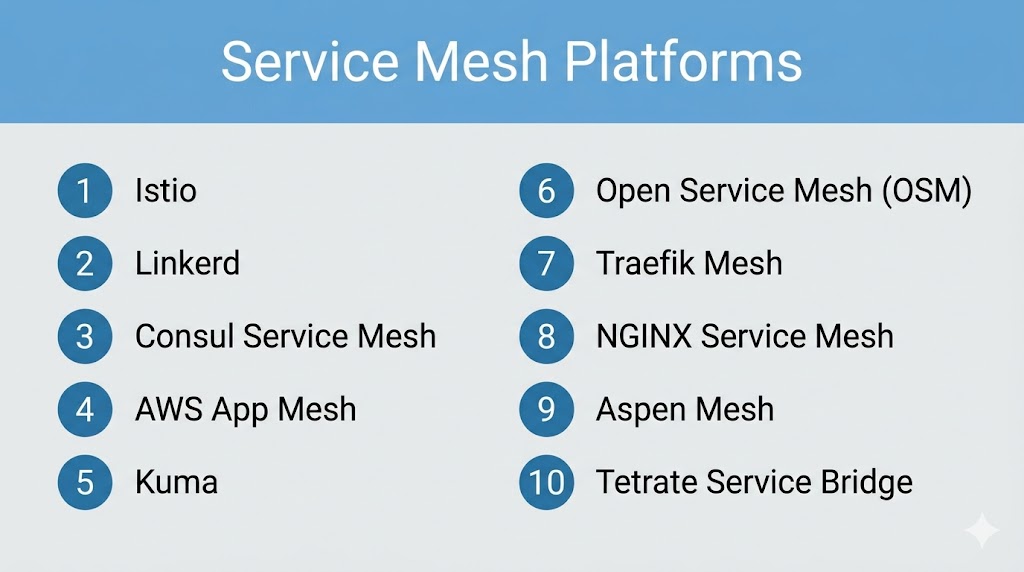
Top 10 Service Mesh Platforms
#1 — Istio
Short description: The most widely used service mesh platform offering advanced traffic management, security, and observability.
Key Features
- Traffic routing and control
- mTLS encryption
- Service discovery
- Observability and tracing
- Policy enforcement
- Multi-cluster support
Pros
- Feature-rich platform
- Strong ecosystem
Cons
- Complex setup
- Resource overhead
Platforms / Deployment
Kubernetes
Cloud / Self-hosted
Security & Compliance
Advanced security controls with mTLS and RBAC.
Integrations & Ecosystem
Kubernetes, cloud providers, DevOps tools.
Support & Community
Large open-source community.
#2 — Linkerd
Short description: Lightweight and easy-to-use service mesh focused on simplicity and performance.
Key Features
- Automatic mTLS
- Service discovery
- Observability
- Traffic management
- Low resource usage
- Easy installation
Pros
- Simple and fast
- Lightweight
Cons
- Fewer advanced features than Istio
- Smaller ecosystem
Platforms / Deployment
Kubernetes
Cloud / Self-hosted
Security & Compliance
Built-in mTLS.
Integrations & Ecosystem
Kubernetes ecosystem.
Support & Community
Growing community.
#3 — Consul Service Mesh
Short description: Service mesh by HashiCorp offering multi-cloud service networking.
Key Features
- Service discovery
- Secure service communication
- Multi-cloud support
- Traffic management
- Observability tools
- Integration with HashiCorp stack
Pros
- Strong multi-cloud support
- Flexible deployment
Cons
- Requires configuration
- Learning curve
Platforms / Deployment
Cloud / Hybrid / Self-hosted
Security & Compliance
mTLS and access controls.
Integrations & Ecosystem
HashiCorp tools, cloud providers.
Support & Community
Strong enterprise adoption.
#4 — AWS App Mesh
Short description: Managed service mesh solution integrated with AWS ecosystem.
Key Features
- Traffic routing
- Service discovery
- Monitoring tools
- Security controls
- Integration with AWS services
- Managed infrastructure
Pros
- No infrastructure management
- AWS-native integration
Cons
- AWS dependency
- Limited multi-cloud support
Platforms / Deployment
Cloud
Security & Compliance
AWS security model.
Integrations & Ecosystem
AWS services.
Support & Community
Strong cloud support.
#5 — Kuma
Short description: Modern service mesh built for multi-zone and multi-cloud environments.
Key Features
- Multi-cluster support
- Traffic routing
- mTLS encryption
- Observability
- Policy management
- Lightweight architecture
Pros
- Easy to use
- Multi-environment support
Cons
- Smaller ecosystem
- Fewer advanced features
Platforms / Deployment
Kubernetes / VMs
Cloud / Hybrid
Security & Compliance
Built-in mTLS and policies.
Integrations & Ecosystem
Cloud-native tools.
Support & Community
Growing adoption.
#6 — Open Service Mesh (OSM)
Short description: Lightweight service mesh focused on simplicity and Kubernetes integration.
Key Features
- Traffic management
- mTLS security
- Observability
- Kubernetes-native design
- Easy deployment
- Policy management
Pros
- Simple to deploy
- Lightweight
Cons
- Limited advanced features
- Smaller ecosystem
Platforms / Deployment
Kubernetes
Security & Compliance
mTLS and policy controls.
Integrations & Ecosystem
Kubernetes tools.
Support & Community
Moderate community support.
#7 — Traefik Mesh
Short description: Service mesh focused on simplicity and integration with Traefik proxy.
Key Features
- Traffic routing
- Service discovery
- Observability
- Lightweight design
- Easy setup
- Kubernetes integration
Pros
- Easy to use
- Lightweight
Cons
- Limited enterprise features
- Smaller ecosystem
Platforms / Deployment
Kubernetes
Security & Compliance
Basic controls available.
Integrations & Ecosystem
Traefik ecosystem.
Support & Community
Growing adoption.
#8 — NGINX Service Mesh
Short description: Service mesh solution built on NGINX technology.
Key Features
- Traffic management
- Load balancing
- Observability
- Security features
- Kubernetes integration
- Performance optimization
Pros
- Strong performance
- Familiar NGINX ecosystem
Cons
- Smaller adoption
- Limited advanced features
Platforms / Deployment
Kubernetes
Security & Compliance
Enterprise-grade controls.
Integrations & Ecosystem
NGINX ecosystem.
Support & Community
Established user base.
#9 — Aspen Mesh
Short description: Enterprise service mesh platform built on Istio with additional support and features.
Key Features
- Istio-based architecture
- Traffic management
- Security controls
- Observability
- Enterprise support
- Policy enforcement
Pros
- Enterprise-ready
- Built on proven technology
Cons
- Premium pricing
- Smaller adoption
Platforms / Deployment
Kubernetes
Cloud / Hybrid
Security & Compliance
Enterprise-grade controls.
Integrations & Ecosystem
Istio ecosystem.
Support & Community
Enterprise-focused support.
#10 — Tetrate Service Bridge
Short description: Enterprise-grade service mesh platform designed for hybrid and multi-cloud environments.
Key Features
- Multi-cluster management
- Traffic control
- Security policies
- Observability
- Hybrid cloud support
- Centralized management
Pros
- Strong enterprise capabilities
- Multi-cloud support
Cons
- Complex setup
- Premium pricing
Platforms / Deployment
Cloud / Hybrid
Security & Compliance
Advanced enterprise controls.
Integrations & Ecosystem
Istio ecosystem, enterprise tools.
Support & Community
Enterprise-focused.
Comparison Table (Top 10)
| Tool Name | Best For | Platform(s) Supported | Deployment | Standout Feature | Public Rating |
|---|---|---|---|---|---|
| Istio | Enterprises | Kubernetes | Hybrid | Advanced features | N/A |
| Linkerd | SMBs | Kubernetes | Self-hosted | Simplicity | N/A |
| Consul | Multi-cloud | Cross-platform | Hybrid | Service networking | N/A |
| AWS App Mesh | AWS users | Cloud | Cloud | Managed service | N/A |
| Kuma | Multi-zone | Kubernetes/VMs | Hybrid | Lightweight | N/A |
| OSM | Simplicity | Kubernetes | Self-hosted | Easy deployment | N/A |
| Traefik Mesh | Developers | Kubernetes | Self-hosted | Lightweight | N/A |
| NGINX Mesh | Performance | Kubernetes | Self-hosted | NGINX integration | N/A |
| Aspen Mesh | Enterprises | Kubernetes | Hybrid | Istio-based | N/A |
| Tetrate | Enterprises | Cloud | Hybrid | Multi-cloud control | N/A |
Evaluation & Scoring of Service Mesh Platforms
| Tool Name | Core (25%) | Ease (15%) | Integrations (15%) | Security (10%) | Performance (10%) | Support (10%) | Value (15%) | Weighted Total |
|---|---|---|---|---|---|---|---|---|
| Istio | 10 | 6 | 10 | 10 | 9 | 10 | 8 | 9.2 |
| Linkerd | 8 | 9 | 7 | 9 | 9 | 8 | 9 | 8.6 |
| Consul | 9 | 7 | 9 | 9 | 8 | 9 | 8 | 8.7 |
| AWS App Mesh | 8 | 8 | 9 | 9 | 8 | 9 | 8 | 8.5 |
| Kuma | 8 | 8 | 8 | 8 | 8 | 7 | 9 | 8.1 |
| OSM | 7 | 9 | 7 | 8 | 7 | 7 | 9 | 7.9 |
| Traefik Mesh | 7 | 9 | 7 | 7 | 7 | 7 | 9 | 7.8 |
| NGINX Mesh | 8 | 8 | 7 | 8 | 8 | 7 | 8 | 8.0 |
| Aspen Mesh | 9 | 7 | 8 | 9 | 8 | 8 | 7 | 8.2 |
| Tetrate | 9 | 6 | 9 | 10 | 9 | 9 | 7 | 8.8 |
How to interpret scores:
Advanced platforms like Istio and Tetrate excel in features and security, while lightweight tools like Linkerd and OSM perform better in simplicity and efficiency.
Which Service Mesh Platform Is Right for You?
Solo / Freelancer
Linkerd, OSM
SMB
Linkerd, Kuma
Mid-Market
Consul, Kuma, AWS App Mesh
Enterprise
Istio, Tetrate, OpenShift-based meshes
Budget vs Premium
- Budget: Linkerd, OSM
- Premium: Tetrate, Aspen Mesh
Feature Depth vs Ease of Use
- Easy: Linkerd, OSM
- Deep: Istio, Tetrate
Integrations & Scalability
Istio, Consul
Security & Compliance Needs
Istio, Tetrate
Frequently Asked Questions (FAQs)
What is a service mesh?
A layer that manages service-to-service communication.
Do I need a service mesh?
Only for complex microservices architectures.
Is Istio the best?
It is the most feature-rich.
Is service mesh complex?
Yes, it adds operational overhead.
What is mTLS?
Mutual TLS encryption between services.
Can it improve security?
Yes, significantly.
Does it affect performance?
It adds some overhead.
Is Kubernetes required?
Most service meshes are Kubernetes-based.
Which is easiest to use?
Linkerd.
How do I choose?
Evaluate complexity, scale, and ecosystem.
Conclusion
Service Mesh Platforms are critical for managing communication, security, and observability in modern microservices architectures. Istio leads in features and enterprise capabilities, while Linkerd offers simplicity and performance. Consul and Kuma provide strong multi-cloud flexibility, and managed options like AWS App Mesh reduce operational overhead. Enterprise platforms like Tetrate and Aspen Mesh deliver advanced control and scalability. The right choice depends on your infrastructure complexity, security needs, and team expertise. Start with a lightweight solution if you’re new, and scale to advanced platforms as your architecture evolves.
