Introduction
Enterprise Mobility Management (EMM) software helps organizations secure, manage, monitor, and control mobile devices, applications, content, and access policies across the workforce. In simple terms, EMM enables businesses to support mobile productivity while protecting company data on smartphones, tablets, laptops, and BYOD devices.
Modern companies rely on mobile workforces, hybrid employees, field teams, remote executives, and app-driven workflows. Without structured mobility management, devices become security risks, support becomes inefficient, and compliance becomes harder. That is why EMM has become a core IT priority. While many vendors now position broader Unified Endpoint Management (UEM) platforms, EMM remains highly relevant for mobile-first strategies.
Today’s best EMM platforms combine Mobile Device Management (MDM), Mobile Application Management (MAM), identity controls, secure content access, app deployment, compliance enforcement, and analytics in one platform.
Common use cases include:
- Corporate phone and tablet management
- BYOD security policies
- Secure app and content delivery
- Remote workforce access control
- Frontline and field device management
What buyers should evaluate:
- iOS and Android support
- MDM + MAM capabilities
- BYOD privacy controls
- Security and compliance features
- Identity integrations
- Ease of enrollment
- Reporting and analytics
- Scalability
- Support quality
- Pricing and value
Best for: Enterprises, healthcare, finance, education, logistics, retail, government, and organizations with mobile-heavy workforces.
Not ideal for: Businesses with no mobile workforce or teams needing only a few unmanaged devices.
Key Trends in Enterprise Mobility Management (EMM)
- UEM platforms absorbing traditional EMM categories
- Zero Trust mobile compliance policies
- Stronger BYOD privacy separation
- AI-driven remediation and risk alerts
- Secure containerized business apps
- Better Apple zero-touch and Android zero-touch onboarding
- Identity-first mobile access control
- Mobile threat defense integrations
- Kiosk mode growth for frontline workers
- Flexible cloud subscription pricing
How We Selected These Tools (Methodology)
- Strong enterprise market reputation
- Broad mobile platform support
- Mature MDM + MAM capabilities
- Security and compliance readiness
- Ease of deployment at scale
- Integration ecosystem maturity
- Reliability across large fleets
- Fit for regulated industries
- Reporting and automation depth
- Overall long-term value
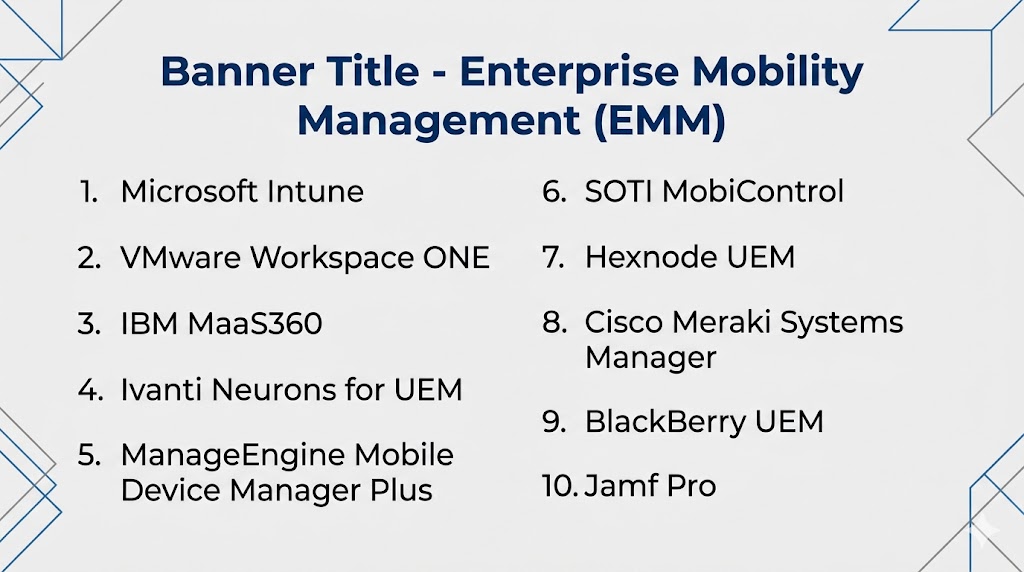
Top 10 Enterprise Mobility Management (EMM) Tools
#1 — Microsoft Intune
Short description: Leading cloud EMM platform with strong Microsoft identity, security, and device management integrations.
Key Features
- Mobile device management
- App protection policies
- Conditional access
- BYOD controls
- Remote wipe
- Compliance policies
Pros
- Excellent Microsoft ecosystem fit
- Strong enterprise security model
Cons
- Best inside Microsoft environments
- Licensing complexity possible
Platforms / Deployment
Web / iOS / Android / Windows / macOS | Cloud
Security & Compliance
Enterprise-grade controls with identity integrations.
Integrations & Ecosystem
Microsoft 365, Entra ID, Defender, Windows tools, APIs.
Support & Community
Large global enterprise ecosystem.
#2 — VMware Workspace ONE
Short description: Mature enterprise mobility platform with advanced EMM/UEM functionality across diverse devices.
Key Features
- Device management
- App lifecycle management
- Identity integrations
- Compliance policies
- Analytics
- Multi-OS support
Pros
- Broad enterprise functionality
- Strong heterogeneous environment support
Cons
- Can be complex for smaller teams
- Premium pricing possible
Platforms / Deployment
Cross-platform | Cloud / Hybrid
Security & Compliance
Enterprise controls available.
Integrations & Ecosystem
Identity tools, enterprise apps, APIs.
Support & Community
Strong enterprise adoption.
#3 — IBM MaaS360
Short description: Established EMM platform focused on security, analytics, and enterprise mobility operations.
Key Features
- Mobile device management
- Secure containerization
- Threat insights
- App management
- Compliance policies
- Reporting dashboards
Pros
- Strong enterprise mobility heritage
- Mature governance features
Cons
- UI preferences vary
- Less momentum than some newer rivals
Platforms / Deployment
Cross-platform | Cloud
Security & Compliance
Enterprise-grade controls available.
Integrations & Ecosystem
Identity systems, enterprise tools, APIs.
Support & Community
Longstanding enterprise presence.
#4 — Ivanti Neurons for UEM
Short description: Enterprise-grade platform combining mobility management, endpoint control, and automation.
Key Features
- Device discovery
- App management
- Compliance automation
- Unified endpoint controls
- Analytics
- Lifecycle workflows
Pros
- Strong enterprise depth
- Good automation capabilities
Cons
- Higher complexity
- Premium buying cycle
Platforms / Deployment
Cross-platform | Cloud
Security & Compliance
Enterprise controls available.
Integrations & Ecosystem
ITSM, identity, security tools, APIs.
Support & Community
Strong enterprise support footprint.
#5 — ManageEngine Mobile Device Manager Plus
Short description: Value-focused EMM solution for SMB and mid-market teams needing strong mobility control.
Key Features
- Device enrollment
- App deployment
- Kiosk mode
- Remote support
- Compliance controls
- Reporting tools
Pros
- Excellent value
- Cloud and on-prem options
Cons
- Interface can feel dense
- Advanced workflows may need tuning
Platforms / Deployment
Cross-platform | Cloud / Self-hosted
Security & Compliance
Policy and admin controls available.
Integrations & Ecosystem
ManageEngine suite, IT tools, APIs.
Support & Community
Strong SMB-mid market presence.
#6 — SOTI MobiControl
Short description: Mature EMM platform known for rugged devices, logistics, and field workforce mobility.
Key Features
- Rugged device management
- Kiosk mode
- App management
- Remote troubleshooting
- Security controls
- Lifecycle tools
Pros
- Excellent frontline device fit
- Strong industry specialization
Cons
- Less mainstream for office-only teams
- UI preferences vary
Platforms / Deployment
Cross-platform | Cloud / Self-hosted
Security & Compliance
Enterprise controls available.
Integrations & Ecosystem
Mobility tools, enterprise apps, APIs.
Support & Community
Strong frontline reputation.
#7 — Hexnode UEM
Short description: Flexible mobility management platform with broad support and modern usability.
Key Features
- Mobile device management
- BYOD policies
- App control
- Kiosk mode
- Remote actions
- Reporting
Pros
- Easy to use
- Strong flexibility
Cons
- Less enterprise depth than top leaders
- Advanced scenarios may need setup
Platforms / Deployment
Cross-platform | Cloud / Self-hosted
Security & Compliance
Policy and compliance controls.
Integrations & Ecosystem
Identity tools, APIs, productivity apps.
Support & Community
Growing global adoption.
#8 — Cisco Meraki Systems Manager
Short description: Cloud EMM solution with strong networking ecosystem integration.
Key Features
- Device management
- App deployment
- Security policies
- Network-aware controls
- Remote commands
- Reporting
Pros
- Great for Cisco customers
- Easy cloud management
Cons
- Best value inside Meraki ecosystem
- Less specialized than some rivals
Platforms / Deployment
Cross-platform | Cloud
Security & Compliance
Enterprise controls available.
Integrations & Ecosystem
Cisco ecosystem, identity tools, APIs.
Support & Community
Strong networking community.
#9 — BlackBerry UEM
Short description: Security-first mobility platform known for regulated industries and high-security environments.
Key Features
- Secure device management
- App containerization
- Policy enforcement
- Identity integrations
- BYOD controls
- Compliance reporting
Pros
- Strong security reputation
- Good regulated industry fit
Cons
- Less mainstream adoption than leaders
- UI preferences vary
Platforms / Deployment
Cross-platform | Cloud / Self-hosted
Security & Compliance
Strong enterprise security controls.
Integrations & Ecosystem
Identity, security, enterprise tools.
Support & Community
Trusted enterprise brand.
#10 — Jamf Pro
Short description: Leading Apple mobility management solution for enterprise iPhone, iPad, and Mac fleets.
Key Features
- Apple zero-touch deployment
- App management
- Security baselines
- Inventory tracking
- Remote commands
- Patch workflows
Pros
- Best Apple-first platform
- Strong admin experience
Cons
- Apple-only focus
- Mixed fleets need extra tools
Platforms / Deployment
Web / iOS / macOS | Cloud
Security & Compliance
Enterprise Apple controls available.
Integrations & Ecosystem
Apple ecosystem, identity tools, security apps.
Support & Community
Very strong Apple IT community.
Comparison Table (Top 10)
| Tool Name | Best For | Platform(s) Supported | Deployment | Standout Feature | Public Rating |
|---|---|---|---|---|---|
| Microsoft Intune | Microsoft enterprises | Cross-platform | Cloud | Conditional access | N/A |
| Workspace ONE | Large enterprises | Cross-platform | Cloud/Hybrid | Broad enterprise mobility | N/A |
| IBM MaaS360 | Security-focused enterprises | Cross-platform | Cloud | Mobility heritage | N/A |
| Ivanti Neurons | Complex enterprises | Cross-platform | Cloud | Automation depth | N/A |
| ManageEngine MDM Plus | SMB-mid market | Cross-platform | Cloud/Self-hosted | Strong value | N/A |
| SOTI MobiControl | Rugged fleets | Cross-platform | Cloud/Self-hosted | Field device strength | N/A |
| Hexnode UEM | Growing businesses | Cross-platform | Cloud/Self-hosted | Ease + flexibility | N/A |
| Cisco Meraki Systems Manager | Cisco customers | Cross-platform | Cloud | Network integration | N/A |
| BlackBerry UEM | Regulated industries | Cross-platform | Cloud/Self-hosted | Security-first model | N/A |
| Jamf Pro | Apple fleets | Apple platforms | Cloud | Best Apple management | N/A |
Evaluation & Scoring of Enterprise Mobility Management (EMM)
| Tool Name | Core (25%) | Ease (15%) | Integrations (15%) | Security (10%) | Performance (10%) | Support (10%) | Value (15%) | Weighted Total |
|---|---|---|---|---|---|---|---|---|
| Microsoft Intune | 9 | 8 | 10 | 9 | 9 | 8 | 8 | 8.8 |
| Workspace ONE | 9 | 7 | 8 | 9 | 8 | 8 | 7 | 8.1 |
| IBM MaaS360 | 8 | 7 | 8 | 8 | 8 | 8 | 7 | 7.8 |
| Ivanti Neurons | 9 | 7 | 8 | 9 | 8 | 8 | 7 | 8.1 |
| ManageEngine MDM Plus | 8 | 8 | 8 | 8 | 8 | 8 | 9 | 8.2 |
| SOTI MobiControl | 8 | 7 | 7 | 8 | 8 | 8 | 7 | 7.7 |
| Hexnode UEM | 8 | 8 | 7 | 8 | 8 | 8 | 8 | 7.9 |
| Cisco Meraki Systems Manager | 8 | 8 | 8 | 8 | 8 | 8 | 7 | 7.9 |
| BlackBerry UEM | 8 | 7 | 7 | 9 | 8 | 8 | 7 | 7.8 |
| Jamf Pro | 9 | 9 | 7 | 8 | 9 | 9 | 7 | 8.4 |
How to interpret scores:
These scores are comparative. Enterprise tools score higher in governance and integrations, while SMB tools often score higher in usability and affordability.
Which Enterprise Mobility Management (EMM) Tool Is Right for You?
Solo / Freelancer
Hexnode or ManageEngine for lightweight needs.
SMB
ManageEngine, Hexnode, Cisco Meraki.
Mid-Market
Intune, Jamf Pro, SOTI.
Enterprise
Microsoft Intune, Workspace ONE, Ivanti, BlackBerry UEM.
Budget vs Premium
- Budget: Hexnode, ManageEngine
- Premium: Intune, Workspace ONE
Feature Depth vs Ease of Use
- Easy: Jamf Pro, Hexnode
- Deep: Intune, Ivanti
Integrations & Scalability
Intune, Workspace ONE, Cisco Meraki.
Security & Compliance Needs
Intune, BlackBerry UEM, MaaS360.
Frequently Asked Questions (FAQs)
What is EMM software?
It helps organizations manage mobile devices, apps, and security centrally.
Is EMM different from MDM?
Yes, EMM usually includes MDM plus apps, content, and access controls.
Is EMM still relevant today?
Yes, though many vendors now position UEM platforms.
Can EMM support BYOD?
Yes, most leading tools support BYOD policies.
Is EMM secure?
Leading platforms provide strong enterprise controls.
Which tool is best for Apple fleets?
Jamf Pro is a leading option.
Which tool is best for Microsoft environments?
Microsoft Intune is a top choice.
Can small businesses use EMM?
Yes, several vendors support SMB pricing.
How much does EMM cost?
Usually priced by user or device subscription.
How do I choose the best EMM tool?
Compare device support, security needs, and integrations.
Conclusion
Enterprise Mobility Management software remains essential for organizations running mobile-first, hybrid, and security-sensitive environments. The best platforms combine device control, secure app access, compliance enforcement, and analytics to reduce risk and improve productivity. Microsoft Intune and Workspace ONE lead in enterprise depth, while ManageEngine, Hexnode, and Cisco Meraki offer strong value for growing teams. Apple-focused businesses should evaluate Jamf Pro, while regulated industries may prefer BlackBerry UEM. The right choice depends on your device mix, security requirements, internal expertise, and budget. Shortlist two or three tools, run a pilot, and validate enrollment, integrations, and compliance workflows before making a final decision.
