Introduction
Storage Management Tools help organizations monitor, optimize, provision, secure, and control data storage systems across on-premises, cloud, and hybrid environments. In simple terms, these tools ensure storage infrastructure performs efficiently, scales properly, and remains cost-effective as business data grows.
Modern companies generate massive amounts of files, databases, analytics data, backups, logs, media assets, and application workloads. Without proper storage management, businesses often face capacity shortages, slow performance, rising costs, poor visibility, and operational risk. That is why storage management platforms are essential for IT teams, infrastructure managers, DevOps teams, and enterprises.
Today’s leading solutions go beyond simple monitoring. They include AI-driven analytics, capacity forecasting, automated tiering, performance troubleshooting, hybrid cloud visibility, ransomware readiness, and policy-based provisioning.
Common use cases include:
- SAN / NAS performance monitoring
- Capacity planning and forecasting
- Hybrid cloud storage visibility
- Storage cost optimization
- Multi-site infrastructure management
What buyers should evaluate:
- Multi-vendor support
- Capacity analytics
- Performance visibility
- Automation features
- Cloud integrations
- Security controls
- Ease of use
- Scalability
- Reporting dashboards
- Pricing and value
Best for: Enterprises, mid-market IT teams, cloud-first businesses, data centers, MSPs, healthcare, finance, and storage-intensive organizations.
Not ideal for: Very small teams using only simple consumer storage platforms.
Key Trends in Storage Management Tools
- AI-based capacity forecasting
- Unified hybrid cloud consoles
- Ransomware-aware monitoring
- Automated data tiering
- Kubernetes storage management growth
- Cloud storage cost optimization
- Zero Trust access controls
- Software-defined storage adoption
- Real-time analytics dashboards
- Multi-cloud governance models
How We Selected These Tools (Methodology)
- Strong market reputation
- Broad ecosystem support
- Proven monitoring reliability
- Automation and optimization maturity
- Security and compliance readiness
- Ease of deployment and management
- Scalability across environments
- Integration ecosystem strength
- Reporting and analytics quality
- Overall long-term value
Top 10 Storage Management Tools
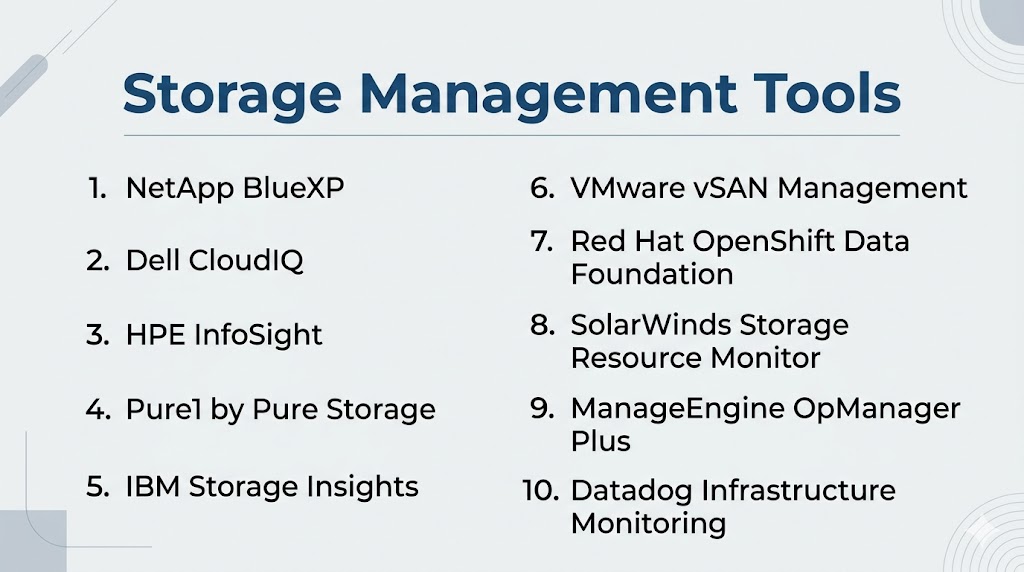
#1 — NetApp BlueXP
Short description: Unified management platform for NetApp environments with strong hybrid cloud control and automation.
Key Features
- Unified storage dashboard
- Capacity optimization
- Cloud tiering
- Backup workflows
- Security insights
- Multi-environment visibility
Pros
- Excellent NetApp ecosystem fit
- Strong hybrid cloud capabilities
Cons
- Best for NetApp users
- Less ideal for mixed estates
Platforms / Deployment
Web
Cloud / Hybrid
Security & Compliance
RBAC and enterprise controls available.
Integrations & Ecosystem
NetApp arrays, AWS, Azure, Google Cloud, backup tools.
Support & Community
Strong enterprise ecosystem.
#2 — Dell CloudIQ
Short description: Dell storage analytics platform with predictive monitoring and fleet visibility.
Key Features
- Performance analytics
- Capacity planning
- Health monitoring
- Alert dashboards
- Fleet visibility
- Predictive insights
Pros
- Excellent Dell customer fit
- Strong proactive monitoring
Cons
- Best for Dell customers
- Mixed-vendor depth limited
Platforms / Deployment
Web
Cloud / Hybrid
Security & Compliance
Enterprise controls available.
Integrations & Ecosystem
Dell infrastructure and storage systems.
Support & Community
Large enterprise presence.
#3 — HPE InfoSight
Short description: AI-driven storage operations platform known for predictive optimization and issue prevention.
Key Features
- AI recommendations
- Capacity forecasting
- Performance analytics
- Fleet monitoring
- Root cause insights
- Alert workflows
Pros
- Strong predictive capabilities
- Excellent HPE ecosystem fit
Cons
- Best for HPE users
- Less useful outside HPE stack
Platforms / Deployment
Web / Cloud
Security & Compliance
Enterprise controls available.
Integrations & Ecosystem
HPE storage and infrastructure products.
Support & Community
Strong enterprise reputation.
#4 — Pure1 by Pure Storage
Short description: Modern cloud-based analytics and management platform for Pure Storage customers.
Key Features
- Fleet monitoring
- Capacity analytics
- Performance metrics
- Predictive support
- Alerts
- Usage reporting
Pros
- Clean modern UX
- Strong Pure ecosystem fit
Cons
- Best for Pure customers
- Limited mixed-vendor relevance
Platforms / Deployment
Web / Cloud
Security & Compliance
Enterprise-grade controls available.
Integrations & Ecosystem
Pure arrays, APIs, cloud workflows.
Support & Community
Strong customer satisfaction reputation.
#5 — IBM Storage Insights
Short description: Enterprise storage monitoring and analytics platform with multi-system visibility.
Key Features
- Storage monitoring
- Performance dashboards
- Capacity planning
- Alerting tools
- Health checks
- Inventory visibility
Pros
- Strong enterprise brand
- Good analytics depth
Cons
- Best fit in IBM environments
- Lower mainstream mindshare
Platforms / Deployment
Web / Cloud
Security & Compliance
Enterprise controls available.
Integrations & Ecosystem
IBM systems, enterprise infrastructure.
Support & Community
Established enterprise support.
#6 — VMware vSAN Management
Short description: Storage management solution for hyperconverged infrastructure and virtualized workloads.
Key Features
- Policy-based storage
- Capacity monitoring
- Performance analytics
- Cluster health checks
- Automation workflows
- VM integration
Pros
- Excellent VMware environments
- Strong HCI model
Cons
- Best for VMware-centric estates
- Licensing may be premium
Platforms / Deployment
Web / Hybrid
Security & Compliance
Enterprise controls available.
Integrations & Ecosystem
VMware stack, virtualization tools.
Support & Community
Large installed base.
#7 — Red Hat OpenShift Data Foundation
Short description: Software-defined storage platform for Kubernetes and container environments.
Key Features
- Kubernetes storage orchestration
- Block/file/object storage
- Policy automation
- Monitoring dashboards
- Scalable clusters
- Resilience workflows
Pros
- Strong cloud-native fit
- Great for container platforms
Cons
- Requires platform expertise
- Less suited for SMB basics
Platforms / Deployment
Linux
Cloud / Hybrid
Security & Compliance
Enterprise controls available.
Integrations & Ecosystem
OpenShift, Kubernetes, hybrid cloud tools.
Support & Community
Strong open-source ecosystem.
#8 — SolarWinds Storage Resource Monitor
Short description: Multi-vendor storage performance monitoring platform with alerts and trend analytics.
Key Features
- Multi-vendor monitoring
- SAN visibility
- Performance metrics
- Capacity trends
- Alert workflows
- Reporting dashboards
Pros
- Good mixed-environment fit
- Strong monitoring depth
Cons
- More monitoring than provisioning
- UI preferences vary
Platforms / Deployment
Windows / Web
Self-hosted
Security & Compliance
Admin controls available.
Integrations & Ecosystem
SolarWinds suite, infrastructure tools.
Support & Community
Well-known IT brand.
#9 — ManageEngine OpManager Plus
Short description: Broad IT operations suite with storage monitoring and infrastructure management features.
Key Features
- Storage monitoring
- Capacity alerts
- Performance visibility
- Unified dashboards
- Automation workflows
- Reporting tools
Pros
- Strong value platform
- Broad IT operations coverage
Cons
- Wider focus than dedicated storage tools
- Advanced storage workflows vary
Platforms / Deployment
Web / Windows / Linux
Cloud / Self-hosted
Security & Compliance
Admin controls available.
Integrations & Ecosystem
ManageEngine suite, IT tools, APIs.
Support & Community
Strong SMB-mid market presence.
#10 — Datadog Infrastructure Monitoring
Short description: Cloud-native observability platform with strong storage metrics visibility.
Key Features
- Storage metrics monitoring
- Cloud disk visibility
- Alerting automation
- Unified observability
- Dashboards
- Capacity trends
Pros
- Excellent cloud-native visibility
- Strong integrations ecosystem
Cons
- Not a dedicated provisioning tool
- Costs can rise with scale
Platforms / Deployment
Web
Cloud
Security & Compliance
Enterprise-grade controls available.
Integrations & Ecosystem
Cloud platforms, containers, apps, APIs.
Support & Community
Strong DevOps popularity.
Comparison Table (Top 10)
| Tool Name | Best For | Platform(s) Supported | Deployment | Standout Feature | Public Rating |
|---|---|---|---|---|---|
| NetApp BlueXP | NetApp customers | Web | Hybrid | Unified cloud storage control | N/A |
| Dell CloudIQ | Dell customers | Web | Hybrid | Predictive analytics | N/A |
| HPE InfoSight | HPE users | Web | Cloud | AI operations insights | N/A |
| Pure1 | Pure customers | Web | Cloud | Modern analytics UX | N/A |
| IBM Storage Insights | Enterprise IBM users | Web | Cloud | Capacity analytics | N/A |
| VMware vSAN Management | HCI teams | Web | Hybrid | Policy-based storage | N/A |
| OpenShift Data Foundation | Kubernetes teams | Linux | Hybrid | Container-native storage | N/A |
| SolarWinds SRM | Mixed environments | Windows/Web | Self-hosted | Multi-vendor monitoring | N/A |
| ManageEngine OpManager Plus | SMB-mid market | Cross-platform | Hybrid | Broad value platform | N/A |
| Datadog Infrastructure Monitoring | Cloud teams | Web | Cloud | Unified observability | N/A |
Evaluation & Scoring of Storage Management Tools
| Tool Name | Core (25%) | Ease (15%) | Integrations (15%) | Security (10%) | Performance (10%) | Support (10%) | Value (15%) | Weighted Total |
|---|---|---|---|---|---|---|---|---|
| NetApp BlueXP | 9 | 8 | 8 | 9 | 9 | 8 | 8 | 8.5 |
| Dell CloudIQ | 8 | 8 | 7 | 8 | 8 | 8 | 8 | 7.9 |
| HPE InfoSight | 9 | 8 | 7 | 8 | 9 | 8 | 8 | 8.2 |
| Pure1 | 8 | 9 | 7 | 8 | 8 | 8 | 7 | 7.9 |
| IBM Storage Insights | 8 | 7 | 7 | 8 | 8 | 8 | 7 | 7.6 |
| VMware vSAN Management | 9 | 7 | 8 | 8 | 9 | 8 | 7 | 8.1 |
| OpenShift Data Foundation | 9 | 6 | 8 | 8 | 8 | 8 | 7 | 7.8 |
| SolarWinds SRM | 8 | 7 | 8 | 7 | 8 | 8 | 8 | 7.8 |
| ManageEngine OpManager Plus | 8 | 8 | 8 | 7 | 8 | 8 | 9 | 8.1 |
| Datadog Infrastructure Monitoring | 8 | 9 | 9 | 8 | 8 | 8 | 7 | 8.2 |
How to interpret scores:
Vendor-native tools often score highest for deep ecosystem alignment, while independent tools score better in flexibility and mixed-environment visibility.
Which Storage Management Tool Is Right for You?
Solo / Freelancer
Datadog or ManageEngine for lightweight monitoring.
SMB
ManageEngine, SolarWinds, Datadog.
Mid-Market
NetApp BlueXP, HPE InfoSight, VMware vSAN.
Enterprise
NetApp BlueXP, Dell CloudIQ, HPE InfoSight, IBM Storage Insights.
Budget vs Premium
- Budget: ManageEngine, SolarWinds
- Premium: NetApp, VMware, Pure1
Feature Depth vs Ease of Use
- Easy: Pure1, Datadog
- Deep: NetApp, VMware
Integrations & Scalability
Datadog, NetApp, OpenShift Data Foundation.
Security & Compliance Needs
NetApp, Dell, HPE.
Frequently Asked Questions (FAQs)
What are Storage Management Tools?
They help monitor, optimize, and control storage infrastructure.
Why are they important?
They improve uptime, performance, and cost efficiency.
Are they only for enterprises?
No, SMBs can benefit too.
Can they manage cloud storage?
Many modern tools support cloud and hybrid storage.
Do they help with backups?
Some integrate with backup platforms.
Are these tools secure?
Leading vendors provide enterprise controls.
Can they predict capacity shortages?
Yes, many tools include forecasting analytics.
Are they hard to deploy?
Cloud-native tools are usually easier.
How much do they cost?
Pricing varies by capacity, devices, or subscriptions.
How do I choose the best tool?
Compare vendor fit, integrations, visibility needs, and budget.
Conclusion
Storage Management Tools are essential for organizations dealing with rapid data growth, hybrid infrastructure, and rising performance expectations. The best solutions improve visibility, reduce costs, and keep storage environments scalable and reliable. NetApp BlueXP, HPE InfoSight, and Dell CloudIQ are excellent vendor-native options, while Datadog and SolarWinds offer strong mixed-environment monitoring. VMware and OpenShift solutions are ideal for modern virtualized and containerized workloads. The right choice depends on your infrastructure, vendor ecosystem, internal expertise, and budget. Shortlist two or three tools, run a pilot, and validate monitoring depth, automation, and reporting before making a final decision.
