Introduction
Microlearning Platforms are software solutions designed to deliver short, focused learning content—typically in the form of quick lessons, videos, quizzes, or interactive modules. These platforms break complex topics into bite-sized segments, making it easier for learners to absorb and retain information efficiently.
In today’s fast-paced work environment, microlearning has become a preferred approach for training and upskilling because it fits into busy schedules and supports just-in-time learning. These platforms are widely used in corporate training, onboarding, compliance education, and continuous skill development. They also leverage mobile accessibility, gamification, and analytics to enhance engagement and learning outcomes.
Common use cases include:
- Employee onboarding and training
- Compliance and policy training
- Skill development and upskilling
- Sales enablement and product training
- Mobile and on-the-go learning
What buyers should evaluate:
- Content creation and delivery capabilities
- Mobile-first learning experience
- Gamification and engagement features
- Analytics and reporting
- Integration with LMS and HR systems
- Ease of use
- Scalability
- Security and compliance
Best for: Enterprises, L&D teams, SMBs, and organizations focused on continuous learning and quick skill development.
Not ideal for: Long-form academic training or complex certification programs.
Key Trends in Microlearning Platforms
- AI-driven personalized learning paths
- Mobile-first and on-demand learning
- Gamification with badges and leaderboards
- Integration with LMS and HR systems
- Real-time analytics and performance tracking
- Video-based and interactive content
- Microlearning combined with workflow tools
- Continuous learning and upskilling models
How We Selected These Tools (Methodology)
- Market adoption and credibility
- Feature completeness for microlearning delivery
- Ease of use and learner experience
- Integration ecosystem strength
- Reliability and performance
- Security and compliance readiness
- Innovation in AI and engagement
- Customer feedback and usability
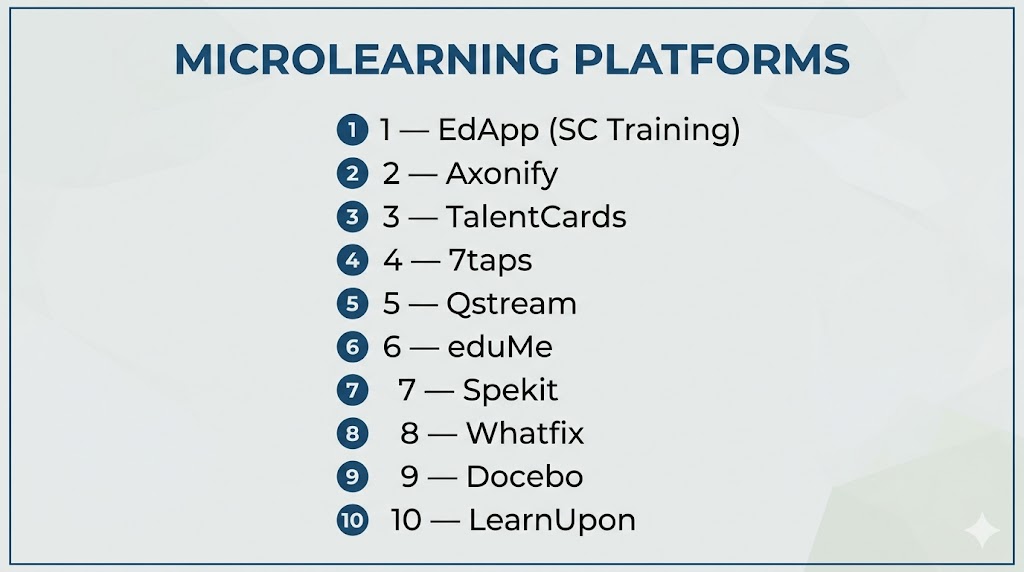
Top 10 Microlearning Platforms
#1 — EdApp (SC Training)
Short description: Mobile-first microlearning platform with strong gamification and content delivery.
Key Features
- Mobile learning
- Gamification
- Course templates
- Analytics
- Content library
Pros
- Easy to use
- Strong engagement features
Cons
- Limited advanced customization
- Pricing tiers
Platforms / Deployment
Web / Mobile / Cloud
Security & Compliance
Not publicly stated
Integrations & Ecosystem
- LMS tools
- APIs
Support & Community
Strong support
#2 — Axonify
Short description: AI-powered microlearning platform focused on employee performance and reinforcement.
Key Features
- AI-driven learning
- Personalized training
- Gamification
- Analytics
- Reinforcement learning
Pros
- Strong AI capabilities
- Enterprise-ready
Cons
- Expensive
- Complex setup
Platforms / Deployment
Web / Mobile / Cloud
Security & Compliance
Not publicly stated
Integrations & Ecosystem
- Enterprise tools
- APIs
Support & Community
Enterprise support
#3 — TalentCards
Short description: Mobile microlearning platform designed for frontline and deskless workers.
Key Features
- Card-based learning
- Mobile-first design
- Offline access
- Analytics
- Content creation
Pros
- Ideal for deskless teams
- Simple interface
Cons
- Limited advanced features
- Basic customization
Platforms / Deployment
Web / Mobile / Cloud
Security & Compliance
Not publicly stated
Integrations & Ecosystem
- LMS tools
- APIs
Support & Community
Reliable support
#4 — 7taps
Short description: Lightweight microlearning tool focused on rapid content creation.
Key Features
- Quick course creation
- Mobile delivery
- Templates
- Analytics
- Automation
Pros
- Very easy to use
- Fast content creation
Cons
- Limited enterprise features
- Basic reporting
Platforms / Deployment
Web / Cloud
Security & Compliance
Not publicly stated
Integrations & Ecosystem
- APIs
Support & Community
Good support
#5 — Qstream
Short description: Microlearning platform focused on knowledge reinforcement and retention.
Key Features
- Spaced learning
- Gamification
- Analytics
- Performance tracking
- Automation
Pros
- Strong retention focus
- Proven methodology
Cons
- Limited content creation
- Pricing tiers
Platforms / Deployment
Web / Mobile / Cloud
Security & Compliance
Not publicly stated
Integrations & Ecosystem
- Enterprise tools
- APIs
Support & Community
Professional support
#6 — eduMe
Short description: Microlearning platform designed for workforce training and onboarding.
Key Features
- Mobile learning
- Training modules
- Analytics
- Automation
- Integration
Pros
- Great for onboarding
- Easy deployment
Cons
- Limited advanced features
- Pricing tiers
Platforms / Deployment
Web / Mobile / Cloud
Security & Compliance
Not publicly stated
Integrations & Ecosystem
- HR tools
- APIs
Support & Community
Good support
#7 — Spekit
Short description: Just-in-time microlearning platform integrated into workflow tools.
Key Features
- In-app learning
- Knowledge base
- Automation
- Analytics
- Integration
Pros
- Learning in workflow
- Easy access
Cons
- Limited standalone features
- Pricing tiers
Platforms / Deployment
Web / Cloud
Security & Compliance
Not publicly stated
Integrations & Ecosystem
- CRM tools
- APIs
Support & Community
Strong support
#8 — Whatfix
Short description: Digital adoption platform with microlearning and in-app guidance.
Key Features
- In-app training
- Interactive walkthroughs
- Analytics
- Automation
- Knowledge base
Pros
- Strong workflow integration
- Interactive learning
Cons
- Complex setup
- Enterprise-focused
Platforms / Deployment
Web / Cloud
Security & Compliance
Not publicly stated
Integrations & Ecosystem
- Enterprise tools
- APIs
Support & Community
Enterprise support
#9 — Docebo
Short description: Enterprise LMS with strong microlearning and AI-powered capabilities.
Key Features
- Microlearning modules
- AI recommendations
- Analytics
- Automation
- Integration
Pros
- Scalable
- Advanced analytics
Cons
- Expensive
- Complex implementation
Platforms / Deployment
Web / Mobile / Cloud
Security & Compliance
Not publicly stated
Integrations & Ecosystem
- Enterprise systems
- APIs
Support & Community
Enterprise support
#10 — LearnUpon
Short description: LMS platform with microlearning support for corporate training.
Key Features
- Microlearning modules
- Course management
- Reporting
- Automation
- Integration
Pros
- Easy to use
- Strong reporting
Cons
- Limited advanced features
- Pricing tiers
Platforms / Deployment
Web / Mobile / Cloud
Security & Compliance
Not publicly stated
Integrations & Ecosystem
- HR tools
- APIs
Support & Community
Reliable support
Comparison Table (Top 10)
| Tool Name | Best For | Platform(s) Supported | Deployment | Standout Feature | Public Rating |
|---|---|---|---|---|---|
| EdApp (SC Training) | Mobile learning | Web/Mobile | Cloud | Gamification | N/A |
| Axonify | Enterprise | Web/Mobile | Cloud | AI learning | N/A |
| TalentCards | Deskless teams | Web/Mobile | Cloud | Card-based learning | N/A |
| 7taps | Quick creation | Web | Cloud | Simplicity | N/A |
| Qstream | Retention | Web/Mobile | Cloud | Spaced learning | N/A |
| eduMe | Onboarding | Web/Mobile | Cloud | Workforce training | N/A |
| Spekit | Workflow learning | Web | Cloud | In-app learning | N/A |
| Whatfix | Digital adoption | Web | Cloud | Interactive guidance | N/A |
| Docebo | Enterprise | Web/Mobile | Cloud | AI recommendations | N/A |
| LearnUpon | Corporate training | Web/Mobile | Cloud | Reporting | N/A |
Evaluation & Scoring of Microlearning Platforms
| Tool Name | Core (25%) | Ease (15%) | Integrations (15%) | Security (10%) | Performance (10%) | Support (10%) | Value (15%) | Weighted Total |
|---|---|---|---|---|---|---|---|---|
| EdApp | 8 | 9 | 8 | 7 | 8 | 8 | 8 | 8.2 |
| Axonify | 9 | 7 | 9 | 8 | 9 | 8 | 6 | 8.3 |
| TalentCards | 8 | 9 | 7 | 7 | 8 | 7 | 8 | 8.0 |
| 7taps | 7 | 10 | 6 | 6 | 7 | 7 | 9 | 7.9 |
| Qstream | 8 | 8 | 7 | 7 | 8 | 7 | 7 | 7.8 |
| eduMe | 8 | 9 | 7 | 7 | 8 | 7 | 7 | 7.9 |
| Spekit | 8 | 8 | 8 | 7 | 8 | 7 | 7 | 7.9 |
| Whatfix | 9 | 7 | 9 | 8 | 9 | 8 | 6 | 8.3 |
| Docebo | 9 | 7 | 9 | 8 | 9 | 8 | 6 | 8.3 |
| LearnUpon | 8 | 8 | 8 | 7 | 8 | 8 | 7 | 8.0 |
Scores are comparative and reflect balance across usability, features, and value.
Which Microlearning Platform Is Right for You?
Solo / Freelancer
7taps
SMB
EdApp or TalentCards
Mid-Market
eduMe or Spekit
Enterprise
Axonify, Whatfix, or Docebo
Budget vs Premium
Budget tools focus on simplicity; premium tools offer AI and analytics
Feature Depth vs Ease of Use
Simple tools are easier; advanced tools require training
Integrations & Scalability
Enterprise tools provide stronger integrations
Security & Compliance Needs
Large organizations should prioritize secure platforms
Frequently Asked Questions (FAQs)
What is a microlearning platform?
It delivers short, focused learning content in small modules.
Why is microlearning effective?
It improves retention and engagement through bite-sized learning.
How long are microlearning modules?
Typically 2–15 minutes.
Can microlearning replace LMS?
No, it often complements LMS platforms.
Are these platforms mobile-friendly?
Yes, most are mobile-first.
Do they support gamification?
Yes, many include gamified elements.
Are they expensive?
Pricing varies depending on features.
Do they integrate with HR systems?
Yes, integrations are widely supported.
Can they improve employee training?
Yes, they enhance engagement and retention.
What are alternatives?
Traditional LMS or classroom training.
Conclusion
Microlearning platforms have become essential for organizations aiming to deliver fast, engaging, and effective training in today’s fast-paced work environment. While enterprise solutions like Axonify, Whatfix, and Docebo offer powerful AI-driven insights and scalability, tools such as EdApp and 7taps provide simplicity and accessibility for smaller teams. The right choice depends on your training goals, workforce size, and integration needs rather than a single universal solution. It is important to evaluate platforms based on usability, engagement features, and scalability before making a decision. Testing a few tools in real scenarios can help identify the best fit. A well-chosen microlearning platform ultimately drives better learning outcomes and continuous skill development.
