Introduction
HPC Job Schedulers help organizations manage, prioritize, distribute, and optimize workloads across High Performance Computing clusters. These platforms automate job queuing, resource allocation, workload balancing, and compute scheduling for scientific computing, AI training, simulations, rendering, engineering analysis, and large-scale data processing. As enterprises, research institutions, and AI teams deploy increasingly complex compute infrastructure, HPC schedulers have become essential for maximizing cluster efficiency and minimizing idle resources.
Real-world use cases include AI and machine learning training orchestration, scientific simulations, genomic analysis, computational fluid dynamics, financial modeling, rendering farms, and engineering simulations. Buyers evaluating HPC schedulers should focus on scalability, workload orchestration, GPU scheduling, cluster utilization efficiency, cloud bursting, policy management, automation capabilities, integration ecosystem, monitoring visibility, and operational reliability.
Evaluation Criteria for Buyers: Resource scheduling efficiency, GPU and accelerator support, cluster scalability, cloud integration, workload prioritization, policy management, monitoring dashboards, automation workflows, container orchestration compatibility, and operational reliability.
Best for: Research institutions, AI infrastructure teams, engineering organizations, universities, scientific computing environments, rendering farms, and enterprises operating HPC clusters.
Not ideal for: Small businesses with minimal compute infrastructure, organizations without centralized cluster management, or teams requiring only lightweight task automation.
Key Trends in HPC Job Schedulers
- GPU-aware scheduling for AI and machine learning workloads
- Hybrid cloud and cloud-bursting HPC orchestration
- Kubernetes integration for containerized HPC environments
- AI-assisted workload optimization and resource allocation
- Energy-efficient scheduling and sustainability optimization
- Multi-cluster orchestration and federated scheduling
- Real-time monitoring and predictive workload analytics
- Integration with Slurm, Kubernetes, and container runtimes
- Automated policy enforcement and fair-share scheduling
- Support for heterogeneous compute environments
How We Selected These Tools
- Evaluated adoption across enterprise, research, and HPC environments
- Assessed workload scheduling and resource allocation capabilities
- Reviewed scalability for large compute clusters
- Evaluated GPU and accelerator scheduling support
- Considered hybrid cloud and multi-cluster orchestration capabilities
- Assessed monitoring, analytics, and automation functionality
- Reviewed integrations with Kubernetes, containers, and HPC infrastructure
- Evaluated ease of deployment and administration
- Considered operational reliability and scheduling efficiency
- Reviewed vendor ecosystem, support quality, and community adoption
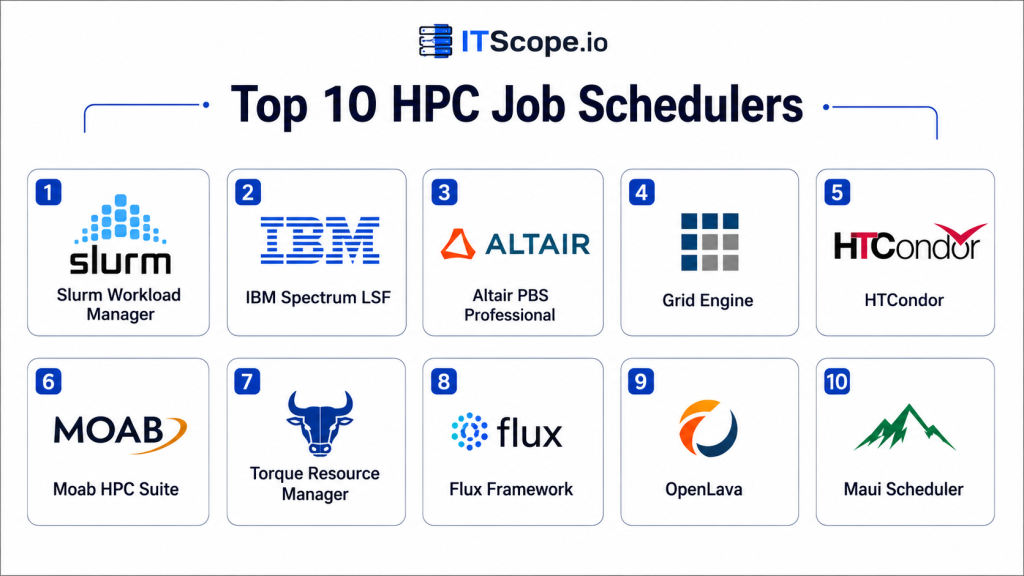
Top 10 HPC Job Schedulers
#1 — Slurm Workload Manager
Short description: Slurm Workload Manager is one of the most widely used open-source HPC schedulers for scientific computing, AI infrastructure, and enterprise HPC clusters. It manages workload scheduling, resource allocation, and cluster orchestration across large distributed environments. Organizations use Slurm for GPU scheduling, AI training, simulations, and research computing workloads. It is highly scalable and widely adopted in supercomputing environments.
Key Features
- Distributed workload scheduling
- GPU and accelerator resource management
- Fair-share scheduling policies
- Multi-cluster federation support
- Cloud bursting capabilities
- Real-time resource allocation
- Container and Kubernetes integration
Pros
- Extremely scalable architecture
- Large open-source community
- Strong GPU scheduling capabilities
- Widely adopted in research environments
Cons
- Requires Linux and HPC expertise
- Complex large-scale configuration
- UI and monitoring require additional tooling
- Enterprise support depends on vendor ecosystem
Platforms / Deployment
Linux
Cloud / Self-hosted / Hybrid
Security & Compliance
RBAC, authentication integration, and audit controls are supported. Security implementation depends on deployment architecture.
Integrations & Ecosystem
Slurm integrates with HPC infrastructure, Kubernetes, AI frameworks, monitoring systems, and container platforms.
- Kubernetes
- NVIDIA GPU infrastructure
- MPI frameworks
- Prometheus
- Containers and Singularity
- Cloud HPC environments
Support & Community
Large open-source community, enterprise vendor ecosystem, extensive documentation, and HPC-focused support services.
#2 — IBM Spectrum LSF
Short description: IBM Spectrum LSF is an enterprise HPC workload scheduler designed for AI, analytics, engineering, and large-scale compute environments. It automates workload distribution, resource optimization, and policy-based scheduling across heterogeneous infrastructure. Organizations use it to manage HPC clusters, AI workloads, and cloud-based compute resources. It is particularly strong in enterprise and hybrid computing environments.
Key Features
- Policy-based workload scheduling
- AI and GPU workload optimization
- Hybrid cloud orchestration
- Multi-cluster management
- Resource utilization analytics
- Fair-share scheduling
- Container-aware scheduling
Pros
- Enterprise-grade scalability
- Strong hybrid cloud support
- Advanced workload optimization
- Good AI and GPU scheduling features
Cons
- Enterprise pricing structure
- Complex administration for large environments
- Requires experienced HPC administrators
- Smaller community than Slurm
Platforms / Deployment
Linux
Cloud / Hybrid / Self-hosted
Security & Compliance
RBAC, enterprise authentication, audit logging, and encryption are commonly supported.
Integrations & Ecosystem
LSF integrates with enterprise HPC infrastructure, AI frameworks, cloud systems, and analytics platforms.
- Kubernetes
- IBM Cloud
- NVIDIA GPU infrastructure
- AI frameworks
- MPI environments
- APIs
Support & Community
IBM provides enterprise support, consulting services, and technical documentation.
#3 — Altair PBS Professional
Short description: Altair PBS Professional is an HPC scheduler designed for scientific computing, engineering simulations, AI workloads, and enterprise compute clusters. It provides workload scheduling, policy enforcement, GPU resource allocation, and cluster optimization. Organizations use PBS Professional to improve cluster utilization and automate compute operations. It is widely used in research and engineering environments.
Key Features
- HPC workload scheduling
- GPU and accelerator support
- Queue management and prioritization
- Cloud bursting support
- Multi-cluster orchestration
- Resource utilization analytics
- Policy-driven scheduling
Pros
- Strong enterprise scheduling capabilities
- Good hybrid cloud support
- Reliable cluster management
- Effective policy enforcement
Cons
- Requires HPC operational expertise
- Enterprise pricing model
- Advanced features require tuning
- Smaller open-source ecosystem than Slurm
Platforms / Deployment
Linux
Cloud / Hybrid / Self-hosted
Security & Compliance
Authentication controls, RBAC, and audit functionality are commonly supported.
Integrations & Ecosystem
PBS Professional integrates with HPC infrastructure, cloud providers, analytics systems, and AI frameworks.
- Kubernetes
- Cloud HPC infrastructure
- MPI systems
- NVIDIA GPU environments
- APIs
- Monitoring systems
Support & Community
Enterprise support, training resources, and HPC consulting services are available.
#4 — Univa Grid Engine
Short description: Univa Grid Engine provides distributed workload scheduling and cluster resource management for HPC, AI, rendering, and scientific computing environments. It supports workload prioritization, automation, and hybrid cloud orchestration. Organizations use it for high-throughput computing and efficient cluster utilization. It is known for scalable scheduling and policy flexibility.
Key Features
- Distributed job scheduling
- High-throughput workload management
- GPU scheduling support
- Resource quota management
- Hybrid cloud integration
- Policy-based scheduling
- Cluster utilization analytics
Pros
- Strong high-throughput workload handling
- Flexible policy controls
- Scalable scheduling architecture
- Good cloud integration support
Cons
- Requires Linux expertise
- Enterprise deployment complexity
- Smaller ecosystem than Slurm
- Advanced monitoring may require integrations
Platforms / Deployment
Linux
Cloud / Hybrid / Self-hosted
Security & Compliance
RBAC, authentication controls, and enterprise admin policies are commonly supported.
Integrations & Ecosystem
Univa Grid Engine integrates with cloud platforms, containers, AI infrastructure, and HPC environments.
- Kubernetes
- Docker
- MPI systems
- Cloud infrastructure
- APIs
- GPU clusters
Support & Community
Enterprise support, consulting, and technical documentation are available.
#5 — HTCondor
Short description: HTCondor is an open-source workload management system designed for high-throughput computing, distributed workloads, and large-scale scientific processing. It helps organizations manage compute-intensive jobs across distributed environments. Research institutions and universities commonly use HTCondor for computational science and distributed resource management. It is especially useful for opportunistic computing environments.
Key Features
- Distributed workload scheduling
- High-throughput computing support
- Job checkpointing and recovery
- Resource matchmaking
- Fair-share scheduling
- Policy-based execution
- Distributed compute federation
Pros
- Strong distributed workload management
- Open-source flexibility
- Good fault tolerance features
- Suitable for academic research environments
Cons
- Requires technical administration expertise
- UI and dashboards are basic
- Enterprise tooling ecosystem smaller
- GPU scheduling less mature than some competitors
Platforms / Deployment
Linux / Windows
Cloud / Self-hosted / Hybrid
Security & Compliance
Authentication, authorization, and workload isolation controls are supported.
Integrations & Ecosystem
HTCondor integrates with distributed compute infrastructure, scientific workflows, and research environments.
- Research clusters
- MPI systems
- Cloud environments
- APIs
- Scientific workflows
Support & Community
Strong academic community, open-source documentation, and research-oriented support ecosystem.
#6 — Kubernetes Volcano
Short description: Volcano is a Kubernetes-native batch scheduler designed for AI, machine learning, HPC, and big data workloads. It extends Kubernetes scheduling capabilities for batch and distributed workloads. Organizations use Volcano to orchestrate containerized AI and HPC jobs across Kubernetes clusters. It is increasingly popular for cloud-native HPC environments.
Key Features
- Kubernetes-native batch scheduling
- GPU-aware workload orchestration
- Queue and priority management
- Distributed AI workload scheduling
- Fair-share scheduling policies
- Elastic job scaling
- Containerized HPC support
Pros
- Strong Kubernetes integration
- Good fit for AI and ML workloads
- Cloud-native architecture
- Flexible container orchestration
Cons
- Requires Kubernetes expertise
- Less mature than traditional HPC schedulers
- Monitoring requires ecosystem tooling
- Enterprise support depends on vendors
Platforms / Deployment
Linux
Cloud / Hybrid
Security & Compliance
Kubernetes security controls, RBAC, and namespace isolation are supported.
Integrations & Ecosystem
Volcano integrates with Kubernetes ecosystems, AI frameworks, cloud infrastructure, and GPU scheduling environments.
- Kubernetes
- NVIDIA GPUs
- Kubeflow
- Prometheus
- Containers
- Cloud-native infrastructure
Support & Community
Open-source community support, Kubernetes ecosystem documentation, and vendor-backed services are available.
#7 — Adaptive Computing Moab
Short description: Adaptive Computing Moab provides policy-driven workload management and scheduling for HPC clusters and enterprise compute environments. It supports workload prioritization, cloud bursting, and resource optimization across distributed compute infrastructure. Organizations use it to improve cluster efficiency and workload automation. It is suitable for enterprise and research HPC environments.
Key Features
- Policy-based workload scheduling
- Fair-share resource allocation
- Cloud bursting capabilities
- Multi-cluster orchestration
- Job prioritization workflows
- Resource monitoring and analytics
- HPC automation tools
Pros
- Flexible scheduling policies
- Strong enterprise workload control
- Good cluster optimization capabilities
- Hybrid infrastructure support
Cons
- Smaller ecosystem than leading competitors
- Enterprise deployment complexity
- Requires experienced administrators
- Limited cloud-native functionality
Platforms / Deployment
Linux
Cloud / Hybrid / Self-hosted
Security & Compliance
Authentication integration, RBAC, and administrative controls are commonly supported.
Integrations & Ecosystem
Moab integrates with enterprise HPC systems, resource managers, and cloud infrastructure.
- HPC resource managers
- Cloud infrastructure
- APIs
- Monitoring tools
- MPI systems
Support & Community
Enterprise support and technical consulting services are available.
#8 — Flux Framework
Short description: Flux Framework is a next-generation open-source HPC scheduler designed for scalable, hierarchical resource management in modern compute environments. It focuses on flexible scheduling architectures and composable workload orchestration. Research institutions and advanced HPC teams use Flux for experimental and large-scale distributed computing. It is particularly useful for modern exascale computing initiatives.
Key Features
- Hierarchical resource scheduling
- Scalable distributed orchestration
- Flexible workload composition
- HPC resource management
- Container-aware scheduling
- Workflow automation
- Exascale computing support
Pros
- Modern scheduling architecture
- Good scalability for advanced HPC environments
- Flexible workload orchestration
- Open-source innovation focus
Cons
- Requires advanced HPC expertise
- Smaller ecosystem and community
- Less mature enterprise tooling
- Limited commercial support options
Platforms / Deployment
Linux
Self-hosted / Hybrid
Security & Compliance
Authentication, workload isolation, and HPC security controls are supported depending on deployment.
Integrations & Ecosystem
Flux integrates with HPC systems, container workflows, and modern distributed compute infrastructure.
- Containers
- MPI frameworks
- HPC environments
- APIs
- Scientific workflows
Support & Community
Open-source community, research collaboration ecosystem, and technical documentation are available.
#9 — Grid Engine Open Core
Short description: Grid Engine Open Core is an HPC and distributed workload scheduler designed for batch processing, compute orchestration, and distributed resource management. Organizations use it to manage compute clusters, prioritize workloads, and optimize infrastructure usage. It supports enterprise and research-oriented scheduling use cases. It is suitable for organizations needing traditional distributed compute scheduling.
Key Features
- Batch workload scheduling
- Queue management and prioritization
- Distributed resource allocation
- Fair-share scheduling
- Resource monitoring
- Cluster management
- Job dependency handling
Pros
- Stable scheduling functionality
- Open-source deployment flexibility
- Good distributed workload management
- Suitable for traditional HPC environments
Cons
- Older architecture compared to newer schedulers
- Smaller ecosystem
- UI capabilities are limited
- Advanced cloud-native features are minimal
Platforms / Deployment
Linux
Self-hosted / Hybrid
Security & Compliance
Authentication, RBAC, and workload isolation controls are supported.
Integrations & Ecosystem
Grid Engine integrates with distributed compute environments and enterprise HPC infrastructure.
- MPI environments
- Distributed clusters
- APIs
- Monitoring tools
- Scientific workloads
Support & Community
Community-driven documentation and enterprise support through vendors are available.
#10 — OpenLava
Short description: OpenLava is an open-source cluster scheduler derived from earlier enterprise workload management systems. It supports job scheduling, queue management, and distributed compute orchestration for HPC and scientific environments. Organizations use it for smaller HPC deployments and research-oriented clusters. It is best suited for teams seeking lightweight open-source scheduling.
Key Features
- Batch job scheduling
- Cluster resource management
- Queue prioritization
- Workload distribution
- Resource allocation policies
- Distributed compute support
- Open-source deployment model
Pros
- Lightweight open-source scheduler
- Flexible deployment options
- Suitable for smaller HPC clusters
- Simple scheduling workflows
Cons
- Limited modern cloud-native functionality
- Smaller ecosystem and community
- Fewer enterprise integrations
- Advanced analytics are minimal
Platforms / Deployment
Linux
Self-hosted
Security & Compliance
Authentication and administrative controls are supported depending on deployment.
Integrations & Ecosystem
OpenLava integrates with traditional HPC infrastructure and distributed compute environments.
- HPC clusters
- MPI systems
- Linux environments
- APIs
- Scientific workloads
Support & Community
Open-source documentation and community resources are available.
Comparison Table
| Tool Name | Best For | Platform Supported | Deployment | Standout Feature | Public Rating |
|---|---|---|---|---|---|
| Slurm Workload Manager | Large-scale HPC clusters | Linux | Cloud / Self-hosted / Hybrid | Massive scalability | N/A |
| IBM Spectrum LSF | Enterprise HPC and AI | Linux | Cloud / Hybrid / Self-hosted | AI and GPU optimization | N/A |
| Altair PBS Professional | Scientific computing | Linux | Cloud / Hybrid / Self-hosted | Policy-based scheduling | N/A |
| Univa Grid Engine | High-throughput workloads | Linux | Cloud / Hybrid / Self-hosted | Flexible policy management | N/A |
| HTCondor | Distributed scientific workloads | Linux / Windows | Cloud / Self-hosted / Hybrid | Opportunistic computing | N/A |
| Kubernetes Volcano | Cloud-native HPC | Linux | Cloud / Hybrid | Kubernetes-native scheduling | N/A |
| Adaptive Computing Moab | Enterprise HPC orchestration | Linux | Cloud / Hybrid / Self-hosted | Policy-driven optimization | N/A |
| Flux Framework | Exascale computing | Linux | Self-hosted / Hybrid | Hierarchical scheduling | N/A |
| Grid Engine Open Core | Traditional HPC scheduling | Linux | Self-hosted / Hybrid | Distributed queue management | N/A |
| OpenLava | Lightweight HPC scheduling | Linux | Self-hosted | Lightweight open-source scheduling | N/A |
Evaluation & Scoring
| Tool Name | Core 25% | Ease 15% | Integrations 15% | Security 10% | Performance 10% | Support 10% | Value 15% | Weighted Total |
|---|---|---|---|---|---|---|---|---|
| Slurm Workload Manager | 9.5 | 7.5 | 9.0 | 8.5 | 9.5 | 8.5 | 9.0 | 8.88 |
| IBM Spectrum LSF | 9.0 | 7.0 | 8.5 | 8.5 | 9.0 | 8.5 | 7.0 | 8.30 |
| Altair PBS Professional | 8.5 | 7.0 | 8.0 | 8.0 | 8.5 | 8.0 | 7.5 | 8.00 |
| Univa Grid Engine | 8.0 | 7.0 | 7.5 | 8.0 | 8.0 | 7.5 | 7.5 | 7.70 |
| HTCondor | 8.0 | 7.0 | 7.0 | 7.5 | 8.0 | 7.5 | 8.5 | 7.78 |
| Kubernetes Volcano | 8.0 | 7.5 | 8.5 | 8.0 | 8.0 | 7.5 | 8.0 | 7.95 |
| Adaptive Computing Moab | 7.5 | 6.5 | 7.5 | 8.0 | 8.0 | 7.0 | 7.0 | 7.35 |
| Flux Framework | 7.5 | 6.0 | 7.0 | 7.5 | 8.5 | 6.5 | 8.0 | 7.28 |
| Grid Engine Open Core | 7.0 | 6.5 | 6.5 | 7.5 | 7.5 | 6.5 | 8.0 | 7.05 |
| OpenLava | 6.5 | 7.0 | 6.0 | 7.0 | 7.0 | 6.0 | 8.5 | 6.93 |
These scores are comparative and intended to guide evaluation based on scalability, scheduling efficiency, operational complexity, and ecosystem maturity. Enterprise schedulers generally score higher in scalability and integrations, while open-source platforms often score better for flexibility and cost efficiency. Buyers should prioritize based on workload type, cluster scale, GPU usage, and operational expertise.
Which HPC Job Scheduler Is Right for You?
Solo / Freelancer
HTCondor or OpenLava can work well for lightweight research clusters and distributed compute experiments where simplicity and cost efficiency matter most.
SMB
Grid Engine Open Core and Kubernetes Volcano are suitable for smaller HPC environments needing manageable deployment complexity and flexible workload orchestration.
Mid-Market
Altair PBS Professional and Univa Grid Engine provide stronger policy-based scheduling, GPU support, and enterprise-ready cluster management capabilities.
Enterprise
Slurm Workload Manager, IBM Spectrum LSF, and Adaptive Computing Moab are better suited for large-scale HPC, AI training, and hybrid cloud orchestration environments.
Budget vs Premium
Open-source platforms like Slurm and HTCondor reduce licensing costs but require internal expertise. Enterprise platforms provide stronger vendor support, analytics, and operational tooling.
Feature Depth vs Ease of Use
Enterprise schedulers offer advanced workload orchestration and policy management but require experienced administrators. Kubernetes-native schedulers may simplify cloud-native HPC workflows.
Integrations & Scalability
Organizations should evaluate integrations with Kubernetes, GPU infrastructure, MPI systems, AI frameworks, monitoring tools, and cloud HPC environments.
Security & Compliance Needs
HPC environments handling sensitive workloads should prioritize RBAC, workload isolation, authentication integration, audit logging, and secure multi-tenant scheduling capabilities.
Frequently Asked Questions
1. What is an HPC Job Scheduler?
An HPC Job Scheduler distributes workloads across compute clusters and allocates resources efficiently.
It automates job queuing, prioritization, and execution in HPC environments.
These tools are essential for scientific computing, AI training, and large-scale simulations.
2. Why are HPC schedulers important?
They maximize cluster utilization, reduce idle resources, and improve workload efficiency.
Schedulers also automate resource allocation and workload balancing.
Without scheduling, large HPC environments become difficult to manage effectively.
3. What workloads commonly use HPC schedulers?
AI training, scientific simulations, rendering, genomic analysis, engineering simulations, and financial modeling commonly rely on HPC scheduling platforms.
Many organizations also use them for large-scale distributed analytics workloads.
4. What is GPU-aware scheduling?
GPU-aware scheduling intelligently allocates GPU resources to AI and compute-intensive workloads.
This improves resource utilization and prevents GPU bottlenecks in shared clusters.
5. Are open-source HPC schedulers common?
Yes, Slurm and HTCondor are widely adopted open-source HPC schedulers.
Many research institutions and supercomputing centers rely heavily on open-source scheduling technologies.
6. Can these schedulers integrate with Kubernetes?
Yes, modern HPC schedulers increasingly integrate with Kubernetes and container orchestration environments.
Kubernetes Volcano is specifically designed for cloud-native HPC scheduling workflows.
7. What is fair-share scheduling?
Fair-share scheduling ensures compute resources are distributed fairly across teams and workloads.
It helps prevent resource monopolization in shared cluster environments.
8. Do these platforms support cloud bursting?
Yes, many enterprise schedulers support cloud bursting to dynamically scale workloads into public cloud environments during peak demand.
9. What skills are required to manage HPC schedulers?
Administrators typically need Linux, networking, cluster management, and workload orchestration expertise.
Large deployments may also require Kubernetes and cloud infrastructure knowledge.
10. What should buyers evaluate before selecting a scheduler?
Organizations should assess scalability, GPU support, workload complexity, cloud integration, monitoring capabilities, automation features, and operational expertise requirements before deployment.
Conclusion
HPC Job Schedulers are essential for organizations operating scientific computing, AI infrastructure, rendering farms, and large-scale distributed compute environments. Open-source leaders like Slurm Workload Manager continue to dominate research and supercomputing environments due to scalability and flexibility, while enterprise platforms such as IBM Spectrum LSF and Altair PBS Professional provide advanced workload orchestration and support capabilities. Kubernetes Volcano is increasingly attractive for cloud-native AI and HPC deployments, especially in containerized environments. The ideal scheduler depends on cluster scale, GPU usage, cloud strategy, workload diversity, and operational expertise. Before selecting a platform, organizations should validate scheduling efficiency, test workload orchestration performance, evaluate monitoring and automation capabilities, and run pilot deployments to ensure long-term operational scalability and reliability.

This article gives a clear overview of HPC job schedulers and explains how they help manage computing resources and workloads efficiently in high-performance environments. It also highlights the strengths and limitations of different schedulers in handling large-scale computational tasks.
One important consideration that is often overlooked in HPC scheduler comparisons is how they handle mixed workloads and resource contention in modern environments. Traditional batch scheduling works well for large simulations, but many organizations now run a combination of AI training, data processing, interactive research, and long-running HPC jobs on shared infrastructure. The real challenge becomes fair-share scheduling, GPU allocation efficiency, queue optimization, and preventing resource fragmentation. Teams should also evaluate observability, capacity forecasting, and integration with cloud bursting strategies, since operational efficiency and cluster utilization often have a greater impact on total cost and user satisfaction than raw scheduling features alone.
In HPC environments, scheduler efficiency is only part of the equation; cluster utilization often depends on how effectively resources are allocated across competing workloads. Large organizations frequently encounter challenges with queue prioritization, resource fragmentation, and fair-share policies that can impact both performance and user satisfaction. Examining capacity forecasting and workload optimization strategies would add valuable operational context beyond feature comparisons.
Selecting an HPC job scheduler is not only about maximizing cluster utilization but also about ensuring fair resource allocation across diverse research teams and workloads. As organizations increasingly run AI training, simulations, and data-intensive analytics on shared infrastructure, balancing priority, cost, and execution time becomes more challenging. Including guidance on policy-based scheduling, quality of service (QoS), and workload forecasting would provide readers with a more practical understanding of how schedulers support efficient and equitable use of HPC resources.