Introduction
Pipeline Integrity Management Software helps energy, oil & gas, utility, and infrastructure organizations monitor, inspect, assess, and maintain the safety and operational health of pipeline networks. These platforms combine asset data, GIS mapping, corrosion monitoring, risk analysis, inspection records, leak detection, compliance workflows, and predictive analytics into centralized operational systems.
As pipeline infrastructure becomes more digitally connected and regulatory scrutiny increases, integrity management platforms are becoming essential for reducing environmental risk, improving operational reliability, and supporting proactive maintenance programs. Modern solutions increasingly include AI-based anomaly detection, digital twins, IoT sensor integration, predictive corrosion modeling, and cloud-enabled field operations.
Real-world use cases include:
- Oil and gas pipeline integrity monitoring
- Corrosion and crack risk assessment
- Leak detection and incident management
- Regulatory compliance reporting
- GIS-based asset management and inspection planning
Key evaluation criteria buyers should consider:
- Risk assessment and analytics depth
- GIS and mapping capabilities
- Compliance and audit reporting
- Integration with SCADA and IoT systems
- Leak detection functionality
- Mobile field inspection support
- Scalability across pipeline networks
- Predictive maintenance features
- Security and access controls
- Data visualization and reporting quality
Best for: pipeline operators, oil & gas enterprises, utility companies, midstream operators, infrastructure engineering firms, integrity engineers, and industrial asset management teams.
Not ideal for: organizations with minimal infrastructure assets or companies needing only lightweight maintenance tracking without regulatory or integrity management requirements.
Key Trends in Pipeline Integrity Management Software
- AI-powered predictive integrity analytics are helping operators identify corrosion, stress, and failure risks earlier.
- Digital twin adoption is improving simulation and lifecycle management of critical pipeline infrastructure.
- Drone and remote inspection integration is expanding for hazardous and geographically remote assets.
- Cloud-based integrity platforms are replacing siloed desktop systems for centralized operations visibility.
- IoT-enabled sensor monitoring is improving real-time pressure, vibration, and leak detection.
- GIS-centric operational workflows are becoming core to integrity and compliance management.
- Automated regulatory reporting is reducing compliance overhead for operators.
- Cybersecurity requirements are increasing as pipeline infrastructure becomes more connected.
- Mobile-first field inspection applications are streamlining technician workflows and offline data collection.
- Integrated ESG and environmental monitoring is becoming increasingly important for infrastructure operators.
How We Selected These Tools
The tools in this list were selected based on practical operational requirements and industry adoption across pipeline and infrastructure management environments.
- Evaluated market adoption within oil & gas and utility sectors.
- Assessed integrity management feature completeness.
- Reviewed GIS, risk analysis, and inspection management capabilities.
- Considered scalability for enterprise pipeline networks.
- Evaluated integration support for SCADA, IoT, and enterprise systems.
- Reviewed predictive maintenance and AI analytics capabilities.
- Considered compliance reporting and regulatory workflow support.
- Evaluated usability for both office and field operations.
- Reviewed deployment flexibility including cloud and hybrid environments.
- Assessed vendor maturity, ecosystem strength, and support capabilities.
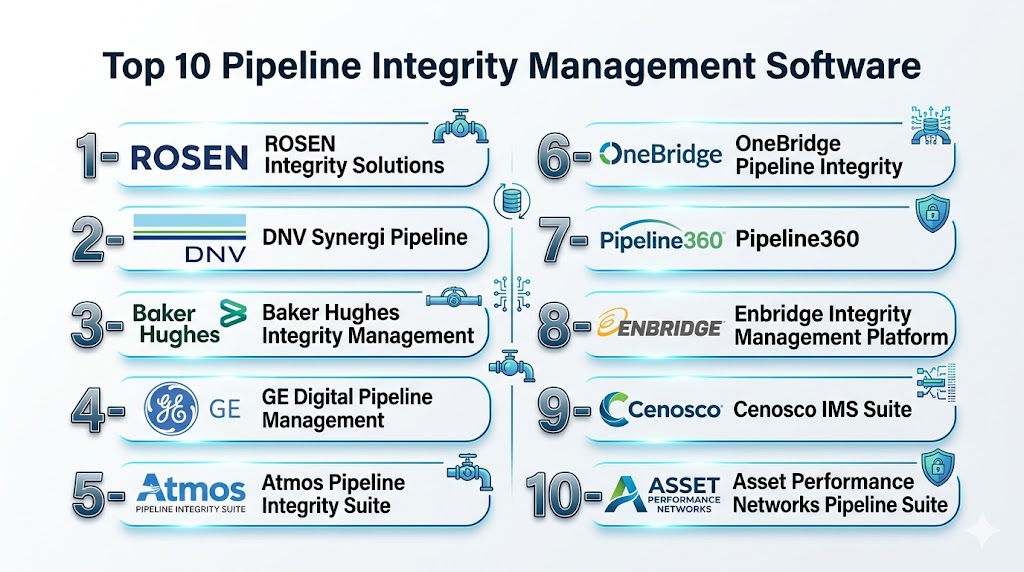
Top 10 Pipeline Integrity Management Software Tools
1- ROSEN Integrity Management
Short description: ROSEN Integrity Management is a widely recognized platform designed for pipeline operators managing large-scale integrity and inspection programs. It combines risk analysis, inspection analytics, defect assessment, and integrity planning into a centralized operational environment. The platform is commonly used in oil, gas, and hazardous liquid pipeline operations.
Key Features
- Pipeline integrity analytics
- Defect assessment and risk modeling
- Inline inspection data analysis
- Corrosion monitoring
- GIS-enabled visualization
- Predictive maintenance support
- Compliance reporting workflows
Pros
- Strong industry reputation
- Advanced integrity analytics
- Excellent inspection data handling
- Suitable for large pipeline networks
Cons
- Enterprise-focused complexity
- Higher implementation effort
- May require specialized training
- Pricing can be significant
Platforms / Deployment
- Web / Windows
- Cloud / Hybrid
Security & Compliance
- RBAC
- Audit logging
- User authentication
- Not publicly stated for certifications
Integrations & Ecosystem
ROSEN integrates with inspection technologies, GIS platforms, and operational systems used in energy infrastructure management.
- GIS integrations
- Inspection data systems
- API support
- SCADA compatibility
- Reporting integrations
Support & Community
Strong enterprise implementation services with extensive pipeline industry expertise and consulting support.
2- DNV Synergi Pipeline
Short description: DNV Synergi Pipeline provides integrity management, risk assessment, and simulation capabilities for pipeline operators. The platform is designed to support operational safety, compliance, and predictive maintenance across complex energy infrastructure environments.
Key Features
- Risk and consequence modeling
- Pipeline simulation
- Integrity assessment workflows
- GIS integration
- Leak detection analysis
- Incident management
- Regulatory reporting tools
Pros
- Strong engineering analytics
- Mature risk modeling capabilities
- Excellent regulatory support
- Enterprise scalability
Cons
- Steeper learning curve
- Requires technical expertise
- Deployment may be resource intensive
- UI complexity for smaller teams
Platforms / Deployment
- Windows / Web
- Cloud / Hybrid
Security & Compliance
- RBAC
- MFA
- Audit trails
- Not publicly stated for certifications
Integrations & Ecosystem
DNV supports integration with engineering tools, GIS platforms, and operational management systems.
- GIS platforms
- SCADA systems
- Engineering applications
- API integrations
- Asset management systems
Support & Community
Strong enterprise support with engineering consulting and industry-focused onboarding services.
3- GE Vernova Pipeline Integrity Suite
Short description: GE Vernova Pipeline Integrity Suite provides operational monitoring, risk management, and asset analytics for energy infrastructure operators. It is designed for organizations requiring centralized visibility across large and distributed pipeline assets.
Key Features
- Pipeline monitoring dashboards
- Asset health analytics
- Risk-based integrity management
- Leak detection support
- Predictive maintenance tools
- GIS-enabled visualization
- Compliance workflows
Pros
- Enterprise-grade scalability
- Strong operational visibility
- Advanced analytics support
- Broad industrial ecosystem
Cons
- Best suited for larger enterprises
- Complex deployment requirements
- Premium pricing
- Some customization may require consulting
Platforms / Deployment
- Web
- Cloud / Hybrid
Security & Compliance
- MFA
- RBAC
- Audit logging
- Encryption
Integrations & Ecosystem
GE Vernova integrates with industrial systems, SCADA infrastructure, and enterprise operational technologies.
- Industrial IoT integrations
- SCADA connectivity
- API ecosystem
- GIS integrations
- ERP support
Support & Community
Global enterprise support presence with strong industrial implementation expertise.
4- Bentley OpenUtilities sisNET
Short description: Bentley OpenUtilities sisNET is designed for pipeline and utility operators needing network modeling, integrity analysis, and operational visibility. It combines spatial intelligence with infrastructure management capabilities.
Key Features
- Pipeline network modeling
- GIS mapping
- Asset integrity workflows
- Spatial analytics
- Leak analysis support
- Inspection management
- Data visualization
Pros
- Strong GIS capabilities
- Useful for utility infrastructure
- Detailed spatial analytics
- Good engineering integrations
Cons
- Best for organizations already using Bentley ecosystem
- UI can require training
- Enterprise deployment effort
- Smaller teams may find it complex
Platforms / Deployment
- Windows / Web
- Hybrid
Security & Compliance
- User authentication
- RBAC
- Encryption
- Not publicly stated for certifications
Integrations & Ecosystem
Bentley integrates with engineering, GIS, and infrastructure management systems.
- Bentley ecosystem tools
- GIS integrations
- Engineering applications
- API support
Support & Community
Strong engineering-focused support and documentation ecosystem.
5- SAP Asset Performance Management
Short description: SAP Asset Performance Management supports industrial asset reliability, integrity, and predictive maintenance across infrastructure-heavy industries. Pipeline operators use it to centralize operational and maintenance intelligence.
Key Features
- Predictive maintenance analytics
- Asset integrity management
- Risk monitoring
- IoT integration
- Maintenance planning
- Operational dashboards
- Enterprise reporting
Pros
- Strong enterprise integration
- Excellent ERP connectivity
- Advanced analytics
- Scalable infrastructure support
Cons
- Complex implementation process
- Requires SAP ecosystem expertise
- Higher operational costs
- Customization can be extensive
Platforms / Deployment
- Web
- Cloud / Hybrid
Security & Compliance
- SSO
- MFA
- RBAC
- Audit logging
Integrations & Ecosystem
SAP integrates with enterprise ERP systems, IoT environments, and industrial monitoring platforms.
- SAP ERP integration
- Industrial IoT systems
- API framework
- Maintenance systems
- Analytics integrations
Support & Community
Large enterprise support ecosystem with extensive global consulting availability.
6- Honeywell Forge Asset Performance Management
Short description: Honeywell Forge Asset Performance Management provides operational intelligence, integrity analytics, and industrial asset monitoring for critical infrastructure environments. It supports predictive maintenance and reliability engineering initiatives.
Key Features
- Asset performance monitoring
- Predictive analytics
- Risk management dashboards
- Industrial IoT integration
- Operational alerts
- Reliability analytics
- Centralized monitoring
Pros
- Strong industrial analytics
- Scalable enterprise architecture
- Good IoT support
- Useful predictive maintenance tools
Cons
- Enterprise-oriented complexity
- Premium deployment costs
- Training may be required
- Best suited for large organizations
Platforms / Deployment
- Web
- Cloud / Hybrid
Security & Compliance
- MFA
- RBAC
- Encryption
- Audit logging
Integrations & Ecosystem
Honeywell integrates with industrial systems, SCADA environments, and operational technology platforms.
- Industrial automation systems
- SCADA integrations
- API support
- IoT connectivity
- Enterprise analytics tools
Support & Community
Strong industrial support organization with enterprise implementation expertise.
7- Emerson Pipeline Manager
Short description: Emerson Pipeline Manager focuses on real-time pipeline monitoring, leak detection, and operational optimization. It is widely used in oil and gas transmission environments requiring continuous monitoring and control.
Key Features
- Real-time pipeline monitoring
- Leak detection analytics
- Operational simulation
- Alarm management
- SCADA integration
- Flow analysis
- Incident management
Pros
- Strong real-time visibility
- Reliable leak detection tools
- Mature operational capabilities
- Well suited for transmission operators
Cons
- Specialized deployment requirements
- UI modernization could improve
- Enterprise pricing structure
- Requires operational expertise
Platforms / Deployment
- Windows / Web
- Hybrid
Security & Compliance
- RBAC
- Audit logging
- User authentication
- Not publicly stated for certifications
Integrations & Ecosystem
Emerson integrates with industrial automation, SCADA, and operational infrastructure systems.
- SCADA integrations
- Industrial automation support
- API connectivity
- Monitoring systems
Support & Community
Strong operational support and industrial engineering services.
8- Quorum Pipeline Management
Short description: Quorum Pipeline Management provides operational, integrity, and compliance tools for midstream and pipeline operators. It supports inspection tracking, maintenance planning, and operational analytics.
Key Features
- Integrity management workflows
- Compliance tracking
- Inspection scheduling
- Operational analytics
- GIS-enabled visibility
- Incident management
- Maintenance planning
Pros
- Good operational workflow support
- Strong midstream industry focus
- Compliance-oriented features
- Flexible reporting tools
Cons
- Some advanced analytics may vary
- UI can feel dated in some modules
- Enterprise customization may require consulting
- Mobile functionality varies
Platforms / Deployment
- Web
- Cloud / Hybrid
Security & Compliance
- RBAC
- Encryption
- Audit logging
- Not publicly stated for certifications
Integrations & Ecosystem
Quorum integrates with operational systems, GIS tools, and enterprise infrastructure environments.
- GIS integrations
- API framework
- Compliance systems
- Operational reporting tools
Support & Community
Established energy-sector support organization with onboarding and consulting services.
9- ESRI ArcGIS Pipeline Referencing
Short description: ESRI ArcGIS Pipeline Referencing helps pipeline operators manage spatially enabled integrity and operational data using GIS-based workflows. It is commonly used for mapping, inspection visualization, and asset analysis.
Key Features
- GIS-based pipeline mapping
- Spatial data management
- Asset visualization
- Inspection tracking
- Route referencing
- Operational analytics
- Geospatial reporting
Pros
- Industry-leading GIS capabilities
- Strong visualization tools
- Excellent mapping accuracy
- Flexible geospatial workflows
Cons
- Requires GIS expertise
- Not a full standalone integrity suite
- Advanced analytics may require additional tools
- Enterprise deployment complexity
Platforms / Deployment
- Web / Windows
- Cloud / Hybrid
Security & Compliance
- SSO
- RBAC
- MFA
- Audit controls
Integrations & Ecosystem
ArcGIS integrates broadly across infrastructure management, analytics, and enterprise systems.
- GIS ecosystem integrations
- API framework
- SCADA support
- Engineering tools
- Data analytics integrations
Support & Community
Large global GIS community with extensive documentation and training resources.
10- Cenosco IMS Suite
Short description: Cenosco IMS Suite is an integrity management platform focused on asset-heavy industries including pipelines, offshore operations, and industrial infrastructure. It provides risk-based inspection and integrity workflows.
Key Features
- Risk-based inspection management
- Corrosion analysis
- Integrity workflow automation
- Compliance management
- Inspection analytics
- Operational dashboards
- Asset lifecycle management
Pros
- Strong integrity workflow capabilities
- Useful inspection analytics
- Good compliance support
- Suitable for industrial infrastructure
Cons
- Requires implementation planning
- Enterprise-oriented pricing
- Smaller organizations may find it complex
- Customization may require consulting
Platforms / Deployment
- Web
- Cloud / Hybrid
Security & Compliance
- RBAC
- Audit logging
- Encryption
- Not publicly stated for certifications
Integrations & Ecosystem
Cenosco supports integrations with inspection systems, enterprise platforms, and operational analytics environments.
- API integrations
- Inspection systems
- Enterprise reporting tools
- Operational analytics support
Support & Community
Strong enterprise onboarding and implementation-focused support services.
Comparison Table
| Tool Name | Best For | Platform(s) Supported | Deployment | Standout Feature | Public Rating |
|---|---|---|---|---|---|
| ROSEN Integrity Management | Large pipeline operators | Web, Windows | Cloud, Hybrid | Advanced integrity analytics | N/A |
| DNV Synergi Pipeline | Risk and simulation modeling | Windows, Web | Cloud, Hybrid | Engineering-grade risk modeling | N/A |
| GE Vernova Pipeline Integrity Suite | Enterprise infrastructure monitoring | Web | Cloud, Hybrid | Industrial operational analytics | N/A |
| Bentley OpenUtilities sisNET | GIS-driven utility operations | Windows, Web | Hybrid | Spatial infrastructure intelligence | N/A |
| SAP Asset Performance Management | Enterprise asset operations | Web | Cloud, Hybrid | ERP-integrated asset intelligence | N/A |
| Honeywell Forge APM | Industrial asset reliability | Web | Cloud, Hybrid | Predictive maintenance analytics | N/A |
| Emerson Pipeline Manager | Real-time transmission monitoring | Windows, Web | Hybrid | Leak detection and monitoring | N/A |
| Quorum Pipeline Management | Midstream pipeline workflows | Web | Cloud, Hybrid | Compliance-oriented operations | N/A |
| ESRI ArcGIS Pipeline Referencing | GIS-centric pipeline mapping | Web, Windows | Cloud, Hybrid | Advanced geospatial management | N/A |
| Cenosco IMS Suite | Risk-based inspection programs | Web | Cloud, Hybrid | Integrity workflow automation | N/A |
Evaluation & Scoring of Pipeline Integrity Management Software
| Tool Name | Core 25% | Ease 15% | Integrations 15% | Security 10% | Performance 10% | Support 10% | Value 15% | Weighted Total |
|---|---|---|---|---|---|---|---|---|
| ROSEN Integrity Management | 9 | 7 | 8 | 8 | 9 | 8 | 7 | 8.1 |
| DNV Synergi Pipeline | 9 | 6 | 8 | 8 | 9 | 8 | 7 | 8.0 |
| GE Vernova Pipeline Integrity Suite | 8 | 7 | 9 | 8 | 8 | 8 | 7 | 7.9 |
| Bentley OpenUtilities sisNET | 8 | 7 | 8 | 7 | 8 | 7 | 7 | 7.6 |
| SAP Asset Performance Management | 9 | 6 | 10 | 9 | 8 | 9 | 6 | 8.2 |
| Honeywell Forge APM | 8 | 7 | 8 | 8 | 8 | 8 | 7 | 7.8 |
| Emerson Pipeline Manager | 8 | 7 | 8 | 7 | 9 | 8 | 7 | 7.8 |
| Quorum Pipeline Management | 7 | 8 | 7 | 7 | 7 | 7 | 8 | 7.4 |
| ESRI ArcGIS Pipeline Referencing | 8 | 7 | 9 | 8 | 8 | 8 | 7 | 7.9 |
| Cenosco IMS Suite | 8 | 7 | 7 | 7 | 8 | 7 | 7 | 7.5 |
These scores are comparative and intended to help organizations evaluate relative strengths across operational scenarios. Enterprise-focused platforms generally score higher in integrations, analytics depth, and scalability, while lighter operational platforms may perform better in usability and deployment simplicity. Buyers should align scoring priorities with infrastructure complexity, compliance requirements, and operational maturity. A higher overall score does not necessarily mean a better fit for every organization.
Which Pipeline Integrity Management Software Tool Is Right for You?
Solo / Freelancer
Independent consultants and smaller engineering firms may benefit most from GIS-focused or lightweight integrity tools that prioritize visualization and reporting over enterprise-scale operational complexity. ESRI ArcGIS Pipeline Referencing can work well for spatial analysis and inspection workflows.
SMB
Small and mid-sized pipeline operators should prioritize manageable deployment, compliance support, and operational visibility. Quorum Pipeline Management and Bentley OpenUtilities sisNET provide balanced functionality without excessive enterprise complexity.
Mid-Market
Mid-market infrastructure operators often require centralized integrity workflows, predictive maintenance support, and scalable operational analytics. Honeywell Forge APM and Emerson Pipeline Manager are strong choices for balancing operational depth with scalability.
Enterprise
Large pipeline operators and infrastructure-heavy enterprises typically require advanced analytics, risk modeling, compliance management, and enterprise integrations. ROSEN Integrity Management, SAP Asset Performance Management, and DNV Synergi Pipeline are particularly strong for enterprise-scale integrity programs.
Budget vs Premium
Budget-conscious buyers should focus on modular deployment and operational priorities instead of pursuing broad enterprise suites immediately. Premium enterprise platforms deliver deeper predictive analytics, automation, and integration capabilities but may require substantial implementation investment.
Feature Depth vs Ease of Use
Platforms with extensive risk modeling and integrity analytics often involve more training and deployment planning. Simpler operational platforms may reduce onboarding complexity but offer less advanced engineering intelligence and predictive capabilities.
Integrations & Scalability
Organizations with complex infrastructure environments should prioritize platforms with strong SCADA, GIS, IoT, and ERP integration capabilities. Scalability becomes critical for operators managing geographically distributed pipeline assets.
Security & Compliance Needs
Pipeline infrastructure operators should prioritize RBAC, audit logging, MFA, and operational governance controls. Regulatory compliance and cybersecurity requirements are increasingly important for critical infrastructure environments.
Frequently Asked Questions
1- What is Pipeline Integrity Management Software?
Pipeline Integrity Management Software helps operators monitor, assess, inspect, and maintain the operational health of pipeline infrastructure. These platforms combine integrity analytics, GIS mapping, inspection records, and risk management workflows into centralized operational systems.
2- Which industries commonly use these platforms?
These tools are primarily used in oil and gas, utilities, energy infrastructure, chemicals, and industrial transportation sectors. Midstream operators and hazardous liquid pipeline companies are among the largest users of integrity management platforms.
3- Why are GIS capabilities important in pipeline integrity management?
GIS functionality allows operators to visualize pipeline assets geographically, monitor inspection locations, track environmental risk areas, and manage route-based operational workflows. Spatial visibility is critical for planning and incident response activities.
4- Do these platforms support predictive maintenance?
Many modern integrity management solutions include predictive maintenance capabilities using AI analytics, historical inspection data, sensor monitoring, and operational modeling. These features help reduce downtime and improve asset reliability.
5- How difficult is implementation?
Implementation complexity depends on pipeline scale, existing infrastructure, integration requirements, and operational maturity. Enterprise deployments often require phased rollouts, data migration, and integration planning with SCADA and GIS systems.
6- Can these tools integrate with SCADA systems?
Yes, many enterprise-grade platforms support integration with SCADA environments for operational monitoring and real-time data analysis. Buyers should validate compatibility with existing industrial infrastructure before deployment.
7- What security features should buyers prioritize?
Organizations should prioritize RBAC, MFA, audit logging, encryption, and operational governance controls. Critical infrastructure operators should also evaluate cybersecurity monitoring and compliance reporting capabilities.
8- Are cloud deployments becoming more common?
Cloud and hybrid deployments are becoming increasingly common because they improve scalability, centralized visibility, and remote operational access. However, some operators still prefer hybrid environments due to regulatory or operational requirements.
9- How do pricing models typically work?
Pricing structures vary based on deployment scale, number of monitored assets, analytics depth, and integration requirements. Enterprise integrity management platforms often involve subscription licensing combined with implementation services.
10- What are common mistakes when selecting a platform?
Common mistakes include underestimating integration complexity, ignoring GIS requirements, focusing only on compliance features, and failing to evaluate long-term scalability. Organizations should also ensure field operations teams are included in software evaluation decisions.
Conclusion
Pipeline Integrity Management Software has become a critical operational layer for energy, utility, and industrial infrastructure organizations managing complex and geographically distributed assets. Modern platforms now combine predictive analytics, GIS intelligence, leak detection, inspection management, IoT monitoring, and compliance workflows into centralized operational environments that help improve reliability and reduce operational risk. The right solution depends heavily on infrastructure scale, regulatory requirements, operational maturity, and integration needs. Smaller operators may prioritize usability and cost efficiency, while enterprise organizations often require advanced risk modeling, predictive maintenance, and large-scale operational visibility. Security, scalability, and interoperability are becoming increasingly important as pipeline infrastructure becomes more digitally connected. Rather than searching for a single universal winner, organizations should shortlist two or three platforms that align with their operational priorities, validate integration requirements, evaluate compliance workflows, and run controlled pilot deployments before making a long-term investment decision.

Very informative article on pipeline integrity management software—it clearly explains how these tools help improve safety, monitoring, and maintenance planning for critical infrastructure.
Pipeline integrity management software is most effective when it supports continuous decision-making rather than periodic inspection cycles alone. As pipelines age and operating conditions change, combining inspection history with live operational data enables earlier identification of emerging risks and better maintenance prioritization. Expanding the comparison to include digital twin integration, real-time sensor analytics, geohazard monitoring, and risk-based maintenance planning would provide readers with a more practical view of how these platforms improve safety, regulatory compliance, and long-term asset reliability.