Introduction
Energy Trading & Risk Management ETRM platforms help energy companies manage commodity trading, risk exposure, regulatory compliance, logistics, settlements, and market operations across electricity, natural gas, oil, renewables, and environmental products. These platforms centralize trading workflows, pricing analytics, contract management, scheduling, and financial reporting into a unified operational system.
As energy markets become more volatile and decentralized, modern ETRM platforms have evolved beyond basic trade capture systems into highly sophisticated operational intelligence environments. Organizations now rely on AI-driven forecasting, real-time risk analytics, cloud-native deployments, renewable energy trading support, and advanced market integrations to optimize trading decisions and maintain regulatory compliance.
Common real-world use cases include:
- Power and gas trading operations
- Commodity risk and exposure management
- Renewable energy certificate tracking
- Trade settlements and confirmations
- Regulatory and compliance reporting
Buyers evaluating ETRM platforms should focus on:
- Commodity and market coverage
- Real-time trading and analytics capabilities
- Risk management functionality
- Integration with exchanges and market operators
- Scheduling and logistics support
- Regulatory reporting workflows
- Scalability for high-volume trading
- Cloud and hybrid deployment flexibility
- Security and audit controls
- Ease of customization and implementation
Best for: Energy traders, utilities, commodity trading firms, oil and gas operators, renewable energy companies, and enterprises managing large-scale energy trading or risk operations.
Not ideal for: Small businesses with limited commodity exposure or organizations requiring only lightweight accounting or spreadsheet-based energy tracking.
Key Trends in Energy Trading & Risk Management Platforms
- AI-powered trading analytics are improving forecasting and risk modeling.
- Renewable energy and carbon credit trading support is expanding rapidly.
- Cloud-native ETRM deployments are becoming more common.
- Real-time market integrations are increasingly critical for traders.
- Advanced scenario modeling is improving risk visibility.
- ESG and sustainability reporting integrations are growing across energy markets.
- Automated compliance reporting is reducing operational overhead.
- API-first architectures are improving interoperability with exchanges and ERP systems.
- Predictive analytics are helping organizations optimize energy portfolios.
- Cybersecurity and operational resilience are becoming major platform priorities.
How We Selected These Tools
The platforms included in this list were evaluated using a practical enterprise-focused methodology designed for trading organizations, utilities, and commodity risk management teams.
Selection factors included:
- Market adoption and industry reputation
- Commodity trading functionality
- Risk analytics and forecasting capabilities
- Real-time market integration support
- Scalability for enterprise trading operations
- Scheduling and settlement functionality
- Security and governance controls
- Integration ecosystem and API flexibility
- Cloud deployment maturity
- Customer support and implementation quality
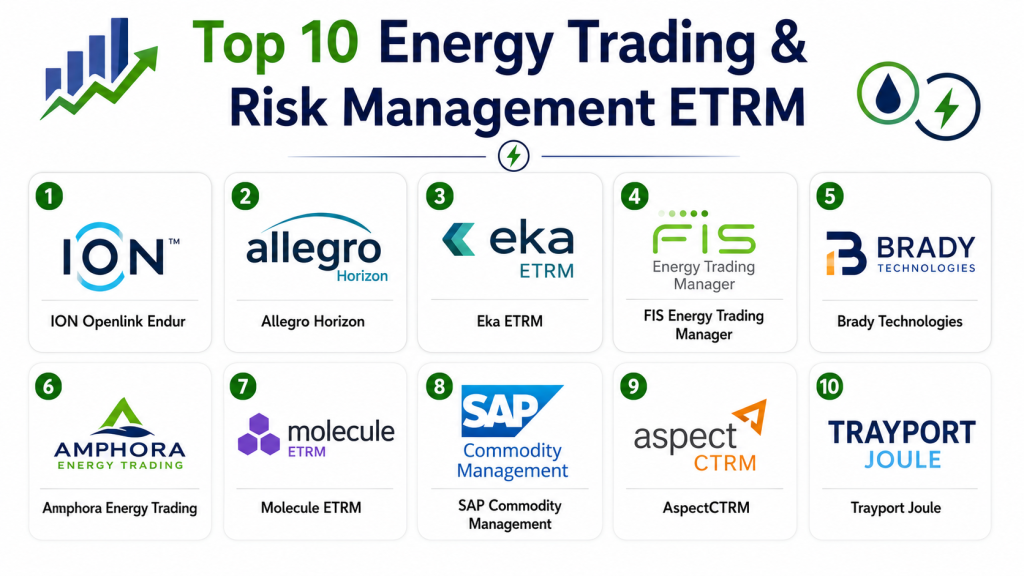
Top 10 Energy Trading & Risk Management ETRM Platforms
#1 — Openlink Endur
Short description: Openlink Endur is one of the most recognized ETRM platforms globally, widely used by utilities, commodity traders, and energy companies for managing complex trading, risk, logistics, and settlement operations across multiple energy markets.
Key Features
- Multi-commodity trading support
- Advanced risk analytics
- Real-time market data integration
- Trade lifecycle management
- Scheduling and logistics workflows
- Regulatory compliance reporting
- Portfolio optimization tools
Pros
- Extremely strong enterprise functionality
- Broad commodity coverage
- Advanced analytics and scalability
- Mature ecosystem and market adoption
Cons
- Complex implementation requirements
- Premium enterprise pricing
- Requires specialized expertise
- Long deployment timelines
Platforms / Deployment
- Web / Windows
- Cloud / Hybrid / Self-hosted
Security & Compliance
- RBAC
- Audit logging
- Encryption
- SSO/SAML
- Additional certifications not publicly stated
Integrations & Ecosystem
Endur integrates with exchanges, ERP systems, market data providers, and enterprise analytics environments.
- ERP integrations
- Exchange connectivity
- API ecosystem
- Market data integrations
- Financial reporting systems
Support & Community
Strong enterprise support ecosystem with extensive consulting, implementation, and training services.
#2 — Allegro Horizon
Short description: Allegro Horizon provides cloud-based ETRM and CTRM capabilities for energy companies and commodity trading organizations seeking scalable trading, logistics, and risk management workflows.
Key Features
- Commodity trading management
- Risk analytics
- Cloud-native architecture
- Logistics and transportation workflows
- Real-time dashboards
- Regulatory reporting
- Market integration support
Pros
- Modern cloud-based architecture
- Strong scalability
- Good operational visibility
- Flexible deployment support
Cons
- Enterprise pricing structure
- Advanced customization may require expertise
- Some niche workflows require configuration
- Smaller ecosystem than older market leaders
Platforms / Deployment
- Web
- Cloud
Security & Compliance
- SSO
- RBAC
- Encryption
- Audit logging
Integrations & Ecosystem
Allegro integrates with market operators, ERP systems, and commodity data providers.
- API support
- ERP integrations
- Commodity market integrations
- Data analytics tools
Support & Community
Strong customer onboarding and enterprise implementation support.
#3 — ION Aspect
Short description: ION Aspect delivers commodity trading and risk management functionality focused on energy, natural gas, power, and renewables trading environments.
Key Features
- Energy trade management
- Risk exposure analytics
- Scheduling and logistics
- Settlement workflows
- Market data integration
- Regulatory reporting
- Real-time dashboards
Pros
- Good commodity market support
- Strong operational workflows
- Reliable market connectivity
- Suitable for enterprise trading desks
Cons
- User interface can feel dated
- Advanced workflows may require customization
- Complex implementation planning
- Premium pricing
Platforms / Deployment
- Web / Windows
- Cloud / Hybrid
Security & Compliance
- RBAC
- Encryption
- Audit logging
- Additional certifications not publicly stated
Integrations & Ecosystem
ION Aspect supports integrations with exchanges, market operators, and financial systems.
- Exchange integrations
- ERP connectivity
- API ecosystem
- Reporting system integrations
Support & Community
Established enterprise support ecosystem with industry-focused implementation services.
#4 — Brady CTRM
Short description: Brady CTRM provides commodity trading and risk management solutions for organizations managing agricultural, recycling, metals, and energy trading operations.
Key Features
- Commodity trade management
- Risk and exposure tracking
- Contract lifecycle management
- Logistics workflows
- Financial settlements
- Operational reporting
- Position management
Pros
- Flexible commodity coverage
- Good operational reporting
- Strong logistics support
- Scalable deployment options
Cons
- Interface modernization could improve
- Advanced analytics may require add-ons
- Implementation can be lengthy
- Some workflows are highly configuration-dependent
Platforms / Deployment
- Web / Windows
- Cloud / Hybrid
Security & Compliance
- RBAC
- Encryption
- Audit logging
- Additional certifications not publicly stated
Integrations & Ecosystem
Brady integrates with ERP systems, logistics providers, and commodity trading workflows.
- ERP integrations
- API support
- Logistics system integrations
- Reporting environments
Support & Community
Practical onboarding and enterprise support with commodity-sector expertise.
#5 — Eka ETRM
Short description: Eka provides cloud-based commodity management and ETRM capabilities designed for energy traders, commodity firms, and supply-chain organizations seeking operational visibility and risk analytics.
Key Features
- Commodity trading workflows
- Risk management analytics
- Real-time dashboards
- Cloud-native architecture
- Position management
- Contract tracking
- Reporting automation
Pros
- Modern cloud deployment
- Flexible operational workflows
- Good analytics visibility
- Easier scalability
Cons
- Some enterprise modules require separate licensing
- Advanced customization can be technical
- Smaller ecosystem than legacy leaders
- Certain workflows may require integration planning
Platforms / Deployment
- Web
- Cloud
Security & Compliance
- RBAC
- Encryption
- Audit logs
- SSO support
Integrations & Ecosystem
Eka supports integrations across ERP systems, trading environments, and analytics platforms.
- API integrations
- ERP connectivity
- Data analytics tools
- Commodity market integrations
Support & Community
Strong customer onboarding with growing enterprise ecosystem support.
#6 — Amphora Energy Trading
Short description: Amphora Energy Trading is designed for oil, natural gas, power, and renewable energy operations requiring trading, scheduling, and settlement management.
Key Features
- Energy trading management
- Scheduling workflows
- Position tracking
- Settlement automation
- Contract management
- Risk analytics
- Operational dashboards
Pros
- Strong energy-sector specialization
- Good scheduling capabilities
- Practical operational workflows
- Flexible deployment support
Cons
- Interface feels more traditional
- Smaller market ecosystem
- Advanced analytics capabilities may vary
- Implementation requires planning
Platforms / Deployment
- Web / Windows
- Cloud / Hybrid
Security & Compliance
- Encryption
- RBAC
- Audit logging
- Additional certifications not publicly stated
Integrations & Ecosystem
Amphora integrates with operational energy systems, market platforms, and financial workflows.
- API support
- Market integrations
- ERP connectivity
- Financial reporting systems
Support & Community
Industry-focused support with strong operational expertise.
#7 — Molecule ETRM
Short description: Molecule ETRM is a modern cloud-native platform designed for mid-market and enterprise energy trading organizations seeking faster deployment and simplified operational workflows.
Key Features
- Cloud-native trade management
- Risk analytics
- Position monitoring
- Renewable energy trading support
- Real-time dashboards
- Reporting automation
- API-first architecture
Pros
- Modern user experience
- Faster deployment timelines
- Good renewable energy support
- Flexible cloud scalability
Cons
- Smaller ecosystem than established leaders
- Some advanced workflows may be limited
- Less historical market presence
- Complex enterprise customizations may vary
Platforms / Deployment
- Web
- Cloud
Security & Compliance
- RBAC
- Encryption
- SSO
- Audit logging
Integrations & Ecosystem
Molecule emphasizes API-driven integrations and modern cloud interoperability.
- API-first integrations
- Market data connectivity
- ERP integrations
- Renewable energy workflows
Support & Community
Responsive support organization with modern onboarding resources.
#8 — FIS Energy Trading and Risk Management
Short description: FIS provides ETRM capabilities focused on commodity trading, risk analytics, and operational visibility for utilities and enterprise trading organizations.
Key Features
- Commodity trading support
- Risk exposure analytics
- Market data integration
- Settlement management
- Regulatory reporting
- Portfolio tracking
- Real-time dashboards
Pros
- Strong enterprise financial ecosystem
- Good market connectivity
- Reliable analytics support
- Enterprise-grade scalability
Cons
- Complex deployments
- Enterprise-oriented pricing
- Some interfaces feel legacy-focused
- Customization may require consulting support
Platforms / Deployment
- Web / Windows
- Cloud / Hybrid
Security & Compliance
- RBAC
- Encryption
- Audit logs
- SSO/SAML
Integrations & Ecosystem
FIS integrates with financial systems, market operators, and enterprise analytics environments.
- Financial system integrations
- API support
- Market data providers
- ERP connectivity
Support & Community
Large enterprise support ecosystem with implementation consulting services.
#9 — SAP Commodity Management
Short description: SAP Commodity Management helps enterprises manage commodity procurement, trading, pricing, logistics, and risk operations within SAP-centric environments.
Key Features
- Commodity pricing management
- Risk exposure monitoring
- ERP-connected workflows
- Logistics integration
- Financial settlements
- Reporting automation
- Operational dashboards
Pros
- Excellent SAP ecosystem integration
- Strong enterprise scalability
- Good governance controls
- Useful financial workflows
Cons
- Best suited for SAP-centric organizations
- Complex enterprise implementation
- Premium licensing structure
- Requires technical expertise
Platforms / Deployment
- Web
- Cloud / Hybrid
Security & Compliance
- SSO/SAML
- RBAC
- Encryption
- Audit logging
Integrations & Ecosystem
SAP Commodity Management integrates deeply with ERP, finance, procurement, and operational systems.
- SAP ERP integrations
- API ecosystem
- Financial workflows
- Analytics integrations
Support & Community
Extensive enterprise support and implementation ecosystem.
#10 — Trayport Joule
Short description: Trayport Joule provides energy trading connectivity, market access, and real-time trading functionality for European and global wholesale energy markets.
Key Features
- Real-time market connectivity
- Energy exchange access
- Trading analytics
- Market data visualization
- Trade execution workflows
- Position management
- Trading dashboards
Pros
- Excellent exchange connectivity
- Strong wholesale market coverage
- Real-time operational visibility
- Widely used in energy trading markets
Cons
- Primarily market-focused
- Less comprehensive enterprise workflow coverage
- Specialized energy trading focus
- Broader ETRM functionality may require integrations
Platforms / Deployment
- Windows / Web
- Cloud / Hybrid
Security & Compliance
- Encryption
- RBAC
- Audit logging
- Additional certifications not publicly stated
Integrations & Ecosystem
Trayport integrates with exchanges, market operators, and trading analytics environments.
- Exchange integrations
- Market connectivity
- API support
- Analytics systems
Support & Community
Strong market-focused support ecosystem with energy trading expertise.
Comparison Table
| Tool Name | Best For | Platform(s) Supported | Deployment | Standout Feature | Public Rating |
|---|---|---|---|---|---|
| Openlink Endur | Enterprise energy trading | Web, Windows | Cloud, Hybrid, Self-hosted | Multi-commodity risk management | N/A |
| Allegro Horizon | Cloud-based ETRM operations | Web | Cloud | Cloud-native trading workflows | N/A |
| ION Aspect | Power and gas trading | Web, Windows | Cloud, Hybrid | Real-time market analytics | N/A |
| Brady CTRM | Commodity and logistics operations | Web, Windows | Cloud, Hybrid | Contract and logistics workflows | N/A |
| Eka ETRM | Cloud commodity management | Web | Cloud | Modern operational visibility | N/A |
| Amphora Energy Trading | Oil and gas scheduling | Web, Windows | Cloud, Hybrid | Scheduling and settlements | N/A |
| Molecule ETRM | Modern renewable trading | Web | Cloud | API-first architecture | N/A |
| FIS Energy Trading and Risk Management | Enterprise commodity analytics | Web, Windows | Cloud, Hybrid | Financial ecosystem integration | N/A |
| SAP Commodity Management | SAP-centric enterprises | Web | Cloud, Hybrid | ERP-connected commodity workflows | N/A |
| Trayport Joule | Wholesale energy markets | Windows, Web | Cloud, Hybrid | Exchange connectivity | N/A |
Evaluation & Scoring of Energy Trading & Risk Management Platforms
| Tool Name | Core 25% | Ease 15% | Integrations 15% | Security 10% | Performance 10% | Support 10% | Value 15% | Weighted Total |
|---|---|---|---|---|---|---|---|---|
| Openlink Endur | 9.5 | 6.8 | 9.4 | 9.0 | 9.3 | 8.9 | 7.2 | 8.6 |
| Allegro Horizon | 8.9 | 8.0 | 8.7 | 8.5 | 8.8 | 8.4 | 7.9 | 8.4 |
| ION Aspect | 9.0 | 7.2 | 8.8 | 8.5 | 8.9 | 8.5 | 7.5 | 8.4 |
| Brady CTRM | 8.5 | 7.5 | 8.2 | 8.1 | 8.4 | 8.2 | 8.0 | 8.1 |
| Eka ETRM | 8.6 | 8.2 | 8.4 | 8.3 | 8.5 | 8.2 | 8.1 | 8.3 |
| Amphora Energy Trading | 8.4 | 7.3 | 8.0 | 8.0 | 8.5 | 8.1 | 8.0 | 8.0 |
| Molecule ETRM | 8.3 | 8.5 | 8.1 | 8.2 | 8.3 | 8.0 | 8.4 | 8.2 |
| FIS Energy Trading and Risk Management | 8.9 | 7.0 | 8.9 | 8.8 | 8.8 | 8.6 | 7.3 | 8.3 |
| SAP Commodity Management | 9.1 | 6.9 | 9.2 | 8.9 | 9.0 | 8.7 | 7.1 | 8.4 |
| Trayport Joule | 8.7 | 8.0 | 8.5 | 8.1 | 8.9 | 8.3 | 7.8 | 8.3 |
These scores are comparative and intended to help organizations evaluate ETRM platforms across operational priorities. Enterprise-focused platforms typically score higher in integrations, scalability, and analytics depth, while modern cloud-native platforms may offer better usability and deployment speed. Buyers should prioritize the categories most aligned with their trading operations, commodity exposure, and regulatory obligations instead of focusing only on weighted totals.
Which Energy Trading & Risk Management Tool Is Right for You?
Solo / Freelancer
Independent commodity consultants or smaller trading operations may benefit from modern cloud-native platforms such as Molecule ETRM or Eka ETRM, which generally offer simpler deployment and more approachable operational workflows.
SMB
Small and mid-sized trading organizations should prioritize usability, cloud deployment flexibility, and operational visibility. Allegro Horizon and Eka ETRM provide a balanced combination of analytics, scalability, and manageable deployment complexity.
Mid-Market
Mid-market energy companies often require stronger integrations, advanced scheduling, and risk analytics. ION Aspect and Brady CTRM are good options for organizations balancing operational depth with scalability.
Enterprise
Large utilities, commodity trading firms, and multinational energy organizations generally need advanced analytics, exchange connectivity, enterprise governance, and large-scale integration ecosystems. Openlink Endur, SAP Commodity Management, and FIS Energy Trading and Risk Management are especially strong for enterprise-scale deployments.
Budget vs Premium
Budget-conscious organizations may prefer Molecule ETRM or Eka ETRM due to cloud-native flexibility and simplified deployment. Premium enterprise buyers requiring deep commodity coverage and large-scale operational governance may prefer Endur or SAP.
Feature Depth vs Ease of Use
Platforms like Endur and SAP Commodity Management provide extensive enterprise functionality but often require more implementation expertise. Molecule and Allegro Horizon typically provide more modern user experiences and faster onboarding.
Integrations & Scalability
Organizations operating across multiple markets and exchanges should prioritize platforms with strong API ecosystems and enterprise integrations. Openlink Endur, SAP, and FIS are particularly strong in large-scale integration environments.
Security & Compliance Needs
Highly regulated energy markets require strong governance controls, audit trails, encryption, RBAC, and compliance reporting workflows. Endur, SAP, and FIS provide strong enterprise governance capabilities for compliance-heavy operations.
Frequently Asked Questions
1. What is an Energy Trading & Risk Management platform?
An Energy Trading & Risk Management platform is software designed to help organizations manage commodity trading, risk exposure, settlements, logistics, compliance, and market operations across energy markets such as electricity, oil, gas, and renewables.
2. Which industries use ETRM platforms the most?
Utilities, commodity trading firms, oil and gas companies, renewable energy providers, financial institutions, and large industrial organizations commonly use ETRM systems to manage trading and operational risk.
3. Why are cloud-native ETRM platforms becoming more popular?
Cloud-native platforms offer faster deployment, easier scalability, remote accessibility, and simplified infrastructure management. Many organizations are modernizing legacy ETRM environments to improve agility and operational efficiency.
4. How important are real-time market integrations?
Real-time market connectivity is critical for energy traders because pricing, market exposure, and risk positions can change rapidly. Strong exchange integrations and low-latency analytics are major competitive advantages.
5. What are the biggest implementation challenges?
Implementation complexity often includes market integrations, data migration, workflow customization, compliance mapping, and user training. Enterprise ETRM deployments can take significant planning and operational alignment.
6. Do ETRM platforms support renewable energy trading?
Yes, many modern ETRM platforms now support renewable energy certificates, carbon markets, emissions trading, and sustainability-related trading workflows alongside traditional commodity markets.
7. Are ETRM platforms expensive?
Enterprise ETRM platforms can become expensive due to licensing, implementation consulting, integrations, and infrastructure requirements. However, cloud-native platforms are helping reduce deployment and operational costs for smaller organizations.
8. How important is risk analytics in ETRM systems?
Risk analytics are one of the most critical components of ETRM platforms because organizations must continuously monitor market exposure, volatility, pricing risk, and operational positions across trading portfolios.
9. Can ETRM platforms integrate with ERP systems?
Yes, most enterprise ETRM platforms integrate with ERP, finance, accounting, logistics, and analytics systems to streamline operational workflows and improve reporting consistency across the organization.
10. How should organizations shortlist ETRM vendors?
Organizations should begin by identifying commodity coverage requirements, market integrations, risk analytics needs, deployment preferences, and scalability expectations. Running a pilot deployment with real operational workflows is often the best way to validate platform fit.
Conclusion
Energy Trading & Risk Management platforms have become essential operational systems for utilities, commodity traders, and energy enterprises managing increasingly volatile and complex global markets. Modern ETRM solutions now combine real-time market connectivity, AI-driven analytics, renewable energy support, operational automation, and enterprise-grade governance to help organizations improve trading efficiency and reduce risk exposure. The right platform depends heavily on commodity coverage, organizational scale, integration requirements, regulatory obligations, and operational complexity rather than a single universal best solution. Enterprise organizations often prioritize scalability, advanced analytics, and exchange integrations, while mid-sized firms may focus more on deployment speed, usability, and cloud flexibility. Before selecting a platform, organizations should shortlist two or three vendors, validate exchange and ERP integrations, run pilot trading workflows, and confirm that analytics, security, and operational capabilities align with long-term trading and risk management goals.

Very informative and well-structured blog on energy trading and risk management platforms. The comparison of features, pros, and cons is clear and practical, making complex ETRM solutions much easier to understand.
Excellent comparison of ETRM platforms—this article does a great job explaining how these tools help manage energy trading, risk analysis, and operational efficiency in the energy sector.
Energy Trading and Risk Management (ETRM) platforms are increasingly judged by how well they help organizations respond to rapidly changing market conditions rather than simply recording trades and calculating exposure. As renewable generation, battery storage, and cross-border energy markets expand, firms need solutions that support real-time portfolio optimization, scenario planning, and counterparty risk monitoring. Including topics such as AI-assisted trading decisions, stress-testing under volatile market conditions, carbon market integration, and resilience against market disruptions would give readers a more practical framework for evaluating modern ETRM platforms.