Introduction
Crisis Management Platforms are specialized software systems that help organizations prepare for, respond to, and recover from emergencies or disruptive events such as cyberattacks, natural disasters, supply chain failures, or safety incidents. These platforms act as a centralized command center, coordinating communication, workflows, and decision-making during high-pressure situations.
In modern organizations, crises are more complex and fast-moving. Without structured tools, teams often face confusion, delayed responses, and fragmented communication. Crisis management platforms solve this by providing real-time visibility, task coordination, and automated response workflows, ensuring that every stakeholder knows what to do and when.
Common use cases include:
- Managing cybersecurity incidents or outages
- Coordinating emergency response teams
- Business continuity and disaster recovery planning
- Crisis communication with employees and stakeholders
- Risk monitoring and escalation workflows
What buyers should evaluate:
- Real-time communication and alerting
- Incident tracking and workflow automation
- Collaboration and task assignment tools
- Integration with IT, HR, and safety systems
- Analytics and reporting dashboards
- Ease of use under pressure
- Mobile accessibility
- Compliance and audit tracking
- Scalability across locations
- Support and reliability
Best for: Enterprise risk teams, IT leaders, compliance officers, operations leaders, and organizations with complex incident response needs.
Not ideal for: Small teams with minimal operational risk or basic communication needs.
Key Trends in Crisis Management Platforms
- Unified platforms combining crisis, incident, and communication tools
- Real-time dashboards and situational awareness systems
- AI-driven risk prediction and prioritization
- Integration with emergency notification and EHS systems
- Mobile-first crisis response apps
- Automated workflows and playbooks
- Cross-functional collaboration tools
- Geo-location tracking and alerts
- Compliance and audit-ready reporting
- Integration with business continuity planning systems
How We Selected These Tools (Methodology)
- Evaluated crisis lifecycle coverage (prepare, respond, recover)
- Assessed communication and coordination capabilities
- Reviewed workflow automation and task tracking
- Analyzed real-time data and analytics features
- Considered integrations with enterprise systems
- Evaluated scalability across global operations
- Assessed usability in high-pressure scenarios
- Reviewed compliance and reporting capabilities
- Considered vendor adoption and reliability
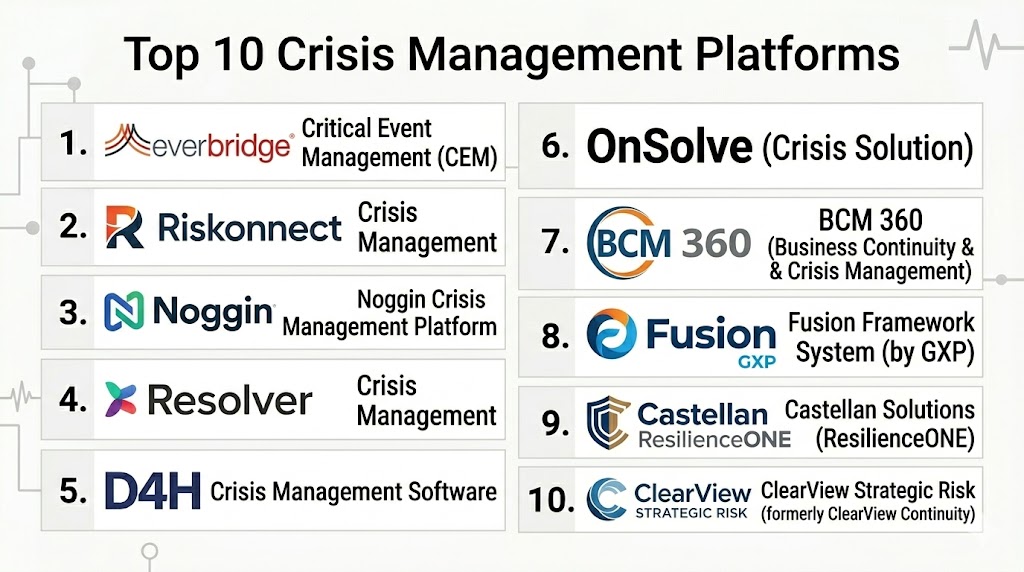
Top 10 Crisis Management Platforms Tools
#1 — Everbridge Critical Event Management
Short description:
Everbridge CEM is a leading enterprise platform for crisis response, offering real-time alerts, incident coordination, and risk intelligence. It enables organizations to manage critical events across global operations.
Key Features
- Real-time alerts and notifications
- Incident management workflows
- Geo-targeting and risk intelligence
- Automation and playbooks
- Analytics dashboards
Pros
- Enterprise scalability
- Strong global coverage
Cons
- Premium pricing
- Complex setup
Platforms / Deployment
Web / Mobile
Cloud
Security & Compliance
SSO, encryption
Not publicly stated additional certifications
Integrations & Ecosystem
- HR systems
- IT monitoring tools
- Emergency systems
Support & Community
24/7 enterprise support.
#2 — Riskonnect Crisis Management
Short description:
Riskonnect provides crisis management integrated with enterprise risk management. It helps teams coordinate response actions and track incidents from initiation to resolution.
Key Features
- Incident tracking
- Workflow automation
- Risk analytics
- Response plan activation
Pros
- Strong risk integration
- Centralized dashboards
Cons
- Learning curve
- Enterprise pricing
Platforms / Deployment
Web / Mobile
Cloud
Security & Compliance
SSO, encryption
Integrations & Ecosystem
- Risk systems
- ERP
Support & Community
Enterprise-level support.
#3 — Noggin Crisis Management Platform
Short description:
Noggin offers a comprehensive crisis and incident management platform focused on real-time coordination and situational awareness. It is widely used by government and enterprise teams.
Key Features
- Incident reporting
- Real-time dashboards
- Collaboration tools
- Workflow automation
Pros
- Strong situational awareness
- Flexible workflows
Cons
- Complex onboarding
- Premium pricing
Platforms / Deployment
Web / Mobile
Cloud
Security & Compliance
Encryption
Integrations & Ecosystem
- EHS systems
- Communication tools
Support & Community
Enterprise support.
#4 — Resolver Crisis Management
Short description:
Resolver provides crisis and incident management tools with strong analytics and investigation workflows. It supports risk tracking and compliance reporting.
Key Features
- Incident tracking
- Risk analysis
- Workflow automation
- Reporting dashboards
Pros
- Strong analytics
- Easy reporting
Cons
- Moderate customization
- Pricing
Platforms / Deployment
Web
Cloud
Security & Compliance
SSO, encryption
Integrations & Ecosystem
- Compliance systems
Support & Community
Good support.
#5 — D4H Crisis Management Software
Short description:
D4H is a crisis and emergency management platform focused on operational coordination and incident response. It is popular among emergency services and NGOs.
Key Features
- Incident tracking
- Team coordination
- Resource management
- Reporting
Pros
- Easy to use
- Practical workflows
Cons
- Limited enterprise analytics
- Smaller ecosystem
Platforms / Deployment
Web / Mobile
Cloud
Security & Compliance
Encryption
Integrations & Ecosystem
- Emergency systems
Support & Community
Strong support.
#6 — OnSolve Crisis Platform
Short description:
OnSolve combines crisis management with mass notification and risk intelligence. It enables organizations to respond quickly to threats and communicate effectively.
Key Features
- Mass notification
- Incident tracking
- Risk intelligence
- Workflow automation
Pros
- Strong alerting capabilities
- Scalable
Cons
- Complex interface
- Premium pricing
Platforms / Deployment
Web / Mobile
Cloud
Security & Compliance
Encryption
Integrations & Ecosystem
- Alerting systems
- HR systems
Support & Community
Enterprise support.
#7 — BCM 360
Short description:
BCM 360 focuses on business continuity and crisis management, helping organizations prepare for disruptions and maintain operations during crises.
Key Features
- Business continuity planning
- Crisis workflows
- Risk assessments
- Reporting
Pros
- Strong continuity focus
- Structured workflows
Cons
- Limited real-time features
- Smaller ecosystem
Platforms / Deployment
Web
Cloud
Security & Compliance
Encryption
Integrations & Ecosystem
- Risk systems
Support & Community
Support available.
#8 — Fusion Framework System
Short description:
Fusion provides a resilience platform that combines crisis management, risk, and business continuity. It offers real-time analytics and operational visibility.
Key Features
- Real-time dashboards
- Incident tracking
- Risk management
- Analytics
Pros
- Strong analytics
- Enterprise scalability
Cons
- Complex setup
- Premium pricing
Platforms / Deployment
Web / Mobile
Cloud
Security & Compliance
SSO, encryption
Integrations & Ecosystem
- ERP
- IT systems
Support & Community
Enterprise support.
#9 — Castellan ResilienceONE
Short description:
ResilienceONE offers crisis management, business continuity, and risk tools in a unified platform. It helps organizations coordinate response and recovery efforts.
Key Features
- Crisis planning
- Incident tracking
- Risk analytics
- Workflow automation
Pros
- Integrated resilience platform
- Scalable
Cons
- Learning curve
- Pricing
Platforms / Deployment
Web
Cloud
Security & Compliance
Encryption
Integrations & Ecosystem
- Compliance tools
Support & Community
Professional support.
#10 — ClearView Strategic Risk
Short description:
ClearView provides crisis management and continuity planning tools with incident tracking and reporting. It focuses on structured workflows and compliance.
Key Features
- Incident tracking
- Risk assessment
- Reporting dashboards
- Compliance workflows
Pros
- Structured approach
- Easy reporting
Cons
- Limited advanced analytics
- Smaller ecosystem
Platforms / Deployment
Web
Cloud
Security & Compliance
Encryption
Integrations & Ecosystem
- Risk systems
Support & Community
Support available.
Comparison Table
| Tool Name | Best For | Platform(s) Supported | Deployment | Standout Feature | Public Rating |
|---|---|---|---|---|---|
| Everbridge | Enterprise | Web/Mobile | Cloud | Global crisis coordination | N/A |
| Riskonnect | Risk teams | Web/Mobile | Cloud | Risk integration | N/A |
| Noggin | Government/enterprise | Web/Mobile | Cloud | Situational awareness | N/A |
| Resolver | Compliance teams | Web | Cloud | Analytics | N/A |
| D4H | Emergency teams | Web/Mobile | Cloud | Operational coordination | N/A |
| OnSolve | Large orgs | Web/Mobile | Cloud | Alerting + crisis | N/A |
| BCM 360 | Continuity planning | Web | Cloud | BCP focus | N/A |
| Fusion | Enterprise | Web/Mobile | Cloud | Real-time analytics | N/A |
| Castellan | Resilience teams | Web | Cloud | Unified resilience | N/A |
| ClearView | SMB/Mid | Web | Cloud | Structured workflows | N/A |
Evaluation & Scoring of Crisis Management Platforms
| Tool Name | Core | Ease | Integrations | Security | Performance | Support | Value | Weighted Total |
|---|---|---|---|---|---|---|---|---|
| Everbridge | 9 | 7 | 9 | 9 | 9 | 9 | 7 | 8.4 |
| Riskonnect | 9 | 7 | 9 | 9 | 9 | 9 | 7 | 8.4 |
| Noggin | 8 | 7 | 8 | 8 | 8 | 8 | 7 | 7.9 |
| Resolver | 8 | 8 | 8 | 8 | 8 | 8 | 8 | 8.0 |
| D4H | 7 | 9 | 7 | 8 | 7 | 8 | 8 | 7.8 |
| OnSolve | 8 | 7 | 8 | 8 | 8 | 8 | 7 | 7.9 |
| BCM 360 | 7 | 8 | 7 | 8 | 7 | 7 | 8 | 7.6 |
| Fusion | 9 | 7 | 9 | 9 | 9 | 9 | 7 | 8.4 |
| Castellan | 8 | 7 | 8 | 8 | 8 | 8 | 7 | 7.9 |
| ClearView | 7 | 8 | 7 | 8 | 7 | 7 | 8 | 7.6 |
How to interpret scores:
These scores compare platforms across critical capabilities such as coordination, communication, analytics, and compliance. Enterprise tools score higher in scalability and integrations, while simpler platforms focus on usability and value. Crisis platforms are most effective when aligned with your organization’s workflows and response structure, as they act as a single source of truth for decision-making during crises.
Which Crisis Management Platform Is Right for You?
Solo / Small Teams
D4H and ClearView offer simple workflows and cost-effective solutions.
SMB
Resolver and BCM 360 provide structured crisis planning and reporting.
Mid-Market
Noggin and OnSolve balance analytics and coordination capabilities.
Enterprise
Everbridge, Riskonnect, and Fusion deliver global scalability and advanced analytics.
Budget vs Premium
D4H is budget-friendly; Everbridge and Fusion are premium.
Feature Depth vs Ease of Use
Everbridge offers depth; D4H focuses on simplicity.
Integrations & Scalability
Fusion, Everbridge, and Riskonnect lead in integrations.
Security & Compliance Needs
Enterprise platforms provide stronger governance and audit trails.
Frequently Asked Questions (FAQs)
1. What is a crisis management platform?
A crisis management platform helps organizations prepare for, respond to, and recover from emergencies by coordinating communication, workflows, and decision-making.
2. Why is crisis management software important?
It improves response speed, reduces confusion, and ensures coordinated action during emergencies, helping minimize operational impact and risk.
3. What features should I look for?
Key features include real-time communication, incident tracking, workflow automation, analytics dashboards, and integration with enterprise systems.
4. How do these platforms improve communication?
They centralize communication channels and provide real-time updates, ensuring everyone has accurate information during crises.
5. Can crisis platforms automate workflows?
Yes, they automate response plans, assign tasks, and track progress to ensure efficient execution of crisis procedures.
6. Are these tools suitable for all industries?
Yes, they are used across industries such as finance, healthcare, manufacturing, IT, and government.
7. How do these tools help decision-making?
They provide real-time data and dashboards, improving situational awareness and enabling faster decisions.
8. Can these platforms integrate with other systems?
Yes, most platforms integrate with HR, IT, safety, and communication systems for unified workflows.
9. What is situational awareness?
It refers to having a real-time understanding of events, risks, and actions during a crisis, enabling better coordination.
10. How long does implementation take?
Implementation varies from weeks for simple tools to months for enterprise platforms depending on customization.
Conclusion
Crisis Management Platforms have become essential for organizations operating in an increasingly unpredictable world. By centralizing communication, automating workflows, and providing real-time situational awareness, these platforms help teams respond faster, coordinate effectively, and recover more efficiently from disruptions. Whether dealing with cybersecurity incidents, natural disasters, or operational crises, the right platform can significantly reduce risk and improve resilience. From lightweight tools like D4H to enterprise-grade solutions like Everbridge and Fusion, the best choice depends on your organization’s size, complexity, and risk exposure. Start by identifying your crisis response gaps, shortlist 2–3 platforms, run pilot scenarios, and validate integrations to ensure your organization is fully prepared when it matters most.

A well-written comparison that highlights the key features of crisis management platforms and makes it easier to evaluate which solution best supports effective incident response and communication.