Introduction
Airline Reservation Systems are specialized software platforms used by airlines and travel companies to manage flight bookings, seat inventory, ticketing, pricing, and passenger records. These systems act as the backbone of airline operations, enabling real-time booking, scheduling, and distribution across multiple channels. They are often integrated with Global Distribution Systems, allowing travel agencies and online platforms to access flight data globally.
As the aviation industry becomes more digital and customer expectations rise, modern reservation systems now focus on automation, scalability, and real-time data processing. These platforms support dynamic pricing, customer personalization, and seamless booking experiences across devices.
Common use cases include:
- Managing flight bookings and ticketing
- Handling seat inventory and availability
- Integrating with travel agencies and booking platforms
- Supporting pricing and revenue management
- Managing passenger data and services
What buyers should evaluate:
- Real-time booking performance
- Global distribution integration
- Scalability and reliability
- Pricing and revenue management features
- API and integration capabilities
- Security and compliance
- Customer experience features
- Reporting and analytics
Best for: Airlines, travel agencies, online booking platforms, and aviation technology providers.
Not ideal for: Small businesses without aviation operations or those needing only basic booking tools.
Key Trends in Airline Reservation Systems
- Cloud-based reservation platforms replacing legacy systems
- API-first architectures for seamless integrations
- AI-driven pricing and demand forecasting
- Real-time inventory and booking synchronization
- Mobile-first booking and passenger experience
- Integration with Global Distribution Systems
- Automation of ticketing and customer service
- Microservices-based scalable architectures
How We Selected These Tools
- Market leadership and global adoption
- Feature completeness across reservation and inventory
- Reliability and performance in real-time operations
- Integration with global distribution systems
- Security and compliance capabilities
- Flexibility for different airline business models
- Ecosystem support and scalability
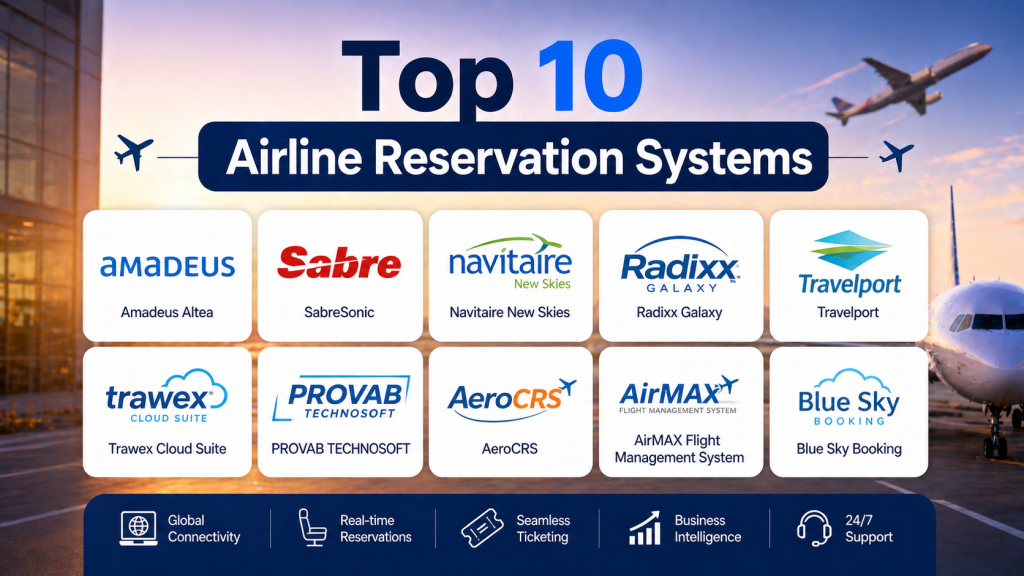
Top 10 Airline Reservation Systems Tools
1 — Amadeus Altea
Short description: Amadeus Altea is one of the most widely used airline reservation and passenger service systems globally. It provides end-to-end functionality including reservations, inventory, and departure control. The platform is used by major airlines worldwide. It supports large-scale operations and global distribution. It is ideal for enterprise airlines.
Key Features
- Reservation and inventory management
- Ticketing and pricing
- Global distribution integration
- Passenger service management
- Analytics
Pros
- Industry-leading platform
- Strong global ecosystem
Cons
- Complex implementation
- High cost
Platforms / Deployment
Web — Cloud
Security & Compliance
Enterprise-grade controls
Integrations & Ecosystem
Deep integration with travel systems and GDS
- Travel agencies
- Booking platforms
- Payment systems
Support & Community
Enterprise-level support
2 — SabreSonic
Short description: SabreSonic is a powerful airline reservation system used by global carriers. It provides booking, ticketing, and passenger management capabilities. The platform supports advanced retailing features. It integrates with global distribution networks. It is suitable for large airlines.
Key Features
- Reservation system
- Ticketing and pricing
- Passenger management
- Retailing features
- Analytics
Pros
- Strong global presence
- Advanced features
Cons
- Complex system
- High cost
Platforms / Deployment
Web — Cloud
Security & Compliance
Enterprise-level security
Integrations & Ecosystem
Integrated with global travel systems
Support & Community
Strong enterprise support
3 — Navitaire New Skies
Short description: Navitaire New Skies is a cloud-based reservation system designed for low-cost and hybrid airlines. It focuses on ancillary revenue and digital services. The platform supports scalability and automation. It is widely used by budget airlines. It offers modern booking capabilities.
Key Features
- Reservation and booking
- Ancillary revenue management
- Inventory control
- Digital services
- Reporting
Pros
- Cloud-native platform
- Strong for low-cost carriers
Cons
- Limited enterprise features
- Customization constraints
Platforms / Deployment
Web — Cloud
Security & Compliance
Not publicly stated
Integrations & Ecosystem
API integrations with travel platforms
Support & Community
Good support
4 — Travelport
Short description: Travelport is a global distribution and reservation platform used by airlines and travel agencies. It connects travel providers with booking systems worldwide. The platform supports multiple booking channels. It is essential for travel distribution. It offers global reach and scalability.
Key Features
- Global distribution system
- Booking and ticketing
- Inventory management
- Multi-channel distribution
- Analytics
Pros
- Wide global reach
- Strong connectivity
Cons
- Complex integration
- Cost considerations
Platforms / Deployment
Web — Cloud
Security & Compliance
Not publicly stated
Integrations & Ecosystem
Extensive travel ecosystem
Support & Community
Strong industry support
5 — Radixx Galaxy
Short description: Radixx Galaxy is a reservation system designed for low-cost and regional airlines. It offers booking, inventory, and ancillary services management. The platform is flexible and modular. It is suitable for growing airlines. It supports fast deployment.
Key Features
- Reservation system
- Inventory control
- Ancillary services
- Reporting
- API integration
Pros
- Cost-effective
- Flexible
Cons
- Limited advanced features
- Smaller ecosystem
Platforms / Deployment
Web — Cloud
Security & Compliance
Not publicly stated
Integrations & Ecosystem
API-based integrations
Support & Community
Standard support
6 — Trawex Cloud Suite
Short description: Trawex Cloud Suite is a travel technology platform offering airline reservation capabilities. It supports booking engines and integrations. The platform is suitable for travel agencies and airlines. It focuses on scalability. It enables real-time booking.
Key Features
- Booking engine
- Inventory management
- API integration
- Reporting
- Multi-channel support
Pros
- Flexible platform
- Good for agencies
Cons
- Limited enterprise depth
- Customization required
Platforms / Deployment
Web — Cloud
Security & Compliance
Not publicly stated
Integrations & Ecosystem
Supports GDS integrations
Support & Community
Standard support
7 — PROVAB TECHNOSOFT
Short description: PROVAB TECHNOSOFT offers airline reservation systems for travel companies. It provides booking, ticketing, and API integration. The platform is suitable for agencies and startups. It supports scalable deployment. It enables real-time data access.
Key Features
- Booking system
- API integration
- Inventory management
- Reporting
- Ticketing
Pros
- Flexible
- Scalable
Cons
- Limited enterprise features
- Requires customization
Platforms / Deployment
Web — Cloud
Security & Compliance
Not publicly stated
Integrations & Ecosystem
Supports multiple integrations
Support & Community
Standard support
8 — AeroCRS
Short description: AeroCRS is a cloud-based airline reservation system designed for regional airlines. It offers booking, inventory, and reporting features. The platform focuses on simplicity and efficiency. It is suitable for small and mid-sized airlines. It provides easy deployment.
Key Features
- Reservation system
- Inventory management
- Reporting
- Ticketing
- Customer management
Pros
- Easy to deploy
- Cost-effective
Cons
- Limited scalability
- Smaller ecosystem
Platforms / Deployment
Web — Cloud
Security & Compliance
Not publicly stated
Integrations & Ecosystem
Basic integrations
Support & Community
Standard support
9 — AirMAX Flight Management System
Short description: AirMAX is a reservation and flight management system designed for airline operations. It supports booking, scheduling, and reporting. The platform is suitable for small airlines. It provides operational control. It helps improve efficiency.
Key Features
- Booking system
- Scheduling
- Inventory control
- Reporting
- Analytics
Pros
- Simple system
- Easy management
Cons
- Limited features
- Smaller ecosystem
Platforms / Deployment
Web — Cloud
Security & Compliance
Not publicly stated
Integrations & Ecosystem
Basic integrations
Support & Community
Standard support
10 — Blue Sky Booking
Short description: Blue Sky Booking is a reservation system designed for travel agencies and airlines. It offers booking, ticketing, and reporting features. The platform is easy to use. It supports online booking. It is suitable for small businesses.
Key Features
- Booking system
- Ticketing
- Reporting
- Customer management
- Online booking
Pros
- Easy to use
- Affordable
Cons
- Limited advanced features
- Small ecosystem
Platforms / Deployment
Web — Cloud
Security & Compliance
Not publicly stated
Integrations & Ecosystem
Basic integrations
Support & Community
Standard support
Comparison Table
| Tool | Best For | Platforms | Deployment | Standout Feature |
|---|---|---|---|---|
| Amadeus Altea | Enterprise airlines | Web | Cloud | Full PSS |
| SabreSonic | Global carriers | Web | Cloud | Retailing features |
| Navitaire | Low-cost airlines | Web | Cloud | Ancillary revenue |
| Travelport | Travel agencies | Web | Cloud | Global distribution |
| Radixx Galaxy | Regional airlines | Web | Cloud | Cost-effective |
| Trawex | Agencies | Web | Cloud | Booking engine |
| PROVAB | Startups | Web | Cloud | API flexibility |
| AeroCRS | Small airlines | Web | Cloud | Easy deployment |
| AirMAX | Small airlines | Web | Cloud | Simplicity |
| Blue Sky | Agencies | Web | Cloud | Affordability |
Evaluation & Scoring
| Tool | Core | Ease | Integrations | Security | Performance | Support | Value | Total |
|---|---|---|---|---|---|---|---|---|
| Amadeus | 9 | 6 | 9 | 8 | 9 | 9 | 6 | 8.1 |
| SabreSonic | 9 | 6 | 9 | 8 | 9 | 9 | 6 | 8.1 |
| Navitaire | 8 | 8 | 8 | 7 | 8 | 8 | 7 | 8.0 |
| Travelport | 9 | 6 | 9 | 7 | 9 | 9 | 6 | 8.0 |
| Radixx | 7 | 8 | 7 | 6 | 7 | 7 | 8 | 7.3 |
| Trawex | 7 | 8 | 7 | 6 | 7 | 7 | 8 | 7.3 |
| PROVAB | 7 | 8 | 7 | 6 | 7 | 7 | 8 | 7.3 |
| AeroCRS | 7 | 8 | 6 | 6 | 7 | 7 | 8 | 7.2 |
| AirMAX | 6 | 8 | 5 | 6 | 7 | 6 | 8 | 6.9 |
| Blue Sky | 6 | 8 | 5 | 6 | 7 | 6 | 8 | 6.9 |
These scores reflect a comparative analysis across core capabilities, usability, and scalability. Enterprise systems score higher due to strong integration and performance. Mid-level tools balance usability and features. Smaller platforms offer better affordability but limited scalability. Always align scoring with your operational needs before choosing.
Which Airline Reservation System Is Right for You
Small Airline
AeroCRS, AirMAX, and Blue Sky are simple and cost-effective.
SMB / Regional Airline
Radixx, Navitaire, and PROVAB offer flexibility and scalability.
Mid-Market Airline
Navitaire and Travelport provide balanced features and integrations.
Enterprise Airline
Amadeus Altea and SabreSonic are best for global operations.
Budget vs Premium
Budget tools focus on simplicity, premium tools provide advanced analytics.
Feature Depth vs Ease of Use
Complex systems offer more control but require training.
Integrations & Scalability
Choose systems with strong GDS integration.
Security & Compliance Needs
Enterprise systems provide stronger compliance features.
Frequently Asked Questions
1. What is an airline reservation system
It is software that manages flight bookings, ticketing, and passenger data. It enables real-time booking and inventory control. Airlines use it to manage operations efficiently. It is essential for travel businesses.
2. How do these systems work
They connect booking channels with airline inventory. Users can search flights and book tickets. The system updates availability in real time. It ensures accurate booking data.
3. What is a GDS in airline systems
A GDS is a global distribution system that connects airlines with travel agencies. It provides access to flight data and pricing. It enables global bookings. Major GDS platforms dominate the market.
4. Are these systems cloud-based
Many modern systems are cloud-based. This improves scalability and performance. Cloud platforms allow real-time updates. It also reduces infrastructure costs.
5. How much do these systems cost
Costs vary based on features and scale. Enterprise systems are expensive. Smaller systems are more affordable. Pricing depends on usage.
6. Can small airlines use these systems
Yes, there are solutions designed for small airlines. They offer simplified features. They are easier to deploy. Businesses should choose based on needs.
7. What are common mistakes when choosing a system
Choosing based only on cost is a mistake. Ignoring integrations can cause issues. Not testing the system is risky. Proper evaluation is important.
8. Do these systems support mobile booking
Yes, most systems support mobile access. This improves customer experience. It allows real-time booking. Mobile support is essential today.
9. How secure are these systems
Security varies by platform. Enterprise systems offer strong protection. Smaller tools may have limited features. Businesses should verify security standards.
10. Can I switch systems later
Switching is possible but complex. Data migration is required. Training may be needed. Planning helps ensure smooth transition.
Conclusion
Airline reservation systems are the backbone of modern aviation operations, enabling airlines and travel platforms to manage bookings, inventory, and customer interactions efficiently. These systems have evolved significantly, moving from legacy centralized architectures to cloud-based, API-driven platforms that support real-time operations and global distribution. As competition increases and customer expectations rise, adopting a reliable and scalable reservation system is no longer optional but essential for operational success. Different systems cater to different needs, from enterprise-grade platforms like Amadeus and Sabre to flexible solutions for smaller airlines and travel agencies. The right choice depends on factors such as scale, integration requirements, budget, and operational complexity. There is no single best solution, and organizations must carefully evaluate their priorities before making a decision.

A useful point to consider is how easily these reservation systems integrate with other airline platforms. Smooth data flow between booking, customer service, and operations can make a noticeable difference in both efficiency and passenger experience.