Introduction
Airline Crew Scheduling Tools are specialized software systems used by airlines to plan, assign, and manage crew members across flights while ensuring compliance with aviation regulations. These tools handle complex scheduling tasks such as crew pairing, rostering, duty tracking, and disruption management. They ensure that the right crew with the right qualifications is assigned to the right flight at the right time.
With increasing flight volumes, regulatory requirements, and operational complexity, manual scheduling is no longer feasible. Modern tools leverage automation, real-time data, and optimization algorithms to reduce delays, minimize costs, and improve operational efficiency.
Common use cases include:
- Creating crew schedules and rosters
- Managing duty hours and rest compliance
- Handling last-minute disruptions
- Tracking crew qualifications and certifications
- Optimizing crew utilization and cost
What buyers should evaluate:
- Compliance with aviation regulations
- Automation and optimization capabilities
- Real-time scheduling updates
- Integration with flight operations systems
- Scalability
- Reporting and analytics
- Ease of use
- Security and data handling
Best for: Airline operations teams, crew planners, dispatch teams, and aviation enterprises managing complex flight schedules.
Not ideal for: Businesses without aviation operations or those needing simple workforce scheduling tools.
Key Trends in Airline Crew Scheduling Tools
- AI-based optimization for crew pairing and scheduling
- Real-time disruption management and recovery planning
- Automated compliance with global aviation regulations
- Integration with flight operations and payroll systems
- Predictive analytics for demand and scheduling
- Mobile access for crew communication and updates
- Cloud-based deployment replacing legacy systems
- Fatigue risk management integration
- Scenario simulation for operational planning
How We Selected These Tools
- Strong industry adoption and credibility
- Advanced scheduling and optimization capabilities
- Reliability in real-time airline operations
- Compliance with aviation standards
- Integration ecosystem with airline systems
- Suitability across airline sizes
- Usability and automation features
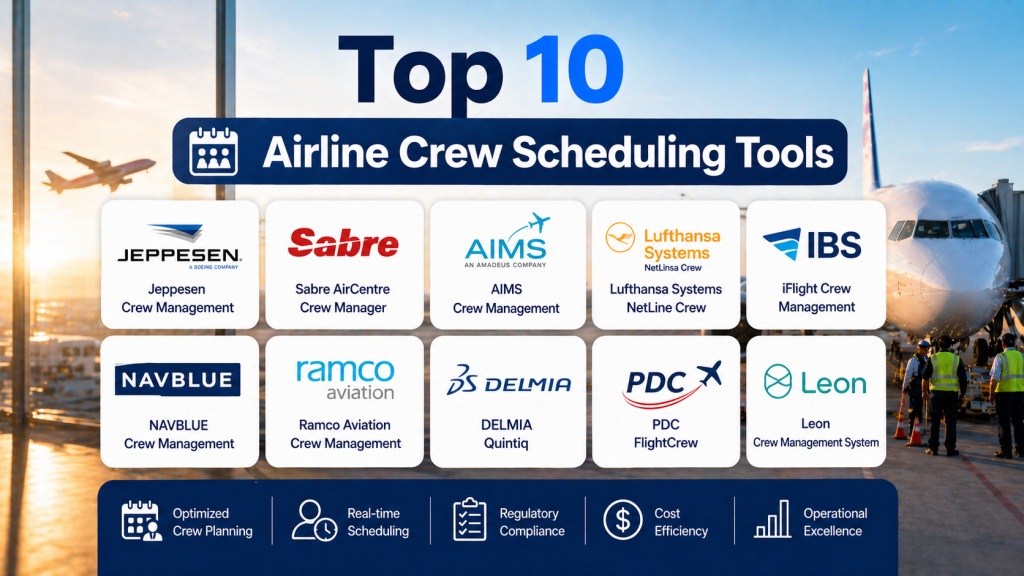
Top 10 Airline Crew Scheduling Tools
1 — Jeppesen Crew Management
Short description: Jeppesen Crew Management is a widely adopted airline crew scheduling solution used by major airlines worldwide. It offers advanced optimization for crew pairing and rostering. The platform focuses on operational efficiency and compliance. It supports real-time disruption management. It is ideal for large-scale airline operations.
Key Features
- Advanced crew pairing
- Rostering optimization
- Fatigue management
- Real-time disruption handling
- Compliance automation
Pros
- Industry-leading solution
- Strong optimization capabilities
Cons
- Complex implementation
- High cost
Platforms / Deployment
Web — Cloud
Security & Compliance
Enterprise-grade controls
Integrations & Ecosystem
Deep integration with airline systems
Support & Community
Enterprise-level support
2 — Sabre AirCentre Crew Manager
Short description: Sabre AirCentre Crew Manager is a comprehensive crew scheduling platform designed for airlines. It helps optimize crew assignments and manage disruptions. The platform integrates with flight operations systems. It is suitable for enterprise airlines. It offers strong analytics capabilities.
Key Features
- Crew planning and scheduling
- Disruption management
- Analytics
- Compliance tracking
- Integration with operations systems
Pros
- Strong integration
- Scalable platform
Cons
- Complex interface
- High cost
Platforms / Deployment
Web — Cloud
Security & Compliance
Enterprise security features
Integrations & Ecosystem
Integrated with airline systems
Support & Community
Strong support
3 — AIMS Crew Management
Short description: AIMS Crew Management is a comprehensive solution that automates crew scheduling, tracking, and compliance. It supports both manual and automated scheduling. The platform helps manage crew legality and assignments efficiently. It is suitable for airlines of various sizes. It improves operational visibility.
Key Features
- Automated crew scheduling
- Crew legality checks
- Real-time tracking
- Reporting
- Notification system
Pros
- Flexible system
- Strong compliance features
Cons
- Limited UI modernity
- Requires training
Platforms / Deployment
Web — Cloud
Security & Compliance
Not publicly stated
Integrations & Ecosystem
Supports integration with airline systems
Support & Community
Standard support
4 — Lufthansa Systems NetLine Crew
Short description: NetLine Crew is an advanced crew scheduling solution designed for airline operations. It optimizes scheduling and improves operational efficiency. The platform supports large-scale operations. It integrates with airline planning systems. It is suitable for enterprise airlines.
Key Features
- Crew scheduling
- Optimization algorithms
- Reporting
- Integration capabilities
- Scenario planning
Pros
- Strong optimization
- Enterprise scalability
Cons
- Complex setup
- Costly
Platforms / Deployment
Web — Cloud
Security & Compliance
Not publicly stated
Integrations & Ecosystem
Enterprise integrations
Support & Community
Enterprise support
5 — IBS iFlight Crew Management
Short description: IBS iFlight Crew Management provides advanced scheduling and crew optimization capabilities. It supports automation and real-time data processing. The platform is suitable for modern airlines. It improves operational efficiency. It integrates with flight operations.
Key Features
- Crew scheduling
- Optimization
- Real-time updates
- Reporting
- Integration
Pros
- Scalable
- Efficient
Cons
- Complex implementation
- Learning curve
Platforms / Deployment
Web — Cloud
Security & Compliance
Not publicly stated
Integrations & Ecosystem
Strong integration capabilities
Support & Community
Standard support
6 — NAVBLUE Crew Management
Short description: NAVBLUE Crew Management is a solution focused on optimizing airline crew operations. It supports planning, scheduling, and tracking. The platform is suitable for airlines of all sizes. It helps improve operational performance. It integrates with aviation systems.
Key Features
- Crew planning
- Scheduling
- Tracking
- Reporting
- Optimization
Pros
- Reliable system
- Good performance
Cons
- Limited customization
- Smaller ecosystem
Platforms / Deployment
Web — Cloud
Security & Compliance
Not publicly stated
Integrations & Ecosystem
Integration with aviation tools
Support & Community
Standard support
7 — Ramco Aviation Crew Management
Short description: Ramco Aviation Crew Management is a cloud-based solution designed for airline operations. It offers automation and analytics features. The platform supports compliance and optimization. It is suitable for enterprises. It provides real-time insights.
Key Features
- Crew scheduling
- Analytics
- Compliance tracking
- Automation
- Reporting
Pros
- Cloud-native
- Strong analytics
Cons
- Complex setup
- Higher cost
Platforms / Deployment
Web — Cloud
Security & Compliance
Not publicly stated
Integrations & Ecosystem
Supports enterprise integrations
Support & Community
Enterprise support
8 — DELMIA Quintiq
Short description: DELMIA Quintiq is an advanced planning and optimization platform used for complex scheduling problems, including airline crew management. It provides powerful optimization algorithms. The platform is suitable for large enterprises. It supports advanced analytics. It helps improve efficiency.
Key Features
- Advanced optimization
- Scenario simulation
- Scheduling
- Analytics
- Planning tools
Pros
- Highly flexible
- Powerful optimization
Cons
- Complex system
- Requires expertise
Platforms / Deployment
Web — Cloud
Security & Compliance
Not publicly stated
Integrations & Ecosystem
Enterprise integrations
Support & Community
Enterprise support
9 — PDC FlightCrew
Short description: PDC FlightCrew is a specialized airline crew scheduling solution designed for efficient rostering and tracking. It supports automatic scheduling and compliance. The platform ensures proper crew assignment. It is suitable for airlines needing streamlined operations. It offers reporting capabilities.
Key Features
- Crew scheduling
- Automatic rostering
- Compliance tracking
- Crew tracking
- Reporting
Pros
- Efficient scheduling
- Compliance support
Cons
- Limited ecosystem
- Smaller scale
Platforms / Deployment
Web — Cloud
Security & Compliance
Not publicly stated
Integrations & Ecosystem
Supports integrations
Support & Community
Standard support
10 — Leon Crew Management System
Short description: Leon Crew Management System is a flexible platform designed for managing crew scheduling and operations. It supports roster management and crew tracking. The platform is suitable for small and mid-sized airlines. It offers automation features. It improves efficiency.
Key Features
- Crew rostering
- Duty management
- Notifications
- Reporting
- Tracking
Pros
- Easy to use
- Flexible
Cons
- Limited enterprise features
- Smaller ecosystem
Platforms / Deployment
Web — Cloud
Security & Compliance
Not publicly stated
Integrations & Ecosystem
Basic integrations
Support & Community
Standard support
Comparison Table
| Tool | Best For | Platforms | Deployment | Standout Feature |
|---|---|---|---|---|
| Jeppesen | Enterprise | Web | Cloud | Optimization |
| Sabre AirCentre | Enterprise | Web | Cloud | Integration |
| AIMS | Mid-market | Web | Cloud | Compliance |
| NetLine Crew | Enterprise | Web | Cloud | Scheduling |
| IBS iFlight | Mid-market | Web | Cloud | Automation |
| NAVBLUE | Mid-market | Web | Cloud | Performance |
| Ramco | Enterprise | Web | Cloud | Analytics |
| Quintiq | Enterprise | Web | Cloud | Optimization |
| PDC FlightCrew | SMB | Web | Cloud | Rostering |
| Leon | SMB | Web | Cloud | Simplicity |
Evaluation & Scoring
| Tool | Core | Ease | Integrations | Security | Performance | Support | Value | Total |
|---|---|---|---|---|---|---|---|---|
| Jeppesen | 9 | 6 | 9 | 8 | 9 | 9 | 6 | 8.1 |
| Sabre | 9 | 6 | 9 | 8 | 9 | 9 | 6 | 8.1 |
| AIMS | 8 | 7 | 7 | 7 | 8 | 8 | 7 | 7.7 |
| NetLine | 9 | 6 | 8 | 8 | 9 | 9 | 6 | 8.0 |
| IBS | 8 | 7 | 8 | 7 | 8 | 8 | 7 | 7.8 |
| NAVBLUE | 8 | 7 | 7 | 7 | 8 | 8 | 7 | 7.7 |
| Ramco | 8 | 7 | 8 | 7 | 8 | 8 | 7 | 7.8 |
| Quintiq | 9 | 6 | 9 | 8 | 9 | 9 | 6 | 8.1 |
| PDC | 7 | 8 | 6 | 6 | 7 | 7 | 8 | 7.2 |
| Leon | 7 | 8 | 6 | 6 | 7 | 7 | 8 | 7.2 |
These scores represent a comparative evaluation of each platform across critical factors such as functionality, usability, and scalability. Higher scores indicate stronger enterprise-level capabilities, while mid-range scores reflect balanced usability and performance. Smaller tools often score higher in ease of use and affordability but may lack advanced features. Always interpret these scores based on your operational requirements and airline size.
Which Airline Crew Scheduling Tool Is Right for You
Small Airline
Leon and PDC FlightCrew are simple and cost-effective solutions.
SMB Airline
AIMS and NAVBLUE provide balanced features and scalability.
Mid-Market Airline
IBS iFlight and Ramco offer automation and integration capabilities.
Enterprise Airline
Jeppesen, Sabre AirCentre, and NetLine Crew are ideal for large-scale operations.
Budget vs Premium
Budget tools focus on simplicity, while premium tools offer optimization and analytics.
Feature Depth vs Ease of Use
Advanced tools provide more control but require training.
Integrations & Scalability
Enterprise tools offer better integration with airline systems.
Security & Compliance Needs
Compliance-focused tools are critical for regulatory adherence.
Frequently Asked Questions
1. What is airline crew scheduling software
It is software that helps airlines manage crew assignments, schedules, and compliance. It ensures efficient allocation of crew members. It reduces manual errors. It improves operational efficiency.
2. Why is crew scheduling important
Crew scheduling ensures flights operate smoothly and safely. It helps manage costs and compliance. It reduces disruptions. It improves efficiency. It is critical for airline operations.
3. How do these tools ensure compliance
They track duty hours and rest periods automatically. They follow aviation regulations. This reduces risk. It ensures safety. Compliance is built into the system.
4. Can these tools handle disruptions
Yes, they provide real-time updates. They adjust schedules automatically. This reduces delays. It improves reliability.
5. Are these tools cloud-based
Most modern tools are cloud-based. This improves scalability. It allows real-time access. It reduces infrastructure costs.
6. What are common mistakes when choosing tools
Ignoring integrations is a mistake. Choosing only based on cost is risky. Not testing the tool can cause issues. Proper evaluation is important.
7. Can small airlines use these tools
Yes, some tools are designed for smaller airlines. They offer simplified features. They are easier to deploy. Businesses should choose based on needs.
8. Do these tools support mobile access
Many tools provide mobile access. Crew can view schedules easily. This improves communication. It enhances efficiency.
9. How do these tools reduce costs
They optimize crew assignments. They reduce downtime. They improve utilization. This lowers operational costs.
10. Can I switch tools later
Switching is possible but complex. It requires planning. Data migration is needed. Training is required.
Conclusion
Airline crew scheduling tools are critical systems that ensure efficient and compliant airline operations by managing one of the most complex aspects of aviation—crew planning and assignment. These platforms go beyond basic scheduling by incorporating automation, real-time updates, and regulatory compliance into a single system, helping airlines minimize disruptions and maintain operational stability.From enterprise-grade solutions like Jeppesen and Sabre to flexible tools like Leon and PDC FlightCrew, each platform serves a different segment of the aviation industry. The right choice depends on factors such as airline size, operational complexity, integration requirements, and budget. There is no universal solution, and organizations must align tool capabilities with their specific operational needs.A practical approach is to shortlist a few tools, test their scheduling capabilities, evaluate integration with existing systems, and assess usability for operations teams. Running a pilot implementation can help identify gaps and ensure the system meets real-world requirements. Choosing the right crew scheduling tool can significantly improve efficiency, reduce operational risks, and enhance overall airline performance.

One aspect that often determines the success of crew scheduling software is how well it adapts to last-minute changes. A system that can quickly handle disruptions while keeping crews informed can reduce a lot of operational stress and improve overall efficiency.