Introduction
Airport Operations Management Software is a centralized digital platform that helps airports manage flight operations, passenger flow, resource allocation, and real-time coordination across multiple stakeholders. These systems act as the operational backbone of airports, integrating data from airlines, ground handlers, security systems, and air traffic control into a unified interface.
Modern airports operate like complex ecosystems where efficiency, safety, and real-time decision-making are critical. These platforms enable airports to minimize delays, optimize resource usage, and improve passenger experience through automation and data-driven insights.
Common use cases include:
- Managing flight schedules and real-time updates
- Allocating gates, check-in counters, and baggage systems
- Monitoring passenger flow and airport congestion
- Coordinating ground handling and airport staff
- Generating operational analytics and reports
What buyers should evaluate:
- Real-time data processing capabilities
- Integration with airport and airline systems
- Resource allocation and optimization
- Scalability for growing passenger volumes
- Security and regulatory compliance
- Reporting and analytics features
- Ease of use for multi-team coordination
- Vendor support and training
Best for: International airports, regional airports, airport authorities, and aviation operators needing centralized operational control and real-time visibility.
Not ideal for: Small facilities with limited flight operations or businesses outside aviation.
Key Trends in Airport Operations Management Software
- AI-driven predictive analytics for delay management and forecasting
- Real-time operational dashboards for better decision-making
- Integration with IoT devices for asset and infrastructure monitoring
- Biometric systems improving passenger processing and security
- Cloud-based deployment replacing legacy infrastructure
- Collaborative decision-making tools across stakeholders
- Automation of resource allocation and scheduling
- Increased focus on sustainability and operational efficiency
How We Selected These Tools
- Industry adoption and credibility in airport operations
- Feature completeness across airside and terminal operations
- Real-time performance and reliability
- Integration with airline, ATC, and airport subsystems
- Security and compliance readiness
- Scalability for small to large airports
- Usability for operational teams
- Vendor support and ecosystem maturity
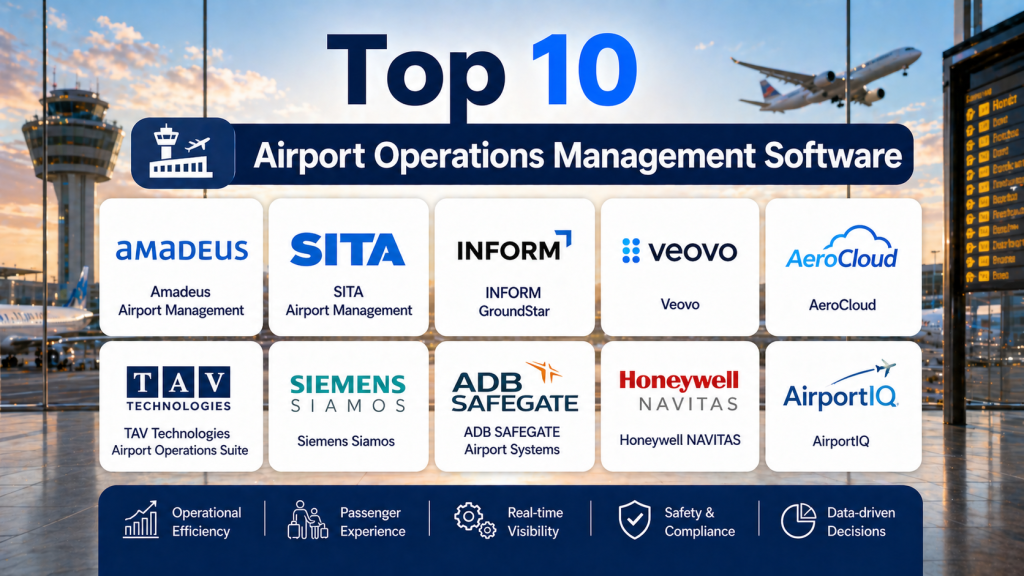
Top 10 Airport Operations Management Software Tools
1 — Amadeus Airport Operations
Short description: Amadeus Airport Operations is a comprehensive platform designed for medium to large airports. It provides real-time operational control, collaboration tools, and predictive analytics. The system integrates multiple airport functions into a single platform. It helps improve efficiency and decision-making. It is widely used by international airports.
Key Features
- Airport operational database
- Resource and gate management
- Real-time dashboards
- Disruption management
- Collaborative decision-making
Pros
- Strong global adoption
- Excellent real-time visibility
Cons
- Complex implementation
- Higher cost
Platforms / Deployment
Web — Cloud
Security & Compliance
Role-based access, encryption
Integrations & Ecosystem
Integrates with airline systems and ATC
- Flight systems
- Baggage systems
- Security systems
Support & Community
Enterprise-grade support
2 — SITA Airport Management
Short description: SITA Airport Management is a modular platform focused on operational efficiency and passenger flow optimization. It provides real-time insights and predictive analytics. The system integrates with biometric and IoT technologies. It is suitable for large and modern airports. It enhances passenger experience and operations.
Key Features
- Operations control center
- Passenger flow analytics
- AI-based forecasting
- Resource management
- Disruption recovery
Pros
- Strong analytics
- Scalable architecture
Cons
- Premium pricing
- Customization complexity
Platforms / Deployment
Web — Cloud
Security & Compliance
Enterprise-grade security
Integrations & Ecosystem
Integration with biometric and IoT systems
Support & Community
Global enterprise support
3 — INFORM GroundStar
Short description: INFORM GroundStar is a powerful airport operations platform designed for resource optimization and operational efficiency. It supports workforce and ground handling management. The system improves coordination across airport teams. It is suitable for large airports. It provides advanced analytics.
Key Features
- Resource optimization
- Workforce management
- Real-time monitoring
- Analytics
- Operational alerts
Pros
- Strong optimization capabilities
- Good decision support
Cons
- Complex setup
- Requires training
Platforms / Deployment
Web — Cloud
Security & Compliance
Not publicly stated
Integrations & Ecosystem
Supports integration with airport systems
Support & Community
Enterprise support
4 — Veovo
Short description: Veovo is a data-driven airport operations platform focusing on predictive insights and performance optimization. It provides real-time analytics and passenger journey tracking. The system helps improve operational efficiency. It is suitable for modern airports. It offers intuitive dashboards.
Key Features
- Predictive analytics
- Passenger flow tracking
- Real-time dashboards
- KPI monitoring
- Resource optimization
Pros
- Strong analytics
- User-friendly interface
Cons
- Requires high-quality data
- Premium pricing
Platforms / Deployment
Web — Cloud
Security & Compliance
Data encryption and access controls
Integrations & Ecosystem
Integrates with airport data systems
Support & Community
Responsive support
5 — AeroCloud
Short description: AeroCloud is a cloud-native airport operations platform designed for modern airports. It focuses on ease of use and scalability. The system provides real-time operational insights. It helps optimize airport resources. It is suitable for growing airports.
Key Features
- Cloud-based operations management
- Resource planning
- Real-time monitoring
- Reporting
- Analytics
Pros
- Modern interface
- Scalable
Cons
- Limited enterprise depth
- Smaller ecosystem
Platforms / Deployment
Web — Cloud
Security & Compliance
Not publicly stated
Integrations & Ecosystem
Basic integrations
Support & Community
Standard support
6 — TAV Technologies Airport Operations Suite
Short description: TAV Technologies offers an integrated airport operations suite designed for coordination and efficiency. It provides tools for resource planning and monitoring. The system supports terminal and airside operations. It is suitable for mid to large airports. It offers strong operational control.
Key Features
- Operations control center
- Resource allocation
- Performance monitoring
- Incident management
- Reporting
Pros
- Integrated solution
- Balanced features
Cons
- Limited global footprint
- Fewer advanced AI features
Platforms / Deployment
Web — Cloud
Security & Compliance
Standard enterprise security
Integrations & Ecosystem
Integration with airport systems
Support & Community
Regional enterprise support
7 — Siemens Siamos
Short description: Siemens Siamos is an airport management platform designed to optimize operational efficiency and coordination. It supports resource planning and scheduling. The system is suitable for large airports. It integrates with airport infrastructure. It focuses on reliability.
Key Features
- Resource planning
- Scheduling
- Monitoring
- Reporting
- Integration
Pros
- Reliable system
- Strong performance
Cons
- Complex interface
- Higher cost
Platforms / Deployment
Web — Cloud
Security & Compliance
Not publicly stated
Integrations & Ecosystem
Enterprise integrations
Support & Community
Enterprise support
8 — ADB SAFEGATE Airport Systems
Short description: ADB SAFEGATE provides airport systems focusing on airside operations and safety. It centralizes operational data for better decision-making. The platform supports runway and apron management. It is suitable for complex airport environments. It enhances operational control.
Key Features
- Airside operations management
- Flight tracking
- Resource allocation
- Safety monitoring
- Data centralization
Pros
- Strong safety focus
- Reliable operations
Cons
- Limited passenger features
- Technical interface
Platforms / Deployment
Web — Cloud
Security & Compliance
Access controls and audit logs
Integrations & Ecosystem
Integrates with airport infrastructure systems
Support & Community
Technical support
9 — Honeywell NAVITAS
Short description: Honeywell NAVITAS is an airport operations platform designed to optimize performance and efficiency. It integrates multiple operational systems. The platform provides real-time insights. It is suitable for large airports. It focuses on automation.
Key Features
- Operations management
- Real-time monitoring
- Resource optimization
- Analytics
- Integration
Pros
- Strong automation
- Scalable
Cons
- Complex deployment
- Higher cost
Platforms / Deployment
Web — Cloud
Security & Compliance
Not publicly stated
Integrations & Ecosystem
Enterprise integrations
Support & Community
Enterprise support
10 — AirportIQ
Short description: AirportIQ is a data-driven airport operations platform focused on analytics and business intelligence. It provides operational insights and reporting tools. The system helps improve decision-making. It is suitable for data-focused airports. It offers performance tracking.
Key Features
- Business intelligence
- Operational dashboards
- Reporting
- Data analytics
- KPI tracking
Pros
- Strong analytics
- Easy reporting
Cons
- Limited operational control features
- Smaller ecosystem
Platforms / Deployment
Web — Cloud
Security & Compliance
Role-based access
Integrations & Ecosystem
Integrates with airport systems
Support & Community
Good support
Comparison Table
| Tool | Best For | Platforms | Deployment | Standout Feature | Public Rating |
|---|---|---|---|---|---|
| Amadeus | Large airports | Web | Cloud | Real-time coordination | N/A |
| SITA | Passenger-focused airports | Web | Cloud | AI analytics | N/A |
| INFORM | Resource optimization | Web | Cloud | Workforce planning | N/A |
| Veovo | Data-driven airports | Web | Cloud | Predictive analytics | N/A |
| AeroCloud | Growing airports | Web | Cloud | Cloud-native | N/A |
| TAV | Integrated operations | Web | Cloud | Coordination | N/A |
| Siemens | Enterprise airports | Web | Cloud | Reliability | N/A |
| ADB SAFEGATE | Airside operations | Web | Cloud | Safety focus | N/A |
| Honeywell | Large airports | Web | Cloud | Automation | N/A |
| AirportIQ | Analytics-focused | Web | Cloud | BI dashboards | N/A |
Evaluation & Scoring
| Tool | Core | Ease | Integrations | Security | Performance | Support | Value | Total |
|---|---|---|---|---|---|---|---|---|
| Amadeus | 9 | 7 | 9 | 8 | 9 | 9 | 7 | 8.4 |
| SITA | 9 | 8 | 9 | 8 | 9 | 9 | 7 | 8.5 |
| INFORM | 8 | 7 | 8 | 7 | 8 | 8 | 7 | 7.9 |
| Veovo | 8 | 8 | 8 | 7 | 8 | 8 | 7 | 7.9 |
| AeroCloud | 7 | 9 | 7 | 6 | 7 | 7 | 8 | 7.6 |
| TAV | 8 | 7 | 7 | 7 | 8 | 7 | 7 | 7.6 |
| Siemens | 8 | 6 | 8 | 7 | 8 | 8 | 6 | 7.5 |
| ADB SAFEGATE | 8 | 6 | 8 | 8 | 8 | 8 | 6 | 7.6 |
| Honeywell | 8 | 6 | 8 | 7 | 8 | 8 | 6 | 7.5 |
| AirportIQ | 7 | 8 | 7 | 7 | 7 | 7 | 8 | 7.4 |
These scores provide a comparative view of each platform based on operational capabilities, usability, and value. Higher scores indicate stronger enterprise-level features and integration capabilities, while mid-range scores reflect balanced performance and usability. Tools designed for analytics often score higher in ease of use, while enterprise platforms excel in scalability and compliance. Always interpret scores relative to your airport size and operational complexity.
Which Airport Operations Management Software Is Right for You
Small Airport
AeroCloud and AirportIQ are simple and cost-effective.
Regional Airport
TAV Technologies and INFORM offer balanced features.
Mid-Market Airport
Veovo and SITA provide analytics and scalability.
Large International Airport
Amadeus, Siemens, and Honeywell are ideal for complex operations.
Budget vs Premium
Budget tools focus on simplicity, premium tools provide advanced analytics and automation.
Feature Depth vs Ease of Use
Complex systems offer more control but require training.
Integrations & Scalability
Choose platforms with strong integration capabilities.
Security & Compliance Needs
Large airports should prioritize compliance and data protection.
Frequently Asked Questions
1. What is airport operations management software
It is a platform that manages airport operations in one system. It integrates data from multiple sources. It helps improve efficiency. It reduces delays. It supports real-time decision-making.
2. Why is it important
Airports are complex environments with many moving parts. These tools help coordinate operations. They improve safety and efficiency. They reduce operational errors. They enhance passenger experience.
3. What features are essential
Key features include real-time data processing, resource management, and analytics. Integration capabilities are also important. These systems support coordination across teams.
4. Can small airports use these systems
Yes, there are solutions designed for smaller airports. They offer simplified features. They are easier to deploy. Businesses should choose based on needs.
5. Are these systems cloud-based
Most modern systems are cloud-based. This improves scalability and access. It reduces infrastructure costs. It enables real-time updates.
6. How do these tools improve efficiency
They automate processes and provide real-time insights. This helps reduce delays. It improves coordination. It optimizes resource usage.
7. Do these systems integrate with airlines
Yes, integration is a key feature. They connect with airline systems and ATC. This ensures smooth operations. It improves coordination.
8. What are common mistakes when choosing software
Choosing based only on cost is a mistake. Ignoring integration needs can cause issues. Not testing the system is risky. Proper evaluation is essential.
9. Is security important
Yes, these systems handle critical data. Security and compliance are essential. Businesses should verify protection measures.
10. Can systems scale with airport growth
Yes, most modern systems are scalable. They support increasing traffic. They adapt to operational needs. Scalability is a key factor.
Conclusion
Airport Operations Management Software plays a crucial role in ensuring that modern airports function efficiently, safely, and in a coordinated manner. These platforms act as the central nervous system of airport operations, integrating flight data, resource allocation, passenger flow, and communication into a unified system. As airports continue to handle increasing passenger volumes and operational complexity, adopting advanced software solutions becomes essential for maintaining performance and reliability.From enterprise-grade platforms like Amadeus and SITA to flexible cloud-native solutions like AeroCloud, each tool serves different operational needs. Larger airports benefit from comprehensive systems with deep integrations and advanced analytics, while smaller airports can leverage simpler tools focused on usability and cost efficiency. The right choice depends on operational scale, integration requirements, and long-term growth strategy.

One factor that can make a big difference in airport operations is how quickly staff can act on real-time information during unexpected disruptions. The ability to coordinate teams efficiently is often just as valuable as having advanced planning and scheduling features.