Introduction
Legal Research Platforms are digital tools that provide access to case law, statutes, regulations, legal commentary, and analytics in a centralized system. These platforms help legal professionals quickly find authoritative legal information, verify case validity, and build strong legal arguments without manually searching through physical records.
In today’s legal environment, research has become faster, more data-driven, and increasingly powered by AI. Platforms now offer advanced search, citation tracking, and even AI-assisted legal analysis, enabling lawyers to work more efficiently and accurately.
Common use cases include:
- Case law and statute research
- Legal drafting and argument preparation
- Citation validation and “good law” checks
- Legal analytics and insights
- Academic and policy research
What buyers should evaluate:
- Depth and accuracy of legal database
- Search capabilities and AI features
- Citation tools and validation systems
- Ease of use and interface
- Integration with legal workflows
- Coverage across jurisdictions
- Analytics and insights
- Scalability for firms or enterprises
- Security and compliance
Best for: Lawyers, law firms, in-house legal teams, law students, researchers, and compliance professionals.
Not ideal for: Non-legal users or organizations with minimal legal research requirements.
Key Trends in Legal Research Platforms
- AI-powered legal research assistants for faster insights
- Natural language search replacing keyword-only queries
- Integration with drafting and document tools
- Real-time citation validation systems
- Legal analytics for case prediction and strategy
- Cloud-based access across devices
- Cross-jurisdiction legal databases
- Automation of research workflows
- Integration with knowledge management systems
- Growth of AI-native legal research startups
How We Selected These Tools (Methodology)
- Evaluated market leadership and adoption in legal industry
- Assessed database size and content accuracy
- Reviewed AI-powered research capabilities
- Considered citation tracking and validation tools
- Analyzed usability and workflow integration
- Evaluated global and regional coverage
- Reviewed scalability for firms and enterprises
- Considered support, training, and ecosystem strength
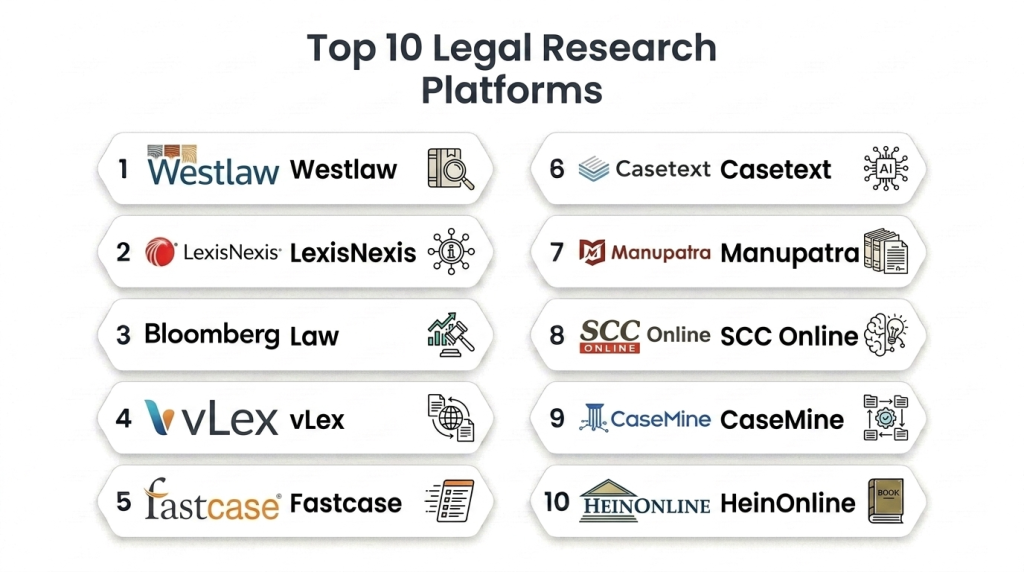
Top 10 Legal Research Platforms
#1 — Westlaw
Short description:
Westlaw is one of the most trusted legal research platforms used globally. It offers a vast database of case law, statutes, and legal commentary. The platform includes AI-assisted research tools and citation tracking features. It is widely used by law firms and enterprises.
Key Features
- Extensive legal database
- AI-assisted research
- KeyCite citation validation
- Legal analytics tools
- Advanced search capabilities
Pros
- Highly reliable legal content
- Strong citation tools
Cons
- Expensive subscription
- Learning curve
Platforms / Deployment
Web
Cloud
Security & Compliance
SSO, encryption
Integrations & Ecosystem
Westlaw integrates with legal workflows and document systems for seamless research.
- Document management tools
- Legal analytics systems
Support & Community
Strong enterprise support with training and documentation.
#2 — LexisNexis
Short description:
LexisNexis is a leading legal research platform offering comprehensive legal content and AI-powered tools. It provides access to statutes, case law, and practical guidance. The platform supports drafting, research, and analytics. It is widely used across industries.
Key Features
- AI-powered legal research
- Extensive legal database
- Shepard’s citation tool
- Legal drafting support
Pros
- Comprehensive content
- Strong AI features
Cons
- Pricing varies
- Workflow fragmentation in some cases
Platforms / Deployment
Web
Cloud
Security & Compliance
SSO, encryption
Integrations & Ecosystem
LexisNexis integrates with enterprise systems for legal workflows.
- CRM systems
- Document tools
Support & Community
Strong global support and ecosystem.
#3 — Bloomberg Law
Short description:
Bloomberg Law combines legal research with business intelligence and news. It provides access to legal content along with financial and regulatory insights. The platform is ideal for professionals needing both legal and business data. It supports advanced analytics.
Key Features
- Legal research database
- Business and financial insights
- News integration
- Analytics tools
Pros
- Integrated business intelligence
- Strong analytics
Cons
- Expensive
- May be overkill for small firms
Platforms / Deployment
Web
Cloud
Security & Compliance
Not publicly stated
Integrations & Ecosystem
- Financial tools
- Legal systems
Support & Community
Enterprise-level support.
#4 — vLex
Short description:
vLex provides global legal research with access to millions of legal documents. It offers AI-powered search and analytics. The platform is suitable for international law research. It is used by law firms and academic institutions.
Key Features
- Global legal database
- AI-powered search
- Legal analytics
- Document management
Pros
- Strong global coverage
- Advanced search
Cons
- Limited local depth in some regions
- Learning curve
Platforms / Deployment
Web
Cloud
Security & Compliance
Not publicly stated
Integrations & Ecosystem
- Legal tools
- Data platforms
Support & Community
Growing global support.
#5 — Fastcase
Short description:
Fastcase is a cost-effective legal research platform offering access to case law and statutes. It is known for its visualization tools and ease of use. The platform is popular among small firms. It provides affordable access to legal data.
Key Features
- Legal database
- Visualization tools
- Search capabilities
- Case law access
Pros
- Affordable pricing
- Easy to use
Cons
- Limited advanced features
- Smaller database
Platforms / Deployment
Web
Cloud
Security & Compliance
Not publicly stated
Integrations & Ecosystem
- Legal tools
Support & Community
Moderate support.
#6 — Casetext
Short description:
Casetext is an AI-powered legal research platform designed for speed and simplicity. It offers tools for case law research and document analysis. The platform includes AI assistants for faster insights. It is suitable for modern legal teams.
Key Features
- AI legal assistant
- Case law search
- Document analysis
- Research automation
Pros
- Fast and efficient
- AI-driven insights
Cons
- Smaller database compared to leaders
- Limited enterprise depth
Platforms / Deployment
Web
Cloud
Security & Compliance
Not publicly stated
Integrations & Ecosystem
- Legal tools
- Data systems
Support & Community
Strong support for modern teams.
#7 — Manupatra
Short description:
Manupatra is a legal research platform focused on Indian law. It provides access to case law, statutes, and legal commentary. The platform is widely used in India. It supports legal professionals and researchers.
Key Features
- Indian legal database
- Case law access
- Search tools
- Legal updates
Pros
- Strong India coverage
- Reliable content
Cons
- Limited global reach
- Basic UI
Platforms / Deployment
Web
Cloud
Security & Compliance
Not publicly stated
Integrations & Ecosystem
- Legal systems
Support & Community
Good regional support.
#8 — SCC Online
Short description:
SCC Online is another leading Indian legal research platform offering case law and legal commentary. It is widely used by lawyers and judges. The platform provides reliable and authoritative legal information. It supports research and analysis.
Key Features
- Case law database
- Legal commentary
- Search tools
- Citation features
Pros
- Trusted content
- Strong Indian legal coverage
Cons
- Limited global database
- Traditional interface
Platforms / Deployment
Web
Cloud
Security & Compliance
Not publicly stated
Integrations & Ecosystem
- Legal tools
Support & Community
Strong legal community adoption.
#9 — CaseMine
Short description:
CaseMine is an AI-driven legal research platform offering advanced search and analytics. It uses machine learning to identify relevant cases and insights. The platform focuses on improving research efficiency. It is suitable for modern legal teams.
Key Features
- AI-powered search
- Case analysis
- Legal analytics
- Citation tracking
Pros
- Advanced AI capabilities
- Efficient research
Cons
- Smaller database
- Growing platform
Platforms / Deployment
Web
Cloud
Security & Compliance
Not publicly stated
Integrations & Ecosystem
- Legal tools
Support & Community
Growing support base.
#10 — HeinOnline
Short description:
HeinOnline is a legal research platform specializing in legal journals, historical documents, and government publications. It is widely used in academic and research environments. The platform provides deep archival content. It is ideal for legal scholars.
Key Features
- Legal journals
- Historical documents
- Government publications
- Research tools
Pros
- Extensive archives
- Academic focus
Cons
- Limited practical tools
- Less focus on case law
Platforms / Deployment
Web
Cloud
Security & Compliance
Not publicly stated
Integrations & Ecosystem
- Academic tools
Support & Community
Strong academic support.
Comparison Table
| Tool Name | Best For | Platform(s) Supported | Deployment | Standout Feature | Public Rating |
|---|---|---|---|---|---|
| Westlaw | Enterprise | Web | Cloud | AI-assisted research | N/A |
| LexisNexis | Enterprise | Web | Cloud | AI legal workflows | N/A |
| Bloomberg Law | Enterprise | Web | Cloud | Legal + business data | N/A |
| vLex | Global research | Web | Cloud | International database | N/A |
| Fastcase | SMB | Web | Cloud | Affordable access | N/A |
| Casetext | Modern teams | Web | Cloud | AI assistant | N/A |
| Manupatra | India | Web | Cloud | Indian law database | N/A |
| SCC Online | India | Web | Cloud | Legal commentary | N/A |
| CaseMine | AI research | Web | Cloud | AI insights | N/A |
| HeinOnline | Academic | Web | Cloud | Historical archives | N/A |
Evaluation & Scoring of Legal Research Platforms
| Tool Name | Core | Ease | Integrations | Security | Performance | Support | Value | Weighted Total |
|---|---|---|---|---|---|---|---|---|
| Westlaw | 9 | 7 | 9 | 9 | 9 | 9 | 7 | 8.5 |
| LexisNexis | 9 | 8 | 9 | 9 | 9 | 9 | 7 | 8.6 |
| Bloomberg Law | 8 | 7 | 8 | 8 | 9 | 9 | 7 | 8.1 |
| vLex | 8 | 7 | 7 | 7 | 8 | 8 | 7 | 7.8 |
| Fastcase | 7 | 9 | 6 | 7 | 7 | 7 | 9 | 7.6 |
| Casetext | 8 | 9 | 7 | 7 | 8 | 8 | 8 | 8.0 |
| Manupatra | 7 | 7 | 6 | 7 | 7 | 7 | 8 | 7.2 |
| SCC Online | 7 | 7 | 6 | 7 | 7 | 7 | 8 | 7.2 |
| CaseMine | 7 | 8 | 6 | 7 | 7 | 7 | 8 | 7.4 |
| HeinOnline | 8 | 6 | 6 | 7 | 7 | 7 | 7 | 7.2 |
How to interpret scores:
These scores are comparative and help identify strengths across platforms. Higher scores indicate strong databases, advanced features, and enterprise readiness. Some tools prioritize affordability and ease of use, while others focus on deep analytics and global coverage. Always match scores with your research needs and workflow requirements.
Which Legal Research Platform Is Right for You?
Solo / Freelancer
Fastcase or Casetext offer affordable and easy-to-use solutions.
SMB
Casetext and Fastcase provide a balance of usability and cost.
Mid-Market
vLex and Bloomberg Law offer broader features and analytics.
Enterprise
Westlaw and LexisNexis are best for large-scale legal research.
Budget vs Premium
Budget options include Fastcase, while premium tools include Westlaw and LexisNexis.
Feature Depth vs Ease of Use
Westlaw offers deep functionality, while Casetext provides ease of use.
Integrations & Scalability
LexisNexis and Westlaw lead in integrations and scalability.
Security & Compliance Needs
Enterprise platforms provide stronger security and compliance capabilities.
Frequently Asked Questions
1. What are legal research platforms?
Legal research platforms are tools that provide access to legal information such as case law, statutes, and regulations. They help legal professionals find and analyze relevant legal materials. These platforms improve research efficiency. They also ensure accuracy and reliability in legal work.
2. How do legal research platforms work?
They use advanced search engines and databases to retrieve legal information. Many platforms now include AI tools for summarization and analysis. Users can search using keywords or natural language. Results are organized for easy review.
3. What are the benefits of using legal research platforms?
They save time, improve accuracy, and provide access to comprehensive legal data. These tools also help validate case law using citation systems. They support better decision-making. Overall, they enhance productivity for legal professionals.
4. Are legal research platforms suitable for small firms?
Yes, some platforms are designed for smaller firms with lower costs. Tools like Fastcase offer affordable options. However, enterprise platforms may be too expensive. The choice depends on budget and needs.
5. What features should I look for in a legal research tool?
Look for database coverage, search capabilities, and citation tools. AI features and analytics are also important. Integration with other systems adds value. Ease of use should also be considered.
6. Can legal research platforms integrate with other tools?
Yes, most platforms integrate with document management and legal systems. This improves workflow efficiency. Integration reduces manual work. It also enhances collaboration.
7. How long does it take to learn these platforms?
Learning time varies depending on the platform. Simple tools can be learned quickly. Advanced platforms may require training. Most vendors provide tutorials and support.
8. What industries use legal research platforms?
Law firms, corporate legal departments, government agencies, and academic institutions use these tools. They are essential for legal work. They also support compliance and policy research.
9. Do legal research platforms use AI?
Yes, many modern platforms include AI-powered features. These include summarization, search, and analytics. AI improves speed and accuracy. It also enhances user experience.
10. Can users rely completely on AI-based legal research?
AI tools are helpful but should not replace human judgment. Legal professionals must verify results. AI may not always be accurate. It should be used as a support tool, not a replacement.
Conclusion
Legal Research Platforms have become indispensable tools for modern legal professionals, transforming how legal information is accessed, analyzed, and applied in real-world scenarios. With the integration of AI, advanced search capabilities, and vast legal databases, these platforms significantly reduce the time and effort required for research while improving accuracy and insight generation. As legal complexity continues to grow across jurisdictions and industries, organizations must rely on robust research tools to stay compliant and competitive. The platforms covered in this guide offer a wide range of capabilities, from affordable solutions for small firms to comprehensive enterprise-grade systems with deep analytics and global coverage. However, the right choice depends on your specific requirements, including budget, research depth, and integration needs. Firms should shortlist a few tools, evaluate their features through trials or demos, and ensure they align with existing workflows before making a final decision. This structured approach will help maximize efficiency, reduce risk, and deliver long-term value.

This article provides a clear and practical comparison of legal research platforms, making it easier to understand their features and choose the right tool for efficient case research and analysis.