Introduction
IP Management (Patents & Trademarks) Software refers to platforms designed to help organizations manage intellectual property portfolios — including patents, trademarks, designs, and related assets — through structured workflows, deadline tracking, and analytics. These tools centralize IP data, automate routine tasks like docketing and renewals, and provide strategic insights into IP performance and compliance.
In a global market where innovation is a core business driver, protecting and managing intellectual property effectively is essential. Companies and legal teams handling complex IP portfolios need systems that help reduce risk, avoid costly missed deadlines, and optimize IP strategy across jurisdictions and asset types.
Common use cases include:
- Tracking patent and trademark deadlines and renewals
- Centralizing IP records and workflows
- Automating docketing and maintenance tasks
- Managing fees and budget forecasting
- Reporting on portfolio value and performance
What buyers should evaluate:
- Support for global patent and trademark jurisdictions
- Deadline monitoring and automation features
- Integration with legal docketing and case systems
- Reporting and analytics capabilities
- Ease of use and configurability
- Scalability for enterprise portfolios
- Security and compliance standards
- IP valuation and strategic insights
- Support quality and ecosystem
Best for: Corporate IP teams, patent attorneys, trademark specialists, legal operations leaders, and innovation‑driven enterprises managing large and diverse IP portfolios.
Not ideal for: Small businesses with minimal IP holdings or those that use basic docketing calendars and spreadsheets.
Key Trends in IP Management Software
- AI‑assisted prior art search and similarity detection
- Automated deadline tracking with smart alerts
- Cloud‑native IP data platforms
- Integration with patent offices and global trademark registries
- Analytics dashboards for portfolio health and value
- Machine learning for IP landscape insights
- API‑driven integration with CLM and financial systems
- Risk scoring and renewal forecasting
- Collaboration tools for cross‑functional IP teams
- Support for compliance and audit readiness
How We Selected These Tools (Methodology)
- Assessed market adoption and IP tooling relevance
- Evaluated support for patent and trademark lifecycles
- Reviewed docketing and deadline automation capabilities
- Considered global jurisdiction coverage
- Analyzed analytics and reporting functionality
- Evaluated integration with legal and financial systems
- Assessed scalability for enterprises
- Reviewed security and compliance readiness
- Considered support quality and customer ecosystem
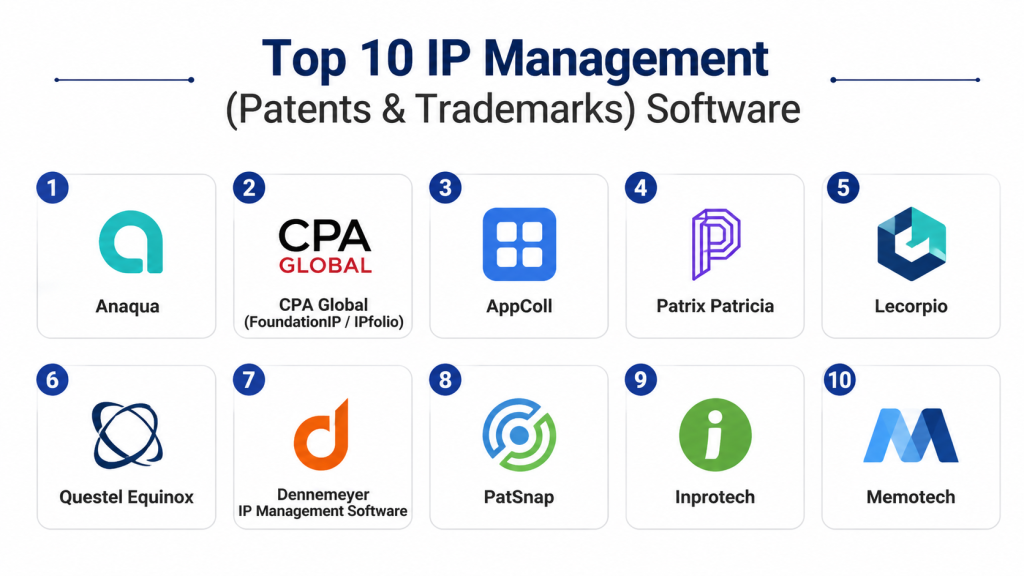
Top 10 IP Management (Patents & Trademarks) Software
#1 — Anaqua
Short description:
Anaqua is a market‑leading IP management platform designed for large enterprises and corporate IP teams. It provides patent and trademark docketing, portfolio insight, and lifecycle automation. The system supports strategic decision‑making and compliance across global jurisdictions.
Key Features
- Patent & trademark lifecycle tracking
- Docketing automation and alerts
- Portfolio analytics dashboards
- Global office integrations
- Fee and renewal management
Pros
- Strong enterprise capabilities
- Deep analytics and reporting
Cons
- Complex implementation
- Premium pricing
Platforms / Deployment
Web / Cloud
Security & Compliance
SSO, encryption
Not publicly stated detailed certifications
Integrations & Ecosystem
Integrates with enterprise legal and financial systems.
- Docketing tools
- Finance systems
- Data platforms
Support & Community
Enterprise support with onboarding and training.
#2 — CPA Global (FoundationIP / IPfolio)
Short description:
CPA Global offers two major IP management suites — FoundationIP for large portfolios and IPfolio for agile teams. These tools provide robust docketing, analytics, and strategic reporting. They are widely adopted for patent, trademark, and design workflows.
Key Features
- Docketing and renewal tracking
- Portfolio insight analytics
- Financial forecasting
- Workflow automation
Pros
- Flexible platform editions
- Strong global coverage
Cons
- Complex feature sets
- Learning curve
Platforms / Deployment
Web / Cloud
Security & Compliance
SSO, encryption
Integrations & Ecosystem
- ERP integration
- Legal tools
Support & Community
Strong global support and documentation.
#3 — AppColl
Short description:
AppColl is an IP management platform focused on docketing, deadline automation, and portfolio oversight. It supports patent and trademark workflows with alerts and fee tracking. The system is suitable for mid-sized and large legal teams.
Key Features
- Patent & trademark tracking
- Deadline alerts
- Fee and budget tracking
- Reporting dashboards
Pros
- Strong deadline automation
- Usable interface
Cons
- Limited advanced analytics
- Smaller ecosystem
Platforms / Deployment
Web / Cloud
Security & Compliance
Encryption
Integrations & Ecosystem
Integrates with legal and docketing systems.
- Case management
- Document tools
Support & Community
Responsive support.
#4 — Patrix Patricia
Short description:
Patrix Patricia is an IP lifecycle and portfolio management solution that focuses on flexibility and configurability. It provides workflow automation, docketing, and compliance features for patent and trademark assets. The tool is used by global corporate IP teams.
Key Features
- Lifecycle tracking
- Workflow automation
- Renewal scheduling
- Compliance monitoring
Pros
- Flexible architecture
- Strong workflow tools
Cons
- Limited community ecosystem
- Implementation effort
Platforms / Deployment
Web / Cloud
Security & Compliance
Not publicly stated detailed certifications
Integrations & Ecosystem
- ERP
- Legal platforms
Support & Community
Regional support.
#5 — Lecorpio
Short description:
Lecorpio is an IP management platform that supports patents, trademarks, and life sciences assets. It delivers docketing, licensing tools, and portfolio analytics. The system is designed for both corporate and law firm IP teams.
Key Features
- Patent & trademark tracking
- Licensing management
- Analytics dashboards
- Workflow automation
Pros
- Broad asset support
- Usable interface
Cons
- Growing feature set
- Limited advanced analytics
Platforms / Deployment
Web / Cloud
Security & Compliance
SSO, encryption
Integrations & Ecosystem
- Financial systems
- Legal tools
Support & Community
Support and onboarding.
#6 — Questel Equinox
Short description:
Questel Equinox is an IP management suite that combines patent and trademark lifecycle tools with IP research and analytics. It provides global docketing, document management, and strategic insight. It is suitable for enterprises and research‑intensive organizations.
Key Features
- Global docketing
- Document management
- Analytics and reporting
- Patent and trademark workflow tools
Pros
- Strong research and analytics
- Global reach
Cons
- Complex setup
- Premium pricing
Platforms / Deployment
Web / Cloud
Security & Compliance
SSO, encryption
Integrations & Ecosystem
- Research tools
- Legal systems
Support & Community
Enterprise support.
#7 — Dennemeyer IP Management Software
Short description:
Dennemeyer provides an IP management platform that integrates patent and trademark docketing with fee management and reporting. It supports compliance tracking and global portfolio oversight. It is suitable for corporate IP functions.
Key Features
- Docketing and alerts
- Renewal and fee tracking
- Portfolio analytics
- Compliance tools
Pros
- Global jurisdiction support
- Comprehensive risk tracking
Cons
- Moderate advanced analytics
- Smaller ecosystem
Platforms / Deployment
Web / Cloud
Security & Compliance
Encryption
Integrations & Ecosystem
- Legal systems
- Accounting tools
Support & Community
Support options available.
#8 — PatSnap
Short description:
PatSnap focuses on combining IP management with innovation analytics. It provides patent and trademark tracking along with competitive insight tools. The platform is suitable for R&D teams and corporate IP departments seeking broader innovation data.
Key Features
- Patent & trademark tracking
- Innovation analytics
- Competitive landscape tools
- Alerts and notifications
Pros
- Strong analytics focus
- Innovation insights
Cons
- Not pure docketing depth
- Pricing
Platforms / Deployment
Web / Cloud
Security & Compliance
SSO, encryption
Integrations & Ecosystem
- Research tools
- Data platforms
Support & Community
Strong support for analytics use.
#9 — Inprotech
Short description:
Inprotech provides IP docketing and management tools with global coverage. Designed for corporate IP teams and law firms, it supports tracking, alerts, and workflow automation. It is a practical choice for structured portfolio tracking.
Key Features
- Docketing and deadline alerts
- Renewal management
- Compliance tracking
- Analytics reporting
Pros
- Practical interface
- Good global tracking
Cons
- Less advanced analytics
- Smaller ecosystem
Platforms / Deployment
Web / Cloud
Security & Compliance
Encryption
Integrations & Ecosystem
- Accounting
- Legal tools
Support & Community
Responsive support.
#10 — Memotech
Short description:
Memotech offers IP portfolio and docket management with strong tracking and reporting. It supports patent and trademark lifecycle tasks along with alerts and document management. It is suitable for legal teams managing diverse portfolios.
Key Features
- Patent & trademark tracking
- Document storage
- Alerts and notifications
- Reporting dashboards
Pros
- Affordable option
- Straightforward workflows
Cons
- Limited advanced analytics
- Less enterprise depth
Platforms / Deployment
Web / Cloud
Security & Compliance
Not publicly stated detailed certifications
Integrations & Ecosystem
- Legal systems
- Document tools
Support & Community
Basic support available.
Comparison Table
| Tool Name | Best For | Platform(s) Supported | Deployment | Standout Feature | Public Rating |
|---|---|---|---|---|---|
| Anaqua | Enterprise | Web / Cloud | Cloud | Portfolio analytics | N/A |
| CPA Global | Enterprise | Web / Cloud | Cloud | Flexible editions | N/A |
| AppColl | Mid‑large teams | Web / Cloud | Cloud | Deadline automation | N/A |
| Patrix Patricia | Enterprise | Web / Cloud | Cloud | Workflow flexibility | N/A |
| Lecorpio | Corporate IP teams | Web / Cloud | Cloud | Asset breadth | N/A |
| Questel Equinox | Research‑heavy | Web / Cloud | Cloud | Global analytics | N/A |
| Dennemeyer | Corporate | Web / Cloud | Cloud | Fee tracking | N/A |
| PatSnap | R&D + IP | Web / Cloud | Cloud | Innovation analytics | N/A |
| Inprotech | Mid‑sized teams | Web / Cloud | Cloud | Practical docketing | N/A |
| Memotech | SMB/IP teams | Web / Cloud | Cloud | Straightforward workflow | N/A |
Evaluation & Scoring of IP Management Software
| Tool Name | Core | Ease | Integrations | Security | Performance | Support | Value | Weighted Total |
|---|---|---|---|---|---|---|---|---|
| Anaqua | 9 | 7 | 9 | 8 | 9 | 9 | 7 | 8.4 |
| CPA Global | 9 | 7 | 9 | 8 | 9 | 9 | 7 | 8.4 |
| AppColl | 8 | 8 | 7 | 7 | 8 | 8 | 8 | 7.9 |
| Patrix | 8 | 8 | 7 | 7 | 8 | 8 | 7 | 7.8 |
| Lecorpio | 8 | 8 | 8 | 8 | 8 | 8 | 7 | 8.0 |
| Questel | 9 | 7 | 9 | 8 | 9 | 9 | 7 | 8.4 |
| Dennemeyer | 8 | 8 | 7 | 7 | 8 | 8 | 7 | 7.8 |
| PatSnap | 8 | 8 | 8 | 8 | 8 | 8 | 7 | 8.0 |
| Inprotech | 7 | 8 | 7 | 7 | 8 | 8 | 8 | 7.7 |
| Memotech | 7 | 9 | 7 | 7 | 7 | 7 | 8 | 7.6 |
How to interpret scores:
These scores compare core capabilities such as docketing automation, analytics, integrations, and ease of use. Enterprise platforms tend to score higher on analytics, scalability, and integration breadth, while mid‑market tools often excel in usability and value. Teams should align rankings with strategic priorities such as global coverage, automation depth, or innovation insights when choosing a solution.
Which IP Management Software Is Right for You?
Solo / Small IP Teams
Memotech and AppColl offer straightforward tracking and alerts without heavy complexity.
Mid‑Market
Lecorpio and Inprotech provide balanced features with good usability and portfolio oversight.
Enterprise
Anaqua, CPA Global, and Questel Equinox are best for large, complex portfolios requiring automation and analytics.
Innovation + R&D Focus
PatSnap adds competitive and analytics context alongside IP tracking.
Budget vs Premium
Memotech and AppColl provide cost‑effective options, while enterprise suites deliver deeper capabilities.
Workflow Depth vs Ease of Use
Anaqua and CPA Global provide strategic depth; Inprotech and AppColl prioritize simplicity.
Integrations & Scalability
Questel, Anaqua, and CPA Global lead in integrations and scaling across global IP operations.
Security & Compliance Needs
Enterprise platforms provide stronger governance and audit features.
Frequently Asked Questions
1. What is IP management software?
IP management software helps organizations track, manage, and optimize intellectual property assets like patents and trademarks. It centralizes docketing, renewals, and analytics in a unified system. This improves visibility and reduces risk from missed deadlines.
2. How does IP software improve docket tracking?
These tools automate deadline monitoring across jurisdictions and asset types, send alerts, and provide centralized dashboards. This ensures teams never miss critical filings or renewals. Automation also reduces administrative overhead.
3. Can IP management tools handle global portfolios?
Yes, many platforms support global patent and trademark offices. This allows teams to track assets across countries and jurisdictions. Coverage breadth is essential for international IP strategies.
4. Do these tools integrate with other systems?
Most modern tools integrate with legal, financial, and document management systems. This creates seamless workflows and reduces data silos. Integration enhances efficiency and reporting accuracy.
5. What features should I look for in IP software?
Key features include docketing automation, renewal tracking, portfolio analytics, alerts, and compliance controls. Integration with global office data adds value. Ease of use also matters for adoption.
6. Are IP tools suitable for small teams?
Yes, some solutions are designed for smaller IP portfolios and firms. They offer essential tracking and alerts without premium complexity. Choosing the right fit depends on asset volume and workflow needs.
7. How long does implementation take?
Implementation times vary by platform and customization. SMB tools can be deployed quickly, while enterprise suites may require longer onboarding and data migration.
8. What industries use IP management software?
Technology, pharmaceuticals, manufacturing, and research‑driven sectors benefit most. These industries manage large patent and trademark portfolios and need automated systems for compliance and insight.
9. Can IP tools help with strategy?
Yes, analytics dashboards and competitive insights help teams spot trends, gauge portfolio performance, and prioritize filings. Tools with innovation analytics add strategic value.
10. Can companies switch IP management tools easily?
Switching is possible but requires planning, especially around docket data and integrations. Proper migration strategies and vendor support help ensure a smooth transition.
Conclusion
IP Management Software has become an essential part of modern intellectual property operations, enabling teams to track patents, trademarks, and related assets with precision and strategic insight. As innovation drives competitive advantage, organizations must move beyond spreadsheets and manual calendars toward automated, analytics‑driven solutions that reduce risk and enhance oversight. The tools featured in this guide cover a spectrum of needs — from straightforward docket tracking for smaller teams to comprehensive enterprise platforms with deep analytics and global coverage. However, the right choice depends on your portfolio size, geographic reach, and strategic goals. By carefully evaluating features, scalability, and fit with existing workflows, legal and IP teams can select solutions that not only keep deadlines on track but also provide meaningful insights into portfolio performance. Start by shortlisting a few contenders, run pilots, and validate integrations before finalizing your decision to ensure long‑term value and operational efficiency.

This article offers a helpful comparison of IP management software, making it easier to understand how different tools support patents, trademarks, and overall intellectual property tracking.