Introduction
Rail Operations Management Software is designed to help railway operators manage train scheduling, dispatching, traffic control, asset monitoring, and operational performance in a centralized platform. These systems integrate real-time data from rail infrastructure, signaling systems, rolling stock, and control centers to ensure safe, efficient, and reliable rail operations.
As rail networks grow more complex and passenger expectations increase, operators need advanced digital tools to manage disruptions, optimize schedules, and improve efficiency. Modern platforms now include predictive maintenance, automation, and real-time analytics to reduce delays and enhance operational performance.
Common use cases include:
- Train scheduling and dispatching
- Traffic and network control
- Asset and infrastructure monitoring
- Incident and disruption management
- Performance analysis and reporting
What buyers should evaluate:
- Real-time monitoring and control capabilities
- Scheduling and dispatch optimization
- Integration with signaling and infrastructure systems
- Scalability for large rail networks
- Analytics and reporting features
- Automation and predictive maintenance
- Ease of use for operators
- Security and compliance
Best for: Railway operators, metro systems, freight companies, and transportation authorities managing complex rail networks.
Not ideal for: Small transport operations or organizations without rail infrastructure.
Key Trends in Rail Operations Management Software
- AI-driven scheduling and traffic optimization
- Real-time train monitoring and predictive alerts
- Integration with IoT sensors and signaling systems
- Cloud-based deployment for scalability
- Digital twins and simulation for planning
- Predictive maintenance for infrastructure and rolling stock
- Automation of dispatching and control center workflows
- Data-driven performance analytics
- Energy optimization and sustainability tracking
How We Selected These Tools
- Market adoption across global rail operators
- Completeness of scheduling, dispatching, and monitoring features
- Reliability in real-time rail operations
- Integration with infrastructure and signaling systems
- Security and compliance readiness
- Scalability for metro, freight, and national rail networks
- Ease of use for operators and planners
- Vendor ecosystem and support
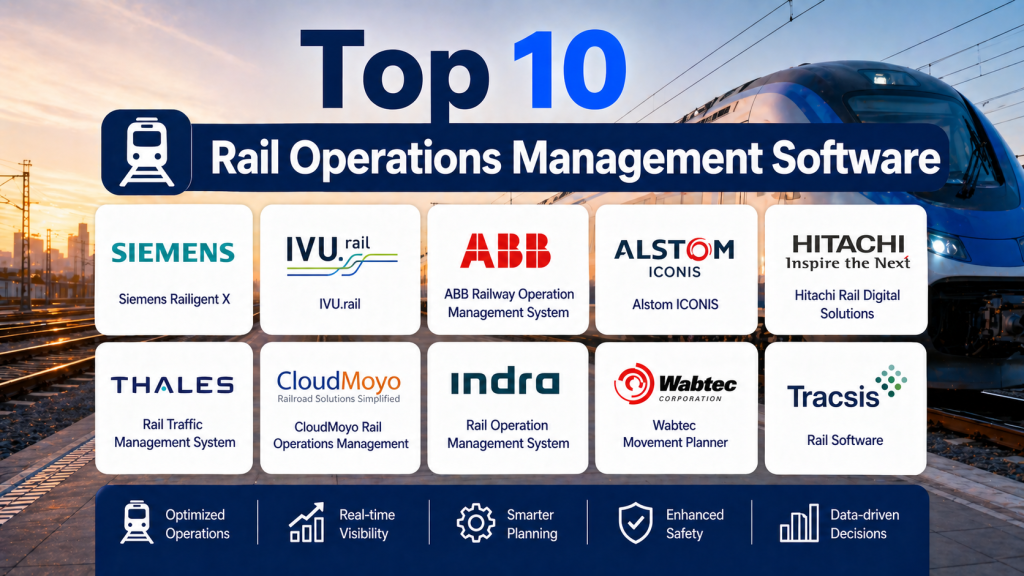
Top 10 Rail Operations Management Software Tools
1 — Siemens Railigent X
Short description: Siemens Railigent X is a digital rail platform combining operations, maintenance, and analytics into one system. It enables predictive insights and real-time monitoring. The platform is designed for large rail networks. It integrates operational and asset data. It is ideal for enterprise rail operators.
Key Features
- Predictive maintenance analytics
- Real-time monitoring dashboards
- Asset and operations integration
- Energy optimization
- Performance analytics
Pros
- Strong analytics capabilities
- Deep infrastructure integration
Cons
- Complex implementation
- Enterprise-focused
Platforms / Deployment
Web — Cloud
Security & Compliance
Not publicly stated
Integrations & Ecosystem
Integrates with signaling systems, IoT devices, and APIs
Support & Community
Enterprise-level support
2 — IVU.rail
Short description: IVU.rail is a modular rail operations platform focused on planning, scheduling, and dispatching. It is widely used in public transport systems. The platform supports real-time operations and optimization. It is suitable for mid to large rail networks. It provides strong planning tools.
Key Features
- Timetable planning
- Crew and vehicle scheduling
- Real-time dispatching
- Optimization algorithms
- Reporting
Pros
- Flexible modular design
- Strong planning capabilities
Cons
- Requires customization
- Learning curve
Platforms / Deployment
Web — Cloud
Security & Compliance
Not publicly stated
Integrations & Ecosystem
Supports ERP and API integrations
Support & Community
Strong enterprise support
3 — ABB Railway Operation Management System
Short description: ABB’s platform helps optimize train scheduling, traffic control, and dispatching. It integrates real-time data from infrastructure and rolling stock. The system enhances operational efficiency. It is suitable for large rail networks. It supports automation and analytics.
Key Features
- Train scheduling and dispatching
- Real-time monitoring
- Incident management
- Capacity planning
- Performance analytics
Pros
- Strong operational visibility
- Reliable and scalable
Cons
- Complex setup
- High cost
Platforms / Deployment
Web — Cloud
Security & Compliance
Not publicly stated
Integrations & Ecosystem
Integrates with rail infrastructure systems
Support & Community
Enterprise support
4 — Alstom ICONIS
Short description: Alstom ICONIS is a centralized rail traffic management platform used for control center operations. It supports real-time monitoring and service regulation. The platform is designed for large rail systems. It improves operational coordination. It enhances efficiency.
Key Features
- Traffic management
- Control center operations
- Incident handling
- Performance monitoring
- Reporting
Pros
- Centralized control
- Strong operational coordination
Cons
- Complex deployment
- High cost
Platforms / Deployment
Web — Cloud / Hybrid
Security & Compliance
Not publicly stated
Integrations & Ecosystem
Integrates with signaling and control systems
Support & Community
Vendor-led enterprise support
5 — Hitachi Rail Digital Solutions
Short description: Hitachi Rail provides digital solutions for traffic management, asset monitoring, and analytics. It enables real-time decision-making and operational optimization. The platform supports large rail networks. It integrates data across systems. It is ideal for modernization projects.
Key Features
- Traffic management
- Predictive analytics
- Asset monitoring
- Real-time data integration
- Reporting
Pros
- Strong analytics
- Scalable platform
Cons
- Complex implementation
- Enterprise-focused
Platforms / Deployment
Web — Cloud
Security & Compliance
Not publicly stated
Integrations & Ecosystem
Integration with infrastructure systems
Support & Community
Enterprise support
6 — Thales Rail Traffic Management System
Short description: Thales provides traffic management solutions for rail networks with a focus on safety and operational control. It enables centralized monitoring and dispatching. The platform is suitable for complex rail systems. It improves coordination and reliability. It supports real-time operations.
Key Features
- Traffic supervision
- Real-time monitoring
- Dispatch coordination
- Incident management
- Reporting
Pros
- Strong safety focus
- Reliable performance
Cons
- Complex system
- Requires training
Platforms / Deployment
Web — Cloud / Hybrid
Security & Compliance
Not publicly stated
Integrations & Ecosystem
Integrates with signaling and control systems
Support & Community
Enterprise support
7 — CloudMoyo Rail Operations Management
Short description: CloudMoyo offers a cloud-based platform for managing rail operations, assets, and scheduling. It focuses on automation and real-time visibility. The system is suitable for modern rail operators. It supports compliance and reporting. It is designed for scalability.
Key Features
- Train scheduling
- Asset tracking
- Real-time monitoring
- Work order management
- Compliance reporting
Pros
- Cloud-native platform
- Strong visibility
Cons
- Growing ecosystem
- Customization required
Platforms / Deployment
Web — Cloud
Security & Compliance
Not publicly stated
Integrations & Ecosystem
Supports integration with enterprise systems
Support & Community
Standard support
8 — Indra Rail Operation Management System
Short description: Indra provides a rail operations management platform focused on traffic control and monitoring. It integrates multiple subsystems for better coordination. The system supports real-time decision-making. It is suitable for large rail networks. It improves efficiency and reliability.
Key Features
- Traffic management
- Real-time monitoring
- Scheduling
- Incident management
- KPI tracking
Pros
- Strong control capabilities
- Good integration
Cons
- Complex setup
- Enterprise-focused
Platforms / Deployment
Web — Cloud
Security & Compliance
Not publicly stated
Integrations & Ecosystem
Integrates with signaling and communication systems
Support & Community
Enterprise support
9 — Wabtec Movement Planner
Short description: Wabtec Movement Planner is designed for dispatching and optimizing rail network operations. It provides decision support for train movement and scheduling. The platform improves efficiency and reduces congestion. It is suitable for freight and passenger rail systems. It enhances operational performance.
Key Features
- Dispatch optimization
- Network planning
- Real-time monitoring
- Scheduling
- Reporting
Pros
- Strong dispatch capabilities
- Improves network efficiency
Cons
- Limited analytics depth
- Requires integration
Platforms / Deployment
Web — Cloud
Security & Compliance
Not publicly stated
Integrations & Ecosystem
Integration with rail systems
Support & Community
Enterprise support
10 — Tracsis Rail Software
Short description: Tracsis provides rail software solutions for scheduling, monitoring, and analytics. It helps operators manage resources and performance. The platform supports data-driven decision-making. It is suitable for rail operators and transport companies. It enhances operational efficiency.
Key Features
- Scheduling and planning
- Resource management
- Analytics
- Reporting
- Monitoring
Pros
- Strong analytics
- Flexible usage
Cons
- Limited enterprise depth
- Smaller ecosystem
Platforms / Deployment
Web — Cloud
Security & Compliance
Not publicly stated
Integrations & Ecosystem
Supports integration with rail systems
Support & Community
Standard support
Comparison Table
| Tool | Best For | Platforms | Deployment | Standout Feature | Public Rating |
|---|---|---|---|---|---|
| Siemens Railigent X | Enterprise | Web | Cloud | Predictive analytics | N/A |
| IVU.rail | Transit systems | Web | Cloud | Modular planning | N/A |
| ABB ROMS | Large networks | Web | Cloud | Real-time control | N/A |
| Alstom ICONIS | Control centers | Web | Cloud / Hybrid | Traffic management | N/A |
| Hitachi Rail | Enterprise | Web | Cloud | Data integration | N/A |
| Thales TMS | Large networks | Web | Cloud / Hybrid | Traffic control | N/A |
| CloudMoyo | Modern rail ops | Web | Cloud | Cloud-native | N/A |
| Indra | Traffic control | Web | Cloud | KPI tracking | N/A |
| Wabtec | Dispatching | Web | Cloud | Network optimization | N/A |
| Tracsis | Analytics | Web | Cloud | Data insights | N/A |
Evaluation & Scoring
| Tool | Core | Ease | Integrations | Security | Performance | Support | Value | Total |
|---|---|---|---|---|---|---|---|---|
| Siemens | 10 | 6 | 9 | 8 | 9 | 9 | 6 | 8.4 |
| IVU | 9 | 7 | 8 | 7 | 8 | 8 | 7 | 7.9 |
| ABB | 9 | 7 | 8 | 8 | 9 | 8 | 7 | 8.1 |
| Alstom | 9 | 6 | 8 | 7 | 9 | 8 | 6 | 7.8 |
| Hitachi | 9 | 6 | 8 | 7 | 8 | 8 | 6 | 7.8 |
| Thales | 8 | 6 | 7 | 7 | 8 | 8 | 6 | 7.5 |
| CloudMoyo | 8 | 8 | 7 | 7 | 8 | 7 | 8 | 7.8 |
| Indra | 8 | 7 | 8 | 7 | 8 | 7 | 7 | 7.6 |
| Wabtec | 8 | 6 | 7 | 7 | 8 | 7 | 7 | 7.4 |
| Tracsis | 7 | 8 | 7 | 6 | 7 | 7 | 8 | 7.3 |
How to interpret scores:
These scores are comparative and reflect relative strengths across features, usability, and scalability. Higher scores indicate enterprise-level capabilities with strong integrations and performance. Mid-range scores reflect balanced tools suitable for growing rail networks. Simpler tools may score higher in usability but lower in advanced features. Always align scoring with operational scale and complexity before selecting a platform.
Which Rail Operations Management Software Is Right for You
Small Operators
CloudMoyo and Tracsis provide simpler, cost-effective solutions.
SMB Rail Networks
IVU.rail and Indra offer balanced features and scalability.
Mid-Market
Hitachi Rail and Thales provide automation and integration capabilities.
Enterprise
Siemens Railigent X, ABB, and Alstom ICONIS are ideal for large-scale operations.
Budget vs Premium
Budget tools focus on usability, premium tools offer analytics and control.
Feature Depth vs Ease of Use
Advanced systems offer deeper control but require training.
Integrations & Scalability
Choose platforms with strong integration for long-term growth.
Security & Compliance Needs
Enterprise systems are better for compliance and regulatory requirements.
Frequently Asked Questions
1. What is rail operations management software
It is software used to manage train scheduling, dispatching, and monitoring. It helps operators control rail networks efficiently. It improves safety and performance. It reduces operational complexity.
2. Why is it important
Rail networks are complex systems. These tools help manage operations efficiently. They reduce delays and improve reliability. They enhance safety and coordination.
3. What features are essential
Key features include real-time monitoring, scheduling, and analytics. Integration with signaling systems is important. Automation helps improve efficiency.
4. Are these systems cloud-based
Many modern systems are cloud-based. This improves scalability and access. It enables real-time updates.
5. How do these tools improve efficiency
They automate scheduling and dispatching. They provide real-time insights. They optimize resource utilization.
6. Can small rail operators use these tools
Yes, some tools are designed for smaller networks. They offer simplified features. They are easier to deploy.
7. Do these systems support predictive maintenance
Yes, many tools include predictive maintenance features. They monitor infrastructure condition. This reduces downtime.
8. What are common mistakes when choosing software
Choosing based only on cost is a mistake. Ignoring integration needs can cause issues. Not testing the system can lead to problems.
9. Can these systems scale
Yes, most modern systems are scalable. They support growing rail networks. They adapt to operational needs.
10. How long does implementation take
Implementation depends on system complexity. Enterprise tools take longer. Cloud-based tools are faster to deploy.
Conclusion
Rail Operations Management Software is a critical component of modern railway systems, enabling operators to manage complex networks with efficiency, safety, and precision. These platforms integrate scheduling, dispatching, monitoring, and analytics into a unified system, allowing rail operators to optimize performance and reduce delays. As rail networks continue to expand and digital transformation accelerates, adopting advanced software solutions becomes essential for maintaining reliability and competitiveness. Different platforms cater to different operational needs, from enterprise-grade systems like Siemens Railigent X and ABB to flexible cloud solutions like CloudMoyo. The right choice depends on factors such as network size, operational complexity, and integration requirements. There is no single best solution, and organizations must evaluate their priorities carefully.
