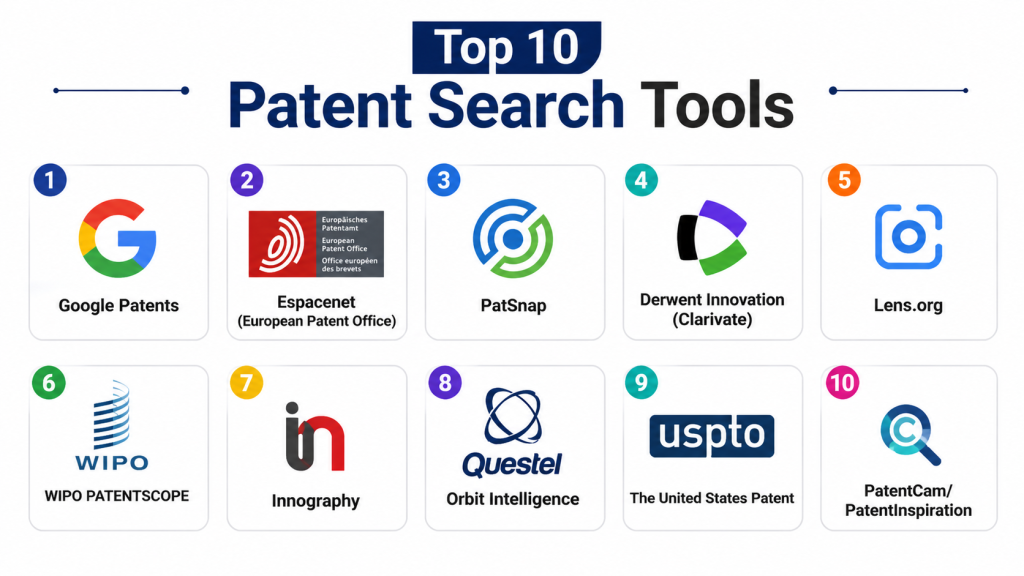
Introduction
Patent Search Tools are specialized platforms that enable inventors, legal professionals, and R&D teams to find, analyze, and monitor patent information from global authorities. These tools help uncover prior art, assess freedom‑to‑operate risks, track competitors, and support strategic innovation decisions.
Patent search is a foundational step in the intellectual property lifecycle — it helps validate novelty, uncover patent landscapes, and reduces the risk of costly litigation or invalidity challenges. Effective patent search software combines comprehensive databases with powerful filtering and analytics to deliver accurate, actionable insights.
Common use cases include:
- Prior art discovery for patent drafting
- Competitive patent landscape analysis
- Freedom‑to‑operate assessments
- Patent portfolio monitoring
- Technical trend analysis
What buyers should evaluate:
- Coverage of global patent offices
- Search accuracy and query flexibility
- Classification and filtering tools
- Analytics and visualization features
- Export and reporting options
- Integration with other IP systems
- Ease of use and collaboration tools
- Data update frequency
- Support and training resources
Best for: Patent attorneys, IP professionals, R&D managers, product developers, legal teams, and innovation strategists.
Not ideal for: Casual inventors with minimal search requirements who can rely on basic free databases.
Key Trends in Patent Search Tools
- AI‑assisted semantic search and natural language queries
- Integrated patent analytics and landscape visuals
- Real‑time patent monitoring and alerts
- Cross‑jurisdiction coverage and harmonization
- Cloud‑native interfaces for collaboration
- API access for integration with IP management systems
- Enhanced classification filtering (CPC, IPC, USPC)
- Competitive intelligence dashboards
- Machine learning prioritization of highly relevant results
- Exportable charts and custom reports
How We Selected These Tools (Methodology)
- Evaluated global patent office coverage
- Assessed depth of search features and filters
- Reviewed analytics and visualization capabilities
- Considered integration and extensibility
- Analyzed data update frequency and quality
- Evaluated ease of use and learning curve
- Considered support, training, and documentation
- Reviewed market reputation and user adoption
Top 10 Patent Search Tools
#1 — Google Patents
Short description:
Google Patents provides free access to millions of patent documents from major jurisdictions. It leverages Google’s search algorithms and integrates machine translation for non‑English patents. The tool is widely used for quick prior art exploration.
Key Features
- Global patent coverage
- Full‑text search
- Classification filters
- PDF downloads
- Machine‑translated results
Pros
- Free and accessible
- Simple interface
Cons
- Limited advanced analytics
- Fewer enterprise features
Platforms / Deployment
Web
Cloud
Security & Compliance
Not publicly stated
Integrations & Ecosystem
Basic export options; integrates with browser tools.
Support & Community
Online help resources.
#2 — Espacenet
Short description:
Espacenet — provided by the European Patent Office — offers comprehensive free patent data from over 100 patent offices. It includes classification search and family‑level views, making it useful for thorough patent research.
Key Features
- Global patent database
- Classification search
- Patent family viewing
- Legal status info
Pros
- Free access
- Broad jurisdiction coverage
Cons
- User interface feels dated
- Limited analytics
Platforms / Deployment
Web
Cloud
Security & Compliance
Not publicly stated
Integrations & Ecosystem
Basic export support.
Support & Community
Documentation and help guides.
#3 — PatSnap
Short description:
PatSnap combines patent search with analytics and innovation intelligence. It enables teams to uncover trends, map technology landscapes, and benchmark competitors. The platform suits both IP specialists and R&D leaders.
Key Features
- Semantic search
- Analytics dashboards
- Competitive mapping
- Alerts and monitoring
- Prior art ranking
Pros
- Strong analytics
- User‑friendly UI
Cons
- Premium pricing
- Learning curve for advanced features
Platforms / Deployment
Web
Cloud
Security & Compliance
SSO, encryption
Integrations & Ecosystem
API access and data export.
Support & Community
Training and support resources.
#4 — Derwent Innovation
Short description:
Derwent Innovation (Clarivate) is a premium patent research and analytics platform. It offers deep metadata, expert indexing, and powerful filters. This tool is widely used for competitive intelligence and freedom‑to‑operate studies.
Key Features
- Expert indexing
- Cross‑jurisdiction search
- Analytics and visualization
- Patent family insights
Pros
- Deep data quality
- Enterprise‑grade analytics
Cons
- High cost
- Steeper learning curve
Platforms / Deployment
Web
Cloud
Security & Compliance
SSO, encryption
Integrations & Ecosystem
Enterprise integrations and export.
Support & Community
Dedicated support.
#5 — Lens.org
Short description:
Lens.org offers free, scholarly‑integrated patent search with robust filtering and analytics tools. It links patents to scientific literature, enabling researchers and innovators to bridge research and IP.
Key Features
- Global patent coverage
- Citation and literature links
- Analytics dashboards
- Classification filters
Pros
- Free and powerful
- Research ecosystem link
Cons
- UI can be complex
- Export limits
Platforms / Deployment
Web
Cloud
Security & Compliance
Not publicly stated
Integrations & Ecosystem
Links with scholarly databases.
Support & Community
Community support.
#6 — WIPO PATENTSCOPE
Short description:
Provided by the World Intellectual Property Organization, PATENTSCOPE gives access to PCT and national patent collections. It includes simple global search and classification browsing.
Key Features
- International patent databases
- PCT search
- Classification filters
- PDF viewing
Pros
- Free global coverage
- Official data source
Cons
- Limited analytics
- Basic interface
Platforms / Deployment
Web
Cloud
Security & Compliance
Not publicly stated
Integrations & Ecosystem
Basic export.
Support & Community
Help documentation.
#7 — Innography
Short description:
Innography is an IP intelligence platform offering advanced search, analytics, and business insights. It supports competitive monitoring, freedom‑to‑operate analysis, and portfolio evaluation.
Key Features
- Semantic search
- Competitive analytics
- Freedom‑to‑operate tools
- Dashboard reporting
Pros
- Deep business insights
- Powerful analytics
Cons
- Enterprise pricing
- Complex onboarding
Platforms / Deployment
Web
Cloud
Security & Compliance
SSO, encryption
Integrations & Ecosystem
Enterprise API and data export.
Support & Community
Professional support.
#8 — Questel Orbit Intelligence
Short description:
Orbit Intelligence combines patent search with IP analytics and monitoring. It features visualization tools, advanced filtering, and global coverage. It is suitable for corporate IP and competitive teams.
Key Features
- Visual analytics
- Semantic and classification search
- Monitoring alerts
- Global data coverage
Pros
- Strong analytics
- Visualization tools
Cons
- Premium subscription
- Learning curve
Platforms / Deployment
Web
Cloud
Security & Compliance
SSO, encryption
Integrations & Ecosystem
API and export tools.
Support & Community
Comprehensive help.
#9 — USPTO PatFT
Short description:
The USPTO Patent Full‑Text and Image Database provides official US patent data for search and retrieval. It’s essential for US‑focused prior art research and legal verification.
Key Features
- Full‑text US patent search
- PDF image download
- Classification browsing
Pros
- Official source
- Free access
Cons
- Limited to US patents
- Basic interface
Platforms / Deployment
Web
Cloud
Security & Compliance
Not publicly stated
Integrations & Ecosystem
Export options only.
Support & Community
USPTO help resources.
#10 — PatentCam / PatentInspiration
Short description:
PatentCam (PatentInspiration) focuses on visual patent search and inspiration tools. It uses clustering and diagram search to help innovators find related art and explore technology spaces creatively.
Key Features
- Visual search tools
- Clustering visualization
- Keyword and IPC filters
- Patent landscape maps
Pros
- Intuitive visual insights
- Creative exploration
Cons
- Smaller database coverage
- Less enterprise focus
Platforms / Deployment
Web
Cloud
Security & Compliance
Not publicly stated
Integrations & Ecosystem
Basic export support.
Support & Community
Online help.
Comparison Table
| Tool Name | Best For | Platform(s) Supported | Deployment | Standout Feature | Public Rating |
|---|---|---|---|---|---|
| Google Patents | Free global search | Web | Cloud | Free and simple | N/A |
| Espacenet | Free global coverage | Web | Cloud | Classification search | N/A |
| PatSnap | Innovation teams | Web | Cloud | Analytics + search | N/A |
| Derwent Innovation | Enterprise | Web | Cloud | Expert indexing | N/A |
| Lens.org | Research‑focused | Web | Cloud | Patents + literature | N/A |
| WIPO PATENTSCOPE | International | Web | Cloud | PCT search | N/A |
| Innography | Competitive intelligence | Web | Cloud | Business insights | N/A |
| Questel Orbit | Corporate IP teams | Web | Cloud | Visual analytics | N/A |
| USPTO PatFT | US research | Web | Cloud | Official US data | N/A |
| PatentCam | Exploratory search | Web | Cloud | Visual landscape | N/A |
Evaluation & Scoring of Patent Search Tools
| Tool Name | Core | Ease | Integrations | Security | Performance | Support | Value | Weighted Total |
|---|---|---|---|---|---|---|---|---|
| Google Patents | 7 | 9 | 6 | 7 | 8 | 8 | 9 | 8.0 |
| Espacenet | 7 | 8 | 5 | 7 | 8 | 7 | 9 | 7.6 |
| PatSnap | 9 | 8 | 8 | 8 | 9 | 9 | 7 | 8.6 |
| Derwent Innovation | 9 | 7 | 8 | 8 | 9 | 9 | 6 | 8.2 |
| Lens.org | 8 | 7 | 6 | 7 | 8 | 8 | 9 | 7.8 |
| WIPO PATENTSCOPE | 6 | 7 | 5 | 7 | 7 | 7 | 9 | 7.1 |
| Innography | 9 | 7 | 8 | 8 | 9 | 9 | 6 | 8.1 |
| Questel Orbit | 8 | 7 | 8 | 8 | 9 | 9 | 7 | 8.0 |
| USPTO PatFT | 6 | 8 | 4 | 7 | 7 | 7 | 9 | 7.0 |
| PatentCam | 7 | 8 | 5 | 7 | 7 | 8 | 9 | 7.4 |
How to interpret scores:
These scores compare core search depth, usability, integration options, and overall value. Higher totals reflect platforms with strong analytics, coverage, and strategic insights — often suited for enterprise and R&D use cases. Free tools excel in accessibility and basic search, while premium tools deliver deeper analytics and business value.
Which Patent Search Tool Is Right for You?
Solo Innovators & Inventors
Google Patents, Espacenet, or Lens.org provide accessible and free options to begin prior art exploration.
Mid‑Sized Teams & IP Analysts
PatSnap and Questel Orbit offer balance between search power and analytics capabilities.
Enterprise & Competitive Intelligence
Derwent Innovation and Innography deliver deep indexing, analytics, and business insight.
US‑Focused Legal Research
USPTO PatFT remains a key official source for US patent data.
Creative Exploration
PatentCam (PatentInspiration) provides visual inspiration and technology clustering for inventive ideation.
Frequently Asked Questions
1. What is a patent search tool?
A patent search tool is a platform that lets users find and analyze patent documents. These tools help uncover prior art, assess freedom to operate, and understand technological landscapes. They combine data from patent offices with filters and analytics to support research and legal workflows.
2. Why is patent search important?
Patent search helps validate the novelty of inventions, identify potential conflicts, and reduce the risk of infringement. It also supports competitive intelligence and R&D strategy by revealing technology trends and patent ownership.
3. Are free tools useful for professional search?
Yes, free tools like Google Patents and Espacenet are valuable for basic prior art discovery. However, they may lack advanced analytics and global harmonization found in premium platforms.
4. What features should I look for in a patent search tool?
Key features include global coverage, advanced filtering, semantic search, classification tools, analytics dashboards, export functions, and alerting. These capabilities improve depth, precision, and usability.
5. Can these tools integrate with IP management systems?
Yes, many enterprise platforms support API‑based integrations with IP management, docketing, and analytics systems. Integration enhances workflows and data consistency.
6. How often is patent data updated?
Most platforms update data regularly, with some providing near‑real‑time updates. Free tools may have a slight delay compared to paid databases with direct feeds from patent offices.
7. What is semantic search?
Semantic search uses AI to understand the meaning of queries, not just keywords. This results in more relevant prior art matches, especially in technical or multidisciplinary fields.
8. Should I use multiple tools?
Yes, combining free sources with premium tools often yields the most comprehensive results. Free tools can provide broad initial coverage, while premium platforms deliver deeper analytics and competitive insights.
9. Can patent search tools handle non‑English patents?
Many modern platforms include machine translation or original foreign language data. This widens global search coverage and reduces blind spots.
10. How can patent search impact business strategy?
Patent search supports technology forecasting, competitive benchmarking, and risk mitigation. By revealing innovation trends and competitor portfolios, it aids strategic decision‑making and investment planning.
Conclusion
Patent search tools have become indispensable for modern innovation, legal strategy, and R&D planning. Whether you are a solo inventor validating novelty or a global enterprise conducting competitive landscape analysis, the right patent search platform can uncover critical insights, reduce risk, and accelerate strategic decisions. Free resources like Google Patents and Espacenet offer broad accessibility, while premium tools such as PatSnap and Derwent Innovation deliver deep analytics, semantic search, and visualization features that support advanced workflows. Ultimately, your choice should reflect your goals, budget, and required level of insight — from foundational prior art checks to comprehensive, data‑driven competitive intelligence. Shortlisting and trialing a few tools will help identify the best fit for your specific patent research needs.

A clear and useful comparison that highlights the key features of patent search tools, making it easier to evaluate options and choose the right platform for research and innovation needs.