Introduction
Maritime Vessel Management Software is designed to help shipping companies manage fleet operations, vessel maintenance, crew, compliance, and operational performance in a centralized platform. These systems integrate data from multiple sources such as onboard sensors, maintenance records, and crew schedules to improve efficiency, safety, and regulatory compliance.
With increasing globalization of shipping, rising fuel costs, and regulatory requirements, maritime operators need advanced tools to optimize fleet performance and reduce operational risks. Modern platforms provide real-time analytics, automated reporting, and predictive maintenance to ensure vessels operate safely and efficiently.
Common use cases include:
- Scheduling and tracking vessel operations
- Managing maintenance and repairs
- Ensuring compliance with maritime regulations
- Monitoring crew performance and certifications
- Fuel management and optimization
What buyers should evaluate:
- Fleet tracking and monitoring
- Maintenance management capabilities
- Compliance features
- Crew management modules
- Integration with existing systems
- Predictive analytics and reporting
- Ease of use
- Security and access controls
Best for: Shipping companies, maritime operators, fleet managers, and vessel operators managing complex operations.
Not ideal for: Small boat operators or companies with minimal fleets and simple operations.
Key Trends in Maritime Vessel Management Software
- Real-time vessel tracking and condition monitoring
- Predictive maintenance using sensor data
- Compliance automation with IMO and regional regulations
- Fuel efficiency and carbon footprint monitoring
- Crew scheduling and digital certification tracking
- Cloud-based deployment with remote access
- Integration with port and logistics systems
- Advanced analytics for operational decision-making
How We Selected These Tools
- Market adoption among maritime operators
- Completeness of fleet and vessel management features
- Reliability and performance for real-time operations
- Compliance support and safety management
- Integration capabilities with onboard and shore systems
- Scalability for fleets of different sizes
- User experience and ease of crew adoption
- Vendor support and global presence
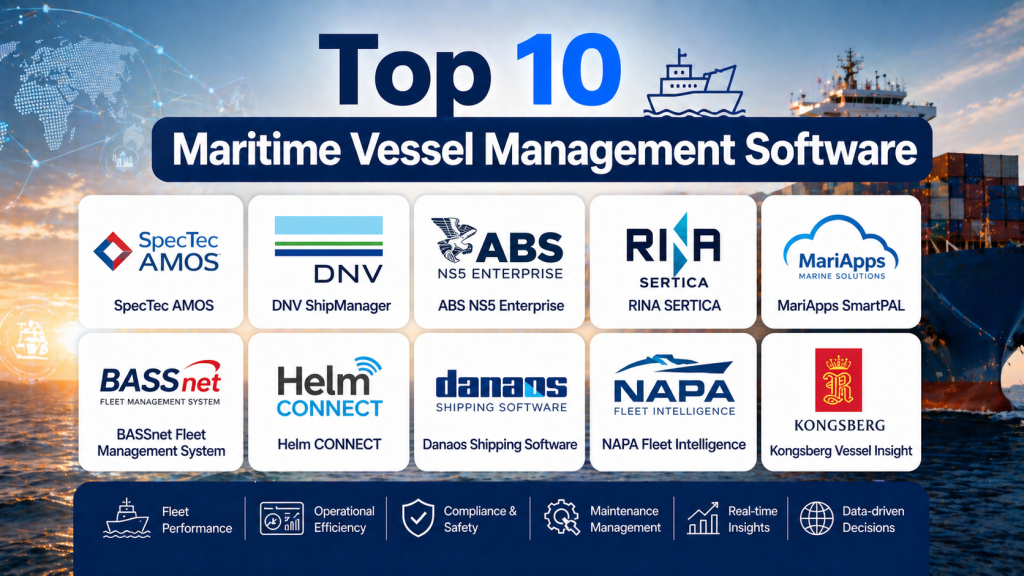
Top 10 Maritime Vessel Management Software Tools
1 — SpecTec AMOS
Short description: SpecTec AMOS is a leading maritime software suite for fleet management and maintenance operations. It provides modules for technical management, purchasing, and inventory control. The system is suitable for large fleets. It supports compliance and reporting. It is widely used in the shipping industry.
Key Features
- Technical management
- Maintenance scheduling
- Inventory and procurement
- Compliance tracking
- Reporting and analytics
Pros
- Comprehensive solution
- Scalable for large fleets
Cons
- Complex implementation
- Higher cost
Platforms / Deployment
Web — Cloud / On-premise
Security & Compliance
Role-based access, encryption
Integrations & Ecosystem
Integration with onboard sensors and enterprise systems
Support & Community
Enterprise-level support
2 — DNV ShipManager
Short description: DNV ShipManager is a global maritime management system focusing on fleet operations, maintenance, and compliance. It provides modules for technical management, crewing, and reporting. The system is suitable for large operators. It emphasizes safety and regulatory compliance.
Key Features
- Fleet operations management
- Maintenance and repair planning
- Crew management
- Safety and compliance monitoring
- Reporting and analytics
Pros
- Strong compliance support
- Enterprise-grade features
Cons
- High cost
- Complexity for small fleets
Platforms / Deployment
Web — Cloud
Security & Compliance
Enterprise security standards
Integrations & Ecosystem
Integration with vessel monitoring systems
Support & Community
Global support network
3 — ABS NS5 Enterprise
Short description: ABS NS5 Enterprise provides end-to-end vessel management capabilities for shipping companies. It covers technical management, compliance, and operational performance. The platform supports predictive maintenance. It is suitable for mid to large fleets. It ensures safety and operational efficiency.
Key Features
- Vessel and fleet monitoring
- Maintenance planning
- Compliance management
- Predictive analytics
- Reporting
Pros
- Predictive maintenance
- Strong operational oversight
Cons
- Implementation effort
- Limited customization
Platforms / Deployment
Web — Cloud
Security & Compliance
Not publicly stated
Integrations & Ecosystem
Supports integration with sensors and enterprise software
Support & Community
Standard support
4 — RINA SERTICA
Short description: RINA SERTICA is a modular vessel management platform designed for technical management, compliance, and operations. It provides tools for maintenance, crewing, and document management. It is suitable for medium to large fleets. The system enhances efficiency and compliance.
Key Features
- Maintenance management
- Crew scheduling
- Compliance tracking
- Document management
- Reporting
Pros
- Modular and flexible
- Strong compliance features
Cons
- Higher learning curve
- Premium pricing
Platforms / Deployment
Web — Cloud / On-premise
Security & Compliance
Role-based access
Integrations & Ecosystem
Integrates with onboard and enterprise systems
Support & Community
Enterprise support
5 — MariApps SmartPAL
Short description: MariApps SmartPAL is a maritime management solution for fleet operations, crewing, and compliance. It provides real-time dashboards and analytics. The system is suitable for mid-sized operators. It helps optimize vessel operations and maintenance. It emphasizes data-driven decision-making.
Key Features
- Fleet operations management
- Crew management
- Maintenance scheduling
- Real-time analytics
- Compliance reporting
Pros
- User-friendly interface
- Real-time insights
Cons
- Limited advanced features
- Smaller ecosystem
Platforms / Deployment
Web — Cloud
Security & Compliance
Not publicly stated
Integrations & Ecosystem
Supports integration with sensors and enterprise software
Support & Community
Standard support
6 — BASSnet Fleet Management System
Short description: BASSnet provides comprehensive fleet and vessel management capabilities, including technical, financial, and operational modules. The system is suitable for large maritime operators. It supports maintenance, compliance, and reporting. It provides dashboards for decision-making.
Key Features
- Technical management
- Financial and operational modules
- Maintenance planning
- Compliance tracking
- Reporting
Pros
- Enterprise-grade features
- Strong reporting capabilities
Cons
- High cost
- Complexity for small fleets
Platforms / Deployment
Web — Cloud
Security & Compliance
Not publicly stated
Integrations & Ecosystem
Integration with onboard systems
Support & Community
Enterprise support
7 — Helm CONNECT
Short description: Helm CONNECT is a cloud-based platform for maritime operations, crew management, and compliance. It provides real-time dashboards and reporting. The system is suitable for fleets of all sizes. It focuses on operational efficiency and crew management.
Key Features
- Crew management
- Vessel maintenance
- Compliance and safety
- Real-time dashboards
- Reporting
Pros
- Cloud-native
- Strong crew management
Cons
- Limited customization
- Smaller enterprise features
Platforms / Deployment
Web — Cloud
Security & Compliance
Not publicly stated
Integrations & Ecosystem
API integrations available
Support & Community
Responsive support
8 — Danaos Shipping Software
Short description: Danaos Shipping Software provides fleet management and vessel operations modules. It supports technical management, maintenance, and reporting. The platform is suitable for medium to large operators. It emphasizes operational efficiency and compliance.
Key Features
- Fleet and technical management
- Maintenance tracking
- Compliance monitoring
- Reporting
- Analytics
Pros
- Comprehensive feature set
- Operational focus
Cons
- Interface complexity
- Premium pricing
Platforms / Deployment
Web — Cloud
Security & Compliance
Not publicly stated
Integrations & Ecosystem
Supports enterprise integrations
Support & Community
Enterprise support
9 — NAPA Fleet Intelligence
Short description: NAPA Fleet Intelligence is a data-driven maritime software platform for fleet performance, fuel efficiency, and operational analytics. It helps operators optimize vessel performance and reduce costs. The system is suitable for medium to large fleets. It provides predictive insights and reporting.
Key Features
- Fleet performance analytics
- Fuel efficiency tracking
- Predictive maintenance
- Reporting and dashboards
- Operational optimization
Pros
- Strong analytics
- Cost optimization
Cons
- Limited crew management
- Smaller integration ecosystem
Platforms / Deployment
Web — Cloud
Security & Compliance
Not publicly stated
Integrations & Ecosystem
Supports enterprise integrations
Support & Community
Standard support
10 — Kongsberg Vessel Insight
Short description: Kongsberg Vessel Insight provides real-time data collection, monitoring, and analytics for vessel operations. It focuses on operational intelligence and predictive insights. The system is suitable for modern fleets. It enables remote monitoring and decision support.
Key Features
- Real-time data collection
- Monitoring and analytics
- Predictive insights
- Reporting
- Operational intelligence
Pros
- Strong real-time monitoring
- Predictive capabilities
Cons
- Limited administrative tools
- Smaller user base
Platforms / Deployment
Web — Cloud
Security & Compliance
Not publicly stated
Integrations & Ecosystem
Integration with onboard sensors
Support & Community
Responsive support
Comparison Table
| Tool | Best For | Platforms | Deployment | Standout Feature | Public Rating |
|---|---|---|---|---|---|
| SpecTec AMOS | Large fleets | Web | Cloud / On-premise | Comprehensive modules | N/A |
| DNV ShipManager | Enterprise operators | Web | Cloud | Compliance support | N/A |
| ABS NS5 | Mid-Large fleets | Web | Cloud | Predictive maintenance | N/A |
| RINA SERTICA | Technical management | Web | Cloud / On-premise | Modular flexibility | N/A |
| MariApps | Mid-sized operators | Web | Cloud | Real-time dashboards | N/A |
| BASSnet | Large operators | Web | Cloud | Enterprise modules | N/A |
| Helm CONNECT | All sizes | Web | Cloud | Crew management | N/A |
| Danaos | Mid-large fleets | Web | Cloud | Operational optimization | N/A |
| NAPA Fleet | Analytics-focused | Web | Cloud | Fleet performance | N/A |
| Kongsberg | Modern fleets | Web | Cloud | Real-time monitoring | N/A |
Evaluation & Scoring
| Tool | Core | Ease | Integrations | Security | Performance | Support | Value | Total |
|---|---|---|---|---|---|---|---|---|
| AMOS | 9 | 7 | 9 | 8 | 9 | 9 | 7 | 8.4 |
| DNV | 9 | 7 | 8 | 8 | 9 | 8 | 7 | 8.2 |
| ABS NS5 | 8 | 7 | 8 | 7 | 8 | 8 | 7 | 7.7 |
| RINA | 8 | 7 | 8 | 7 | 8 | 7 | 7 | 7.6 |
| MariApps | 7 | 8 | 7 | 7 | 7 | 7 | 8 | 7.4 |
| BASSnet | 9 | 6 | 9 | 8 | 9 | 9 | 6 | 8.0 |
| Helm CONNECT | 7 | 8 | 7 | 7 | 7 | 7 | 8 | 7.4 |
| Danaos | 8 | 7 | 7 | 7 | 8 | 7 | 7 | 7.6 |
| NAPA Fleet | 8 | 7 | 8 | 7 | 8 | 7 | 7 | 7.6 |
| Kongsberg | 8 | 7 | 7 | 7 | 8 | 7 | 7 | 7.5 |
Which Maritime Vessel Management Tool Is Right for You
Small Fleets
MariApps SmartPAL and Helm CONNECT are simple and cost-effective.
Mid-Sized Operators
ABS NS5, RINA SERTICA, and Danaos offer balanced features and analytics.
Large Enterprises
SpecTec AMOS, DNV ShipManager, and BASSnet provide comprehensive modules and compliance support.
Analytics vs Operational Control
NAPA Fleet and Kongsberg focus on performance monitoring and predictive insights, while AMOS and BASSnet offer full operational management.
Budget vs Premium
Budget tools prioritize simplicity, premium tools provide advanced analytics, compliance, and enterprise features.
Frequently Asked Questions
1. What is maritime vessel management software
It is a tool that manages vessel operations, maintenance, crew, and compliance. It centralizes fleet management. It improves efficiency and reduces risk.
2. Why is it important
Vessels operate in complex environments. These tools optimize operations. They ensure compliance and safety. They reduce delays and costs.
3. Can small fleets use these systems
Yes, cloud-based solutions like MariApps and Helm CONNECT are suitable. They provide essential operational control.
4. Are these tools cloud-based
Most modern tools offer cloud deployment. This enables remote monitoring and scalability.
5. How do these systems improve efficiency
Automation, predictive maintenance, and real-time monitoring improve fleet utilization.
6. Do these systems track compliance
Yes, they track certifications, maintenance, and safety requirements. This ensures regulatory adherence.
7. Can these systems integrate with sensors
Many tools integrate with onboard sensors for real-time data. This improves operational awareness.
8. Are these systems expensive
Enterprise-grade systems like AMOS and BASSnet are costly. Cloud-based mid-sized solutions are more affordable.
9. Can they scale with fleet size
Yes, tools are scalable to accommodate small, mid-sized, and large fleets.
10. How long does implementation take
Implementation depends on fleet size and system complexity. Enterprise tools take longer. Cloud solutions are faster to deploy.
Conclusion
Maritime Vessel Management Software is essential for modern shipping operations, offering centralized control over fleet operations, maintenance, crew, and compliance. These platforms enable shipping companies to optimize efficiency, reduce operational costs, and maintain regulatory standards.From comprehensive enterprise platforms like SpecTec AMOS and DNV ShipManager to flexible cloud solutions like MariApps SmartPAL, there are options for fleets of all sizes. The right choice depends on fleet size, operational complexity, integration needs, and budget.A practical approach is to shortlist a few platforms, evaluate real-time capabilities, test integration with existing systems, and pilot the software before full deployment. Choosing the right system ensures improved operational performance, compliance, and long-term efficiency.

A feature that deserves more attention is how well these platforms handle communication between onboard crews and shore teams. Even strong maintenance and compliance tools can create delays if information doesn’t flow smoothly. Clear collaboration features often have a bigger operational impact than many companies expect.