Introduction
Healthcare EHR systems help hospitals, clinics, physicians, and care teams manage patient health records in a digital environment. EHR means Electronic Health Record, and these platforms store important clinical information such as diagnoses, medications, allergies, lab results, visit notes, care plans, billing details, prescriptions, referrals, imaging records, and communication history. Instead of keeping paper files or disconnected systems, healthcare organizations use EHR software to centralize patient information and improve care coordination.
EHR systems are now essential because healthcare providers need faster documentation, better interoperability, safer prescribing, stronger compliance, smoother billing, and better patient engagement. A good EHR system supports clinical workflows, administrative workflows, patient portals, telehealth, revenue cycle operations, reporting, and data sharing across care settings.
Common use cases include:
- Patient record management
- Clinical documentation
- Appointment scheduling
- ePrescribing
- Lab and imaging result management
- Billing and claims support
- Care coordination
- Patient portal communication
- Telehealth support
- Population health reporting
Buyers should evaluate:
- Ease of clinical documentation
- Specialty workflow support
- Interoperability and data exchange
- Patient portal experience
- Billing and revenue cycle features
- Security and access controls
- Reporting and analytics
- Implementation support
- Scalability across locations
- Total cost and training requirements
Best for: hospitals, health systems, physician practices, specialty clinics, ambulatory care groups, community health centers, urgent care providers, and healthcare organizations that need secure digital patient record management.
Not ideal for: very small care teams that only need basic scheduling or billing, non-clinical wellness businesses, or organizations that do not manage regulated patient health information. In those cases, practice management software, scheduling tools, or lightweight client record systems may be enough.
Key Trends in Healthcare EHR Systems
- Interoperability is becoming a major priority, as providers need smoother data exchange between hospitals, labs, pharmacies, payers, imaging centers, and specialty care networks.
- AI-assisted documentation is growing, especially for clinical note drafting, visit summaries, coding support, and administrative workflow reduction.
- Patient engagement features are becoming standard, including portals, secure messaging, appointment reminders, digital intake, and online bill payment.
- Cloud-based EHR adoption is increasing, especially among ambulatory practices and multi-location healthcare groups that want easier updates and lower infrastructure burden.
- Specialty-specific workflows are becoming more important, because cardiology, orthopedics, behavioral health, pediatrics, primary care, and surgical practices often need different templates and processes.
- Revenue cycle integration is a key buying factor, as providers want clinical documentation to connect smoothly with claims, coding, billing, and collections.
- Telehealth and hybrid care workflows are now expected, especially for practices that deliver both in-person and virtual care.
- Security and compliance expectations are rising, because EHR systems store highly sensitive patient health information.
- Data analytics and population health features are expanding, helping organizations track quality measures, care gaps, outcomes, and operational performance.
- Implementation experience matters more than feature lists, because poor migration, training, or workflow design can slow adoption and frustrate clinical teams.
How We Selected These Tools
- We selected EHR systems that are widely recognized across hospitals, ambulatory care, specialty practices, and healthcare organizations.
- We included a balanced mix of enterprise hospital platforms, ambulatory EHRs, cloud-based systems, and practice-focused platforms.
- We considered clinical documentation, patient record management, scheduling, ePrescribing, patient portal, interoperability, and billing support.
- We evaluated fit for different healthcare segments, including large health systems, mid-sized groups, independent practices, and specialty clinics.
- We considered usability for providers, nurses, front-office staff, administrators, and revenue cycle teams.
- We reviewed ecosystem strength, including integrations with labs, pharmacies, imaging systems, billing tools, patient engagement platforms, and analytics systems.
- We considered support, implementation services, training, documentation, and long-term adoption needs.
- We avoided guessing ratings, certifications, or compliance claims where public details are not clearly stated.
- We considered scalability, workflow flexibility, reporting, and operational reliability.
- We selected tools that are practical for real healthcare environments rather than narrow recordkeeping use cases only.
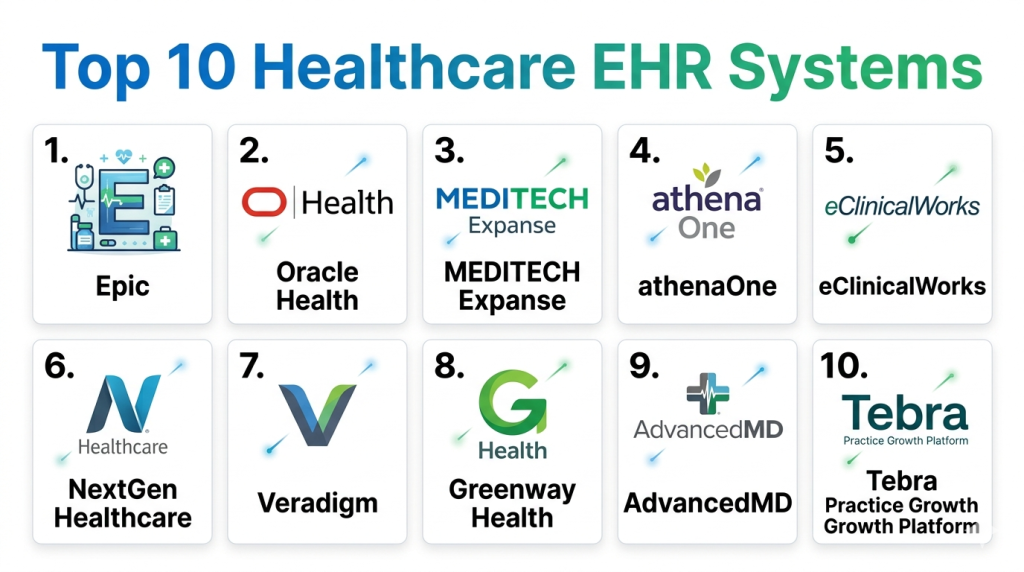
Top 10 Healthcare EHR Systems Tools
#1 — Epic
Short description: Epic is one of the most widely recognized enterprise EHR systems for hospitals, health systems, academic medical centers, and large provider networks. It supports clinical documentation, patient records, scheduling, billing, interoperability, analytics, patient portals, and care coordination. Epic is often selected by organizations that need a deeply integrated system across inpatient, outpatient, emergency, specialty, and revenue cycle workflows. It is best suited for large healthcare organizations with the resources to manage a major implementation.
Key Features
- Enterprise patient record management
- Inpatient and ambulatory workflow support
- Clinical documentation and order management
- Patient portal and engagement tools
- Revenue cycle and billing capabilities
- Interoperability and data exchange support
- Reporting, analytics, and population health features
Pros
- Strong fit for large hospitals and health systems
- Broad clinical and operational workflow coverage
- Mature ecosystem for patient engagement and interoperability
- Useful for organizations needing one integrated enterprise platform
Cons
- Implementation can be complex and resource-intensive
- May be too large for small practices
- Training and workflow change management require planning
- Cost and customization needs can be significant
Platforms / Deployment
Web / Windows / Mobile access varies
Cloud / Self-hosted / Hybrid / Varies
Security & Compliance
Epic is designed for healthcare environments and supports security controls such as role-based access, authentication controls, audit capabilities, and data protection features. Specific security, compliance, hosting, and certification details should be confirmed directly during procurement.
Integrations & Ecosystem
Epic has a large healthcare ecosystem and is commonly connected with clinical, administrative, patient engagement, and data exchange systems.
- Lab and imaging system connections
- Pharmacy and ePrescribing workflows
- Patient portal and mobile engagement tools
- Revenue cycle and billing integrations
- Interoperability and health information exchange workflows
- Analytics and population health tools
Support & Community
Epic provides structured implementation, training, documentation, and support through vendor-led programs. It also has a large customer community across hospitals and health systems, but successful adoption usually requires strong internal governance and dedicated project teams.
#2 — Oracle Health
Short description: Oracle Health is an enterprise healthcare technology platform that includes EHR capabilities for hospitals, health systems, and provider organizations. It supports clinical documentation, patient management, care coordination, revenue cycle workflows, and healthcare data operations. Oracle Health is often considered by organizations looking for enterprise-scale healthcare infrastructure and broader data platform alignment. It is best suited for hospitals and large provider networks with complex operational needs.
Key Features
- Enterprise EHR and clinical workflow support
- Patient record and care coordination capabilities
- Hospital and ambulatory workflow options
- Revenue cycle and administrative support
- Healthcare data and analytics ecosystem
- Interoperability and integration capabilities
- Support for large provider organization needs
Pros
- Strong fit for hospitals and large healthcare networks
- Broad enterprise healthcare technology ecosystem
- Supports clinical and administrative workflows
- Useful for organizations seeking scalable healthcare infrastructure
Cons
- Implementation can be complex
- May require significant configuration and training
- Smaller practices may find it too extensive
- Product experience can vary by organization and deployment scope
Platforms / Deployment
Web / Windows / Mobile access varies
Cloud / Self-hosted / Hybrid / Varies
Security & Compliance
Oracle Health is used in healthcare environments where security, privacy, and access controls are important. Specific details for authentication, encryption, audit logs, role-based access, hosting, and compliance should be validated directly with the vendor based on deployment.
Integrations & Ecosystem
Oracle Health can fit into broader healthcare, enterprise data, and operational ecosystems. It is especially relevant for organizations managing multiple clinical and administrative systems.
- Hospital and ambulatory system integrations
- Lab, pharmacy, and imaging workflows
- Revenue cycle connections
- Healthcare data and analytics integrations
- Interoperability and exchange workflows
- Enterprise infrastructure and cloud ecosystem alignment
Support & Community
Support is vendor-led through implementation services, training, documentation, and enterprise support channels. Large organizations should plan strong internal program management, workflow governance, and change management.
#3 — MEDITECH Expanse
Short description: MEDITECH Expanse is an EHR platform designed for hospitals, health systems, community hospitals, and ambulatory care environments. It supports clinical documentation, patient engagement, interoperability, physician workflows, nursing workflows, and revenue cycle operations. MEDITECH Expanse is often selected by organizations that need a connected EHR platform with strong hospital and community health system relevance. It is best suited for healthcare organizations looking for an integrated clinical and operational system.
Key Features
- Integrated EHR for hospital and ambulatory workflows
- Clinical documentation and order management
- Patient portal and engagement capabilities
- Interoperability and health data exchange support
- Revenue cycle and administrative workflows
- Mobile-friendly clinical access
- Reporting and care coordination features
Pros
- Strong fit for community hospitals and health systems
- Integrated clinical and administrative workflows
- Useful patient engagement and interoperability capabilities
- Good option for organizations seeking a hospital-focused EHR
Cons
- Implementation requires careful planning
- Customization needs may vary by specialty
- Smaller practices may not need the full platform
- Training and workflow redesign can take time
Platforms / Deployment
Web / Mobile access varies / Varies
Cloud / Self-hosted / Hybrid / Varies
Security & Compliance
MEDITECH Expanse supports healthcare security needs such as user access controls and audit-related capabilities. Specific compliance, encryption, authentication, and hosting details should be validated directly with the vendor.
Integrations & Ecosystem
MEDITECH Expanse integrates with many healthcare workflows across clinical care, administration, and patient communication.
- Lab and imaging workflows
- Pharmacy and medication management
- Patient portal tools
- Revenue cycle workflows
- Interoperability and exchange connections
- Reporting and analytics systems
Support & Community
MEDITECH provides vendor-led support, implementation resources, training, and documentation. The platform has strong presence in hospital and community healthcare environments, making adoption support and peer learning important benefits.
#4 — athenaOne
Short description: athenaOne is a cloud-based EHR, practice management, and revenue cycle platform designed primarily for ambulatory care practices and medical groups. It helps providers manage clinical documentation, scheduling, patient communication, billing, claims, and administrative workflows. athenaOne is known for its cloud delivery model and focus on reducing operational burden for practices. It is best suited for ambulatory providers that want EHR and practice management in one connected platform.
Key Features
- Cloud-based EHR and practice management
- Clinical documentation workflows
- Scheduling and patient registration
- Revenue cycle and claims management
- Patient portal and communication tools
- ePrescribing support
- Reporting and practice performance insights
Pros
- Strong fit for ambulatory practices
- Cloud-based platform reduces local infrastructure needs
- Combines EHR, billing, and practice management
- Useful for practices focused on operational efficiency
Cons
- May not fit large hospital inpatient workflows
- Workflow flexibility may vary by specialty
- Pricing and service model should be reviewed carefully
- Some advanced customization needs may require vendor support
Platforms / Deployment
Web / Mobile access varies
Cloud
Security & Compliance
athenaOne is designed for healthcare environments and includes security controls relevant to patient information management. Specific details for encryption, access controls, audit logs, authentication, and compliance should be confirmed directly with the vendor.
Integrations & Ecosystem
athenaOne connects clinical, billing, patient engagement, and administrative workflows for ambulatory practices.
- Lab and imaging result workflows
- ePrescribing and pharmacy connections
- Patient portal and messaging tools
- Claims and billing workflows
- Reporting and analytics tools
- Third-party healthcare app ecosystem
Support & Community
athenahealth provides support, onboarding, documentation, and practice-focused services. Its support model is especially useful for practices that want help with billing, claims, and operational workflows.
#5 — eClinicalWorks
Short description: eClinicalWorks is an EHR and practice management platform used by ambulatory practices, specialty clinics, community health organizations, and healthcare groups. It supports patient records, clinical documentation, scheduling, telehealth, patient engagement, billing, and population health workflows. eClinicalWorks is often selected by practices that want a broad feature set at the ambulatory care level. It is best suited for clinics and healthcare groups needing an integrated practice platform.
Key Features
- Ambulatory EHR and clinical documentation
- Practice management and scheduling
- Patient portal and engagement features
- Telehealth support
- ePrescribing capabilities
- Revenue cycle and billing workflows
- Population health and reporting tools
Pros
- Broad feature set for ambulatory practices
- Useful for specialty clinics and group practices
- Supports patient engagement and telehealth workflows
- Combines clinical and administrative functions
Cons
- Implementation quality can depend on configuration
- Training may be needed for efficient documentation
- Some workflows may require customization
- Larger hospital systems may need broader enterprise platforms
Platforms / Deployment
Web / Windows / Mobile access varies
Cloud / Self-hosted / Hybrid / Varies
Security & Compliance
eClinicalWorks supports healthcare security and patient data protection needs. Specific information about SSO, MFA, audit logs, encryption, access controls, and compliance should be validated directly with the vendor.
Integrations & Ecosystem
eClinicalWorks connects with many ambulatory care workflows and external healthcare systems.
- Lab and diagnostic result workflows
- ePrescribing and pharmacy integrations
- Patient portal and digital intake tools
- Billing and claims workflows
- Telehealth and remote care capabilities
- Reporting and population health tools
Support & Community
eClinicalWorks provides vendor support, documentation, onboarding, and training resources. Practices should plan implementation carefully to ensure templates, billing workflows, and patient engagement tools match their daily operations.
#6 — NextGen Healthcare
Short description: NextGen Healthcare provides EHR, practice management, revenue cycle, and patient engagement solutions for ambulatory practices and specialty care organizations. It is often used by physician groups, community health centers, and specialty practices that need flexible clinical workflows. NextGen Healthcare supports documentation, scheduling, billing, interoperability, analytics, and patient communication. It is best suited for practices that want strong ambulatory and specialty workflow support.
Key Features
- Ambulatory EHR and practice management
- Specialty-specific workflow support
- Clinical documentation and charting
- Revenue cycle management capabilities
- Patient engagement and portal tools
- Interoperability and data exchange support
- Reporting and analytics features
Pros
- Strong fit for ambulatory and specialty practices
- Supports both clinical and administrative workflows
- Useful for practices needing flexible templates
- Good option for community health and physician groups
Cons
- Workflow configuration may require planning
- User experience can vary by setup and specialty
- Implementation and training are important for adoption
- Smaller teams may need simpler solutions
Platforms / Deployment
Web / Windows / Mobile access varies
Cloud / Self-hosted / Hybrid / Varies
Security & Compliance
NextGen Healthcare supports healthcare data protection needs through access controls and security features relevant to patient record management. Specific compliance and security details should be confirmed directly with the vendor.
Integrations & Ecosystem
NextGen Healthcare fits into ambulatory care ecosystems where clinical workflows, billing, reporting, and patient engagement need to work together.
- Lab and imaging connections
- ePrescribing workflows
- Patient portal and communication tools
- Revenue cycle and claims integrations
- Interoperability and data exchange workflows
- Analytics and reporting systems
Support & Community
NextGen Healthcare provides vendor support, training, implementation resources, and documentation. Support experience can depend on practice size, contract model, and deployment complexity.
#7 — Veradigm
Short description: Veradigm provides healthcare technology solutions including EHR, practice management, analytics, patient engagement, and data-driven healthcare tools. It is commonly associated with ambulatory care, provider workflows, and connected healthcare data solutions. Veradigm is useful for practices that need patient record management, documentation, billing support, and broader healthcare data connectivity. It is best suited for ambulatory care organizations and provider groups seeking connected clinical and operational workflows.
Key Features
- Ambulatory EHR capabilities
- Practice management support
- Clinical documentation workflows
- Patient engagement features
- Revenue cycle support
- Healthcare analytics and data connectivity
- Interoperability-focused workflows
Pros
- Strong ambulatory care orientation
- Useful mix of clinical and operational capabilities
- Supports data-driven healthcare workflows
- Good fit for practices needing connected healthcare technology
Cons
- Product fit may vary by practice type
- Implementation planning is important
- Some advanced workflows may require configuration
- Buyers should validate current product scope carefully
Platforms / Deployment
Web / Windows / Mobile access varies / Varies
Cloud / Self-hosted / Hybrid / Varies
Security & Compliance
Security and compliance details should be validated directly with the vendor. Buyers should review authentication, access controls, audit logs, encryption, data sharing, and healthcare privacy requirements before purchase.
Integrations & Ecosystem
Veradigm can support connected healthcare workflows across patient records, billing, analytics, and engagement.
- Practice management integrations
- Patient communication workflows
- Billing and claims connections
- Healthcare analytics tools
- Data exchange and interoperability workflows
- Third-party healthcare ecosystem connections
Support & Community
Support is vendor-led through documentation, onboarding, and customer support resources. Buyers should confirm support tiers, implementation services, training options, and migration support based on their organization size.
#8 — Greenway Health
Short description: Greenway Health provides EHR, practice management, revenue cycle, and patient engagement solutions for ambulatory healthcare practices. It is designed to help practices manage clinical documentation, scheduling, billing, claims, reporting, and patient communication. Greenway Health is often considered by independent practices and medical groups that want connected clinical and administrative workflows. It is best suited for ambulatory care providers looking for a practical practice-focused EHR.
Key Features
- Ambulatory EHR and charting
- Practice management workflows
- Scheduling and registration
- Revenue cycle support
- Patient portal and communication features
- ePrescribing capabilities
- Reporting and operational insights
Pros
- Good fit for ambulatory practices
- Combines EHR and practice management capabilities
- Supports patient engagement and billing workflows
- Practical option for independent and group practices
Cons
- Not intended for large inpatient hospital systems
- Workflow quality depends on setup and training
- Specialty-specific needs should be validated
- Implementation planning is important
Platforms / Deployment
Web / Windows / Mobile access varies / Varies
Cloud / Self-hosted / Hybrid / Varies
Security & Compliance
Greenway Health supports healthcare data security needs, but specific authentication, encryption, audit, access control, and compliance details should be confirmed directly with the vendor during evaluation.
Integrations & Ecosystem
Greenway Health supports common ambulatory care integrations and administrative workflows.
- Lab result workflows
- ePrescribing and pharmacy connections
- Patient portal and engagement tools
- Billing and claims workflows
- Reporting and analytics options
- Third-party healthcare service connections
Support & Community
Greenway Health provides support, training, implementation guidance, and documentation. Practices should validate onboarding quality, template setup, migration support, and revenue cycle assistance before committing.
#9 — AdvancedMD
Short description: AdvancedMD is a cloud-based EHR and practice management platform focused on independent practices, medical groups, and specialty care providers. It supports clinical documentation, scheduling, patient engagement, telehealth, billing, claims, and reporting. AdvancedMD is especially useful for practices that want a cloud-based system with both clinical and administrative tools. It is best suited for small to mid-sized practices looking for flexible practice operations support.
Key Features
- Cloud-based EHR and practice management
- Clinical charting and documentation
- Scheduling and patient registration
- Billing and claims management
- Telehealth support
- Patient portal and engagement tools
- Reporting and practice analytics
Pros
- Strong fit for small and mid-sized practices
- Cloud-based access reduces infrastructure needs
- Combines clinical, billing, and scheduling workflows
- Useful for specialty and independent practices
Cons
- May not fit large inpatient care environments
- Advanced configuration may require training
- Pricing and add-on modules should be reviewed
- Workflow fit varies by specialty
Platforms / Deployment
Web / Mobile access varies
Cloud
Security & Compliance
AdvancedMD is designed for healthcare practice environments and includes security controls relevant to patient data. Specific details for encryption, authentication, audit logging, access management, and compliance should be confirmed directly.
Integrations & Ecosystem
AdvancedMD supports practice operations through integrations with clinical, billing, patient engagement, and reporting workflows.
- Lab and diagnostic workflows
- ePrescribing support
- Patient portal and messaging tools
- Claims and payment workflows
- Telehealth capabilities
- Reporting and analytics features
Support & Community
AdvancedMD provides vendor support, training resources, onboarding, and customer assistance. Practices should validate implementation timelines, billing workflow setup, and support options before selection.
#10 — Tebra Practice Growth Platform
Short description: Tebra Practice Growth Platform combines EHR, practice management, billing, patient engagement, and practice growth tools for independent healthcare practices. It is designed to help practices manage both clinical operations and patient acquisition workflows. Tebra is especially relevant for smaller practices that want a connected platform for records, scheduling, billing, communication, and online presence. It is best suited for independent practices that need both operational and growth-focused capabilities.
Key Features
- EHR and clinical documentation support
- Practice management tools
- Scheduling and patient intake workflows
- Billing and claims support
- Patient engagement and communication
- Online reputation and practice growth tools
- Reporting and operational insights
Pros
- Strong fit for independent practices
- Combines clinical, billing, and growth workflows
- Useful for patient engagement and practice visibility
- Cloud-based model can simplify access
Cons
- May not fit complex hospital environments
- Advanced clinical depth may vary by specialty
- Practices should validate EHR workflow fit carefully
- Some features may depend on selected modules
Platforms / Deployment
Web / Mobile access varies
Cloud
Security & Compliance
Tebra supports healthcare practice workflows involving patient information. Specific security details such as authentication, encryption, audit logs, role-based access, and compliance documentation should be confirmed directly with the vendor.
Integrations & Ecosystem
Tebra connects practice operations, patient communication, billing, and growth workflows for independent healthcare providers.
- Patient intake and scheduling workflows
- Billing and claims support
- Patient communication tools
- Practice marketing and reputation features
- Reporting and operational dashboards
- Third-party healthcare service integrations
Support & Community
Tebra provides vendor-led support, onboarding, documentation, and customer resources. Independent practices should validate training options, billing setup support, and module fit before adoption.
Comparison Table
| Tool Name | Best For | Platforms Supported | Deployment | Standout Feature | Public Rating |
|---|---|---|---|---|---|
| Epic | Large hospitals and health systems | Web / Windows / Mobile access varies | Cloud / Self-hosted / Hybrid / Varies | Deep enterprise healthcare workflow coverage | N/A |
| Oracle Health | Enterprise hospitals and provider networks | Web / Windows / Mobile access varies | Cloud / Self-hosted / Hybrid / Varies | Enterprise healthcare data and clinical ecosystem | N/A |
| MEDITECH Expanse | Community hospitals and health systems | Web / Mobile access varies / Varies | Cloud / Self-hosted / Hybrid / Varies | Integrated hospital and ambulatory workflows | N/A |
| athenaOne | Ambulatory practices and medical groups | Web / Mobile access varies | Cloud | Cloud EHR with practice management and billing | N/A |
| eClinicalWorks | Clinics and ambulatory care groups | Web / Windows / Mobile access varies | Cloud / Self-hosted / Hybrid / Varies | Broad ambulatory care feature set | N/A |
| NextGen Healthcare | Specialty and ambulatory practices | Web / Windows / Mobile access varies | Cloud / Self-hosted / Hybrid / Varies | Specialty workflow flexibility | N/A |
| Veradigm | Ambulatory providers and data-connected care | Web / Windows / Mobile access varies / Varies | Cloud / Self-hosted / Hybrid / Varies | Connected clinical and healthcare data workflows | N/A |
| Greenway Health | Independent and group practices | Web / Windows / Mobile access varies / Varies | Cloud / Self-hosted / Hybrid / Varies | Practice-focused EHR and revenue cycle support | N/A |
| AdvancedMD | Small and mid-sized practices | Web / Mobile access varies | Cloud | Cloud EHR with billing and telehealth support | N/A |
| Tebra Practice Growth Platform | Independent practices | Web / Mobile access varies | Cloud | EHR, billing, engagement, and growth tools | N/A |
Evaluation & Scoring of Healthcare EHR Systems
| Tool Name | Core 25% | Ease 15% | Integrations 15% | Security 10% | Performance 10% | Support 10% | Value 15% | Weighted Total |
|---|---|---|---|---|---|---|---|---|
| Epic | 10 | 7 | 10 | 9 | 9 | 9 | 6 | 8.65 |
| Oracle Health | 9 | 6 | 9 | 9 | 8 | 8 | 6 | 7.95 |
| MEDITECH Expanse | 8 | 7 | 8 | 8 | 8 | 8 | 7 | 7.65 |
| athenaOne | 8 | 8 | 8 | 8 | 8 | 8 | 7 | 7.85 |
| eClinicalWorks | 8 | 7 | 8 | 8 | 7 | 7 | 7 | 7.45 |
| NextGen Healthcare | 8 | 7 | 8 | 8 | 7 | 7 | 7 | 7.45 |
| Veradigm | 7 | 7 | 7 | 7 | 7 | 7 | 7 | 7.00 |
| Greenway Health | 7 | 7 | 7 | 7 | 7 | 7 | 7 | 7.00 |
| AdvancedMD | 7 | 8 | 7 | 7 | 7 | 7 | 8 | 7.30 |
| Tebra Practice Growth Platform | 7 | 8 | 7 | 7 | 7 | 7 | 8 | 7.30 |
These scores are comparative and should be used as a practical shortlist guide, not a final buying decision. Enterprise platforms such as Epic and Oracle Health score higher for depth, integrations, and scalability, but they may require larger budgets and heavier implementation planning. Ambulatory platforms such as athenaOne, eClinicalWorks, NextGen Healthcare, AdvancedMD, Greenway Health, Veradigm, and Tebra may be easier for practices that do not need full hospital-wide complexity. Security scores are conservative because every buyer should validate hosting, access controls, audit logs, encryption, and compliance documentation directly. The right EHR depends on organization size, clinical workflows, specialty needs, implementation capacity, and long-term support expectations.
Which Healthcare EHR System Is Right for You?
Solo / Freelancer
Solo healthcare providers and very small practices usually need an EHR that is easy to adopt, cloud-based, and connected with scheduling, billing, and patient communication. AdvancedMD, Tebra, athenaOne, and Greenway Health may be practical options depending on specialty and budget. These platforms can help reduce administrative work without requiring a large internal IT team.
Solo providers should focus on ease of charting, claims support, patient reminders, telehealth, and overall simplicity. A large enterprise hospital EHR may be too complex and expensive for this segment.
SMB
Small and mid-sized clinics need an EHR that balances clinical documentation, scheduling, billing, patient portal, and reporting. athenaOne, eClinicalWorks, NextGen Healthcare, Greenway Health, AdvancedMD, Veradigm, and Tebra are strong candidates for this segment. Specialty fit is especially important because different practices may need different templates and workflows.
SMBs should evaluate implementation support, data migration, training time, billing performance, and how easily staff can use the system during busy patient visits.
Mid-Market
Mid-market healthcare groups often need multi-location support, stronger reporting, patient engagement, interoperability, and revenue cycle operations. athenaOne, eClinicalWorks, NextGen Healthcare, MEDITECH Expanse, Veradigm, and Greenway Health can be relevant depending on care setting and operational complexity.
These organizations should evaluate centralized administration, role-based access, reporting across locations, referral workflows, claims performance, and integration with labs, imaging, pharmacies, and patient engagement tools.
Enterprise
Large hospitals, health systems, academic medical centers, and integrated delivery networks usually need robust enterprise EHR platforms. Epic, Oracle Health, and MEDITECH Expanse are strong candidates for this segment because they support broader hospital, ambulatory, operational, and revenue cycle workflows.
Enterprise buyers should evaluate implementation governance, integration strategy, data migration, clinical leadership involvement, training programs, analytics needs, and long-term vendor partnership.
Budget vs Premium
Budget-focused practices should evaluate cloud-based ambulatory systems that combine EHR, scheduling, billing, and patient communication in one package. AdvancedMD, Tebra, Greenway Health, and selected ambulatory platforms may be practical depending on module needs and pricing structure.
Premium buyers with complex requirements should consider Epic, Oracle Health, MEDITECH Expanse, athenaOne, eClinicalWorks, or NextGen Healthcare depending on scale. The best choice is not only about subscription cost but also implementation, training, billing efficiency, staff adoption, and integration needs.
Feature Depth vs Ease of Use
For maximum feature depth across large healthcare organizations, Epic, Oracle Health, and MEDITECH Expanse are strong choices. They support complex workflows but may require heavier implementation and training.
For ease of use and ambulatory practice efficiency, athenaOne, AdvancedMD, Tebra, Greenway Health, eClinicalWorks, and NextGen Healthcare may be more suitable. Buyers should ask real users to test charting, scheduling, billing, and patient communication workflows before choosing.
Integrations & Scalability
Healthcare EHR systems must integrate with labs, imaging centers, pharmacies, billing systems, patient portals, telehealth tools, referral networks, data warehouses, and reporting platforms. Epic, Oracle Health, and MEDITECH Expanse are strong for enterprise-scale integration, while athenaOne, eClinicalWorks, NextGen Healthcare, and AdvancedMD are practical for ambulatory interoperability.
Scalability should be evaluated based on number of providers, locations, specialties, patient volume, reporting requirements, and future expansion plans.
Security & Compliance Needs
Healthcare EHR systems handle sensitive patient health information, so security must be a top priority. Buyers should review authentication, role-based access, encryption, audit logs, backup policies, data residency, vendor security documentation, and breach response procedures.
Do not rely only on marketing claims. Ask vendors for detailed security documentation, compliance support information, access control options, data export policies, and implementation guidance before signing.
Frequently Asked Questions
1. What is a healthcare EHR system?
A healthcare EHR system is software used to store and manage digital patient health records. It helps providers document visits, review medical history, prescribe medications, manage lab results, and coordinate care. EHR systems also support scheduling, billing, reporting, and patient communication. They are central to modern clinical and administrative workflows.
2. What is the difference between EHR and EMR?
An EMR usually refers to a digital medical record within one practice or organization. An EHR is broader and is designed to support health information sharing across providers, locations, and care settings. In daily usage, the terms are often used closely together. Buyers should focus more on actual features, interoperability, and workflow fit than terminology alone.
3. Which EHR is best for small practices?
Small practices often benefit from cloud-based EHR systems that include scheduling, billing, charting, patient communication, and telehealth. AdvancedMD, Tebra, athenaOne, Greenway Health, eClinicalWorks, and NextGen Healthcare may be practical options. The best choice depends on specialty, budget, billing needs, and staff workflow. A hands-on demo with real scenarios is very important.
4. Which EHR is best for large hospitals?
Large hospitals and health systems usually need enterprise EHR platforms with deep clinical, operational, and integration capabilities. Epic, Oracle Health, and MEDITECH Expanse are commonly considered for large-scale healthcare environments. These platforms support broader workflows across inpatient, outpatient, emergency, billing, and analytics functions. The best option depends on infrastructure, budget, governance, and implementation readiness.
5. How much does an EHR system cost?
EHR cost varies based on provider count, modules, deployment model, support level, implementation scope, data migration, billing features, and integrations. Small practice platforms may use subscription pricing, while enterprise systems may require major implementation investment. Buyers should calculate total cost, not only software fees. Training, migration, customization, and ongoing support can significantly affect the final budget.
6. How long does EHR implementation take?
Implementation time depends on organization size, specialty complexity, data migration, integrations, training, and workflow redesign. A small clinic may go live faster than a hospital or multi-location health system. Enterprise EHR projects require careful planning, leadership alignment, and phased rollout. Successful implementation depends heavily on user training and change management.
7. What are common mistakes when choosing an EHR?
A common mistake is choosing an EHR based only on brand name or price. Teams may also underestimate implementation effort, workflow redesign, data migration, and staff training. Another mistake is not involving clinicians and billing staff during evaluation. The best EHR should be tested with real patient visit, billing, scheduling, and reporting scenarios.
8. Are EHR systems secure?
EHR systems are designed to manage sensitive healthcare data, but security depends on the vendor, deployment model, configuration, and internal policies. Buyers should review authentication, role-based access, encryption, audit logs, backups, and data sharing controls. Staff training is also important because user behavior affects security. Security review should happen before implementation, not after go-live.
9. Can EHR systems integrate with billing and lab systems?
Yes, many EHR systems integrate with billing, claims, lab results, imaging systems, pharmacies, patient portals, and reporting tools. Integration quality varies by vendor, system, and implementation scope. Practices should validate the exact integrations they need before purchase. Poor integration planning can create duplicate work and slow clinical operations.
10. What are alternatives to a full EHR system?
Alternatives include practice management software, patient scheduling tools, billing platforms, telehealth tools, or lightweight client record systems. These may work for non-clinical or very small operations. However, healthcare providers managing patient medical records usually need a proper EHR. The right alternative depends on whether the organization must document clinical care and protect regulated health information.
Conclusion
Healthcare EHR systems are the digital foundation for modern clinical care, patient record management, billing, reporting, and care coordination. The best platform depends on organization size, specialty workflows, budget, deployment preference, integration needs, security expectations, and implementation capacity. Epic, Oracle Health, and MEDITECH Expanse are strong options for larger hospitals and health systems, while athenaOne, eClinicalWorks, NextGen Healthcare, Veradigm, Greenway Health, AdvancedMD, and Tebra are practical choices for ambulatory and practice-focused environments. No single EHR is best for every provider because clinical workflows, billing models, patient volume, and support needs vary widely. The smartest next step is to shortlist two or three systems, run workflow-based demos, involve clinicians and billing teams, validate integrations, review security documentation, and choose the EHR that best supports daily care delivery and long-term growth.

This is a helpful comparison that clearly explains the key features of different EHR systems, making it easier to evaluate which solution best fits healthcare management needs.